
Step off the plane in Juneau and the first thing you notice is how close the mountains stand, with cloud snagged on the ridges above the Gastineau Channel. Nobody arrives here by car, because no road leaves town, so the airport is where almost every visit begins.
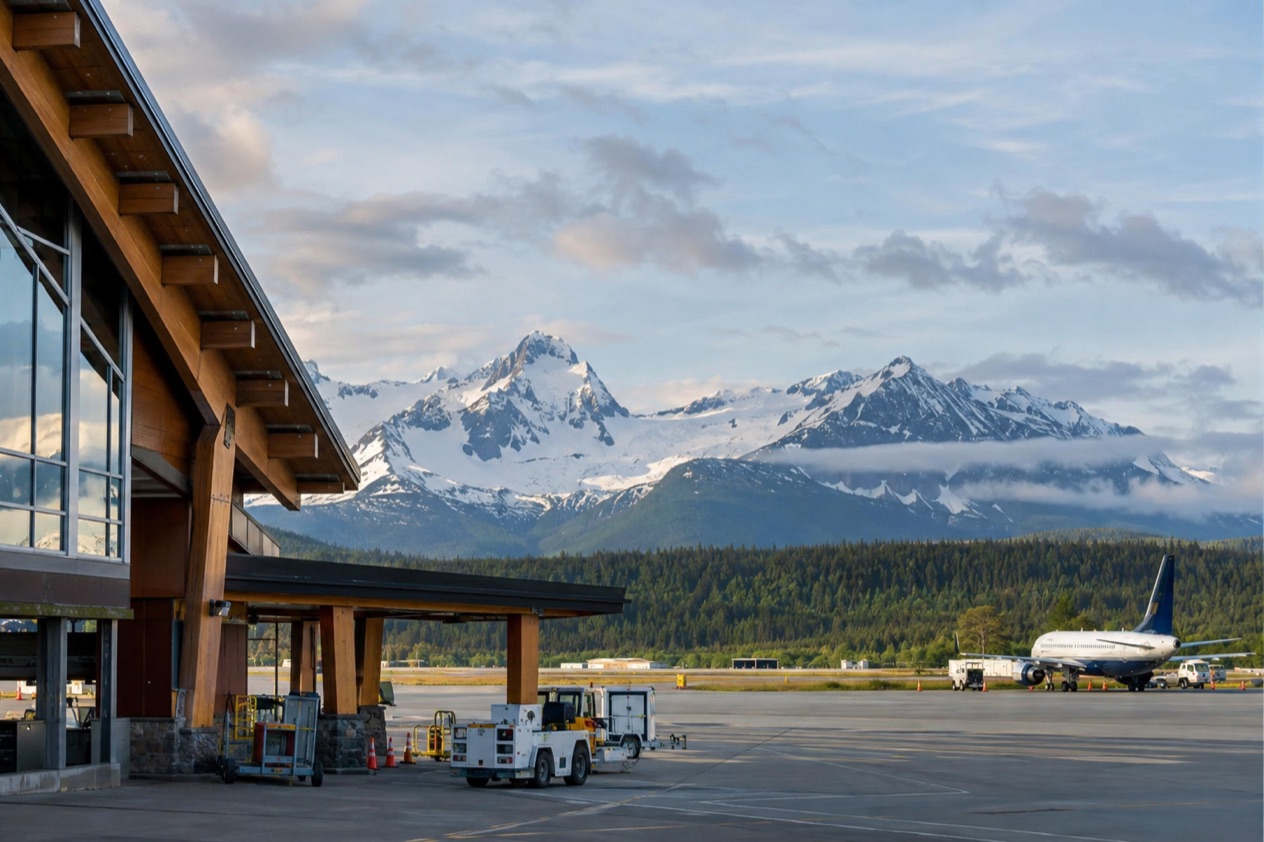
What is Juneau’s airport?
Juneau International Airport is the capital’s main gateway, a single-runway field beside the Gastineau Channel that handles everything from Alaska Airlines jets to floatplanes bound for fishing villages. It matters more here than at most airports its size, because Juneau has no roads connecting it to the rest of Alaska or to the contiguous United States. Groceries, building materials and visitors all come by plane or by boat.
The mix of traffic is unusual. In 2017 the airport recorded 108,885 aircraft operations, and the great majority of them were air taxis, the small commuter and charter aircraft that stitch Southeast Alaska together. Scheduled airline flights were a small slice of the total. What looks like a modest terminal is, in practice, the hub of a regional network where a flight can be as ordinary as a bus ride is elsewhere.
The runway and the water landing area
The airport has one asphalt runway, designated 8/26, and alongside it a seaplane landing area on the water, designated 8W/26W. Jets use the runway, while floatplanes use the water lane, which is why the airport feels like two airports sharing a name. From a window seat on approach you see the channel, the glacier-carved valleys and the dark spruce of the Tongass National Forest before the wheels touch down.
| Landing area | Length (ft) | Width (ft) |
|---|---|---|
| Runway 8/26 | 8,857 | 150 |
| Seaplane area 8W/26W | 4,600 | 150 |
Approaches in a mountain-ringed channel depend on the weather, and travelers who fly in and out of Juneau often learn to hold their schedule loosely. Low cloud is part of the setting here, and a gray, drizzly morning is a normal Southeast Alaska scene rather than an exception.
The dike trail beside the airport
The EVAR / Airport Dike Trail at Juneau International Airport is open. Watching a floatplane lift off the water with the mountains behind it is a pleasant way to spend a layover if you have time to fill.
Think of the trail as a bonus rather than a destination. It suits travelers who like to stretch their legs after a flight and would rather see the landscape than sit at the gate. The wide, open ground around the airport is also a reminder of how much of Juneau is wet, wild country within sight of the terminal.
What airlines fly from it?
Alaska Airlines is the main carrier, with year-round scheduled service to Anchorage, Ketchikan, Petersburg, Seattle/Tacoma, Sitka and Yakutat, plus seasonal service to Gustavus. Delta Air Lines adds seasonal service to Seattle/Tacoma. Alongside the jets, Alaska Seaplanes connects Juneau to a long list of small communities that no road reaches.
| Airline | Destinations | Season |
|---|---|---|
| Alaska Airlines | Anchorage, Ketchikan, Petersburg, Seattle/Tacoma, Sitka, Yakutat | Year-round |
| Alaska Airlines | Gustavus | Seasonal |
| Delta Air Lines | Seattle/Tacoma | Seasonal |
| Alaska Seaplanes | Angoon, Elfin Cove, Excursion Inlet, Gustavus, Haines, Hoonah, Kake, Klawock, Pelican, Petersburg, Sitka, Skagway, Tenakee Springs | Not specified |
Flying in from the Lower 48
Seattle is Juneau’s only direct departure city in the Lower 48, and the nonstop flight takes about 2.5 hours. Alaska Airlines runs daily jet service to Juneau from Seattle and Anchorage all year. Delta flies seasonally, so a traveler comparing options will find a second carrier on the Seattle route only in part of the year.
Because Seattle is the only direct link south, travelers from other cities usually connect there. That is worth holding in mind when you plan, since a missed connection in Seattle matters more when the next leg is a flight into a town reachable only by air or water. Juneau’s visitor bureau advises planning transportation early, and the geography explains why.
Hops around Southeast Alaska
Within the region, Alaska Airlines links Juneau with Ketchikan, Petersburg, Sitka and Yakutat all year. These are towns with their own fishing harbors, totem poles and rain-soaked streets, and a jet connection between them makes it possible to string together several Southeast communities without ever seeing a highway. Sitka and Petersburg also appear on the Alaska Seaplanes list, so those two places can be reached from Juneau on either kind of aircraft.
Gustavus is the one to know if Glacier Bay is on your list. Alaska Airlines operates a seasonal summer route between Juneau and Gustavus for Glacier Bay, and Alaska Seaplanes also serves Gustavus from Juneau. The tiny community sits at the doorway of the national park, so the flight is the usual way to reach it from the capital.
Small planes to villages and Lynn Canal towns
Alaska Seaplanes flies from Juneau to Angoon, Elfin Cove, Excursion Inlet, Gustavus, Haines, Hoonah, Kake, Klawock, Pelican, Petersburg, Sitka, Skagway and Tenakee Springs. The names read like a map of Southeast Alaska’s smaller places, from Tlingit communities to fishing hamlets and hot-spring settlements. Haines and Skagway are the ones travelers recognize, because they sit on the Lynn Canal route that cruise ships and ferries also use.
A trip on a small plane is its own experience, with low flying over channels, islands and forest, and a window that works as a tour of the coastline. These flights serve working communities first, so you share the cabin with residents, freight and mail. Treat it as part of the scenery rather than a way to save time.
How do you get to town?
Juneau International Airport is just 10 minutes from downtown Juneau, so the trip from the terminal to the city center is short. After that the question is less about the airport and more about the town itself, which is squeezed between the channel and steep mountains. Downtown Juneau holds the Alaska State Capitol, built as the Federal and Territorial Building in 1931, along with the waterfront and the old streets climbing the slope.
Arriving in the cruise months
From May to September, Juneau sees a daily influx of 16,000 people or more from visiting cruise ships. That changes the feel of downtown, with sidewalks full of passengers, shops open for the crowds and the waterfront busy by midday. If you land during those months, expect a lively town rather than a quiet one.
Outside those months the streets loosen up, and the town goes back to being a government seat with a fishing and outdoor-sports culture. Eaglecrest, the city-owned ski resort on Douglas Island, belongs to that quieter season. The Tahku humpback whale sculpture and the Empty Chair Memorial in Capital School Park are the kind of downtown stops that suit a slower walk.
Reaching Mendenhall Glacier
The Mendenhall Glacier, visible from the local road system, has been gradually retreating, and its front face is declining in width and height. Many arriving travelers want to see it, which makes the transportation question a real one. Travel Juneau does not recommend Capital Transit for reaching the Mendenhall Glacier Visitors Center, because the bus stops about 1.5 miles short of it, with no services at the stopping point.
The same guidance notes that the round trip on that bus takes about 5 hours. In other words, the glacier is within reach of town, but the public bus is not the option the visitor bureau points you toward. Think through how you will reach the visitors center before you leave the airport area, since it is one of the places on the road system that draws people out of downtown.
Arriving by water instead
Not everyone comes by air. The Alaska Marine Highway System provides year-round ferry transportation to more than 30 coastal communities, and Juneau is one of the towns on that network. Ferries can accommodate vehicles of most sizes, and travelers bringing a vehicle should book well in advance.
That vehicle detail is what makes Juneau different from a typical state capital. A car can reach the town only by boat, so anyone who plans to drive around Southeast Alaska has to think about the ferry first. For travelers who fly in, the airport remains the starting point, and the short run to downtown is the easy part of the journey.
Good to know before you go
Juneau’s isolation shapes everything about getting in and out, so the visitor bureau advises planning transportation early. The town is relatively remote and not completely accessible by car, which is why the airport and the ferry dock carry so much weight in a trip here. Weather can slow a flight in a place surrounded by mountains and water, and a flexible plan helps you enjoy the town whatever the sky is doing.
Between May and September the cruise crowds are part of the scene downtown. Those months bring the busiest streets, while the quieter parts of the year suit a slower look at the capital, from the dike trail by the airfield to the harbor and the glacier valley. Flights and trains of thought are best kept loose.
Sources
- Juneau International Airport (https://juneau.org/airport), checked October 11, 2026
- Wikipedia, Juneau, Alaska (https://en.wikipedia.org/wiki/Juneau,_Alaska), checked October 11, 2026
- Travel Juneau, plan your trip (https://www.traveljuneau.com/plan-your-trip/), checked October 11, 2026
To plan your stay
- Best Time to Visit Juneau: Weather by Month, Wildlife Season and Cruise Crowds
- Things to Do in Juneau: Mendenhall Glacier, Mount Roberts Tram, Whale Watching and Day Trips
- Where to Stay in Juneau: Downtown, Mendenhall Valley and Auke Bay
- Know Before You Go to Juneau: Weather, Getting Around, Bears and Local Customs