
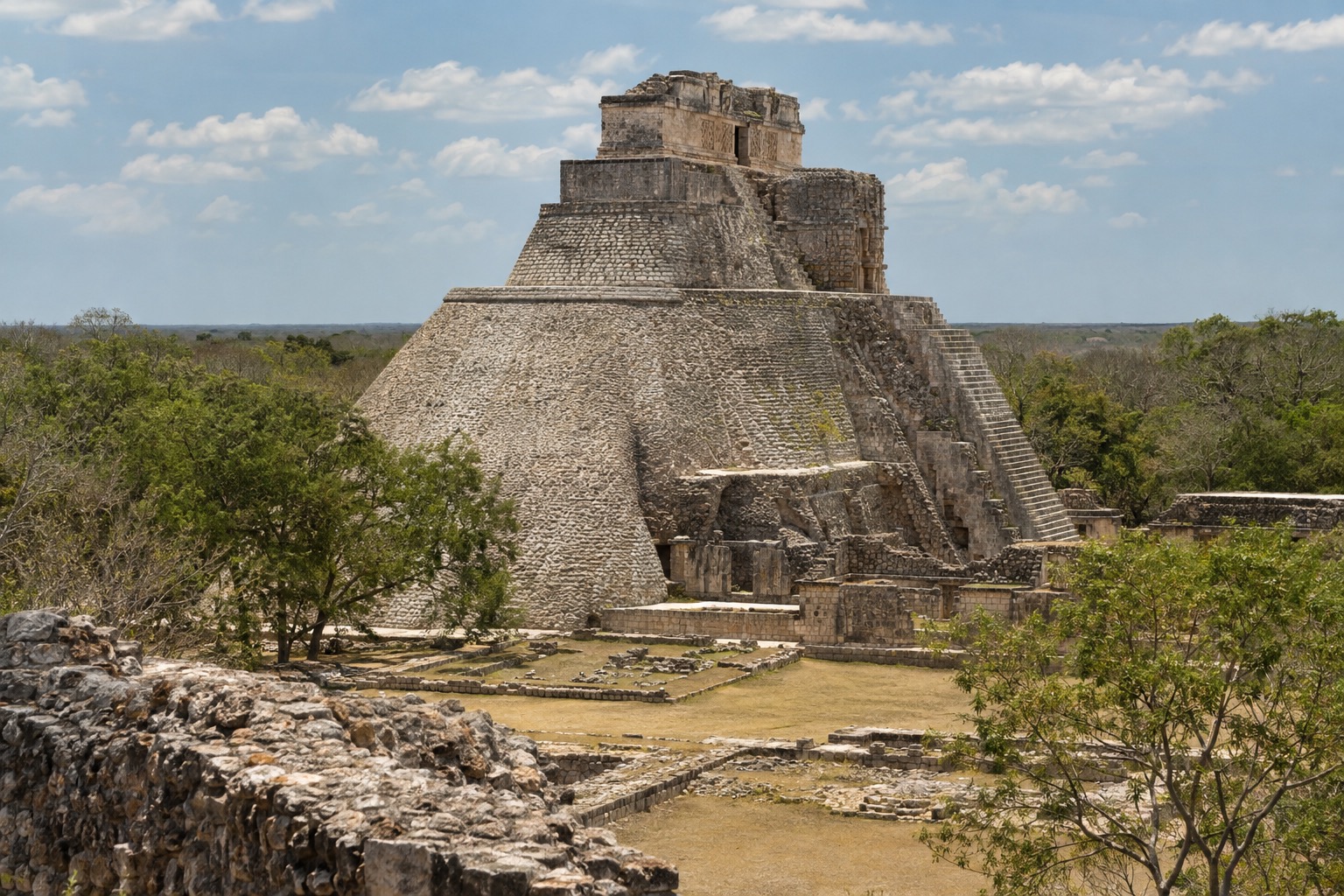
The first thing that appears through the trees at Uxmal is the Pyramid of the Magician, rounded at the corners and rising in steep tiers above the low Yucatan scrub. Cicadas buzz, the stone glows pale in the early light, and the carved façades beyond seem to hold the shade. This Maya city in the Puuc hills, a short trip south of Mérida, is a visit for people who want to look closely at stonework.
Is visiting Uxmal worth it?
Yes, especially for travelers who enjoy architecture and would rather study fine detail than stand before the biggest pyramid. Uxmal was inscribed on the UNESCO World Heritage List in 1996, and it earns that status through craftsmanship: whole façades are covered in stone mosaics of geometric patterns and rain-god masks.
Its character is different from the better-known ruins of the peninsula. The Puuc style favors smooth lower walls topped by richly decorated upper bands, so the interest lies in the ornament and the proportions of each building, not in a single towering monument. It feels quieter and more intimate, a place to wander slowly.
What to see at Uxmal
The Pyramid of the Magician
This is the emblem of Uxmal, and its rounded, oval profile is unlike the square pyramids most people picture. Local legend tells of a dwarf magician who built it in a single night, a story guides and storytellers still love to repeat. In reality it was rebuilt several times over the centuries, each layer covering the one before.
Look at the way the steep sides rise and at the elaborate temple decoration near the top. The best views come from the open plaza at its base, where you can take in the whole shape. Late afternoon light is soft on the stone, though the site closes early, so morning is the more realistic time for photographs.
The mosaic façades and the rain-god masks
The buildings around the main plaza show what Uxmal is famous for. Thousands of cut stones were fitted together into lattices, zigzags and stepped patterns, and repeated again and again are the long-nosed masks of Chaac, the rain god. In a land with no rivers and few surface lakes, rain was everything, and the decoration says so on every wall.
Walk slowly along the quadrangle buildings and let the patterns change as you move. Each façade has its own rhythm, and the deep shadows under the cornices make the carving stand out in the middle of the day. It is a good place for children who like spotting repeated shapes and faces.
The plazas and the walk between buildings
Beyond the headline structures, the pleasure of Uxmal is the walk itself. Broad plazas, grassy terraces and ruined platforms are linked by open paths, with the Puuc hills and forest at the edges. Iguanas sun themselves on the walls, and birds call from the trees along the quieter corners.
There is little shade on the plazas, so the walk is more comfortable early in the day. The layout is easy to follow, and you can choose to see the main group only or to roam farther at your own pace.
Hours, tickets and rules
Uxmal is open every day of the week, closing mid-afternoon. Admission has two parts, a federal fee and a separate state fee paid at the site’s ticket booth, and the state portion is the larger of the two for foreign visitors. Some visitors enter free, as the table notes.
| Site | Open | Admission |
|---|---|---|
| Uxmal archaeological zone | Monday to Sunday, 8:00 a.m. to 4:00 p.m. | General admission $105 pesos, plus State of Yucatan admission of $461 pesos for foreign visitors ($157 pesos for Mexican nationals). Free on Sundays for Mexican nationals and foreign residents of Mexico (federal fee), and free for children under 13, visitors 60 and older, people with disabilities, and Mexican teachers and students with valid ID |
The exemptions apply to the federal admission, and the state fee is described as a separate charge collected at the ticket booth. Fees are set in pesos, so having some on hand is useful at the booth. Beyond these fees and exemptions, no further rules on climbing, drones or tripods are set out for the site.
How to get to Uxmal
Uxmal lies about 39 miles south of Mérida, the capital of Yucatan state, which makes the city the natural base. Mérida International Airport sits just southwest of downtown, so many visitors fly in, settle into the city and head out to the ruins for the day.
The route goes south from the city into the Puuc hills, with the landscape turning greener and more rolling as you go. Because the site closes in mid-afternoon, an early departure from Mérida gives you the cooler hours and an unhurried visit.
When to visit Uxmal
The hour matters more than the month. The gates open at 8:00 a.m., and the first stretch of the morning is the coolest and quietest time to walk the plazas. By midday the sun beats down on open stone with little shade, and the heat is the main thing to plan around.
From November to February afternoons are warmer than pleasant rather than punishing, with highs in the high 80s at the cooler end, and rain is least frequent. March to May brings the hottest weather, with highs in the mid-90s and up, so early arrival is essential.
June to October is the rainy stretch, with showers on more than a dozen days in many of those months, and it overlaps the Atlantic hurricane season, which runs through November. Rain usually comes as passing showers, though a tropical system can bring several gray days.
Tips for your visit
Bring water, a hat, sunglasses and comfortable shoes for walking over uneven ground. Light, breathable clothing helps in the heat, and the paths are mostly open, so the sun finds you almost everywhere. Arriving at opening time lets you cover the main plaza before the warmest hours.
Uxmal pairs well with a day based in Mérida. Back in the city, the Gran Museo del Mundo Maya is open Wednesday to Monday and closed on Tuesdays, and it puts the ruins in the wider story of the Maya. The stately mansions along Paseo de Montejo make a pleasant late-afternoon stroll, and the Cathedral of San Ildefonso, dating to 1598, anchors the historic center.
Families with children will find the open spaces and the carved masks engaging, though the sun and the walking distances can tire little ones. Visitors with limited mobility should expect uneven stone and few shaded places to rest.
Good to know before you go
The U.S. State Department rates the state of Yucatan Level 1, ‘Exercise normal precautions’.
Admission and many small purchases are handled in pesos, so carry some cash. Sun and heat are the everyday concerns on the site, and the usual habits of a day out apply: water, shade breaks and sunscreen. If your trip falls between June and the end of November, it overlaps the Atlantic hurricane season, with most activity concentrated from mid-August to mid-October.
Sources
- Wikipedia, "Uxmal" infobox, en.wikipedia.org, checked September 29, 2026 (secondary source; official UNESCO not reached that day, 403)
- Wikipedia, "Uxmal", en.wikipedia.org, checked September 29, 2026
- common knowledge
- INAH, official for the Uxmal archaeological zone, inah.gob.mx/zonas/110-zona-arqueologica-de-uxmal, checked September 29, 2026
- INAH, inah.gob.mx/zonas-arqueologicas, checked September 29, 2026
- Wikipedia, "Merida, Yucatan", en.wikipedia.org, checked September 29, 2026 (source secondaire)
- Gran Museo del Mundo Maya (exploitant), granmuseodelmundomaya.com.mx, checked September 29, 2026
- U.S. Department of State, Bureau of Consular Affairs, Mexico Travel Advisory, travel.state.gov, checked September 29, 2026 (date issued May 29, 2026) (date issued May 29, 2026)
- Wikipedia, "Manuel Crescencio Rejon International Airport", en.wikipedia.org, checked September 29, 2026 (source secondaire, citant les statistiques de la Agencia Federal de Aviacion Civil)
- EBSCO Research Starters (INEGI data), confirmed by Geo-Mexico, checked September 29, 2026
- NOAA National Hurricane Center, checked September 29, 2026
- Servicio Meteorologico Nacional (CONAGUA), normales climatologicas 1991-2020, estacion 31097 (Merida (Conagua), Mérida), checked September 29, 2026
To plan your stay
- Best Time to Visit Mexico: Weather by Region, Crowds, Hurricane Season and Festivals
- Where to Stay in Mexico: Riviera Maya, Los Cabos, Puerto Vallarta, Mexico City and All-Inclusive Areas
- Getting Around Mexico: Buses, the Tren Maya, Taxis and Driving Your Own Car
- Mexico Travel Tips: Dollars, Tourist Tax, Tipping, Tap Water, Driving and Safety by State