
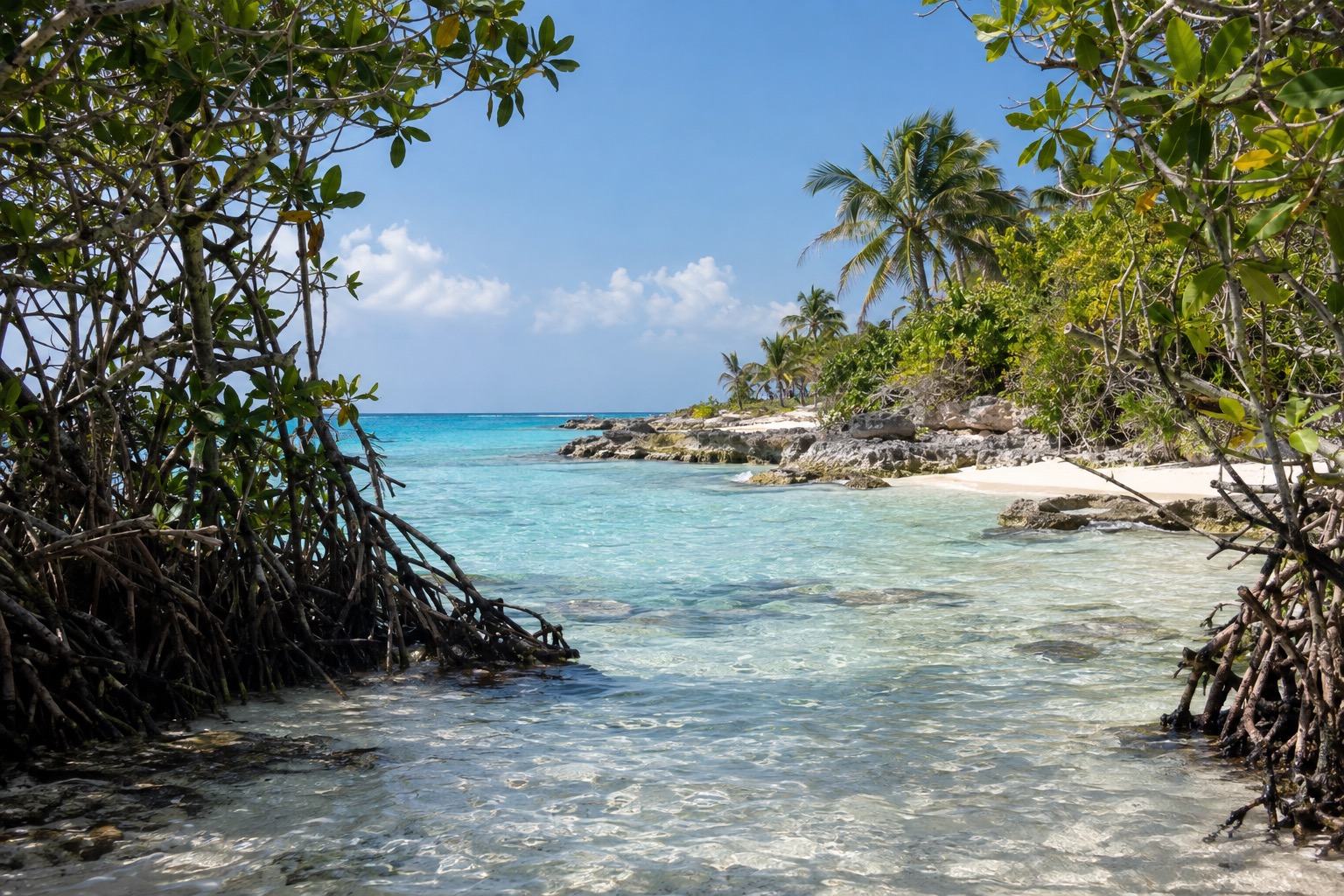
Early in the morning, the road south of Tulum turns to packed sand and the air fills with the smell of salt, wet leaves and woodsmoke. Mangroves close in on both sides, herons lift from the shallows, and the sea shows itself in flashes of turquoise between the trees. Sian Ka’an is a visit by water and on foot, a day spent watching a wild stretch of the Caribbean coast rather than a stop on a checklist.
Is visiting Sian Ka’an worth it?
Yes, if you like wildlife, quiet water and open horizons more than built attractions. It suits birdwatchers, kayakers, photographers and anyone who has seen the busy beaches of the Riviera Maya and wants to see what the coast looked like before them.
What sets it apart from the cenotes and beach clubs around Tulum is scale and silence. The reserve protects reef, mangrove, freshwater channels and coastal marsh along an undeveloped shoreline.
The name means “where the sky is born” in Yucatec Maya, and on a clear morning over the lagoons you understand why. Most of it is reached with local cooperatives rather than on your own, so the day follows the guides, the light and the animals.
What to see at Sian Ka’an
Boat and kayak tours from Muyil
Muyil is the usual gateway for visits on the water. Cooperatives run small boat and kayak outings through lagoons and old canals, where the water shifts from deep green to pale blue over a sandy bottom. Birds are the main show: herons, egrets, kingfishers and, with luck, a crocodile resting on a bank.
The Maya once traveled these channels as trade routes, and the stillness gives a sense of that past. Go with a cooperative guide, who will spot animals you would otherwise paddle straight past. Bring a hat and patience, and let the pace be slow.
Punta Allen and the coast
Punta Allen is the other base, a small fishing village at the far end of the peninsula where cooperatives organize outings on the bay. The reserve’s marine side protects part of the Mesoamerican Barrier Reef, and the shallow waters here are known for rays, dolphins and sea birds.
The interior roads are unpaved, so the journey is part of the experience and independent car access is limited. Plan for a full, unhurried day, and expect lobster and fresh fish in the village kitchens, the local specialty.
The Tulum ruins at the edge of the reserve
Many visitors pair Sian Ka’an with the Tulum archaeological zone, a walled Maya port on cliffs rising directly above the Caribbean. The Castillo watches over the sea, iguanas sun themselves on the stones, and the view down to the small beach is one of the best-known on the coast.
Early morning is the gentlest time to walk it, before the sun gets strong and the tour groups arrive. It makes a good contrast with the reserve: one place shows what the Maya built, the other the landscape they lived in.
Hours, tickets and rules
The Tulum ruins open every day of the week, with last entry in the afternoon. Free entry applies on Sundays for Mexican nationals and foreign residents of Mexico, and children under 13, visitors 60 and older, people with disabilities, and Mexican teachers and students with valid ID are also exempt. Boat and kayak outings in the reserve are set by the local cooperatives, so there is no single posted fee.
| Site | Open | Admission |
|---|---|---|
| Tulum archaeological zone | Daily, 8:00 a.m. to 5:00 p.m. (last entry 3:30 p.m.) | $265 pesos for foreign visitors, $80 pesos for Mexican nationals; free Sundays for Mexican nationals and foreign residents of Mexico |
Independent car access into the reserve is limited and the interior roads are unpaved. The reserve is managed by CONANP as a federal biosphere reserve, and most visits go through the cooperatives of Muyil and Punta Allen.
How to get to Sian Ka’an
The reserve lies south of Tulum, and Tulum is the natural base. Tulum International Airport is the closest airport, open since December 2023, and Cancun International Airport is farther north along the coast. From Tulum, the reserve is reached via Muyil or Punta Allen, where the local cooperatives run the outings.
Because interior roads are unpaved and independent car access is limited, most travelers book a cooperative outing rather than drive in alone. The Tulum ruins sit on the federal highway between Cancun and Chetumal, and are straightforward to reach from town.
When to visit Sian Ka’an
Go early. Mornings are cooler, the birds are active and the light on the water is soft, while midday brings strong heat with highs in the high 80s for much of the year. For the Tulum ruins, opening time is the best moment for the same reasons.
The drier months, roughly from winter into spring, bring fewer rainy days and easier conditions on the water. September and October are the wettest, with showers on about eleven days a month, and they fall within the Atlantic hurricane season, which runs through the end of November. Outside those months, plans tend to run more smoothly.
Tips for your visit
Bring a hat, water, a swimsuit for the heat, and a camera with a zoom for the birds. Plan a full day if you combine the reserve with the ruins, and keep the reserve for the morning when the wildlife is most active.
Families with older children enjoy the boat outings, while the ruins involve walking on uneven ground in the sun. Nearby, the cenotes around Tulum, including Dos Ojos and Gran Cenote, are run independently by private operators or ejidos and make a cool addition to the day.
Good to know before you go
The U.S. State Department rates the state of Quintana Roo Level 2, ‘Exercise increased caution,’ due to terrorism and crime.
Carry some pesos for cooperative guides and village meals, and take the usual habits of any busy coastal area. Foreign visitors entering Quintana Roo pay the Visitax, about 293 pesos per person, except those entering through the state’s southern border.
Sources
- Wikipedia, "Sian Ka'an" infobox, en.wikipedia.org, checked September 29, 2026 (secondary source ; official UNESCO whc.unesco.org not reached that day, 403)
- Wikipedia, "Sian Ka'an", en.wikipedia.org, checked September 29, 2026
- common knowledge
- sourcing caveat (web research budget exhausted on September 29, 2026; dedicated CONANP unreachable, 404), no figure asserted
- INAH, official for the Tulum archaeological zone, inah.gob.mx/zonas/99-zona-arqueologica-de-tulum, checked September 29, 2026
- Wikipedia, "Tulum", en.wikipedia.org, checked September 29, 2026 (source secondaire)
- INAH, inah.gob.mx/zonas-arqueologicas, checked September 29, 2026
- UNESCO World Heritage Centre, record 410, whc.unesco.org/en/list/410, checked September 29, 2026
- Wikipedia, "Tulum International Airport", en.wikipedia.org, checked September 29, 2026 (secondary source; the group’s official site not reachable that day)
- Wikipedia, "Tulum Municipality", en.wikipedia.org, checked September 29, 2026 (source secondaire)
- U.S. Department of State, Bureau of Consular Affairs, Mexico Travel Advisory, travel.state.gov, checked September 29, 2026 (date issued May 29, 2026) (date issued May 29, 2026)
- Ley de Derechos del Estado de Quintana Roo, art. 51-Octies and 51-Nonies ; UMA value 2026 : INEGI
- NOAA National Hurricane Center, checked September 29, 2026
- Servicio Meteorologico Nacional (CONAGUA), normales climatologicas 1991-2020, estacion 23025 (Tulum, Tulum), checked September 29, 2026
To plan your stay
- Best Time to Visit Mexico: Weather by Region, Crowds, Hurricane Season and Festivals
- Where to Stay in Mexico: Riviera Maya, Los Cabos, Puerto Vallarta, Mexico City and All-Inclusive Areas
- Getting Around Mexico: Buses, the Tren Maya, Taxis and Driving Your Own Car
- Mexico Travel Tips: Dollars, Tourist Tax, Tipping, Tap Water, Driving and Safety by State