
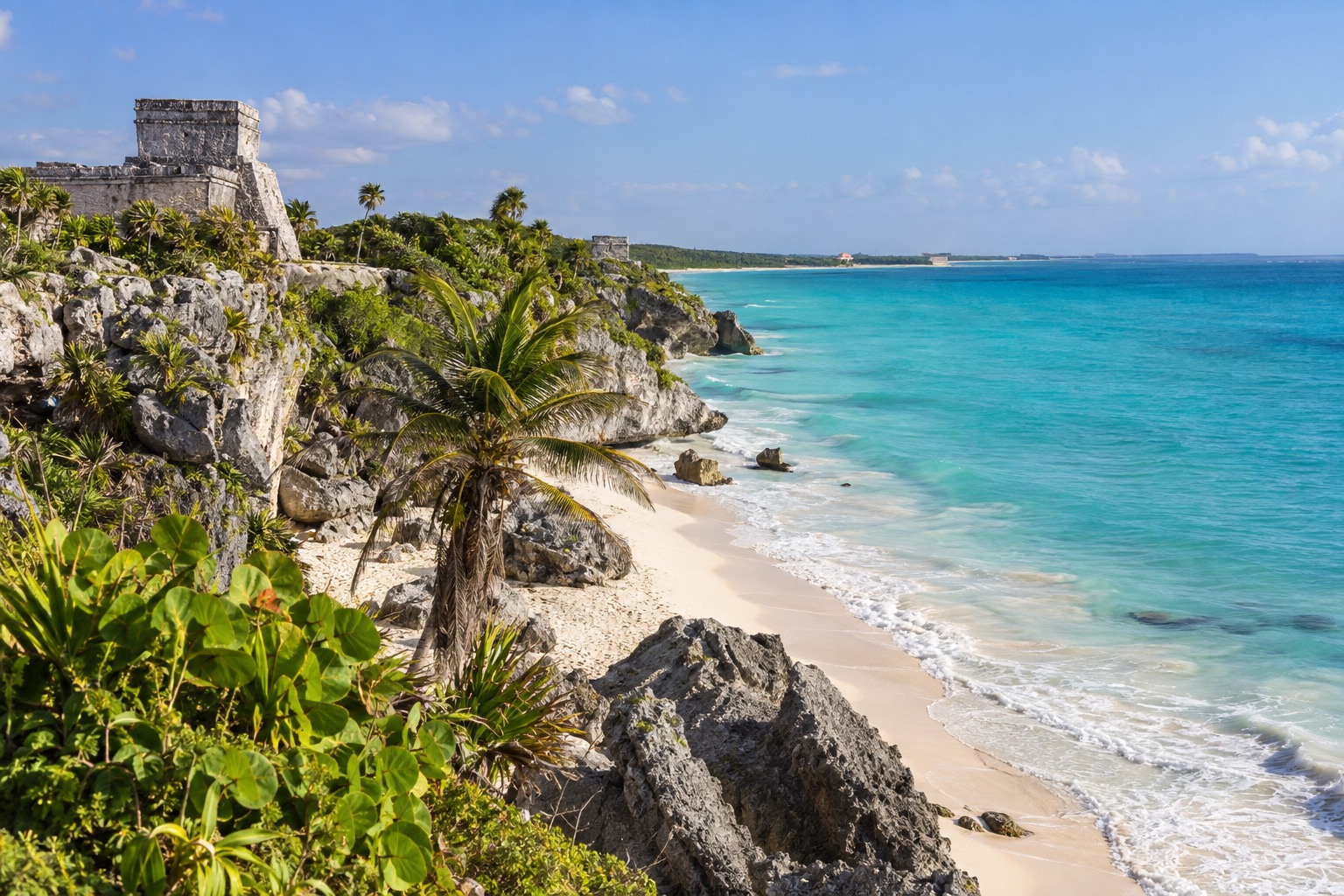
You come out of the jungle path and the Caribbean is suddenly there, a long band of turquoise beyond a gray stone watchtower. Iguanas doze on the walls, and the sea breeze moves through the low doorways of a city that once faced the water instead of the forest. Tulum is a compact, walkable site, a morning’s visit built around the view as much as the history.
Is visiting the Tulum Ruins worth it?
Yes, especially if you want ancient stones and a sea view in the same frame, and if you like your ruins easy to walk rather than sprawling. It suits first-time visitors to the Riviera Maya, families, photographers and anyone who would rather see one memorable place than spend a whole day on a site.
What sets it apart from the big inland Maya cities is the setting. Tulum is one of the last Maya cities built and inhabited, and it stands directly on a clifftop above the sea, so you get no towering jungle pyramids here. Instead you get small, weathered temples with the Caribbean behind them, and a small beach tucked into the cliffs.
What to see at the Tulum Ruins
El Castillo and the clifftop
El Castillo is the landmark everyone photographs, a stepped stone building perched right on the edge of the cliff. It rose in the late Postclassic period, when Tulum was at its greatest prominence, and it likely served as a lookout and a beacon for canoes coming through the reef. The cliffs beneath it are about 39 feet high, which is enough to make the water look impossibly clear.
Look for the dark doorways at the top, the carved columns in the shape of serpents, and the way the building catches the light. The best photos come from the path along the cliff, looking back at the temple with the sea to one side. Give it a good half hour, more if you wait for the crowds to thin between tour groups.
The Temple of the Frescoes and the Temple of the Descending God
Near the center of the site, the Temple of the Frescoes is a small, two-story building with traces of painted decoration and a sheltered gallery. The Temple of the Descending God, nearby, takes its name from the diving figure carved above its entrance, a motif found across Tulum and linked to the sky, rain and the setting sun.
These are modest buildings, so the pleasure is in details: the shape of the doorways, the faded color, the stucco figure above the lintel. They sit close together, so allow about twenty minutes for both. They are the best place to picture daily life in a city that traded along the coast before Spanish ships arrived.
The city wall and the walk in
Tulum was walled on its landward sides, and you pass through one of the openings in the stone wall to enter. It is a good moment to slow down. The wall tells you the city was a fortified trading port, and it frames the grassy plazas inside, where the buildings are scattered at an easy distance from each other.
Stroll the inner paths without a plan, because that is when you notice the small things: lizards on the stones, ceiba trees, the sound of the surf growing louder as you head east. Most visitors spend one to two hours on the whole site, and a slow loop around the wall and plazas is part of that.
The beach below the cliffs
When it is open, a staircase leads from the edge of the site down to a small crescent of white sand under the ruins. It is one of the most photographed beach views on the coast, with El Castillo overhead. Waves and seaweed vary from day to day, so look at the beach flags and the water before deciding anything.
Even if you only stand on the stairs, the view is worth the detour. Early in the day the beach is quiet and the light is soft. Later it fills up, and the sand is a pleasant place to rest after a sunny walk through the stone city.
Hours, tickets and rules
The site opens every day of the week, from early morning to late afternoon, and the last people are let in a little before closing. Foreign visitors pay a higher price than Mexican nationals, and Sundays bring free entry for Mexican nationals and foreign residents of Mexico. Children under 13, visitors 60 and older, people with disabilities, and Mexican teachers and students with valid ID are also exempt.
| Site | Open | Admission |
|---|---|---|
| Tulum archaeological zone | Monday to Sunday, 8:00 a.m. to 5:00 p.m. (last entry 3:30 p.m.) | Foreign visitors $265.00 pesos; Mexican nationals $80.00 pesos; free Sundays for Mexican nationals and foreign residents of Mexico |
The temples are roped off and cannot be climbed, and drones and professional tripods need a permit from the national antiquities institute, so plan photos from the paths. Look at the structures from the paths and treat the stones with care. Where swimming is allowed, it is at the small beach below the cliffs, so check the flags there.
How to get to the Tulum Ruins
The entrance sits on the federal Chetumal-Cancun highway, at kilometer 230, about 80 miles south of Cancun. Driving from Cancun usually takes somewhere between one and a half and two hours, depending on traffic, and the route is straightforward along the coast highway.
Tulum International Airport, which opened in December 2023, is the closer option, roughly 12 miles southwest of Tulum town. From there a taxi or rental car reaches the ruins in under an hour. Buses along the highway and organized day tours also run from the Riviera Maya towns, and tours handle the transport so you only have to show up.
When to visit the Tulum Ruins
Go at opening time. The stone gets hot as the day climbs, the tour buses arrive mid-morning, and the light on El Castillo is softer early. Afternoons are for the beach, not the plazas, and the last entry is late enough that a slow late visit is still possible if you accept the heat.
By month, the winter and spring months are the driest and the most comfortable, with highs in the mid-80s and only a handful of rain days. Summer is hotter, and September and October bring the most rain days, with showers that can come on quickly. Both months fall inside the Atlantic hurricane season, which runs from June 1 to November 30 and peaks around September 10.
Tips for your visit
- Bring a hat, water and sunscreen, and wear shoes that grip on uneven stone paths.
- Pack a swimsuit and a light towel if you plan to go down to the beach under the cliffs.
- Guides wait near the entrance, and a short walk with one adds the stories behind the temples.
- Plan about one to two hours inside, then leave time for the beach or lunch in town.
- Combine the visit with a swim at a nearby cenote such as Gran Cenote or the Dos Ojos system, each run independently, or with a boat trip into the Sian Ka’an Biosphere Reserve.
- Families will find the site compact and easy, though paths are uneven and shade is limited, so mobility can be limited in places.
Good to know before you go
The U.S. State Department rates the state of Quintana Roo Level 2, ‘Exercise increased caution,’ due to terrorism and crime.
Bring pesos for the entrance and small purchases at the gate, and keep an eye on your belongings in busy car parks and crowds, as you would at any popular site. Tulum has a Tourist Assistance Module if you need help with a lost passport or a complaint. Remember that the Atlantic hurricane season runs from June 1 to November 30, so check the forecast if you travel in those months.
| Fee | Amount | Who pays |
|---|---|---|
| Visitax (state tourist fee) | About 293 pesos (2.50 UMA), paid online at visitax.gob.mx | Foreign visitors entering Quintana Roo |
Sources
- Wikipedia, "Tulum", en.wikipedia.org, checked September 29, 2026 (source secondaire)
- common knowledge
- INAH, official for the Tulum archaeological zone, inah.gob.mx/zonas/99-zona-arqueologica-de-tulum, checked September 29, 2026
- INAH, inah.gob.mx/zonas-arqueologicas, checked September 29, 2026
- UNESCO World Heritage Centre, record 410, whc.unesco.org/en/list/410, checked September 29, 2026
- reserve de sourcage (CONANP dediee non atteinte, 404), aucun chiffre affirme
- Wikipedia, "Tulum International Airport", en.wikipedia.org, checked September 29, 2026 (secondary source; the group’s official site not reachable that day)
- Wikipedia, "Tulum Municipality", en.wikipedia.org, checked September 29, 2026 (source secondaire)
- U.S. Department of State, Bureau of Consular Affairs, Mexico Travel Advisory, travel.state.gov, checked September 29, 2026 (date issued May 29, 2026) (date issued May 29, 2026)
- Gobierno del Estado de Quintana Roo, portal visitax.gob.mx, checked September 29, 2026 (amount unconfirmed)
- NOAA National Hurricane Center, checked September 29, 2026
- Servicio Meteorologico Nacional (CONAGUA), normales climatologicas 1991-2020, estacion 23025 (Tulum, Tulum), checked September 29, 2026
- Ley de Derechos del Estado de Quintana Roo, art. 51-Octies, congresoqroo.gob.mx, checked September 29, 2026
To plan your stay
- Best Time to Visit Tulum: Weather by Month, Crowds, Sargassum and Festivals
- Where to Stay in Tulum: Beach Zone, Town, Aldea Zama and La Veleta
- Tulum Airport to City: Taxis, Private Transfers, the ADO Bus and the Ride to the Beach
- Know Before You Go to Tulum: Visitax, Pesos and Cash, Getting Around and Sun Safety