
The moment usually comes at a taqueria counter in the middle of a trip, when the bill arrives in pesos and you wonder what to leave on the table. Most of the real cost of a Mexican vacation is set by where you sleep and how you eat, while the extras that surprise people are small, specific and easy to plan for: a tourist fee, a tip, a car permit.
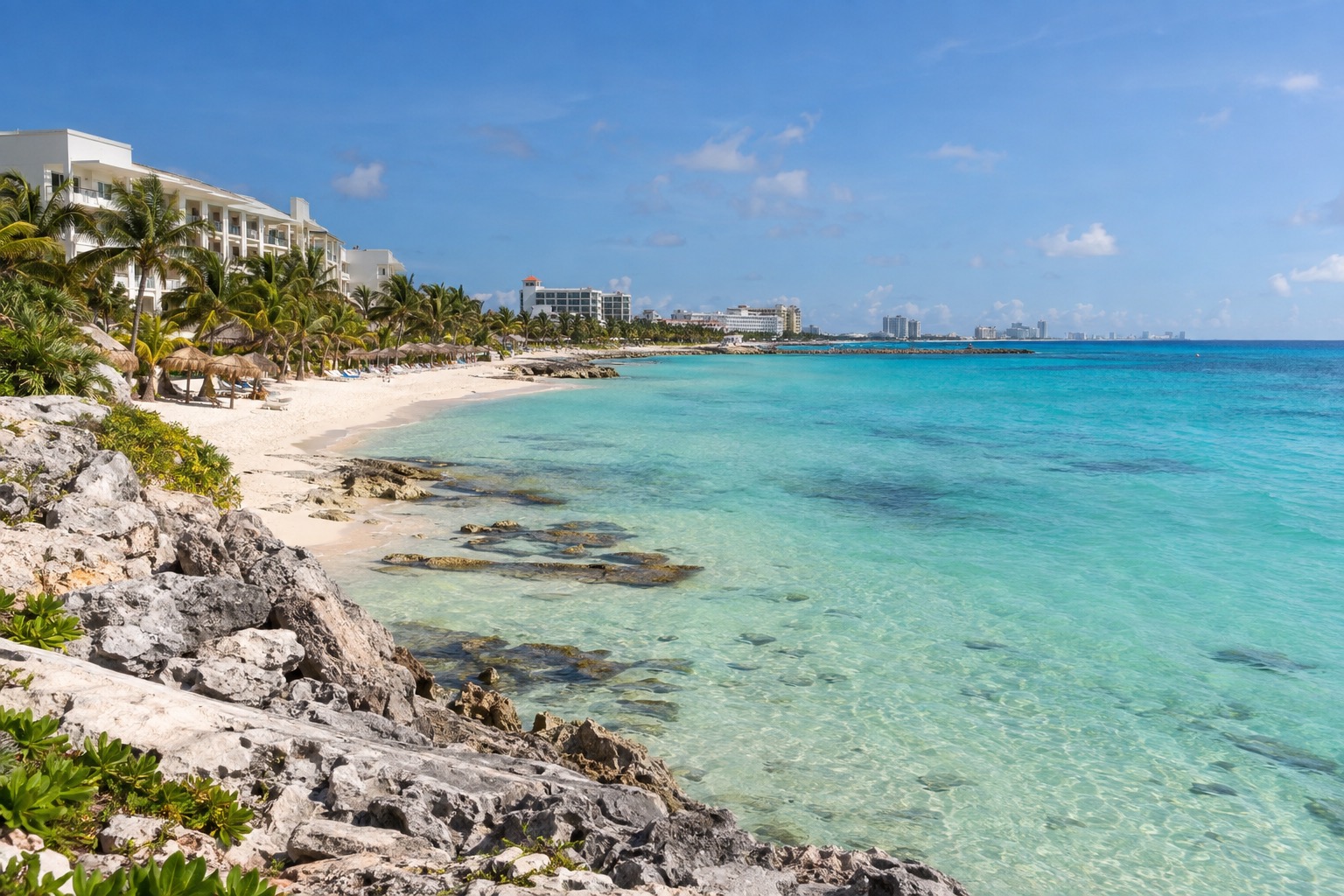
How much does a trip to Mexico cost?
It depends mostly on the style of trip you choose, since a beach week in a resort zone and a road trip through colonial towns are priced very differently. What stays fairly constant is the short list of entry costs and habits that every visitor meets.
Paying in pesos, not dollars
The peso is the country’s money, and the dollar has no legal standing there. Each business decides whether a cash register accepts dollars, what rate it applies and the maximum amount it will take, and this shifts widely between a market in a small town and a Cancun hotel strip. The practical habit is to carry pesos for taxis, street food, markets and small shops, and to treat dollars as a favor some places grant rather than a given.
What an all-inclusive stay changes
Resorts bundle the room with food and drink, which makes the daily budget easy to predict. They are concentrated in Cancun and the Riviera Maya, as well as Los Cabos and Riviera Nayarit, and adults-only properties are easy to find at all four.
The bill grows with whatever sits outside the package, and each resort draws that line differently. Spa treatments, excursions and some specialty restaurants are the usual extras, so ask what your own rate covers before you compare prices.
Mexico tourist fees
Every foreign tourist pays an immigration fee, and visitors to Quintana Roo (Cancun, Tulum, Cozumel) pay a second, state-level fee. Tourists entering Mexico need the Forma Migratoria Multiple, issued by the immigration institute. The base fee was set by law at 717 pesos, but the amount is indexed and republished yearly, so the figure charged today can differ.
Fliers rarely handle this themselves. Your airline adds that fee to the ticket price.
Visitax in Quintana Roo
For every foreign visitor, the state levies a fee equal to 2.50 multiplied by the UMA’s daily value, the unit that indexes fees. For every person, the fee works out to roughly 293 pesos, and the law grants no exemption based on age. People entering the state through its southern border are exempt.
Ahead of your travels, payment can be made online at visitax.gob.mx, or you can take care of it in cash at the airport before you depart. Cruise travelers take another path, as the cruise company charges a separate right of 5 US dollars at ticket purchase, and evidence of that payment stands in for the state fee.
| Fee | Amount | Who pays |
|---|---|---|
| FMM (immigration) | 717 pesos base amount, indexed yearly | Foreign tourists; airlines collect it for air arrivals |
| Visitax (Quintana Roo) | About 293 pesos | Foreign visitors entering the state |
| Cruise passenger right | 5 US dollars | Cruise passengers, collected by the cruise line |
How much money for tips in Mexico
When you dine at a sit-down restaurant, figure on 10 to 15 percent of the check for good service, a guide rather than a rule.
At the table
Resort towns lean higher, closer to 15 to 20 percent, because the habit follows American visitors. Before you add anything, read the bottom of the check: if it says propina incluida or servicio incluido, a charge is already in the total.
If that applies, an extra tip is a second gesture, and leaving it is up to you. Many diners leave a little cash for the server anyway if the service was warm.
Away from the table
Elsewhere the gestures are smaller. Porters receive a small amount for each bag, housekeeping gets a small amount each day, and taxi or rideshare drivers get either a little extra from rounding up or a small percentage. Keeping a handful of small peso bills and coins in a pocket makes all of this painless, since change is not always available for large notes.
Cost of driving your car into Mexico
Taking a U.S.-plated car beyond the border zones costs a permit fee plus a refundable deposit, and the deposit depends on the car’s age.
The vehicle import permit
The Temporary Vehicle Import Permit comes from Banjercito, the army bank, and is meant for foreign tourists arriving with their own car. At a border module or a consulate, you pay 51 US dollars plus VAT, while online the charge is 45 US dollars plus VAT.
| Model year | Refundable deposit (USD) |
|---|---|
| 2000 or older | 200 |
| 2001 to 2006 | 300 |
| 2007 or newer | 400 |
The deposit comes back to you after the car’s exit is logged while your permit is still valid, so the border stop on the return trip is what puts that money back in your pocket.
Where no permit is needed
No permit is needed for the entire Baja California peninsula, which is made up of Baja California and Baja California Sur, or for Sonora’s northwestern free zone. The State Department’s advisory calls these hassle-free zones where cars may drive throughout the state.
That makes a Baja road trip the simplest way to bring your own wheels, from the border to the cape with no paperwork for the car. Anyone continuing farther south should settle the permit before leaving the free zone.
A faster lane home: SENTRI
SENTRI is a trusted-traveler program that sends pre-approved, low-risk travelers through dedicated lanes at southern land border ports. It suits people who drive across often, since the time saved adds up over many crossings.
Every applicant undergoes a background check and takes part in an in-person interview before enrolling, and the application fee is 120 US dollars. For a single vacation it is rarely worth the effort, but for frequent border towns trips it can pay for itself.
Good to know before you go
Keep pesos on hand for small purchases, and use the airport or a bank machine for exchange rather than street changers. Resort zones are easy going on money, while small towns run on cash.
If your trip falls between June and November, remember that this is the official Atlantic hurricane season for the Caribbean and the Gulf, and the Pacific coast has its own season starting in mid-May. High-altitude cities such as Mexico City feel the thin air on the first day or two.
Sources
- U.S. Department of State, "Compare a Passport Card and Book", travel.state.gov, updated on 28 September 2026, read live via browser on 29 September 2026
- Ley Federal de Derechos, art. 8-I (current text, APTA CE mirror, update 91), apta.com.mx ; supplemented by Instituto Nacional de Migracion, "Forma Migratoria Multiple Digital (FMMd)", gob.mx/inm, checked September 29, 2026
- U.S. Customs and Border Protection, « Western Hemisphere Travel Initiative », cbp.gov/travel/us-citizens/western-hemisphere-travel-initiative, checked September 29, 2026
- Ley de Derechos del Estado de Quintana Roo, art. 51-Octies (official PDF from the Congreso de Quintana Roo, congresoqroo.gob.mx) ; UMA value : INEGI, Comunicado de prensa 1/26 "Unidad de Medida y Actualizacion (UMA)", January 8, 2026, inegi.org.mx, checked September 29, 2026
- Ley de Derechos del Estado de Quintana Roo, art. 51-Octies, congresoqroo.gob.mx, checked September 29, 2026
- Ley de Derechos del Estado de Quintana Roo, art. 51-Nonies, congresoqroo.gob.mx, checked September 29, 2026
- Portail officiel VISITAX, visitax.gob.mx/sitio, checked September 29, 2026
- Usage widely and consistently reported, not published by an authority
- Ley Monetaria de los Estados Unidos Mexicanos, art. 1, ordenjuridico.gob.mx, checked September 29, 2026
- Ley Monetaria de los Estados Unidos Mexicanos, art. 8, ordenjuridico.gob.mx, checked September 29, 2026
- article 8 of the Ley Monetaria (see fact money/dollarnoncourslegal above); practice observed and widely reported, not published by a single authority
- Banjercito, "Importacion Temporal de Vehiculos", gob.mx/banjercito, checked September 29, 2026
- Cross-check: Banjercito / ANAM (perimeter silence for Baja California, Baja California Sur, and the northwest of Sonora); U.S. Department of State, Mexico Travel Advisory, section "Travel and transportation", travel.state.gov, read live via browser on 29 September 2026
- U.S. Customs and Border Protection, "SENTRI", cbp.gov, checked September 29, 2026
- U.S. Customs and Border Protection, "Non-Refundable Application Fee", cbp.gov, updated September 9, 2025, checked September 29, 2026
To plan your stay
- Best Time to Visit Mexico: Weather by Region, Crowds, Hurricane Season and Festivals
- Things to Do in Mexico: Ruins, Beaches, Day of the Dead and Street Food
- Where to Stay in Mexico: Riviera Maya, Los Cabos, Puerto Vallarta, Mexico City and All-Inclusive Areas
- Getting Around Mexico: Buses, the Tren Maya, Taxis and Driving Your Own Car