
The ship eases up to the pier just after sunrise, the loudspeaker lists the day’s excursions, and a line of passengers with sunscreen and snorkel bags forms at the gangway. Mexico’s cruise calls come down to a few ports with very different personalities: Cozumel and Costa Maya on the Caribbean side, Ensenada on the Pacific coast of Baja California. Cruise passengers also have a simpler answer than most visitors to the state’s tourist fee, and it is settled when the ticket is bought.
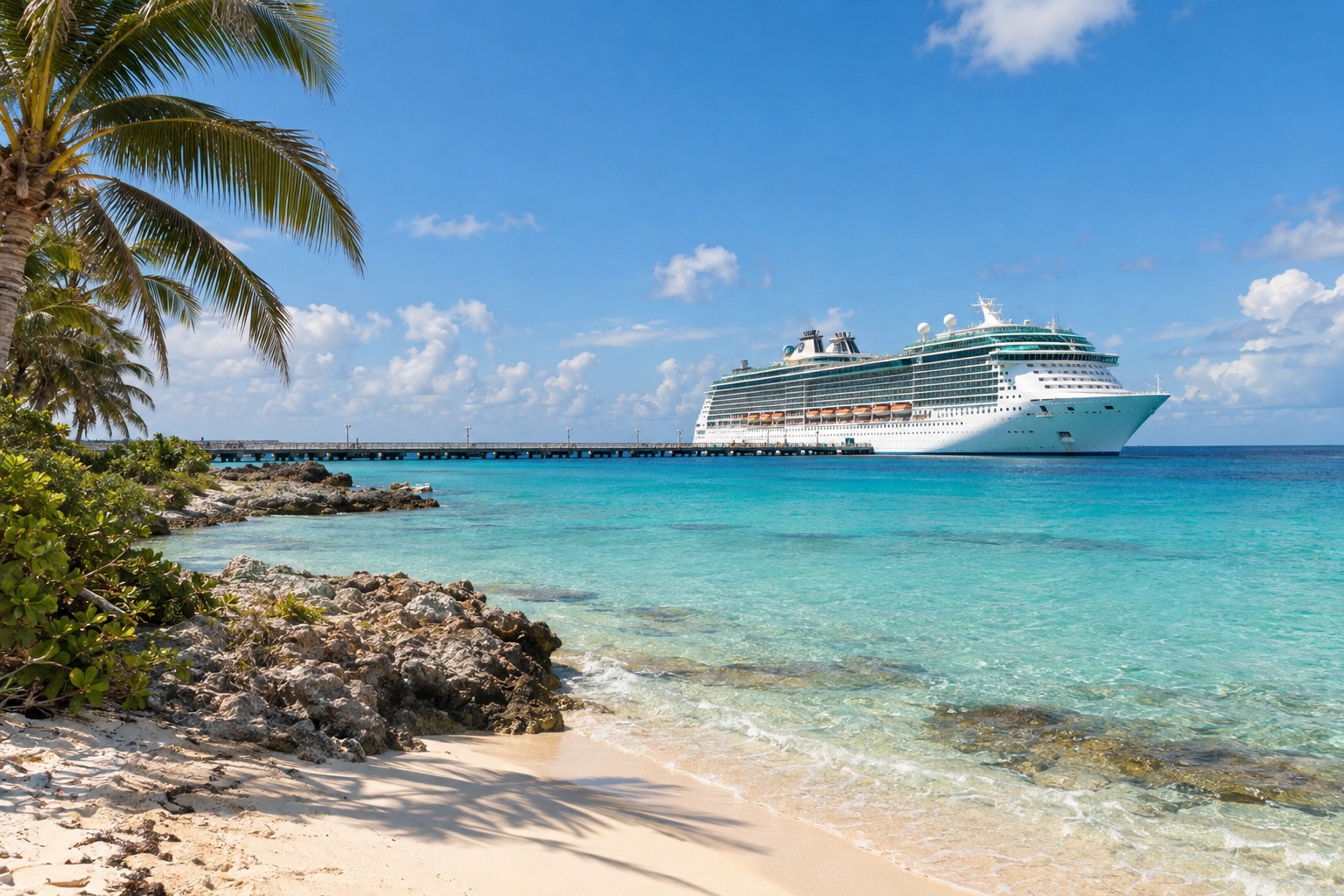
Which Mexican ports do cruise ships stop at?
Most cruise itineraries use three ports: Cozumel and Costa Maya in the Caribbean, and Ensenada on the Pacific side of Baja California. Other Quintana Roo harbors, among them Playa del Carmen, Puerto Morelos, Isla Mujeres and Puerto Juárez, serve ferries and smaller visits. Pacific routes also call at resort towns such as Cabo San Lucas, Puerto Vallarta and Mazatlán, depending on the cruise line.
Who runs a port is invisible on the pier, yet it explains why each terminal feels so different once you step off. Cozumel belongs to the state-run port company APIQROO, which holds a federal concession covering several Quintana Roo harbors.
Costa Maya works differently, since its terminal operates under a public concession from that same company, and Royal Caribbean became its controlling operator in 2025. Ensenada falls under a federal authority that also manages the neighboring cargo and fishing terminals.
For a traveler, this means three distinct days ashore. Cozumel is built around a real island town and its reefs, Costa Maya around a purpose-made cruise complex beside a small Caribbean village, and Ensenada around a working Pacific fishing port you can walk into from the ship.
Cozumel cruise port
Cozumel is the busiest of the Caribbean calls and is run by APIQROO, the state port company that has held its federal concession since 1994. The company says it wants to be an international reference for receiving cruise and ferry passengers, and the waterfront shows it, with piers that open onto shops, bars and taxi lines within a few steps of the gangway.
The island day
Most people spend a Cozumel day on the water. The reefs off the island’s western shore are famous among divers and snorkelers, and boat excursions leave from the piers and from beach clubs along the coast. Others skip the sea entirely and settle into a beach club with a pool, a margarita and a hammock.
A quieter option is to wander San Miguel, the island’s town, where the waterfront promenade gives way to plazas, taco counters and little shops selling vanilla, silver and hand-painted ceramics. Late afternoon is the pleasant hour to stroll, once the heat eases and the sun lowers over the channel toward the mainland.
The tourist rush is concentrated around the waterfront, so a few blocks inland the town feels more like a place where people live. Lunch at a family-run spot serving cochinita pibil or fresh ceviche tends to be easier on the wallet and the nerves than the pier-side restaurants. Sea conditions change from day to day, and a norte can stir up the waves, so watch the beach flags before any swim.
Costa Maya cruise port
Costa Maya is a purpose-built cruise terminal beside the village of Mahahual, on the southern stretch of Quintana Roo’s coast. The terminal is not one of APIQROO’s own ports but operates under a public concession from it that runs until 2059. For years it was held by the Hamui family’s ITM Group through Promociones Turísticas Mahahual, until Royal Caribbean bought the port and 34 adjoining properties in 2025 and took over as controlling operator.
The port feels like a resort village built around the pier, with pools, bars, souvenir stalls and a lively beachfront. Past the complex, Mahahual’s waterfront walk has restaurants and beach bars where the pace slows noticeably. The water is a clear turquoise, and the nearby barrier reef is what draws snorkeling and diving trips.
Many passengers also head inland on excursions to Maya sites such as Chacchoben, set in green jungle, or to the freshwater lagoons of the region. These trips are usually sold by the cruise line or by operators waiting outside the terminal. The area is quiet and rural, so it suits a day of beach and reef rather than shopping and nightlife.
Ensenada cruise port
Ensenada is the Pacific entry on Mexico’s cruise map, a Baja California port that appears mostly on short getaway cruises from Southern California. Its terminal is run by ASIPONA Ensenada, the federal port authority that also looks after the El Sauzal and Costa Azul terminals for cargo, cruise and fishing traffic.
The day here is about food and the sea. The fish market beside the harbor is the place for fish tacos, the Baja classic of battered fish in a corn tortilla with cabbage, crema and salsa, and stalls nearby sell shrimp cocktails and ceviche tostadas. The city center is an easy walk from the pier, with craft beer bars, souvenir shops and a lively main street.
Excursions go to La Bufadora, a marine geyser that blasts water up a rocky inlet, or into the wine country of the Valle de Guadalupe, where tasting rooms and open-air kitchens have turned the valley into a favorite for long lunches. Pacific water is cool, so a day here is about eating, tasting and strolling rather than swimming. The Baja California advisory rating is covered at the end of the page.
Do cruise passengers pay Visitax?
No, cruise passengers do not pay Visitax as a separate charge. Quintana Roo’s law instead sets a distinct right of 5 US dollars for them, and the cruise line collects it when the ticket is bought, so it is already settled before you board.
A receipt for that payment means the passenger does not have to pay the usual Visitax charge, which other foreign visitors must cover when they enter the state. In practice this concerns the Caribbean calls at Cozumel and Costa Maya, both in Quintana Roo. Ensenada is in Baja California, outside that state’s rules.
The practical habit is simple: look at the line items on your cruise booking and keep the confirmation handy. If you later extend your trip with a stay on land in Quintana Roo, arriving some other way, the exemption tied to the cruise ticket does not carry over to that visit.
Good to know before you go
Most cruise ports accept U.S. dollars, but small change in pesos is useful for taxis, market stalls and tips, and an ATM at the terminal or in town is the easy way to get it. Keep valuables simple and stay with the busier, well-trafficked parts of town. The Caribbean ports share the Atlantic hurricane season, which can reroute or cancel calls, while Ensenada follows the Pacific season that starts in mid-May.
Sources
- APIQROO, "Empresa", apiqroo.com.mx, checked September 29, 2026
- Specialized press cross-check: Reportur, "Royal Caribbean toma el control del puerto en Mahahual", reportur.com, July 16, 2025; Milenio, "Royal Caribbean adquiere puerto de Mahahual, Quintana Roo", milenio.com; checked September 29, 2026
- API Ensenada / ASIPONA Ensenada, puertoensenada.com.mx (pages "Inicio" et "Terminales e Instalaciones"), checked September 29, 2026
- Ley de Derechos del Estado de Quintana Roo, art. 51-Octies (official PDF from the Congreso de Quintana Roo, congresoqroo.gob.mx) ; UMA value : INEGI, Comunicado de prensa 1/26 "Unidad de Medida y Actualizacion (UMA)", January 8, 2026, inegi.org.mx, checked September 29, 2026
- Ley de Derechos del Estado de Quintana Roo, art. 51-Octies, congresoqroo.gob.mx, checked September 29, 2026
- Ley de Derechos del Estado de Quintana Roo, art. 51-Nonies, congresoqroo.gob.mx, checked September 29, 2026
- Portail officiel VISITAX, visitax.gob.mx/sitio, checked September 29, 2026
- U.S. Department of State, "Compare a Passport Card and Book", travel.state.gov, updated on 28 September 2026, read live via browser on 29 September 2026
- Ley Federal de Derechos, art. 8-I (current text, APTA CE mirror, update 91), apta.com.mx ; supplemented by Instituto Nacional de Migracion, "Forma Migratoria Multiple Digital (FMMd)", gob.mx/inm, checked September 29, 2026
- U.S. Customs and Border Protection, « Western Hemisphere Travel Initiative », cbp.gov/travel/us-citizens/western-hemisphere-travel-initiative, checked September 29, 2026
- U.S. Department of State, Mexico Travel Advisory (main, level banner), travel.state.gov, read live via browser (protected by Cloudflare, direct fetching blocked with 403) on 29 September 2026
- U.S. Department of State, Mexico Travel Advisory, section "Risks in specific areas" / State of Guerrero, travel.state.gov, read live via browser on September 29, 2026
- U.S. Department of State, Mexico Travel Advisory, section "Risks in specific areas" / State of Baja California, travel.state.gov, read live via browser on September 29, 2026
- U.S. Department of State, Mexico Travel Advisory, section "Risks in specific areas" / State of Baja California Sur, travel.state.gov, read live via browser on September 29, 2026
- U.S. Department of State, Mexico Travel Advisory, section "Risks in specific areas" / State of Sonora, travel.state.gov, read live via browser on September 29, 2026
- U.S. Department of State, Mexico Travel Advisory, section "Risks in specific areas" / State of Michoacan, travel.state.gov, read live via browser on September 29, 2026
- U.S. Department of State, Mexico Travel Advisory, section "Risks in specific areas" / State of Quintana Roo, travel.state.gov, read live via browser on September 29, 2026
- U.S. Department of State, Mexico Travel Advisory, section "Risks in specific areas" / State of Mexico (Estado de Mexico), travel.state.gov, read live via browser on September 29, 2026
- U.S. Department of State, Mexico Travel Advisory (reissued May 29, 2026), section « Risks in specific areas », travel.state.gov/en/international-travel/travel-advisories/mexico.html, read via browser (Cloudflare blocks curl) on 29 September 2026
To plan your stay
- Best Time to Visit Mexico: Weather by Region, Crowds, Hurricane Season and Festivals
- Things to Do in Mexico: Ruins, Beaches, Day of the Dead and Street Food
- Where to Stay in Mexico: Riviera Maya, Los Cabos, Puerto Vallarta, Mexico City and All-Inclusive Areas
- Mexico Travel Tips: Dollars, Tourist Tax, Tipping, Tap Water, Driving and Safety by State