
The question usually comes up at the laptop, when a trip is half-dreamed: sand and cenotes, tacos in the capital, or a desert coast at the tip of Baja? The answer sets your airport, and from there a short list of papers decides how smoothly you walk off the plane. Flying from the U.S. to Mexico comes down to the right airport, then the forms and fees waiting at the end of the jetway.
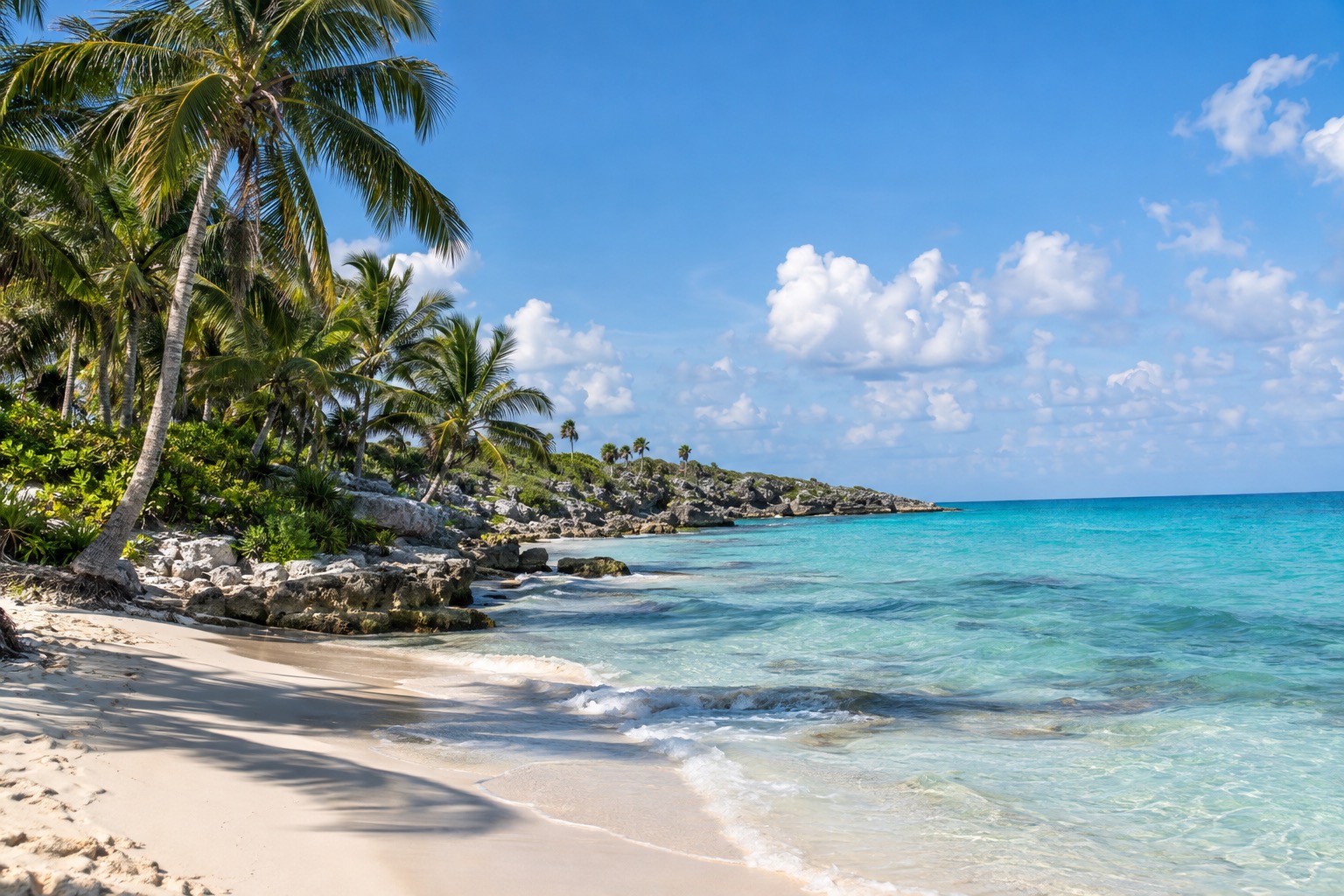
Which airport to fly into in Mexico
The right airport is the one closest to the kind of trip you want, because Mexico is big and the regions are far apart. Domestic flights link Cancun, Mexico City, Los Cabos, Puerto Vallarta and Oaxaca, and many of those routes pass through Mexico City, while driving between regions takes days rather than hours. Picking the wrong gateway can cost you a travel day.
Cancun, for the Caribbean coast
Cancun serves as the doorway to the Quintana Roo coast, where you’ll find Playa del Carmen, Cozumel, Tulum and Isla Mujeres, plus white-sand beaches, cenotes and Maya ruins. Anyone who lands here will see that Chichén Itzá, set inland in Yucatán, makes a natural add-on.
From the airport, ADO first-class buses run to Playa del Carmen and Tulum, which suits travelers who would rather skip a rental car. The Tren Maya also ties Cancun to Mérida, Valladolid and Tulum. When you drive yourself, the direct route into Tulum is Federal Highway 307, with no tolls, and topes (speed bumps) pop up as you enter every town.
Los Cabos and Puerto Vallarta, for the Pacific side
Los Cabos sits where the Baja desert meets the sea. Cabo San Lucas is the nightlife hub, home to the famous arch, while San José del Cabo is the quieter town. Since a lot of the Pacific-side beaches here are too rough for swimming, choose pools and protected coves instead.
Set on the Bay of Banderas, Puerto Vallarta has jungle-covered hills at its back, and a flight into this place likewise leaves Sayulita and Punta Mita, farther along the coast, within easy reach. Ride-hailing apps work in many cities, but not every resort area lets them pick up at the airport, so expect to use the official taxi and shuttle booths inside the terminal.
Mexico City and Oaxaca, for food and colonial centers
The central highlands (Mexico City, Oaxaca, Guadalajara, San Miguel de Allende) trade beaches for museums, markets and colonial plazas. The altitude keeps nights cool, so bring a layer even when the days feel warm.
Mexico City is also the hub many domestic routes run through, which makes it a handy first stop if you plan to combine regions. Long-distance first-class buses are the everyday way to move between cities once you are on the ground.
Do you need a passport to fly to Mexico?
Yes, you need a passport book for any flight, because the passport card does not work for international air travel. The card is made for crossing from Canada, Mexico, some Caribbean destinations and Bermuda by land or sea.
Where the card does help is on the ground and at home: it can speed a land crossing back from Mexico at Ready Lanes and can stand in as a REAL ID alternative on domestic flights. For a trip by plane, though, keep the book in your carry-on.
Children on a flight
The birth-certificate shortcut for younger U.S. citizens exists only for returning by land or sea. By air, every child must present their own passport, babies included.
If a family trip is taking shape and a child has no passport yet, start there before anything else, since it is the document most likely to hold up a departure. Teenagers traveling with a school or youth group follow the same rule once they board a plane.
Getting a passport card too
A first-time card costs 65 USD for an adult and 50 USD for a child under 16, plus a separate execution fee paid at the acceptance facility. A renewal is 30 USD for an adult. Kids younger than 16 can’t renew, so they have to turn in a new application in person.
Adult cards last 10 years and children’s cards 5, the same as the passport book. A card makes sense mostly for families who also plan to drive across the border or sail, since it adds nothing for a flight.
| Passport card | Cost (USD) | Validity |
|---|---|---|
| First card, adult | 65 | 10 years |
| First card, child under 16 | 50 | 5 years |
| Renewal, adult | 30 | 10 years |
Is the FMM included in the plane ticket?
Yes, if you arrive by plane, your airline collects the FMM fee and forwards it on your behalf, so the immigration desk charges you nothing. The FMM is the tourist entry permit issued by Mexico’s immigration institute, the INM.
The fee in the law was set at 717 pesos by the reform that took effect on January 1, 2024. It is indexed each year, so the amount built into your fare may differ from that figure.
The FMMd now serves as the digital replacement for the paper form. After the officer stamps your passport, it arrives as a QR code, so there is nothing to fill out in your seat before landing.
Do you pay Visitax when flying into Cancun?
Yes, if you are one of the foreign visitors entering Quintana Roo, you owe the Visitax fee, and that charge isn’t included in your plane ticket or the FMM. As written, the law calls the payer just foreign visitors, with no age exemption anywhere in the article.
How much and how to pay
The fee is 2.50 UMA, a unit that Mexico updates yearly. At the daily value in force since February 2026, that comes to about 293 pesos per person, so a family of four should count it four times.
The portal at visitax.gob.mx is run by the state tax service, SATQ, and accepts payment before you leave home. You also have the option of paying in cash at the airport before you leave. Keep the receipt handy, since it is your proof if anyone asks.
Exemptions and cruise passengers
An explicit exemption applies to travelers entering Quintana Roo via its southern border. That matters little for someone landing at Cancun airport, but it shows the fee follows the point of entry into the state.
Cruise passengers do not pay Visitax separately. When they purchase their ticket, the cruise line collects a separate 5 US dollars charge from them, and proof of that payment frees them from the Visitax fee. Crew members are not charged the cruise-passenger fee.
Good to know before you go
Most of what you need arrives in your fare or in one online payment, so the practical side of flying in is light. Mexico’s Caribbean and Gulf coasts follow the Atlantic hurricane season, so check the calendar when you pick dates, and remember that the highlands stay cool at night because of their altitude. On arrival, official airport taxis are the simple choice, paid at the booth before you head out.
Sources
- U.S. Department of State, "Compare a Passport Card and Book", travel.state.gov, updated on 28 September 2026, read live via browser on 29 September 2026
- Ley Federal de Derechos, art. 8-I (current text, APTA CE mirror, update 91), apta.com.mx ; supplemented by Instituto Nacional de Migracion, "Forma Migratoria Multiple Digital (FMMd)", gob.mx/inm, checked September 29, 2026
- U.S. Customs and Border Protection, « Western Hemisphere Travel Initiative », cbp.gov/travel/us-citizens/western-hemisphere-travel-initiative, checked September 29, 2026
- Ley de Derechos del Estado de Quintana Roo, art. 51-Octies (official PDF from the Congreso de Quintana Roo, congresoqroo.gob.mx) ; UMA value : INEGI, Comunicado de prensa 1/26 "Unidad de Medida y Actualizacion (UMA)", January 8, 2026, inegi.org.mx, checked September 29, 2026
- Ley de Derechos del Estado de Quintana Roo, art. 51-Octies, congresoqroo.gob.mx, checked September 29, 2026
- Ley de Derechos del Estado de Quintana Roo, art. 51-Nonies, congresoqroo.gob.mx, checked September 29, 2026
- Portail officiel VISITAX, visitax.gob.mx/sitio, checked September 29, 2026
To plan your stay
- Best Time to Visit Mexico: Weather by Region, Crowds, Hurricane Season and Festivals
- Things to Do in Mexico: Ruins, Beaches, Day of the Dead and Street Food
- Where to Stay in Mexico: Riviera Maya, Los Cabos, Puerto Vallarta, Mexico City and All-Inclusive Areas
- Mexico Travel Tips: Dollars, Tourist Tax, Tipping, Tap Water, Driving and Safety by State