
Hilo wakes up to rain on the tin roofs, the smell of wet earth and ginger, and a farmers market where the stalls steam with fresh-baked goods and bundles of tropical flowers. The year here has two moods, a slightly warmer summer and a wetter, cooler winter, but the green never fades and a shower is never far off. It is a town for waterfalls, volcano days and slow mornings on the bay, and the calendar decides how much sun you get along the way.
When is the best time to visit Hilo?
May through October is the best stretch for most visitors, with warmer air, a warmer sea and a little less rain, though Hilo stays a rainy town in every month. Anyone who comes expecting a dry beach vacation will be disappointed, and anyone who comes for waterfalls, rainforest and volcanoes will be happy nearly all year.
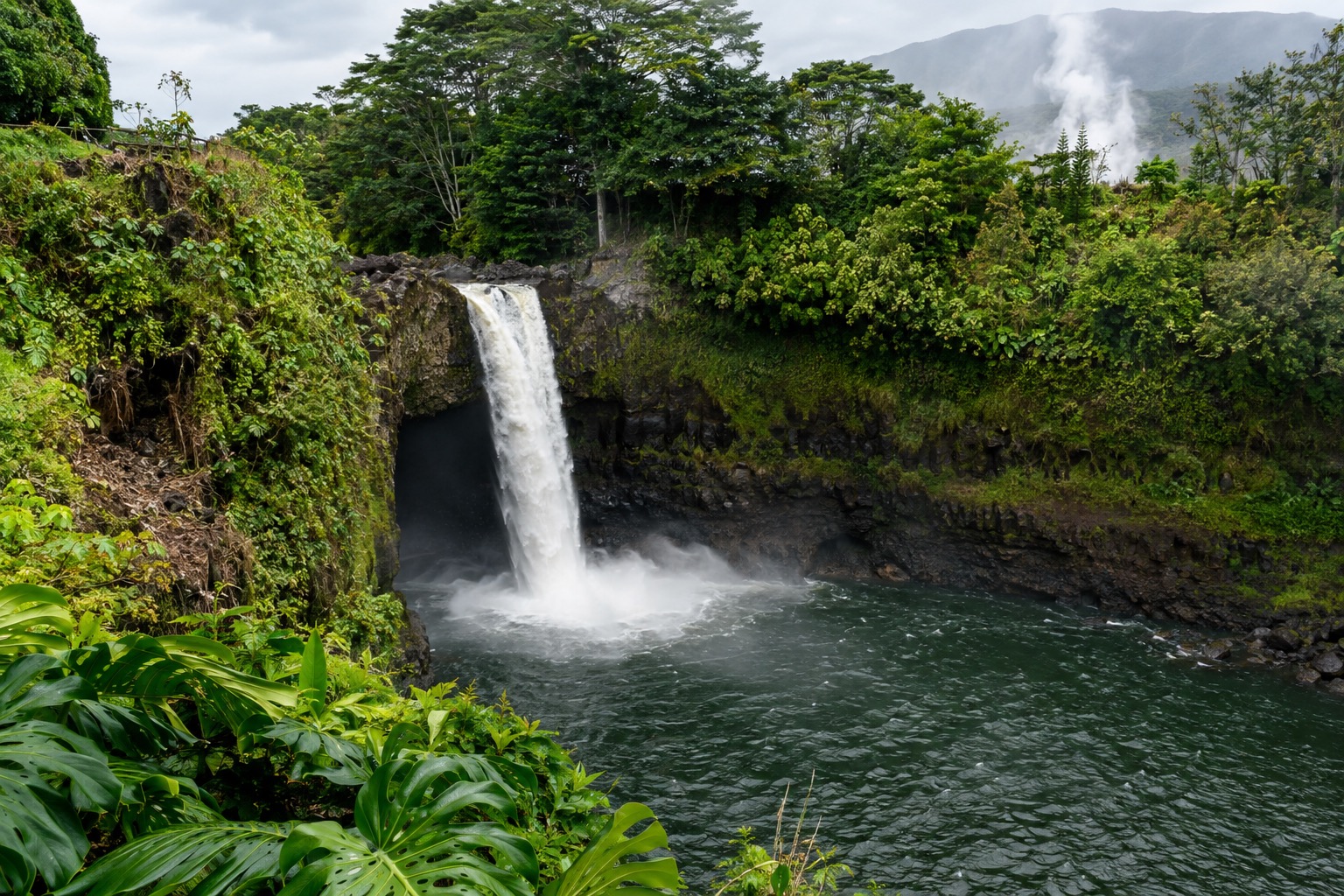
For swimming and snorkeling, late summer into early fall brings the warmest water, and the morning hours are usually the clearest of the day. For sightseeing, spring is a pleasant middle ground. Rainbow Falls and Akaka Falls run fuller after wet weather, and the drive up to Volcanoes National Park feels cool and misty whatever the month. Maunakea is a different climate altogether, cold at the top in every season.
Travelers who like quiet should aim for the shoulder weeks of late April, May and September, when the town is calm and the farmers market feels local again. Families will find March loud, because mainland spring break fills the island’s rental cars and rooms, while summer brings school-vacation crowds to the popular parks.
Hilo weather by month
Temperatures barely move through the year, so rain and the sea are what set one month apart from another.
| Month | Average high (°F) | Average low (°F) | Rain (in) | Rain days | Sea (°F) |
|---|---|---|---|---|---|
| January | 78.7 | 64.1 | 7.86 | 9.6 | 77.4 |
| February | 78.4 | 64.1 | 10.22 | 10.9 | 76.3 |
| March | 78.5 | 65.2 | 12.68 | 14.9 | 75.7 |
| April | 79.0 | 66.1 | 9.40 | 17.2 | 75.6 |
| May | 80.7 | 67.3 | 6.99 | 14.2 | 77.1 |
| June | 81.8 | 68.7 | 7.30 | 16.7 | 78.5 |
| July | 82.8 | 69.9 | 9.24 | 18.8 | 79.3 |
| August | 82.9 | 70.4 | 11.30 | 18.2 | 80.2 |
| September | 83.3 | 69.8 | 8.70 | 15.3 | 80.5 |
| October | 82.4 | 69.0 | 10.24 | 16.7 | 80.5 |
| November | 80.3 | 67.6 | 14.39 | 17.3 | 79.4 |
| December | 78.8 | 65.7 | 12.07 | 16.2 | 78.4 |
Summer is a few degrees warmer, and the sea follows, peaking in early fall. Rain falls on most days all year, yet summer showers tend to be brief and warm, often sliding past by midday. November and December are the soggiest months, with heavy downpours that can last for hours and soak whole days, while late winter brings the driest stretch, still cool and damp by Hawaii standards.
When is Hilo cheapest and least crowded?
The quiet months in Hilo are late April through May, and again from September to mid-November, when the main resort crowds are elsewhere on the island and rooms are easier to find. Hilo has never been the beach-resort side of the Big Island, so its busy periods are gentler than those of Kona or Maui.
The peaks follow the mainland calendar. Christmas and New Year fill the town, March spring breaks bring families, and the weeks around Easter are busy, especially when the hula festival is on. Summer school vacation, roughly June through mid-August, keeps the waterfalls and the volcano park lively. Outside those weeks the bayfront, the farmers market and the waterfalls feel relaxed, and you can often have a lava viewpoint or a tide pool nearly to yourself early in the day.
Which months should you avoid in Hilo?
No month is truly one to skip, but November and December are the hardest on a sunny-day itinerary, with the heaviest rain of the year, and the Central Pacific hurricane season runs from June 1 to November 30.
Storms rarely reach the islands, but a tropical system can bring days of rain and rough surf along the east coast, so it helps to keep plans flexible for those months. The wet months also mean muddy trails and swollen streams at the waterfalls.
Winter can bring big surf to north-facing shores of the island, and the Hilo coast can be choppy at times. Summer heat is mild here compared with leeward Kona, so it is not a reason to stay away.
When can you swim in Hilo?
The water is warm enough to swim in every month, with the mildest stretch from summer into early fall and a slight chill, by local standards, from February to April.
Hilo’s shoreline is mostly black lava rock and small coves rather than long sand beaches, so swimming depends more on the day’s surf than on the season. Winter swells and heavy rain can stir up the water and bring runoff, which makes for murky conditions. The calmer stretch tends to be summer, but before entering the water, beach entrance signs advise checking that day’s surf and currents, and they say to swim near a lifeguard only at spots where one is on duty. Many visitors drive up the coast for the calmer bays and tide pools, then come back to town for lunch and a stroll along the bayfront.
Festivals and events in Hilo through the year
Spring: hula, flowers and farmers markets
The week after Easter, the Merrie Monarch Festival turns Hilo into the center of the hula world. Dancers and halau from across the islands compete in the evening, and the town fills with craft fairs, parades and lei stands. It is the biggest event on the local calendar.
Lei Day on May 1 brings flower garlands, music and school performances to parks across the island. Between these dates the Saturday and Wednesday farmers market on Mamo Street is a good place to taste local fruit and fresh poke.
Summer: Kamehameha Day and family weeks
Kamehameha Day on June 11 is a state holiday, with flower-draped statues, parades and hula, and the Big Island, where the king was born, marks it with particular pride. Expect music and picnics at the parks.
Summer weeks are family time on the island, so waterfalls, the volcano park and the tide pools are busy on weekends. Mornings are the quieter hours for them, and the rain tends to arrive later in the day.
Fall and winter: Ironman, holidays and humpbacks
In October the Ironman World Championship takes place on the Kona side, and the buzz reaches Hilo in the form of busier roads and fuller flights, even though the race itself is across the island. Christmas and New Year bring holiday lights, craft sales and island-style feasts, with plenty of rain to go with them. Humpback whales spend the winter in Hawaiian waters, and on clear days they can sometimes be spotted from the Hamakua and Hilo coasts.
Sources
- NOAA NCEI, monthly normals 1991-2020, station USW00021504, checked September 8, 2026
- Open-Meteo Marine API, average 2015-2024, checked September 8, 2026
- sunrise-sunset.org, sunrise and sunset calculated for the 15th of the month, checked September 8, 2026
- Hawaii Department of Taxation, Tax Announcement No. 2025-03 (Transient Accommodations Tax Law Changes from 2025 Legislative Session), files.hawaii.gov/tax/news/announce/ann25-03.pdf, checked September 24, 2026
- County of Hawaii, Department of Finance, Transient Accommodations Tax (TAT) page, hawaiicounty.gov/departments/finance/transient-accommodations-tax-tat (live returned HTTP 403 on request, read via Internet Archive Wayback Machine snapshot dated August 14, 2026, same official content), checked September 25, 2026
- Hawaii Department of Taxation, County Surcharge on General Excise and Use Tax page, tax.hawaii.gov/geninfo/countysurcharge/, checked September 25, 2026
- Federal Aviation Administration, CY2024 Commercial Service Enplanements (xlsx), faa.gov/airports/planning_capacity/passenger_allcargo_stats/passenger/arp-cy2024-commercial-service-enplanements.xlsx, checked September 24, 2026
- Hawaiʻi Department of Land and Natural Resources, Division of State Parks, "Wailuku River State Park", dlnr.hawaii.gov/dsp/parks/hawaii/wailuku-river-state-park/, read September 25, 2026
- Hawaiʻi Department of Land and Natural Resources, Division of State Parks, "ʻAkaka Falls State Park", dlnr.hawaii.gov/dsp/parks/hawaii/akaka-falls-state-park/, read September 25, 2026
- University of Hawaiʻi at Hilo, Center for Maunakea Stewardship, "Important Things to Know", hilo.hawaii.edu/maunakea/visitor-information/important-things-to-know, read September 25, 2026
- University of Hawaiʻi at Hilo, Center for Maunakea Stewardship, "Maunakea Visitor Information Station", hilo.hawaii.edu/maunakea/visitor-information/station, read September 25, 2026
- National Park Service, "Fees & Passes", nps.gov/havo/planyourvisit/fees.htm, read September 25, 2026
- Imiloa Astronomy Center, University of Hawaii at Hilo, About Imiloa, https://imiloahawaii.org/aboutimiloa, checked September 25, 2026
- Imiloa Astronomy Center, University of Hawaii at Hilo, homepage, https://imiloahawaii.org/, checked September 25, 2026
- NOAA National Centers for Environmental Information, Recent/Significant Tsunami Events, https://www.ncei.noaa.gov/products/natural-hazards/tsunamis-earthquakes-volcanoes/tsunamis/recent-significant-events, checked September 25, 2026
- National Weather Service, International Tsunami Information Center, Hawaii Tsunamis, https://weather.gov/itic-car/hawaii_tsunamis, checked September 25, 2026
- USGS, November 27-December 10, 2022 Eruption of Mauna Loa, https://www.usgs.gov/volcanoes/mauna-loa/science/november-27-december-10-2022-eruption-mauna-loa, checked September 25, 2026
- NPS, Directions, https://www.nps.gov/havo/planyourvisit/directions.htm, checked September 25, 2026
- Hawaii Department of Transportation, New phase of Daniel K. Inouye Highway opens Oct. 10 2017, https://hidot.hawaii.gov/highways/new-phase-of-daniel-k-inouye-highway-opens-oct-10-2017/, checked September 25, 2026
- NOAA NCEI, monthly normals 1991-2020, station USW00021510
- NOAA NCEI, monthly normals 1991-2020, station USC00511303
- NWS Honolulu / Central Pacific Hurricane Center, « 2026 Central Pacific Hurricane Season Outlook », weather.gov/hfo/hurricaneOutlook2026, checked September 24, 2026