
LISBON · KNOW BEFORE YOU GO · TEN LESSONS FROM THE HILLS
The Lisbon in your camera roll is flat. The one under your shoes is a stack of ramps, staircases and polished stone, and almost every first-visit mistake traces back to that gap. These are the corrections our desks collected the tiring way: which tram to board, which street a taxi can physically enter, and why a jacket belongs in an August daypack.
Tickets, rankings and opening hours have their own page, as does the season in the month view. Everything here is experience only: ten things the city teaches by making you climb.
THE LESSONS AT A GLANCE · LISBON
Plan by hill instead of by checklist, board Tram 28 early or not at all, spend one golden hour at one viewpoint, and eat on the local clock: four adjustments that remove most first-visit friction.
TEN LESSONS · HILLS DECIDE THE DAY · VIEWPOINTS ARE FREE · SINTRA IS A FULL DAY
What this page gives you: ten ground-level corrections, sorted by hill, hour and meal, with the sourced facts left on the guides that own them.
Read the companions: the sight-by-sight ranking lives in things to do, the escapes in the day-trips guide. Neither gets repeated below.
An experience page · editorial judgment from our Lisbon reporting trips, with checkable facts linked to their sourced guides
On this page
- Trams, funiculars and the crowded classicWhat to board on Tram 28, and at what hour
- Why my day plan keeps collapsingPlanning by hill, calçada and taxi drop-off
- Where to be at sunset, and what to wearThe miradouro hour and the evening wind
- Lunch, dinner and the waterfront terracesTascas, menu do dia and late tables
Tram 28 and the funiculars: tickets, best time to ride and which hills to skip
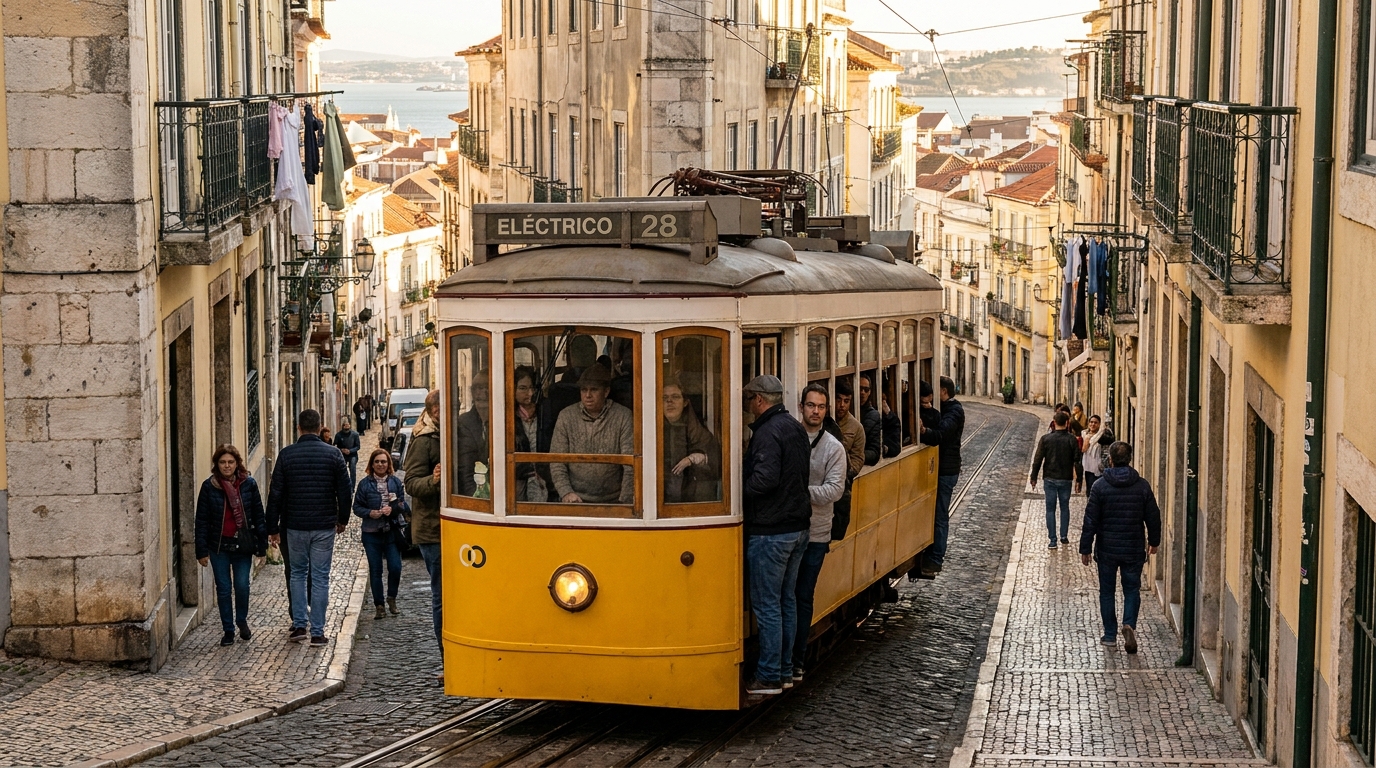
Tram 28 is not an attraction with assigned seats. It is a working line on the transit map, used by people carrying shopping bags up to Graça, and by mid-morning it runs standing-room only with a queue at the terminus. Visitors who picture a scenic loop end up wedged against a window they cannot photograph through, wallet side exposed, for the length of the ride.
Two versions work. Board at the start of the line in the first hour of service, before the city and the tour groups wake up, and the wooden carriage does everything the postcards promise. Or skip it entirely and walk the Alfama stretch downhill, which costs nothing, stops where you want and takes better pictures.
Crowded trams are also where hands get busy, a point the safety guide makes with more precision than we will here.
The funiculars, Glória and Bica among them, earn their fare on different arithmetic. The ride lasts a couple of minutes and the ticket buys you a slope you no longer have to climb at 3pm. Consider it a lift with a view rather than a sight, take it up, and give yourself the walk back down.
Lisbon hills and calçada pavement: which climbs to avoid and what shoes to bring
On a map, two Lisbon addresses can sit a few hundred yards apart. On the ground, one is on the castle slope and the other is across a valley, with a staircase and a full climb in between. Group the day by quarter, finish each hill before you leave it, and use the flat river grid as your connector. The city guide lays out which neighborhood sits on which slope.
The pavement deserves its own warning. Calçada portuguesa, those small limestone cubes, polishes to a shine under decades of feet, and the first drizzle turns a gentle descent into an ice rink.
Grippy soles beat pretty ones every single day of a Lisbon trip, and the packing case for them is made on the packing page.
Taxis and app cars follow the same geography. Many Alfama and Mouraria lanes are too narrow for a car, so your driver stops at the nearest wide corner and you finish on foot, luggage and all. And no, Sintra is not an afternoon: the palaces are spread across a forested hill with their own queues and shuttles, which is why the day-trips guide gives it a full day and an early train.
Lisbon miradouros at sunset
The miradouros are the city’s real currency, and they cost nothing. Every hill ends in one: a terrace, a kiosk selling beer and toasted sandwiches, a wall of tiles, and the Tagus doing its silver trick below. Paid rooftops exist and are pleasant. They rarely beat the free parapet two streets over, which is the calculation locals made a long time ago.
The mistake is collecting them. Four viewpoints in one evening means four walks and no sunset, because the light moves faster than your legs on this terrain. Pick one, arrive around forty minutes before the sun drops (est.), buy the drink, and stay put through the color change and the blue hour that follows.
Then the wind arrives. Even in high summer, the Atlantic breeze funnels up the estuary after dark and a terrace that was pleasant at eight is chilly by ten, which is why a light layer lives in the bottom of the daypack from June through September. The same ocean explains the beaches: the water out at Cascais is Atlantic, not Mediterranean, and it stays bracing in August. Wade first, commit second.
Where to eat in Lisbon: menu do dia, waterfront terraces and 9pm dinners
The restaurants ringing the Baixa grid and the riverfront do a brisk trade in laminated photo menus and greeters who step into your path. They are not scams, merely mediocre at tourist prices. Walking five minutes uphill, away from the water, usually changes the cooking and the bill at the same time.
Lunch is where the value hides. Neighborhood tascas chalk a menu do dia on a board at midday: a soup, a main, bread, often wine or coffee, for a figure that makes dinner look extravagant. Paper tablecloths, a television on in the corner, no English menu and no reservation. Eat your big meal there and let the evening be lighter.
Dinner runs late. Kitchens fill between nine and half past ten (est.), so the 7pm table you booked from home puts you in an empty dining room while the staff are still setting up. Ask for the late slot instead, which is also the easier one to get, and treat the hours before it as viewpoint time. Prices across meals are laid out on the cost guide.
Lisbon travel tips: tram 28, calçada and the menu do dia
| The lesson | What it saves you |
|---|---|
| Board Tram 28 in the first hour, or walk the route | A standing ride with no view and an open pocket |
| Use a funicular for the climb it deletes | Reaching Bairro Alto out of breath at 3pm |
| Group the day by hill, not by opening hours | Crossing the same slope four times |
| Grippy soles on the calçada | The polished-limestone slide after drizzle |
| Meet the car at the nearest wide corner | A driver who cannot enter your lane |
| Give Sintra a full day and an early train | One palace, then a timetable |
| Keep a light jacket in the daypack all summer | The estuary wind on a 10pm terrace |
| Pick one miradouro per evening and stay | Four walks and a missed sunset |
| Eat the chalked menu do dia at lunch | The photo-menu terrace by the water |
| Book dinner for nine, not seven | Dining alone while the kitchen warms up |
| Wade before you swim at Cascais | The Atlantic surprise at knee height |
| Climb in the morning, descend after dark | Stairs at two in the afternoon in July |
The last word
Lisbon is generous with everyone who reads its terrain first. Shoes with grip, one hill per half day, a viewpoint booked into the evening the way other cities book a show, and a table at nine. Do that and the famous fatigue turns into appetite, right on cue, at the top of the last staircase.
Set the base with the neighborhood comparison, spend the earned day on Pena Palace via the day-trips guide, and if Lisbon turns into a longer trip, the week-long route takes it from here.
Sources & data for this guide
- This is an experience page: the ten lessons are editorial judgment from our desks’ Lisbon trips, deliberately unsourced because they are observations rather than published facts · checked Sep 14, 2026
- Figures marked (est.) are our own field estimates, not operator data: funicular ride length, menu do dia value, typical dinner hours · checked Sep 14, 2026
- Checkable facts referenced here live on their own sourced pages · city guide, day trips, safety, costs
- Tram and funicular operating patterns change with works and season · confirm with the operator before you plan an early boarding · checked Sep 14, 2026
- Re-read in our monthly refresh alongside the rest of the Portugal file