
PORTUGAL · LISBON · AIRPORT TO CITY CENTER
Lisbon’s airport sits inside the city. The metro’s Red line starts under Terminal 1, and a taxi reaches most central quarters without ever leaving town, so arrivals here fail for the opposite reason to most airports: it looks too easy to plan, and then you are standing in the hall with two suitcases, no transit card, and a hotel address in an app that will not load. Ten minutes at home settles all of it.
THE ARRIVAL IN SHORT · LISBON AIRPORT
Decide between the Red line and the taxi rank before you land, and book the departure-day ride while you still have wifi.
RED LINE FROM THE TERMINAL · CHANGE AT ALAMEDA FOR BAIXA · TAXI RANK OUTSIDE ARRIVALS · NO METRO OVERNIGHT
Go for: the metro when you travel light and sleep near a red or green line station. It skips the traffic that decides every road option.
Think twice before: improvising a late-night arrival, or assuming the ride back takes what the ride in took.
Network: Metropolitano de Lisboa · terminals: ANA · no fares quoted here · sources at the end
On this page
- Which option from Lisbon Airport?Metro, taxi, ride-hailing and shuttles
- Everything compared in one tableLisbon Airport options
- What to sort out before the flightWhat to prepare before you fly to Lisbon
- My flight lands after midnightArriving in Lisbon at night
- Getting back to the airportDeparture day in Lisbon
From Lisbon Airport to the center: metro, taxi, ride-hailing and shuttles
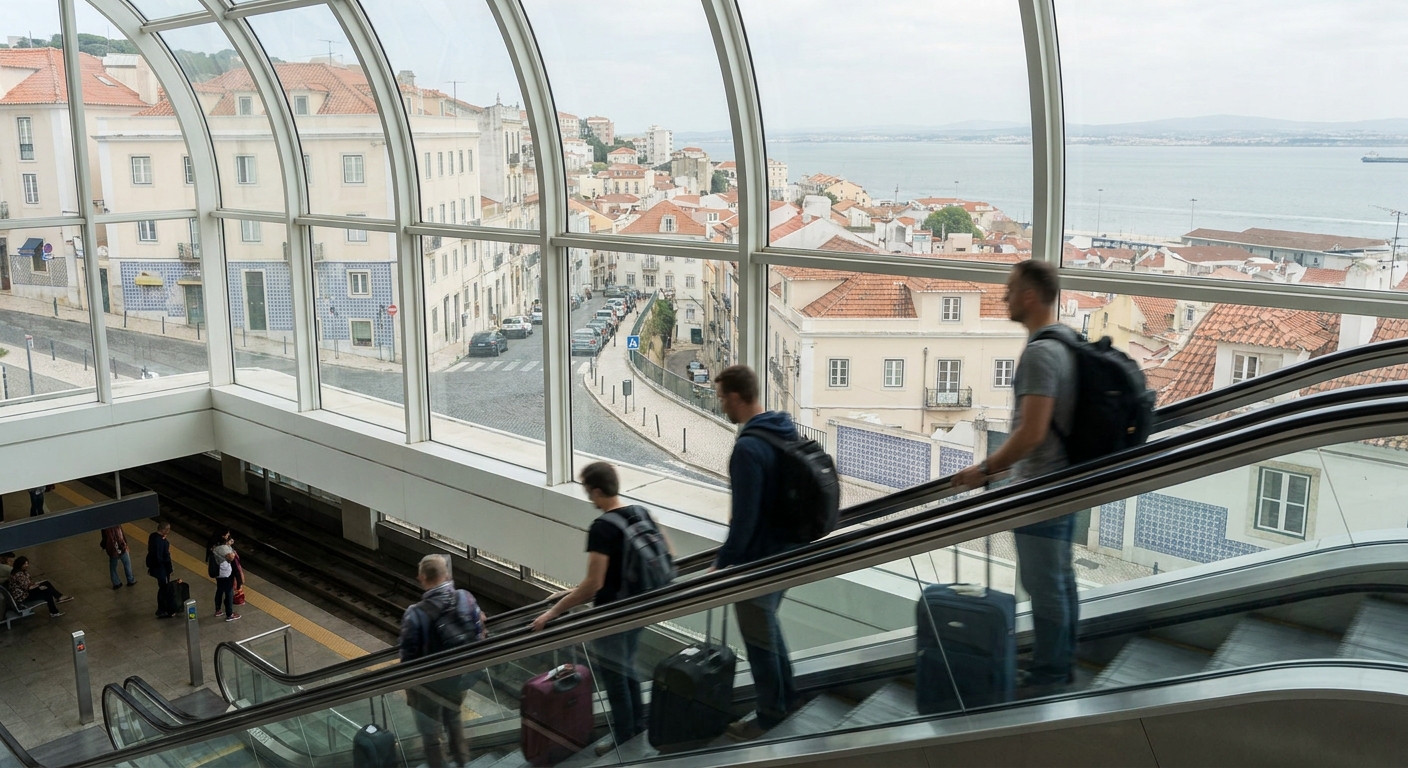
The Red line begins at Aeroporto, one level below the terminal, and runs into town without touching traffic. For Saldanha or São Sebastião you stay on it to the end. For Baixa, Chiado, Rossio or Cais do Sodré you change at Alameda onto the green line, and that change means a corridor, escalators and a platform crowd, all of it handled with whatever you are carrying. Sleeping within a short walk of a red or green line station is what makes this option pleasant.
The official taxi rank is outside the arrivals doors, signed, and at busy hours someone directs the line. Fares run on the meter and a receipt is yours for the asking. Ride-hailing works from the same airport but not from the same spot. The app drops its pin at a marked pickup area rather than the arrivals curb, a walk with bags and a place worth locating on the map before you land.
A pre-booked driver or a hotel shuttle meets you inside with your name on a board, uses your flight number to follow a delay, and can carry a child seat if you request one at booking. Renting a car for the city itself is the choice to avoid, and the collection date is better set for the day you leave Lisbon. Our car guide covers pickup, insurance and driving here.
Unofficial drivers and taxi payment tricks at Lisbon Airport
Someone may offer you a ride before you reach the doors. Those offers are not the licensed rank. The rank sits outside, under a sign, and a marshal often works the head of the queue when several flights land together. A short no ends the conversation, and nobody follows you across the hall.
Complaints cluster around two patterns. One is a flat price proposed instead of the meter before you get in. The other is a driver asking you to cancel the app booking and pay cash. Both erase the record of the trip. Ask for the meter, keep an app ride inside the app, and take the receipt at the end. Our Lisbon safety page handles the rest of the city’s small print.
What to prepare before you fly to Lisbon: transit card, written address, apps and cash

The one purchase that has to happen on arrival is the transit card. The reusable card comes from the machines inside Aeroporto station, the machines take bank cards, and the card carries a charge of its own on top of the fare you load onto it. Our getting-around guide explains how the same card serves the metro, the trams and the suburban trains out to Sintra and Cascais.
Write your address on paper, in Portuguese, with the postal code and the parish. Street numbers repeat across Lisbon, and a hotel name means little to a driver who works the other side of the river. Screenshot the map pin too, since data can be slow before an eSIM settles. Install the ride-hailing app at home, where a verification text still reaches you, and keep small cash for a coffee or a bus even though card payment is standard.
Arriving at Lisbon Airport late at night: transport still running
The metro does not run through the night, so a late landing is a road arrival by default. The rank outside arrivals stays busy while flights come in, and a pre-booked driver follows the flight number rather than the scheduled time. If your bed is a self check-in apartment, get the door code and the key-box location before you board. An unanswered message at two in the morning is worse than any queue.
Every way into Lisbon compared: time, what to have ready, when it fails
| Option | How long it takes | What to have ready | When it does not work |
|---|---|---|---|
| Metro, Red line | Direct from the terminal, unaffected by traffic | Reusable card from the station machines | Heavy bags, a stroller, or an Alameda change you would rather skip |
| Official taxi | Door to door, traffic decides | Address written down, meter on, receipt | Rush hour into Baixa, and a driver who prefers a flat price |
| Ride-hailing app | Same roads as the taxi | App installed, data working, pickup zone located | Peak demand right after a wave of arrivals |
| Carris city bus | Slow, many stops | Card or contactless as posted at the stop | Anything more than a cabin bag |
| Pre-booked transfer or hotel shuttle | Door to door, driver waiting inside | Flight number, child seat requested at booking | A very long delay past the agreed waiting time |
| Rental car from the airport | Minutes to the car park, then city traffic | Reservation, licence, card in the driver’s name | A stay inside the center, where parking works against you |
Bags and children shift the ranking more than distance does. A stroller plus two suitcases turns the Alameda interchange into a two-adult operation, and the rank outside arrivals cannot promise a child seat while a booked transfer can if you ask at the time. Families landing after a long flight from the US have one clean trade: pay for the door-to-door leg once, on arrival, and use the metro for the rest of the week. Portugal with kids takes the wider view.
Fares and journey times move with tariff revisions and traffic, so check them on the day. Both move with tariff revisions and traffic, and the operator’s own page is the version worth trusting on the day you travel.
Getting back to Lisbon Airport on departure day
Departure day runs on someone else’s clock. You leave the center at a time chosen by an airline, frequently inside the morning commute, and the roads toward the airport carry the whole city at that hour. The carriage that was half empty on arrival becomes a rush-hour crush with a case between your knees. Give the return leg more room than the arrival took, and start counting that margin at your door rather than at the metro station.
Some flights leave from Terminal 2, and the metro serves Terminal 1 only, so a T2 departure adds the inter-terminal shuttle to the plan. An early flight that beats the first metro means a car arranged the night before. And if you are sleeping in Alfama or the upper lanes of Bairro Alto, no car reaches your door: agree a corner with the driver, then add the minutes it takes to drag a suitcase over calçada.
The last word
The part of a Lisbon arrival nobody plans is the walk at the end. Wheeled cases and calçada get along badly, the slope is steeper than the map admits, and the taxi stops where the street stops being a street. Ask your host, at booking, for the nearest point a car can reach and whether there are steps after it. That single question saves more grief than any comparison of options.
Arrange the departure-day car before you unpack, then let the first evening go where it wants, up to whichever miradouro sits above the quarter you chose, with the river going metal-colored below. The city guide takes it from there. Lisbon is generous with people who are no longer watching a meter.
Sources & data for this guide
- Red line route, Aeroporto station and the Alameda interchange · Metropolitano de Lisboa network diagram · checked Sep 6, 2026
- Terminal 1 and Terminal 2 layout, inter-terminal shuttle · ANA Aeroportos de Portugal, Lisbon airport pages · checked Sep 6, 2026
- City bus service to the airport · Carris (operator information) · checked Sep 6, 2026
- Taxi rank position and ride-hailing pickup arrangements · airport signage and operator apps · editorial observation, arrangements change without notice
- No fares, journey times or timetables are quoted on this page. They move with tariff revisions, traffic and season, and we would rather send you to the operator than date-stamp a number you will pay differently.