
PORTUGAL · AUGUST · THE PEAK MONTH, REGION BY REGION
August is the month Portugal shares with the rest of Europe. School holidays across much of Europe overlap this month (est.), the beach towns fill to their ceiling, and the national lodging curve hits its yearly high: 100% of the peak, by definition. The weather usually does its part. Lisbon averages 80°F afternoons and a single rainy day across the whole month, Faro’s average rounds to zero rain days (a rounded normal, not a rainless guarantee).
So this page is not a sales pitch. If August is your only window, and for American families tied to a school calendar it usually is, the month works. It just has to be played: north over interior, mornings over afternoons, reservations weeks out instead of days. Move the trip one month later and most of those constraints loosen on their own.
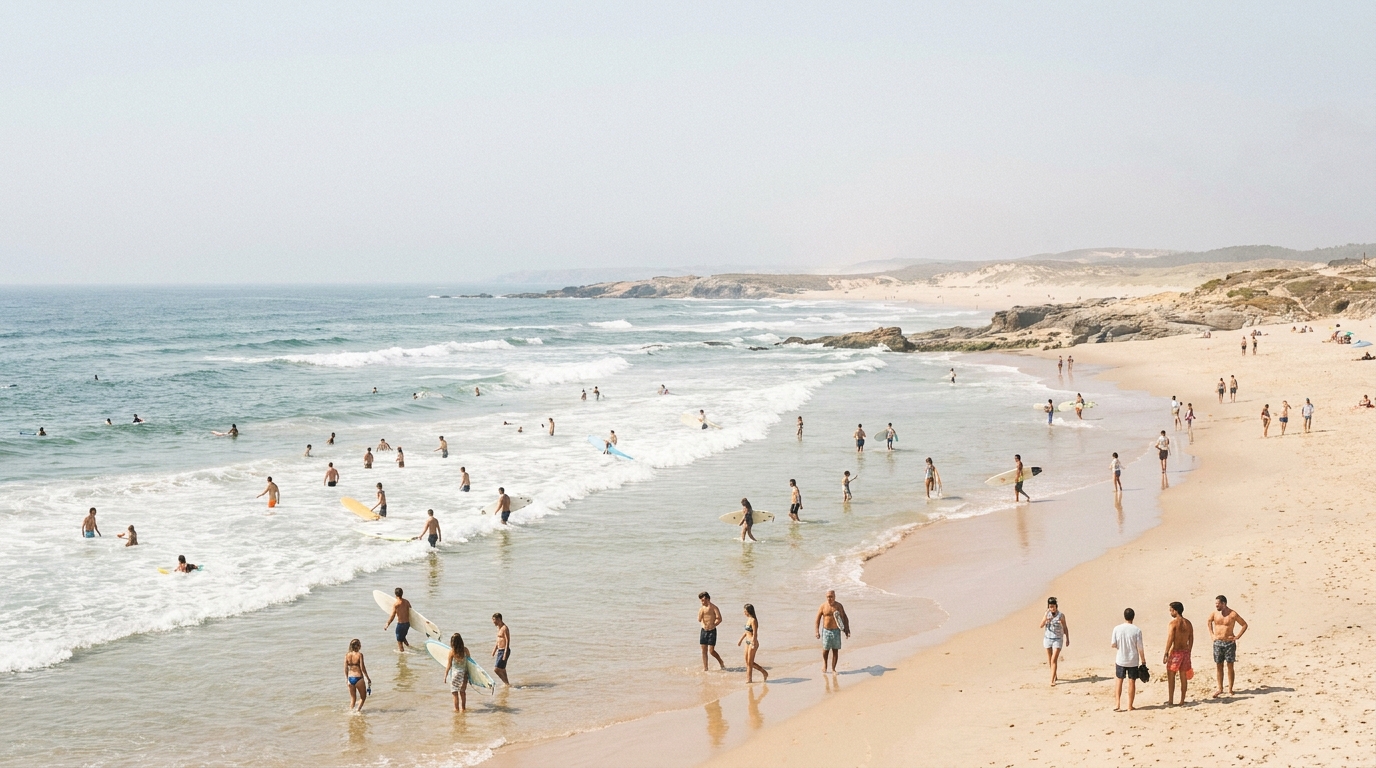
THE MONTH AT A GLANCE · PORTUGAL IN AUGUST
August hands you the driest weather in the three-city record and the year’s most dependable sun (est.) and charges full price for it: peak crowds nationwide, beach towns at their ceiling, and interior afternoons that keep people indoors until six.
MIXED MONTH · BEST ON: THE NORTH COAST · HARDEST IN: THE INTERIOR
Go for: the most dependable beach weather on the calendar, the surf towns north of Porto, dinners outdoors at nine, and small-town festival season (dates vary by parish, est.).
Think twice before: planning an inland road trip around midday sightseeing, hunting an Algarve room at short notice, or assuming a coastal restaurant will seat four at eight without a call.
August is the month before the picking: the Douro’s picking typically opens in September, earlier some years (est.), so the terraces are heavy and the cellars are calm. See the harvest almanac if that is the trip you want.
Climate: 1991–2020 normals per city (ERA5) · Crowds: Eurostat monthly nights · full sources at the end
See the full 12-month verdict →
On this page
- Cooler nights and Atlantic airPorto and the north
- A beach week with kidsThe Algarve, and when to book
- City days at 80°FLisbon and the center
- Évora, Monsaraz, the plainsThe interior, hour by hour
Where to go in Portugal in August: the coast, the cities and the interior
Lisbon and the center: 80°F days, one rain day, seven hills at 3pm
Lisbon in August is bone dry: 4 mm of rain across a single day in the 30-year average, days at 80°F, nights that hold at 66°F. The complication is topography rather than the thermometer. Those seven hills that photograph so well in autumn turn into a stair machine by mid-afternoon, which is why the local rhythm shifts: markets and Alfama before ten, a slow indoor lunch, the coast train out to Cascais, a miradouro once the shadows lengthen.
Sintra is the classic escape valve, a few degrees cooler under its own microclimate and its own crowd problem at the palace gates. Book that morning slot early and treat the afternoon as beach or shade. Our city pages go deeper: Lisbon, start to finish and Sintra without the queue math.
Verdict: Workable · early and late · Rain: 1 day · For: first-timers who will take an 8am start
The Algarve: zero rain days, and rooms going by spring (est.)
Faro’s August normals read like a brochure written by a lawyer: 80°F days, 69°F nights, 2 mm of rain, zero days at or above a millimeter. The sky rarely gets a say in your plans (est.). Everything about capacity might. The national crowd curve peaks this month, and it concentrates hardest on this 100-mile strip of coast (est.), where the same beach parking, the same seafood terraces and the same cliff stairs absorb the whole continent’s holiday at once.
Two practical moves. Book lodging and any car well ahead: months, not weeks (est.). And split your coast: the sheltered south-facing beaches near Lagos and Tavira sit warmer than the Atlantic’s 64°F reference (est.), while the windswept west coast trades that warmth for space. Which side suits you is the whole subject of our two-coasts comparison, and families should read it next to Portugal with kids.
Verdict: Mixed · reliably clear sky, full house · Rain: 0 days · For: beach weeks booked far in advance
Porto, the north coast and the Douro: 79°F days, 63°F nights, 5 rain days
This is where August stops being a compromise. Porto runs a degree below Lisbon by day at 79°F, but the real gift is the night: 63°F, three degrees under the capital and six under Faro, which is the difference between sleeping and negotiating with a fan. The Atlantic wind that annoys sunbathers in Matosinhos is the same wind that makes an August dinner outdoors pleasant here.
The trade is 30 mm of rain across five days, so an occasional gray morning is part of the deal. That is a scheduling detail, not a threat, and Gaia’s port lodges are conveniently indoors. Push inland up the Douro and the thermometer climbs fast, well past the coastal reading (est.), which is why the river valley is a morning-boat and evening-terrace proposition in August. Deciding between the two cities? Lisbon vs Porto.
Verdict: Best · coolest nights of the three · Rain: 5 days · For: anyone who sleeps badly in heat
The Alentejo and the interior: shade, water and a car with working air conditioning
The plains have no coast to borrow from, and August afternoons there run above the 80°F coastal reference by a real margin (est.). Évora’s marble streets and Monsaraz’s walls hold that heat into the evening. Take the heat seriously and structure the day around it: sightseeing from 8 to 11, a three-hour lunch, castles again after six, and a serious water bottle in the car at all times.
Two housekeeping notes. Summer regularly brings heat advisories and wildfire warnings to Portuguese news (est.), and the sane response is checking local advisories rather than skipping the region entirely (our safety page covers how). And an interior road trip is exactly the trip whose rental paperwork you want settled before landing: see the rental page. Or save these plains for October, when they are at their best.
Verdict: Hard · early and late only · For: road-trippers willing to run on Portuguese hours
August weather in Portugal: what the three cities record
| Region (city) | Days | Nights | Rain | The trade |
|---|---|---|---|---|
| Lisbon | 80°F / 27°C | 66°F / 19°C | 1 day · 4 mm | Dry, hot on the hills, priced at peak |
| Algarve (Faro) | 80°F / 27°C | 69°F / 21°C | 0 days · 2 mm | Perfect sky, saturated towns (est.) |
| North (Porto) | 79°F / 26°C | 63°F / 17°C | 5 days · 30 mm | Coolest nights, one gray morning in six |
30-year averages (1991–2020) for each reference city. The Alentejo and Douro interiors run hotter than any figure in this table (est.): no station series we would stand behind, so we describe rather than number them. Atlantic sea temperature sits at 64°F, and crowds are at the year’s 100% mark on the national lodging curve.
August in Portugal: peak crowds, 8pm sunsets and mid-month traffic
Start with the crowd figure, because it drives everything else. August is the 100% mark on Portugal’s monthly nights curve, the number every other month is measured against. In practice that means restaurants that took walk-ins in May often want a phone call (est.), coastal parking fills by mid-morning (est.), and the price of an identical hotel room bears little resemblance to its April self (est.). Our trip-cost page exists to help you budget that gap rather than discover it.
Then the light, which is the month’s genuine luxury. Lisbon’s sun sets at 8:48pm on August 1 and still at 8:09pm on the 31st, so a 9pm dinner outdoors is normal rather than late. For jet-lagged American arrivals that long evening is worth planning around: sleep past the worst heat on day one, then use the four-hour golden stretch that follows.
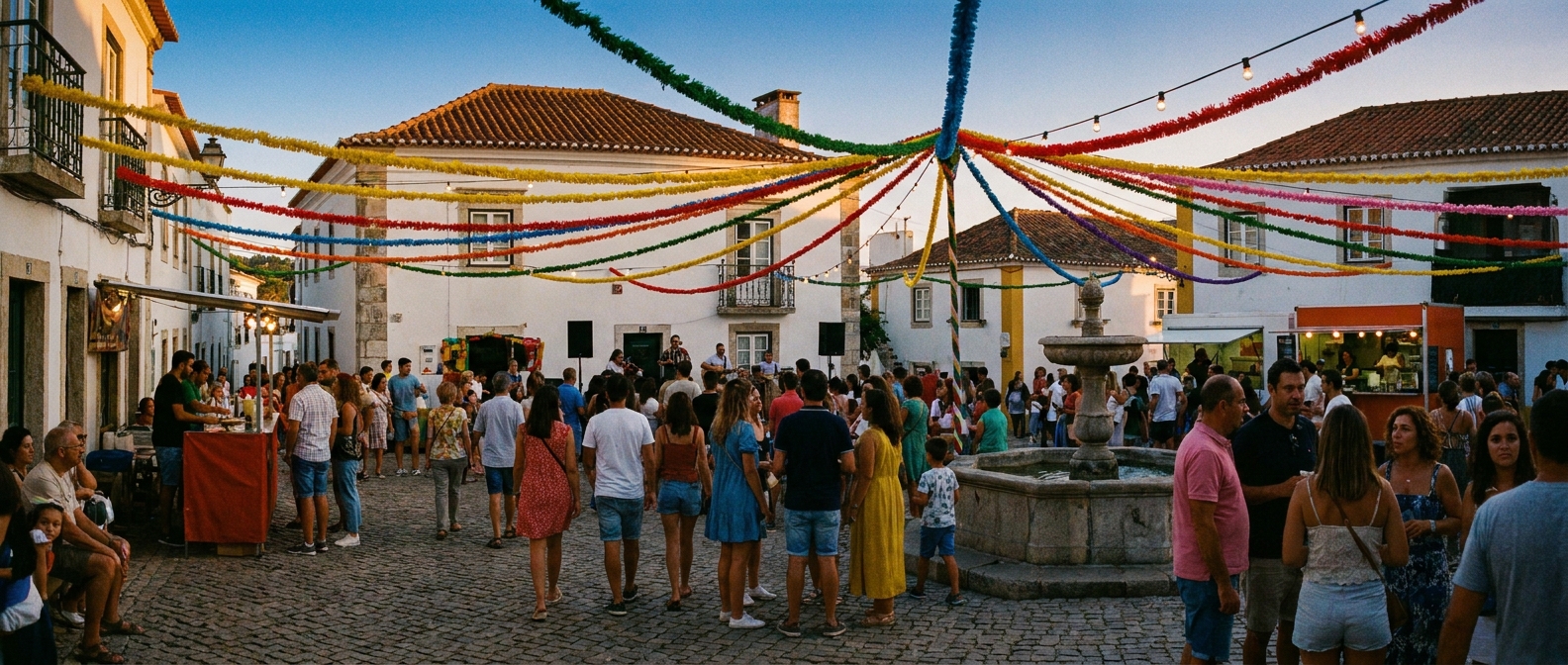
August is also festival season in the interior and the north, where villages hold their romarias and festas across the month (dates shift by parish, est., so ask locally rather than trusting a printed schedule). A national holiday falls mid-month on August 15, which puts Portuguese families on the same coastal roads you are on (est.). Pack for 80°F days and 63°F northern nights: the packing list handles the layering question.
Portugal in September, June or October instead
Gain: the crowd curve steps off its peak, rates follow, and the Douro harvest opens. September in detail.
Lose: a little daylight, and the certainty of an entirely rainless week in the south.
Gain: long days before the continental holiday rush, and the saints’ festivals in Lisbon and Porto. June in detail.
Lose: a cooler ocean and a fair chance of coastal morning cloud.
Gain: the interior becomes walkable again, and the Alentejo turns into the road trip it should be. October in detail.
Lose: real rain days, especially in the north, and the late outdoor dinners.
The last word
August rewards the traveler who books early and gets up early, and punishes everyone else with a parking lot view. Aim your week north if you sleep badly in heat: Porto’s 63°F nights are the single most useful number on this page. Aim it at the Algarve only with a reservation already in hand, and treat any interior castle as an 8am appointment. Do that and you get a country running at full volume, garlands over the square, sardines on the grill at nine.
Still deciding? Compare all twelve in the full-year verdict, check the neighbors in July and September, or start from the whole Portugal playbook if the dates are locked and the map is not.
Sources & data for this guide
- Climate: 1991–2020 normals computed from ERA5 daily data for the Lisbon, Porto and Faro grid cells · Open-Meteo (ECMWF ERA5) · checked Sep 3, 2026
- Crowds: August as the 100% reference point on Portugal’s monthly nights-spent curve · Eurostat, tour_occ_nim · checked Sep 3, 2026
- Sunset, Lisbon, Aug 1 (8:48pm) and Aug 31 (8:09pm), local time · NOAA solar position algorithm · checked Sep 3, 2026
- Sea temperature · 64°F Atlantic reference, carried from the sourced line on our 12-month verdict · checked Sep 3, 2026
- Editorial note: interior temperatures, Algarve occupancy share and village festival dates are marked (est.). We hold no station-level or parish-level series we would publish as fact, so this page describes them instead of numbering them · Sep 3, 2026