
SAGRES · JULY · IPMA STATION 533
July is the month the Atlantic refuses to play along with the thermometer at Sagres. Afternoons average 77.4°F, the whole month’s rain total comes to four hundredths of an inch, and the sea offshore sits at 63.3°F, cooler than it was in June. Sun on the cliffs, a gasp when you go in.
That gap between air and water is the shape of the month, and it decides almost everything else: when you swim, when you walk, what you pack. The compensation is light. On July 15 the village keeps 14 hours 30 minutes of daylight, and the sun does not leave the cape until nearly nine.
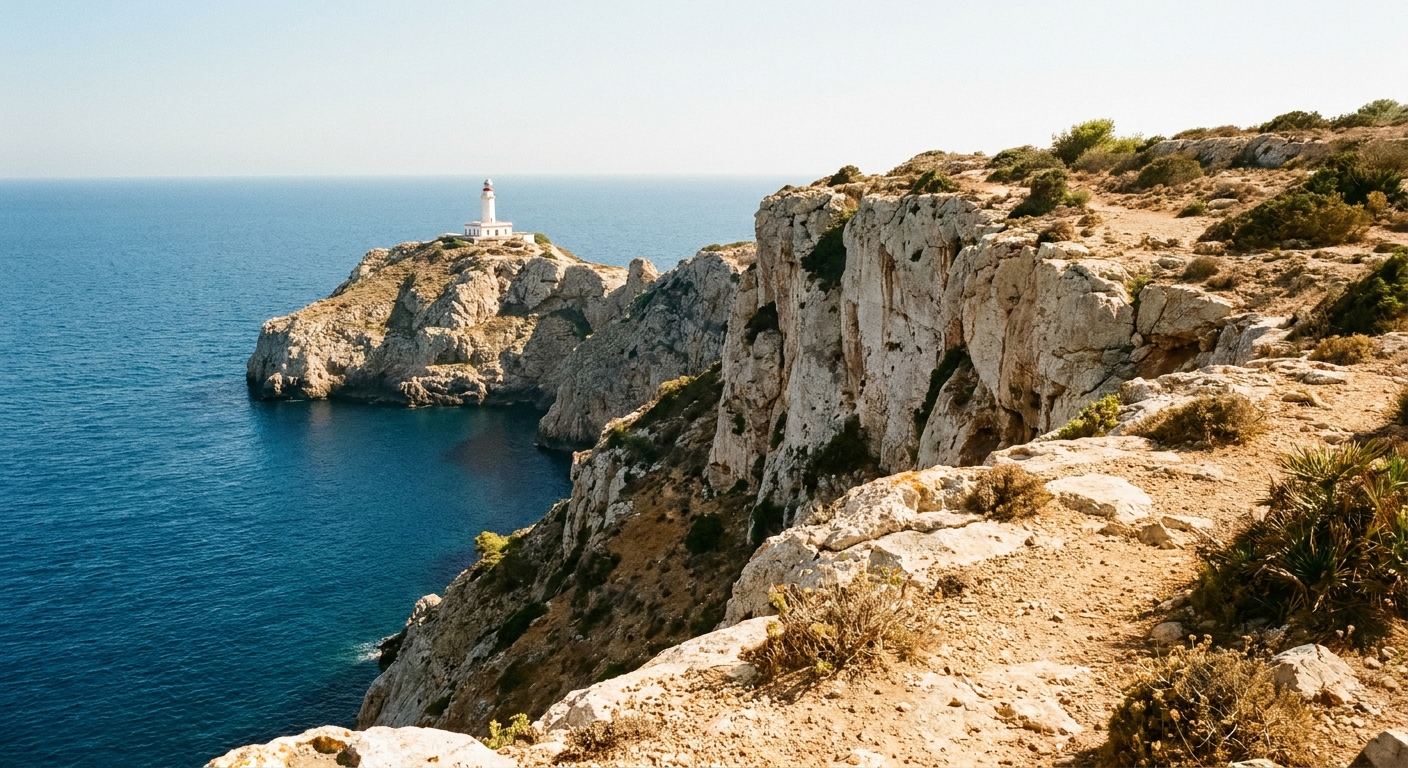
THE MONTH AT A GLANCE · SAGRES IN JULY
July gives Sagres the driest, longest days of its summer, 77.4°F afternoons and light until 8:56 p.m., and asks you to accept a 63.3°F sea in exchange.
HIGH 77.4°F · SEA 63.3°F · 0.2 RAIN DAYS · 14H30 OF DAYLIGHT
Go for: dry days you can plan around, late clifftop sunsets, surf that runs all summer, and an evening cool enough to sleep in.
Think twice before: promising anyone warm swimming water: 63.3°F is bracing, and August is colder still at 62.1°F.
Climate: IPMA station 533 (1991-2020) · Sea: Open-Meteo Marine (2015-2024) · full sources at the end
On this page
- Sagres weather in July77.4°F highs, 0.04 inch of rain, 0.2 rain days
- Can you swim in Sagres in July?A 63.3°F sea, and why it cools as summer runs
- Crowds, prices and booking in high summerWhat we can price and what we could not verify
- Things to do in Sagres in JulyThe fortress, Cabo de São Vicente and four beaches
- A two-day plan built around the lightTwo days, from a 6:26 a.m. sunrise to a 9:30 dinner
- July vs June vs AugustHow the three months compare on air, rain and sea
- Is July a good time to visit Sagres?Yes for walkers and surfers, no for warm-water swimmers
Sagres sits on the exposed south-west corner of the country, and its weather belongs to that headland rather than to the whole Algarve. Everything that is not dated by the month lives elsewhere: the coast’s towns and beds in our Algarve guide, the money in what a Portugal trip costs, and the drive down in the car guide.
Sagres weather in July: average highs, lows and rain days
| Sagres, July normal | Value |
|---|---|
| Average high | 77.4°F |
| Average low | 62.6°F |
| Monthly precipitation | 0.04 in |
| Days with 1 mm (0.04 in) or more | 0.2 |
| Days with 10 mm (0.39 in) or more | 0.0 |
| Daylight on July 15 | 14 h 30 min |
| Sea surface (mean of daily maxima) | 63.3°F |
The numbers come from IPMA, Portugal’s national weather service, and from one specific instrument: station 533 at Sagres, a real thermometer 22.9 meters (75 feet) above the sea on the cape, not a model grid cell. Over 1991-2020 it records an average high of 77.4°F, an average low of 62.6°F and 0.04 inch of rain for the month. Every figure here is read at that cape. The hills inland run colder and far wetter, and the eastern end of the coast keeps its own weather, so pack for a mountain walk on mountain readings.
Rain hardly exists. An average July logs 0.2 days with at least 1 mm (0.04 inch) and not a single day reaching 10 mm (0.39 inch). In plain terms, that is roughly one July in five delivering one damp morning, and a real soaking absent from the 30-year record at this station. Note the small print: those are IPMA’s thresholds, not the 0.10-inch threshold American tables use, so the counts do not swap cleanly with the ones you would read for a beach town back home.
Between the 77.4°F afternoon and the 62.6°F night there is a 14.8°F swing, and a headland with nothing upwind of it for three thousand miles makes the evening feel cooler than the number suggests. A genuine layer earns its place in the bag, not a gauze cover-up: a fleece or a light windbreaker for dinner, plus a hat, because shade on the promontory is scarce. Our packing guide handles the rest of the suitcase.
Light is July’s real gift. On July 15 the sun rises at 6:26 a.m. and sets at 8:56 p.m. local time (05:26 and 19:56 UTC, plus an hour for Portuguese summer time), giving 14 hours 30 minutes of daylight. Dusk lingers after that, so a 9:30 dinner still ends in usable light, and the clifftop viewpoints stay busy well past what an American beach-town clock would call sunset hour.
Can you swim in Sagres in July? Sea temperature and what it feels like
The sea surface off Sagres averages 63.3°F in July, from Open-Meteo’s marine series over 2015-2024. One nuance belongs with that figure: it is the mean of daily maxima, so it runs a shade warmer than a 24-hour average would, and the water you meet at eight in the morning is likely a little below it.
Sixty-three degrees is a swim, not a soak. Adults get a bracing ten or fifteen minutes before the novelty wears off, children tend to shriek and run, and anyone planning to stay in the water for an hour wants a wetsuit, which is exactly why the surf schools in the village keep racks of them. Go in fast, come out, and let the 77.4°F air do the reheating on the sand.
We could not verify a monthly wind or swell series for Sagres, so we publish none. What the measurements do show is a sea moving the wrong way: 65.3°F in June, 63.3°F in July, 62.1°F in August, while the air climbs all summer. If warmer water is the point, June holds the best of the three, and it is still cold.
How busy is Sagres in July? Crowds, prices and the demand peak
July falls inside the Algarve’s high summer, which is a fact of the calendar rather than a claim about money. On money we are short: we found no occupancy series and no monthly room-rate series for Sagres, so we crown no month the year’s most expensive and we publish no percentage. What the village looks like in practice is a small place at the end of a long road absorbing a lot of visitors at once.
Without those series we also name no booking window in weeks, because inventing one would be worse than admitting it. The practical order still holds: lock the flights, then the room, then the car, in the same sitting rather than three weeks apart. Flights from the US land at Faro, and the drive west is the part people underestimate, as our getting-around guide sets out.
We could not verify whether a nightly lodging tax applies in Sagres, or at what rate, so no amount appears above. Ask at check-in, and treat any figure quoted on a booking screen as the one that counts. Know before you go covers the paperwork side of a Portuguese stay.
There is one place where paying more genuinely changes the month, and it is walking distance. With sunset at 8:56 p.m. and dinner after it, a room you can stroll home to from Mareta turns the evening into the best part of the day. A room ten minutes out by car turns the same evening into a designated driver and a dark cliff road.
Things to do in Sagres in July
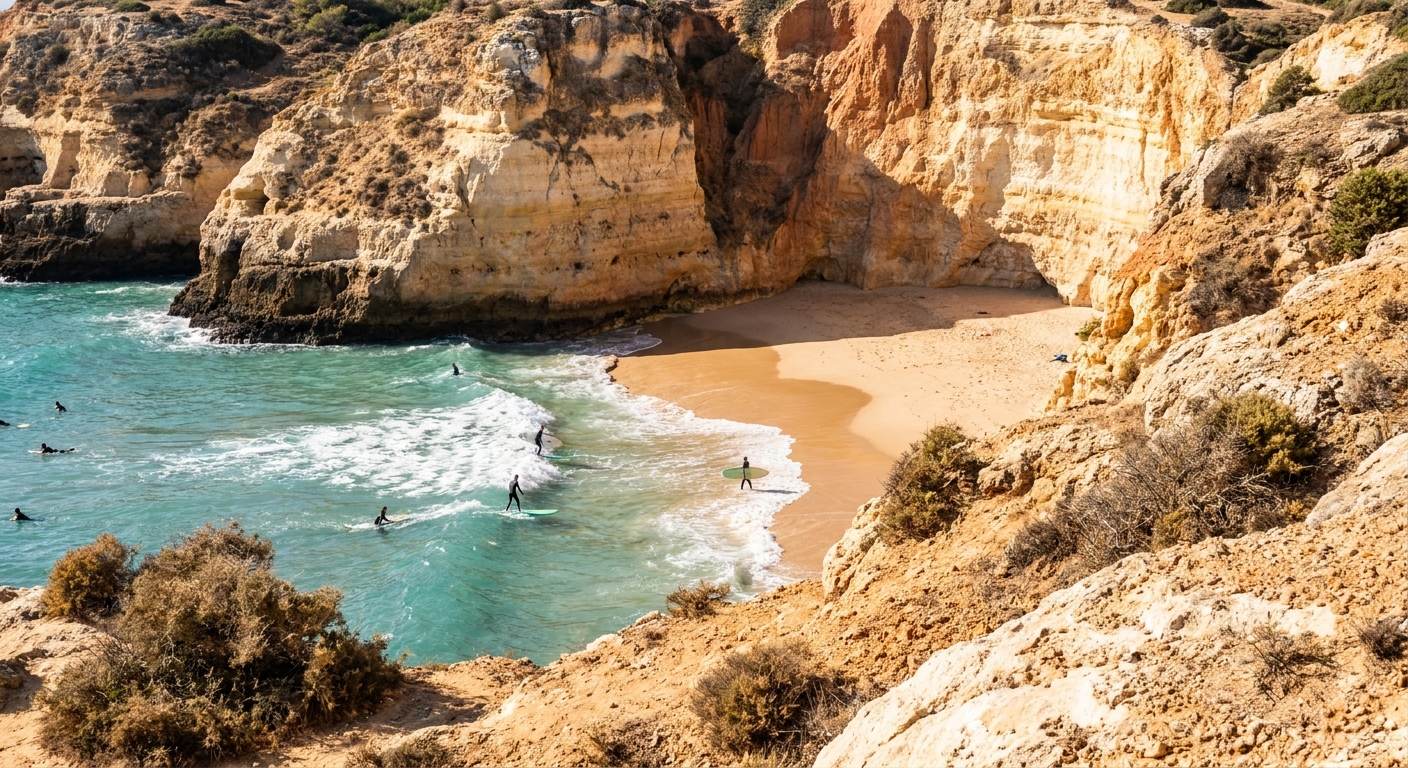
What July hands over, and the shoulder months cannot, is an unbroken day. With 0.2 rain days and 14 hours 30 minutes of light, you can put a swim at eight, a boat or a surf lesson at eleven, and the cliffs at seven, and lose nothing in between to weather. The price is the middle of the day: 77.4°F with almost no shade on the promontory makes noon to four an hour for lunch and a flat roof, not for walking.
The village’s fixed points are few and close together: the Fortaleza de Sagres on its promontory, the lighthouse at Cabo de São Vicente a short drive west, and four beaches, Praia do Tonel, Praia da Mareta, Praia do Beliche and Praia do Martinhal. We could not verify the fortress’s July hours or its admission price, so we quote neither: check at the gate. For a bigger day out, Lagos and Ponta da Piedade sit east along the same coast.
July changes those places less than you would think, and in one direction only. The water stays at 63.3°F while the air reaches 77.4°F, a gap of 14.1°F, so a wet swimsuit on the clifftop at Tonel is a cold mistake and a towel is not optional. Mareta faces south and sits in the lee of the village, which makes it the default when the headland is blowing and the reasonable choice with small children, as our family guide argues for the coast generally.
The free half of the month is the better half. Walking out to the point, the clifftop paths above Beliche, and the whole ritual of watching the sun drop off the end of Europe at 8:56 p.m. cost nothing at all. Parking is the unknown: we could not verify what the beach and cape lots charge in summer, so carry a little cash and expect to be asked.
Sagres in July: a two-day itinerary
Day one runs early and late, with a hole in the middle. Sunrise is at 6:26 a.m., so be on Mareta by eight for a swim while the sand is empty and the air is still near its 62.6°F overnight low. Fortress and promontory from nine to noon, before the heat has any weight. Lunch indoors, then a long flat afternoon. Back out to Tonel around five, up to Cabo de São Vicente by eight, sunset at 8:56, dinner at half past nine with the sky still pale.
Day two swaps ends: Beliche early, the coastal path above it while the light is low, Martinhal in the afternoon on the sheltered side of the village. Rain is not the variable here, with 0.2 wet days in an average July, so the thing that reroutes a day is wind on the exposed cape. When it blows hard, move east: Martinhal, then a drive inland or up the coast, and let the headland have its afternoon to itself.
Sagres in July vs June and August
| Measure | June | July | August |
|---|---|---|---|
| Average high | 75.0°F | 77.4°F | 78.6°F |
| Average low | 61.2°F | 62.6°F | 63.3°F |
| Precipitation | 0.15 in | 0.04 in | 0.06 in |
| Days with 1 mm (0.04 in) or more | 0.7 | 0.2 | 0.4 |
| Sea surface (daily maxima) | 65.3°F | 63.3°F | 62.1°F |
Read the three columns together and the summer tells a strange story. The air climbs steadily, 75.0°F in June to 78.6°F in August, a rise of 3.6°F. The rain thins to almost nothing in July, 0.04 inch against June’s 0.15. And the sea falls the whole way, 65.3°F to 62.1°F, losing 3.2°F while the land gains. July sits at the crossing point: the driest of the three months, and the last one with water above 63°F.
Shift four weeks earlier and you gain 2.0°F of sea and lose 2.4°F of afternoon warmth, along with three and a half times July’s rain and 0.7 wet days instead of 0.2. Shift four weeks later and August pays you 1.2°F more air for 1.2°F less water, plus the busiest weeks of the Portuguese summer. Our 12-month verdict for Portugal puts the rest of the calendar next to these three.
Is July a good time to visit Sagres?
For most travelers, yes, and confidently. If you came to walk clifftops, surf, eat outside at ten at night and bank on dry weather for a whole week, July is as close to a guarantee as a coastline gets: 0.04 inch of rain for the month and 14 and a half hours of light to spend. If you came to float in warm water with a book, no. Sixty-three degrees is not that trip, and no amount of sunshine changes the reading.
If the swimming decides it, June is the better of the two summer options we measured, at 65.3°F, and it comes with cooler afternoons and a little more rain, 0.15 inch across 0.7 wet days. August is the wrong correction: warmer air, the coldest sea of the three at 62.1°F. Families whose plan is built around long swims are better served on the calmer eastern Algarve around Tavira than on this cape in any month.
Among the three, only July pairs 14 hours 30 minutes of daylight with a month total of 0.04 inch of rain, and that combination is what people actually come to Sagres for.
The last word
Book July if you want your days back: the weather will not cancel anything, and the light runs from 6:26 in the morning to nearly nine at night. Book June if the water is the point, and accept a few more clouds for 2°F. One last figure to file away before you pack a swimsuit and nothing else: August’s average overnight low, 63.3°F, is exactly the temperature of July’s sea. The air at night and the ocean at noon meet at the same number out here, which is the cape in one line.
Sources & data for this guide
- July normals (high 77.4°F, low 62.6°F, 0.04 in) and rain-day counts · IPMA, 1991-2020 climate normals, station 533 Sagres, altitude 22.9 m · checked Sep 23, 2026
- June and August normals, including rain days · same IPMA 1991-2020 series, station 533 · checked Sep 23, 2026
- Sea surface 63.3°F in July (June 65.3°F, August 62.1°F), mean of daily maxima 2015-2024 · Open-Meteo Marine API · checked Sep 23, 2026
- Daylight of 14 h 30 min, sunrise 05:26 UTC and sunset 19:56 UTC on July 15, converted to Europe/Lisbon · sunrise-sunset.org · checked Sep 23, 2026
- Rain-day thresholds are IPMA’s 1 mm and 10 mm marks, not the 0.10-inch threshold used in US climate tables · checked Sep 23, 2026
- We could not verify a lodging-tax rate, an occupancy or room-rate series, the fortress’s July hours and admission, or summer parking charges, so no figures for them appear above. Hours and fees change, so confirm with the operator when you book.