
SOUTH WALTON · FLORIDA · JULY
The Gulf off South Walton runs 85.9°F in July. Afternoons average 90.9°F, nights bottom out at 76.2°F, and 5.77 inches of rain fall across the month. Those air figures are NOAA’s 1991-2020 normals for the Destin-Fort Walton Beach Airport station, the official thermometer behind every temperature below. July is when the school calendar hands this coast its busiest weeks, and when nobody wades in slowly.
Four weeks in either direction move less than you would hope. June runs 88.9°F days with water at 82.9°F. August climbs to 6.08 inches of rain over 8.1 wet days. What July changes is the shape of a vacation day: dawn on the sand, the flat middle hours indoors or under water, dinner after a 7:49 p.m. sunset. Where to sleep among the sixteen beach neighborhoods belongs to our South Walton guide.
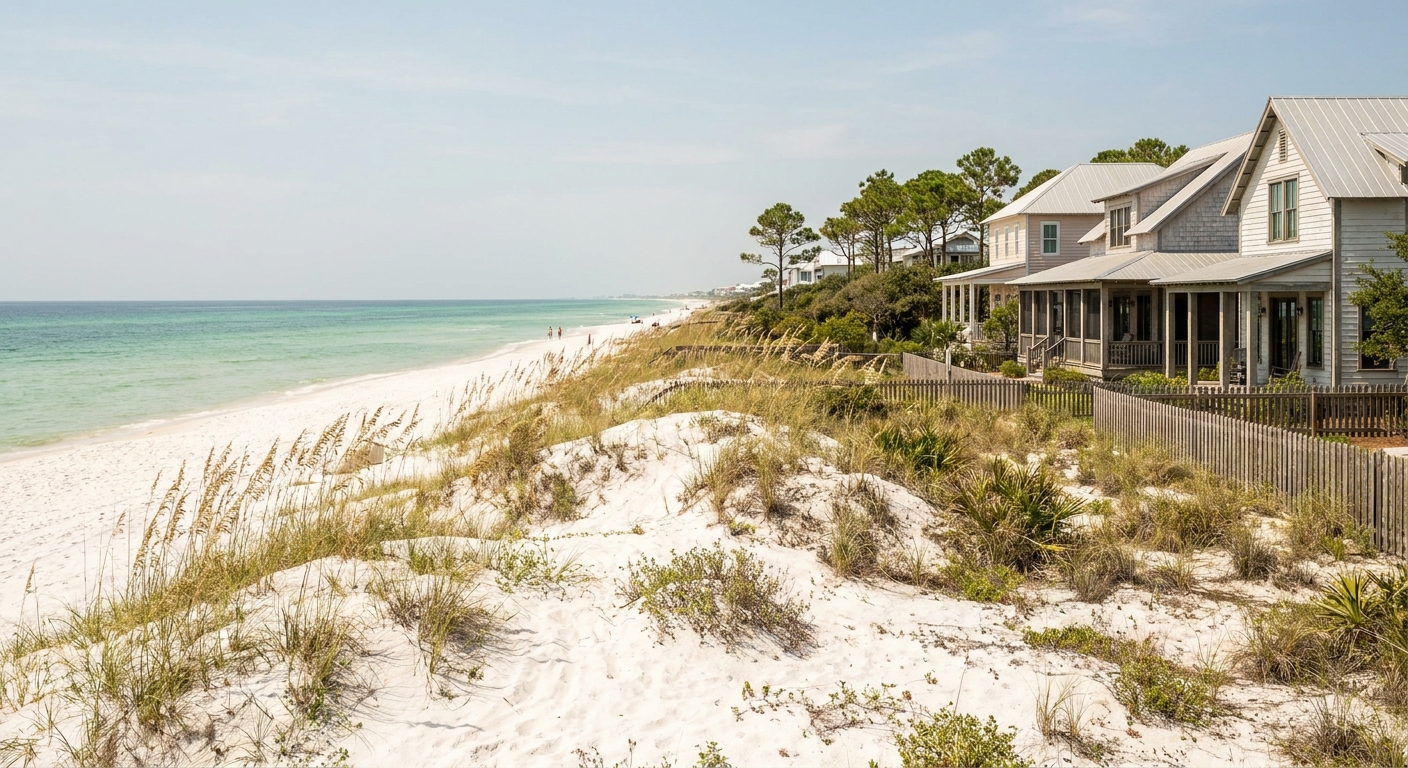
THE MONTH AT A GLANCE · SOUTH WALTON IN JULY
July gives you the warmest early-summer water on this coast and a wet day roughly one in four, at the price of 90.9°F afternoons and nights that never drop below the mid-70s.
NOAA 1991-2020 NORMALS · GULF AT 85.9°F · HURRICANE SEASON OPEN
Go for: swimming that needs no courage, two usable beach windows a day between 5:52 a.m. and 7:49 p.m., and 63 public access points spread along 26 miles of sand.
Think twice before: booking non-refundable, since the Atlantic hurricane season is open from June 1, and before planning midday outdoors at 90.9°F with a 76.2°F night for recovery.
Air and rain: NOAA NCEI 1991-2020 · Water: Open-Meteo Marine · Tax: Florida DOR · full sources at the end
On this page
- July weather in South Walton90.9°F highs and 5.77 inches of rain
- Is the Gulf warm enough to swim in July?85.9°F, read as daily maxima
- Crowds, booking and the lodging tax5% county plus 6% state on the room
- Things to do on 30A in JulyFive state parks and 15 dune lakes
- A two-day plan built around the heatDawn beach, indoor middle, 7:49 p.m. sunset
- July vs June and AugustHow the three months compare
- Is July a good time to visit South Walton?Yes if you swim, no if you wilt
Two kinds of number sit side by side here, and they are not equivalent. Air temperature and rainfall are station normals, measured between 1991 and 2020 at Destin-Fort Walton Beach Airport (NOAA NCEI, station USW00053853). Water temperature comes from a marine model, Open-Meteo, averaged over 2015-2024. Costs beyond the tax live in our Florida trip-cost guide, and the twelve-month case for the whole state is in the best-time guide.
South Walton weather in July: average highs, lows and rain days
| Measure | July | Source |
|---|---|---|
| Average high | 90.9°F | NOAA NCEI 1991-2020, station USW00053853 |
| Average low | 76.2°F | NOAA NCEI 1991-2020, station USW00053853 |
| Precipitation | 5.77 in | NOAA NCEI 1991-2020 |
| Days with 0.10 in or more | 7.2 | NOAA NCEI 1991-2020 |
| Days with 1.00 in or more | 1.6 | NOAA NCEI 1991-2020 |
| Gulf surface | 85.9°F | Open-Meteo Marine, 2015-2024 daily maxima |
| Daylight, July 15 | 13 h 57 min | sunrise-sunset.org |
Start with the air. NOAA’s 1991-2020 normals for station USW00053853, at Destin-Fort Walton Beach Airport, give July an average high of 90.9°F, an average low of 76.2°F and 5.77 inches of rain. That is a real instrument at a real airfield rather than a grid cell from a reanalysis model, and the difference between those two sources can run several degrees on the overnight figure. Whatever your weather app shows, the number above has a station behind it.
Spread the 5.77 inches across the 7.2 days that record at least a tenth of an inch and you get close to 0.8 inch on any day that gets wet. Rain arrives in volume here, not as drizzle. Roughly one day in four turns wet, and the other three stay dry from breakfast to sunset. Plan against the wet-day count: a monthly total of 5.77 inches reads like a washout on paper and behaves like seven interruptions in a week.
The gap between the 90.9°F afternoon and the 76.2°F night is 14.7 degrees, and it never opens into anything you would call cool. Mid-70s at 4 a.m. means no sweater, no jacket, nothing with sleeves for the evening walk to dinner. Pack a rain shell light enough to fold into a beach bag, sun cover for the hours between 10 and 4, and a second swimsuit, because the first will not dry overnight in that humidity.
On July 15 the sun rises at 5:52 a.m. and sets at 7:49 p.m. Central Daylight Time, converted from the times published by sunrise-sunset.org, for 13 hours 57 minutes of daylight. That buys two beach windows in one day with a long empty middle between them. Light holds past 8 p.m. for the walk back, so a 7 o’clock table still ends in daylight.
Can you swim in South Walton in July? Sea temperature and what it feels like
85.9°F is the July average for the Gulf surface off this coast, from the Open-Meteo Marine model over 2015-2024. One caveat travels with that figure: it is built from daily maxima, the warmest reading of each day, so it sits a shade above a true 24-hour mean. Early-morning water runs a little cooler than 85.9°F suggests, late-afternoon water a little closer to it.
In practice, nobody stands at the edge doing the slow shuffle. You walk in. Children stay in for an hour and come out warm rather than shivering. For an adult trying to shed a 90.9°F afternoon, the sea offers no relief at all, since bath-warm water cools nobody. Wear a rash guard for the sun rather than for warmth, and treat the shaded hour after 6 p.m. as the best swim of the day.
We could not verify a wind or wave record for July off Walton County, so we give no surf or breeze figure. What is fixed on the calendar is the Atlantic hurricane season, open June 1 through November 30 according to the National Hurricane Center. Its peak falls on September 10, with most activity between mid-August and mid-October, so July sits inside the season but ahead of its busiest stretch. Watch the tropics the week before you fly.
How busy is South Walton in July? Crowds, booking and the lodging tax
July is school-vacation weeks end to end, and the coast absorbs them across sixteen beach neighborhoods, from Miramar Beach at the western end to Rosemary Beach and Inlet Beach at the eastern one. We found no monthly occupancy series and no room-rate series for Walton County, so we crown no month the most expensive. The calendar is the honest signal: summer holidays plus 85.9°F water fill a beach destination without any help from a spreadsheet.
On lead times we have to show our limits. No booking-window data for South Walton passed our checks, so read what follows as editorial judgment rather than measurement. For a July week in a rental with a specific bedroom count and a specific walk to the sand, book months ahead, and book a refundable rate. The open hurricane season is the reason for the second half of that sentence.
The tax, at least, is documented. Walton County levies a 5.0% transient rental tax on short stays, filed and paid alongside Florida’s 6% state sales tax, per the Department of Revenue’s form DR-15TDT. That is 11% on top of the nightly rate before any cleaning or resort charge appears. Compare two properties on the final checkout screen rather than on the headline nightly price.
One upgrade changes this particular month more than any other: distance to the water. The county counts 63 public beach access points along 26 miles of sand, and in July the difference between a five-minute walk and a ten-minute drive decides whether you get the 6:30 a.m. beach and the 6 p.m. beach on the same day. A bigger kitchen, an extra bedroom and the pool all matter less when the usable hours sit at both ends of the day.
Things to do in South Walton in July: 30A, the state parks and the dune lakes
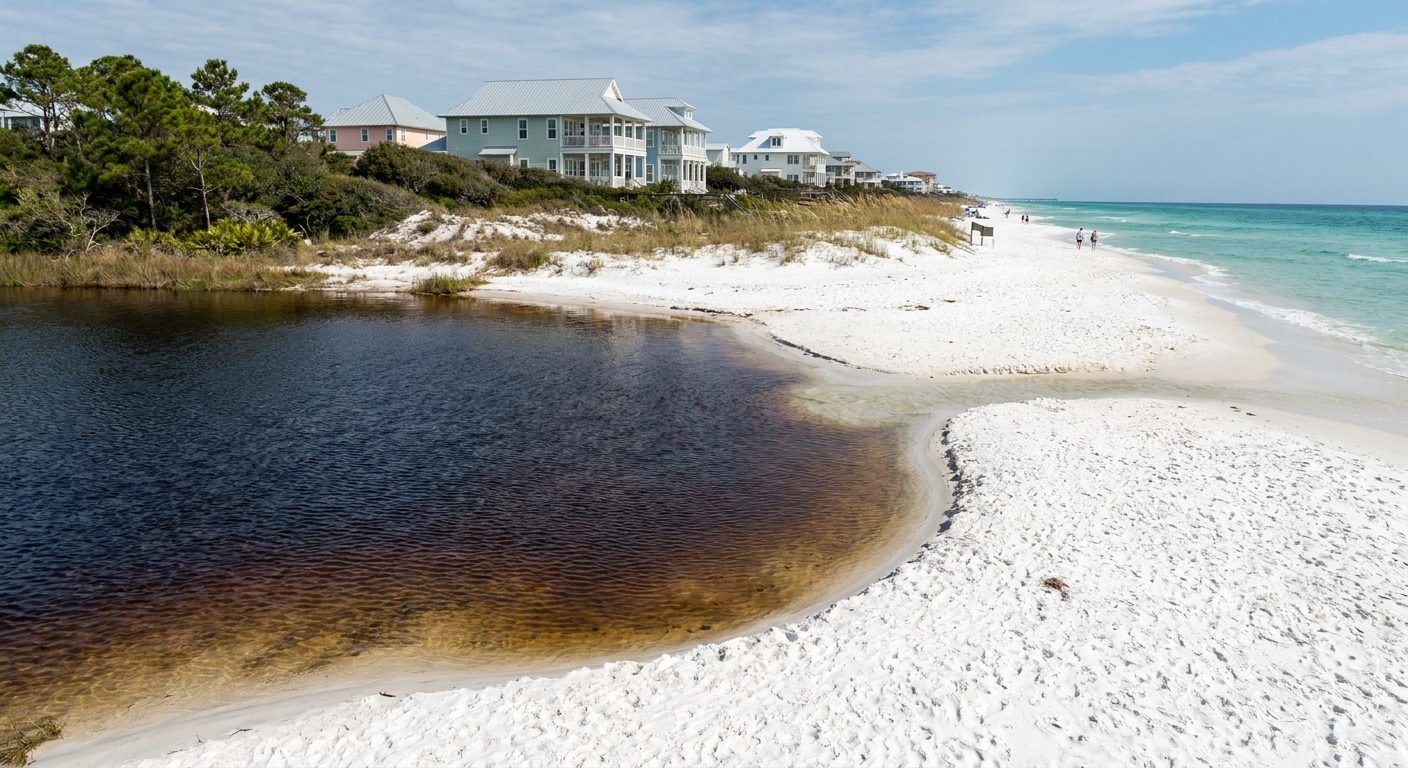
July is the month the Gulf stops being a plunge. At 85.9°F, snorkeling off a sandbar, paddling a dune lake at first light and floating for an hour all work without a wetsuit and without a shiver. The 13 hours 57 minutes of daylight on July 15 leave room for two of those in one day, which December could not give you on this coast at any temperature.
Five state parks sit inside the county: Topsail Hill Preserve, Grayton Beach, Deer Lake, Eden Gardens and Ponce de Leon Springs. Walton also holds all 15 of Florida’s coastal dune lakes, a landform recorded in only four other places on earth: Australia, New Zealand, Madagascar and Oregon. Scenic Highway 30A, designated a Florida Scenic Highway on April 9, 2008, strings the eastern neighborhoods together. Official state documents give the corridor as 24 miles in one place and 28 in another, so we quote no single length.
July changes the air around those places far more than the water inside them. Ponce de Leon Springs holds a near-constant temperature all year while the air above it climbs to 90.9°F, and that gap is the entire argument for driving inland in July instead of March. The dune lakes stay shallow and warm through summer, calm water a few steps behind the dunes when the Gulf side is bright, loud and full of families.
On what it costs, we stop where our sources stop. The state publishes 63 public beach access points along the county’s 26 miles of shoreline, spread across the sixteen neighborhoods. We could not verify entry fees for the five state parks, and we could not verify whether those access points charge for parking, so we give no dollar figure for either. Driving 30A itself costs gas, and a sunset at 7:49 p.m. costs nothing.
South Walton in July: a two-day itinerary
Day one runs at both ends. Sunrise lands at 5:52 a.m., so be on the sand by 6:30 with coffee while the air is still in the 70s. Out of the sun by 10:30, when the climb toward 90.9°F begins. Give the flat middle to lunch, a nap or an indoor hour, since a wet day here drops close to 0.8 inch and does it in bursts. Back to the water at 5, dinner after the 7:49 p.m. sunset.
Day two trades the Gulf for the inland half: Eden Gardens in the morning, Grayton Beach State Park or a dune lake afterward, and the 30A drive between Inlet Beach and Dune Allen in the long evening light. If the sky turns, flip the order and take the parks in the afternoon, because 7.2 wet days in an average July still leave most of a week dry. Our Florida things-to-do guide carries the rest of the state’s wet-afternoon options.
South Walton in July vs June and August
| Measure | June | July | August |
|---|---|---|---|
| Average high | 88.9°F | 90.9°F | 90.6°F |
| Average low | 74.1°F | 76.2°F | 75.8°F |
| Precipitation | 4.70 in | 5.77 in | 6.08 in |
| Days with 0.10 in or more | 6.1 | 7.2 | 8.1 |
| Gulf surface (2015-2024 daily maxima) | 82.9°F | 85.9°F | 87.8°F |
Set the three beside each other and July takes the hottest daytime average of the summer, 90.9°F against August’s 90.6°F and June’s 88.9°F. Rain climbs in one direction across the season: 4.70 inches, then 5.77, then 6.08, with wet days going 6.1, 7.2, 8.1. So does the water, from 82.9°F to 85.9°F to 87.8°F, all three from the same marine model and all three read as daily maxima.
Shift four weeks earlier and you drop 1.1 wet days, sleep with the thermometer 2.1 degrees lower at night, and give up 3.0 degrees of water warmth. June’s full numbers sit one month back. Shift four weeks later and the Gulf reaches 87.8°F, the warmest reading of the three, but you take on 0.9 more wet day and you move into the post-mid-August stretch when Atlantic activity picks up.
Is July a good time to visit South Walton?
Yes for families whose dates are chosen by a school calendar, for anyone whose whole trip is swimming, and for travelers who like a 7:49 p.m. sunset and a dinner that ends in daylight. No for anyone who wilts at 90.9°F when the night only falls to 76.2°F, and no for a non-refundable booking made months out with the hurricane season open from June 1.
If the answer is no, the nearest fix is four weeks earlier: June delivers 88.9°F days, 74.1°F nights, 4.70 inches over 6.1 wet days and a Gulf already at 82.9°F. You trade three degrees of water for a drier, slightly cooler week. For a larger change of season, our best-time guide makes the case for the state’s dry months, and it points away from summer entirely.
What July holds that neither neighbor matches: Gulf water at 85.9°F paired with a wet-day count nearly a full day below August’s 8.1, on 26 miles of coast where the water is the reason you came.
The last word
Let the school calendar pick the week, then run each day at its two ends: 5:52 a.m. light, an indoor or underwater middle, a 7:49 p.m. sunset with the sand still warm underfoot. One last number for the nerves before you book a July week on 30A. An inch of rain or more falls on just 1.6 days in the average July at the Destin-Fort Walton Beach station, so the storm icon that looks like a ruined vacation on a forecast app usually costs one afternoon.
Sources & data for this guide
- July normals: high 90.9°F, low 76.2°F, 5.77 in precipitation · NOAA NCEI monthly normals 1991-2020, station USW00053853, Destin-Fort Walton Beach Airport · checked Sep 23, 2026
- Wet days: 7.2 at 0.10 in or more, 1.6 at 1.00 in or more · same NOAA NCEI normals · checked Sep 23, 2026
- June and August normals (88.9/74.1/4.70 in; 90.6/75.8/6.08 in) · same NOAA station and period · checked Sep 23, 2026
- Gulf surface temperature, mean of daily maxima 2015-2024: June 82.9°F, July 85.9°F, August 87.8°F · Open-Meteo Marine API · checked Sep 23, 2026
- Daylight 13 h 57 min, sunrise 5:52 a.m. and sunset 7:49 p.m. CDT on July 15, converted from published UTC times · sunrise-sunset.org · checked Sep 23, 2026
- Hurricane season June 1 to November 30, peak September 10, most activity mid-August to mid-October · NOAA National Hurricane Center · checked Sep 23, 2026
- Transient rental tax 5.0% plus 6% state sales tax · Florida Department of Revenue, form DR-15TDT · checked Sep 23, 2026
- 26 miles of beach, 63 public access points, 15 coastal dune lakes, five state parks · Florida DEP Coastal Access Guide, Walton County · checked Sep 23, 2026
- Scenic Highway 30A designated April 9, 2008; corridor length given as 24 miles in one official document and 28 in another · Florida Scenic Highways Program · checked Sep 23, 2026
- We found no monthly occupancy or room-rate series for Walton County, and we could not verify state-park entry fees, beach-access parking charges or booking lead times, so we give no figure for any of them.