
DOURO VALLEY · OCTOBER · IPMA NORMALS 1991-2020
October takes the heat out of the Douro. At Vila Real, the national weather service station sitting at 561.5 meters inside wine country, the month averages a high of 66.7°F and a low of 50.2°F, down from 77.4°F by day in September. Rain returns with the cool: 4.76 inches over the month, falling on ten days that record measurable rain. The vine leaves turn on the terraces, and an afternoon of walking no longer needs a shaded table.
What the month costs you is daylight and certainty. On October 15 the valley gets 11 hours 09 minutes between sunrise and sunset, and the sun is down by 6:51 p.m. local. Harvest timing is a separate question, answered in our Douro harvest guide, and how many nights to give the valley belongs to the valley guide. The question here is narrower: what these four weeks hand you, and whether September or November would serve your trip better.
THE MONTH AT A GLANCE · DOURO VALLEY · OCTOBER
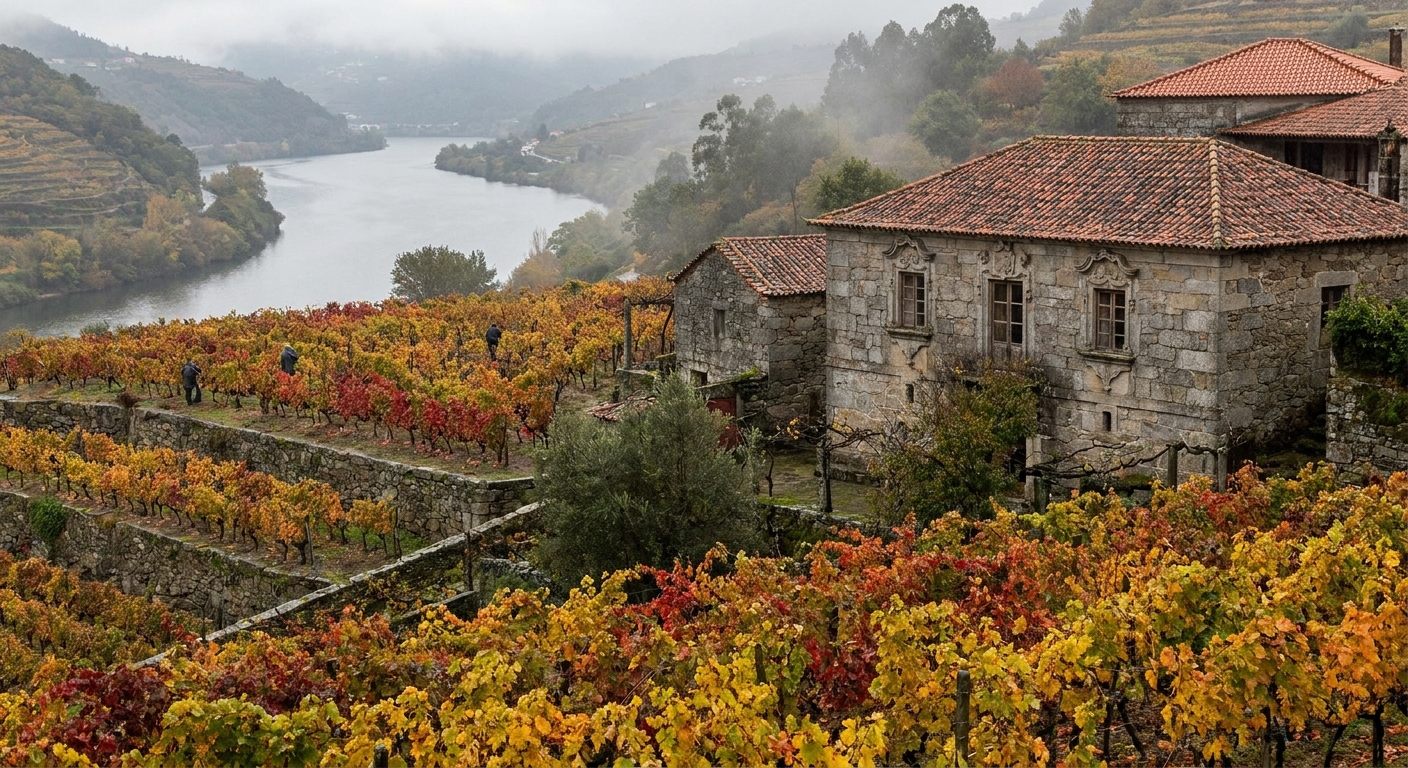
October gives you 66.7°F afternoons on the terraces and vines in full color, in exchange for rain on about one day in three and sunset before seven.
IPMA NORMALS 1991-2020 · STATION 567, VILA REAL, 561.5 M · 2 TO 3 NIGHTS · RAIN ON ONE DAY IN THREE
Go for: vineyard walking in 66.7°F air, fall color on the schist terraces, and a valley you can be outside in all day rather than at breakfast and dusk.
Think twice before: planning an all-outdoor weekend with no indoor fallback: 4.3 October days record 0.39 inch of rain or more, and the light is gone by 6:51 p.m. mid-month.
Climate: IPMA station 567, Vila Real · Daylight: sunrise-sunset.org · Landscape: UNESCO file 1046 · full sources at the end
On this page
- Douro Valley weather in October66.7°F days, 4.76 inches, 10 wet days
- How warm does it get, and does it freeze at night?The 50.2°F nights and the 16.5°F spread
- Crowds and when to bookWhat we can and cannot tell you about prices
- Things to do in OctoberThe terraces, the quintas, the Upper Corgo
- A two-day Douro itineraryDay one and day two, cued to the light
- October or September or November?How the three months compare
- Is October a good time to go?Our verdict, and who should move dates
Every figure here comes from one thermometer: IPMA station 567 at Vila Real, 561.5 meters up, and in Douro country rather than on the coast. That distinction matters more in the north than anywhere else in Portugal, because the valley floor runs far hotter than Porto, while the high ground around the Marão and Montemuro is colder and wetter again. Pack for the altitude you will be standing on, not for an average of the region.
The Douro Valley weather in October: average highs, lows and rain days
| October at Vila Real (IPMA, 1991-2020) | Figure |
|---|---|
| Average daily high | 66.7°F |
| Average daily low | 50.2°F |
| Total precipitation | 4.76 in |
| Days with 0.04 in (1 mm) or more | 10.0 |
| Days with 0.39 in (10 mm) or more | 4.3 |
| Daylight on October 15 | 11 hours 09 minutes |
| Sunrise / sunset, October 15 | 7:41 a.m. / 6:51 p.m. local |
The numbers come from IPMA, the Portuguese institute for the sea and the atmosphere, 1991-2020 normals at station 567. October averages 66.7°F by day, 50.2°F by night, and 4.76 inches of precipitation. That is a real thermometer at a fixed altitude, not a model grid cell averaged over ground that drops from mountain to river inside a few miles. Read it as the plateau reading: warm afternoons, no heat, and a monthly rain total roughly two and a half times September’s 1.93 inches.
Ten October days record at least 0.04 inch, so measurable rain arrives about one day in three. Of those, 4.3 reach 0.39 inch or more. That is the difference between a shower you walk through and an afternoon spent under a roof. One caution on the counting: these are IPMA’s own thresholds, not the 0.10-inch threshold American tables use, so the day counts are not interchangeable with a US forecast page. Keep one indoor option per two days outdoors and the month behaves.
The gap between the average high and the average low is 16.5°F, and it lands at the two ends of the day. A 50.2°F sunrise on a terrace above the river asks for a fleece and long pants. A 66.7°F two o’clock asks for a shirt. The packing answer is layers you shed by ten and put back on at six, plus a rain shell rather than an umbrella, since the walking here is on stone walls and steps. Our packing guide has the rest of the list.
Daylight on October 15 runs 11 hours 09 minutes, sunrise at 7:41 a.m. and sunset at 6:51 p.m. in local time. It is a full working day of light, but it ends early enough to matter on a driving day. Leave a quinta at five and you are on tributary roads in the last of it. Put the long views in the afternoon and the drive back before dark.
How warm is the Douro Valley in October?
66.7°F by day sits 10.7°F below September and 10.9°F above November, so October lands almost exactly halfway down the fall slope. Nights fall faster than days: the 50.2°F average low is 5.2°F under September’s 55.4°F and still 7.4°F over November’s 42.8°F. The two ends of the day are 16.5°F apart, and you will be outdoors for both of them.
In practice that means a jacket at breakfast, off by mid-morning, back on at the viewpoint before sunset. The socalcos, the oldest terraces, are narrow walls of schist carrying one or two rows of vines each, and 66.7°F is the comfortable end of the year for walking them. Anyone tasting outdoors at a quinta in the Upper Corgo wants a second layer once the sun leaves the slope.
Freezing nights are not in our figures. IPMA’s monthly normals for station 567 give the average low and no count of nights at or below 32°F, so we give none either, and 50.2°F sits comfortably clear of frost. There is no swimming answer here of the kind a coast page carries: we could not verify a water temperature for the Douro in October, so no river figure appears. Where a sea temperature is quoted in Portugal it is normally an average of daily maxima, which reads a little warmer than a 24-hour mean.
How busy is the Douro Valley in October? Crowds and how far ahead to book
October is a shoulder month by the calendar, and that is as far as our data goes. We found no occupancy series and no monthly room-rate series for the Douro, so we crown no month expensive and name no cheapest week. The valley’s visitor calendar turns on the harvest, and our harvest guide handles that timing question in full.
Book the nights before you book the tastings. We have no lead-time data for the valley, so we print no number of weeks, but the shape of the place argues for early: beds sit in scattered estate houses and small villages strung along the tributaries, not in a hotel district you can work through on arrival. Decide the base, then the route. Where to sleep and how long to stay compares them, and renting a car covers the driving.
On the tourist tax, we could not verify a rate for the Douro municipalities, so we give no percentage and no per-night figure. Ask at check-in, where it is usually billed as a separate line rather than folded into the room price. For what a week in Portugal adds up to overall, our trip cost breakdown does the arithmetic.
One upgrade genuinely changes this month, and it is the room with a terrace over the vineyards. In September’s 77.4°F you use that terrace at breakfast and at dusk. At 66.7°F it works all day, and on the 4.3 days that bring 0.39 inch or more you want glass in front of the same view. The second spend worth making is a driver for a tasting day, because the valley roads are narrow and a 6:51 p.m. sunset puts the return leg in the dark.
Things to do in the Douro Valley in October: the terraces, the quintas and the Upper Corgo
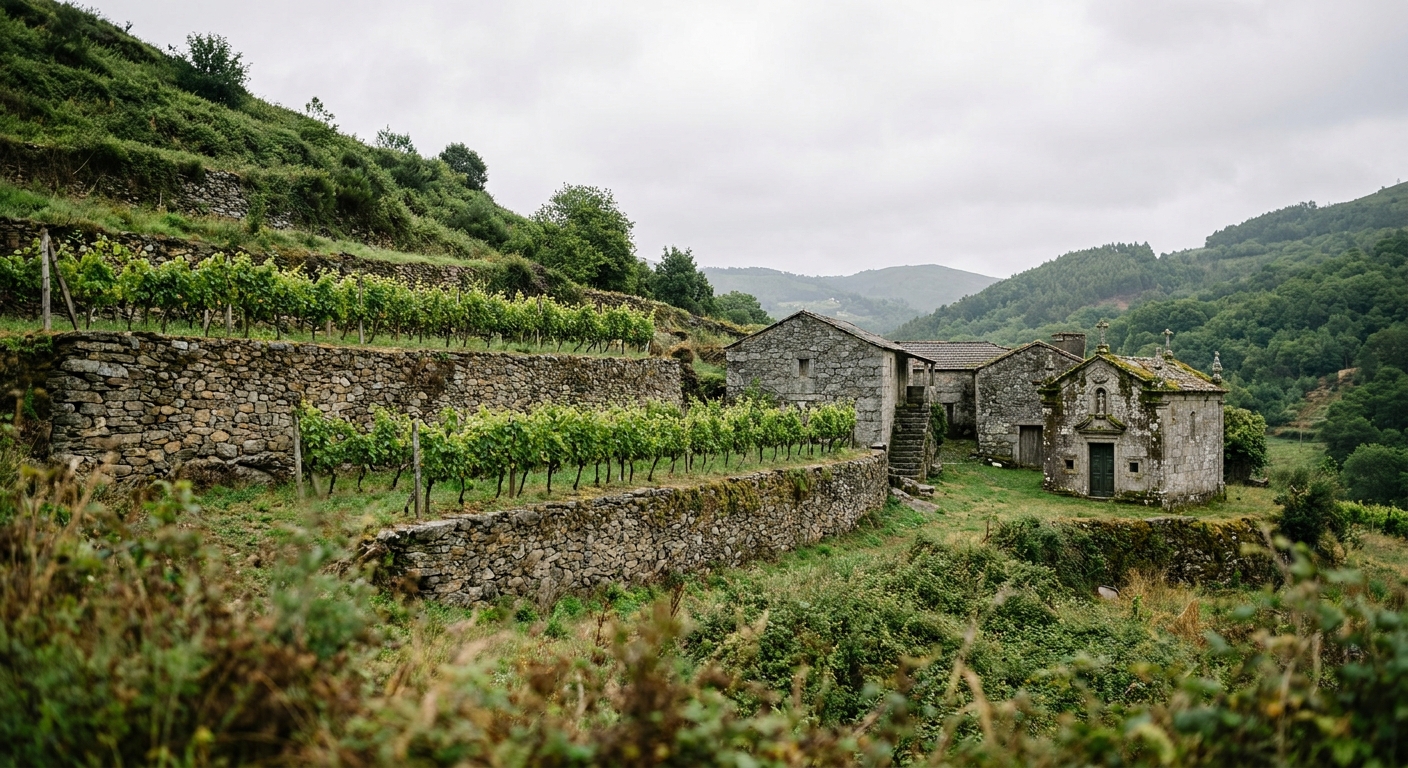
October is the month for walking the terraces rather than looking at them through a car window. Air at 66.7°F over a slope of stone steps is 10.7°F kinder than September, and the leaves have turned. The other half of the trade is water: 4.76 inches through the month puts flow back into the hillside watercourses and stone channels that the dry end of summer leaves empty.
Put a number on the view. The Alto Douro Wine Region was inscribed by UNESCO in 2001 under criteria three, four and five, and covers 24,600 hectares of terraced vineyard inside a buffer zone of 225,400 hectares, nine times the size of the property, which UNESCO itself calls difficult to manage. The Douro and five tributaries form the backbone of the landscape: the Varosa, Corgo, Távora, Torto and Pinhão. Quintas stand thickest in the Upper Corgo and the Upper Douro, each a main house with farm buildings and winery around it, the smaller holdings called casais.
We hold no opening hour and no tasting price for any single quinta, so book direct and confirm the day before. What the season changes is underfoot and overhead rather than in the stone: those schist walls need constant maintenance in any month, and rain on ten days makes steps slick and dirt tracks soft. The valley knows what its own water can do, and torrential rain in late January 2001 damaged terraces badly enough that UNESCO recorded the need for a special effort to bring them back into working order.
Looking at the valley costs nothing. The roadside viewpoints, the white-walled villages stacked midway up the slopes around their imposing eighteenth-century parish churches, and the orange groves along the lower banks, some of them walled, are all free to walk into. We hold no admission charge for any of them. Give one village an hour of the afternoon and let the tasting appointment sit at four.
The Douro Valley in October: a two-day itinerary
Day one runs off a 7:41 a.m. sunrise. Breakfast before light, on the terraces by eight while the air is still near 50.2°F and the sun is low across the walls. Late morning, drive one tributary road up from the river, the Corgo or the Pinhão, and stop where the view opens. Lunch late, then a quinta in the Upper Corgo booked for mid-afternoon. Be off the small roads by 6:51 p.m., and save the village wander for the hour after that.
Day two goes the other way: morning on the river, afternoon on foot in one village, then the drive back toward Porto before dark. If the sky turns, and 4.3 October days bring 0.39 inch or more, swap the walking for a long indoor tasting and a slow lunch, then take the high road for the views when it clears. An average wet day here carries 0.48 inch, which is a morning of rain, not a day of it.
The Douro Valley in October vs September and November
| September | October | November | |
|---|---|---|---|
| Average high | 77.4°F | 66.7°F | 55.8°F |
| Average low | 55.4°F | 50.2°F | 42.8°F |
| Precipitation | 1.93 in | 4.76 in | 4.83 in |
| Days with 0.04 in or more | 5.2 | 10.0 | 11.2 |
| In one line | Summer heat, dry weeks | Warm days, cool nights, rain every third day | Cold days, rain on more than a third |
Side by side the three separate cleanly. September runs 77.4°F by day on 1.93 inches of rain across 5.2 wet days. October drops the high to 66.7°F and more than doubles the rain, 4.76 inches on 10.0 days. November takes another 10.9°F off the day, down to 55.8°F, with 4.83 inches on 11.2 days: nearly the same water as October, spread thinner and falling on a colder valley.
Move four weeks earlier and you buy heat and dry days, 77.4°F with rain on roughly one day in six, and you pay with afternoons too warm for a full day on open stone. Our September guide makes that case with its own numbers. Move four weeks later and you buy quiet and low light, and you pay 42.8°F nights and 11.2 wet days. October sits between them at 10 wet days and 50.2°F nights.
Is October a good time to visit the Douro Valley?
Yes, for anyone whose trip is built on walking, driving and looking. Afternoons at 66.7°F and vines in color are the right conditions for the terraces, and rain on one day in three is manageable with one indoor plan held in reserve. No, if the week has no slack in it: 4.3 heavy-rain days and 11 hours 09 minutes of light will squeeze a tight itinerary, and a washed-out afternoon costs double when you only have two.
In that case September is the month to move to. Rain totaling 1.93 inches over 5.2 days is close to a dry guarantee by Portuguese standards, and the price is 77.4°F afternoons plus whatever the harvest does to availability. November is the wrong direction for a first visit, with 55.8°F days and 11.2 wet days handing you the scenery without the comfort. The country-wide view sits in our best time to visit Portugal guide.
No other month combines color on the terraces, air 10.7°F cooler than September’s, and enough water to put the stone channels back in use.
The last word
Book the base first and let the sky pick the order of the days. Wine has been made on these slopes by traditional landholders for some two thousand years, and Port has been a defined and regulated quality since 1756, older than most of the borders you crossed to get here. The landscape has had formal management since an Intermunicipal Spatial Plan in 2003, with the Douro Mission created in 2006 to safeguard it. October hands you all of that at 66.7°F, with a fleece in the bag for 6:51 p.m.
Sources & data for this guide
- October highs, lows, precipitation and rain-day thresholds · IPMA, climatological normals 1991-2020, station 567 Vila Real, 561.5 m · checked Sep 23, 2026
- September and November normals used in the comparison · same IPMA station and same 1991-2020 period, not estimates · checked Sep 23, 2026
- Daylight, sunrise and sunset on October 15, converted from UTC to local time · sunrise-sunset.org · checked Sep 23, 2026
- 2001 inscription, 24,600 ha property and 225,400 ha buffer, socalcos and post-phylloxera terraces, tributaries, quintas and casais, orange groves, the late January 2001 storm damage, the 2003 Intermunicipal Spatial Plan and the 2006 Douro Mission · UNESCO World Heritage Centre, file 1046 Alto Douro Wine Region · checked Sep 23, 2026
- We could not verify quinta opening hours, tasting prices, boat or train fares, occupancy figures or a lodging-tax rate, so none appear · confirm with operators when you book.
To plan your stay
- Things to Do in the Douro Valley: Quinta Tastings, the River Train, Boats and Miradouros
- Douro Valley vs Alentejo: Monthly Temperatures, Rain Days and Daylight
- Best Time to Visit the Douro Valley: Month-by-Month Weather, Harvest Season and the Quiet Months
- The Douro Valley in September: Weather, Crowds and Harvest Season