
PONTA DA PIEDADE · JUNE · THE ALGARVE
By June the most photographed headland in the western Algarve has its full day back. On June 15 the sun clears the horizon at 6:14 in the morning and stays up until 8:58 at night, local clock, close to fourteen hours and forty-five minutes of light on the ochre stacks and sea arches south of Lagos. The month is also dry to an almost comic degree: 0.15 inches of rain across the whole of June in the 1991-2020 official normals, and fewer than one day in the month recording as much as 1 mm (0.04 inch).
What June holds back is the water. The sea off the headland averages 65.3°F, warm enough for a swim you commit to rather than drift into. Crowds and prices we cannot settle with numbers, and we say so plainly further down. Everything that is true of these cliffs in any month, the boats, the coves, the walk in from town, sits on the main Ponta da Piedade guide and in our Lagos guide.
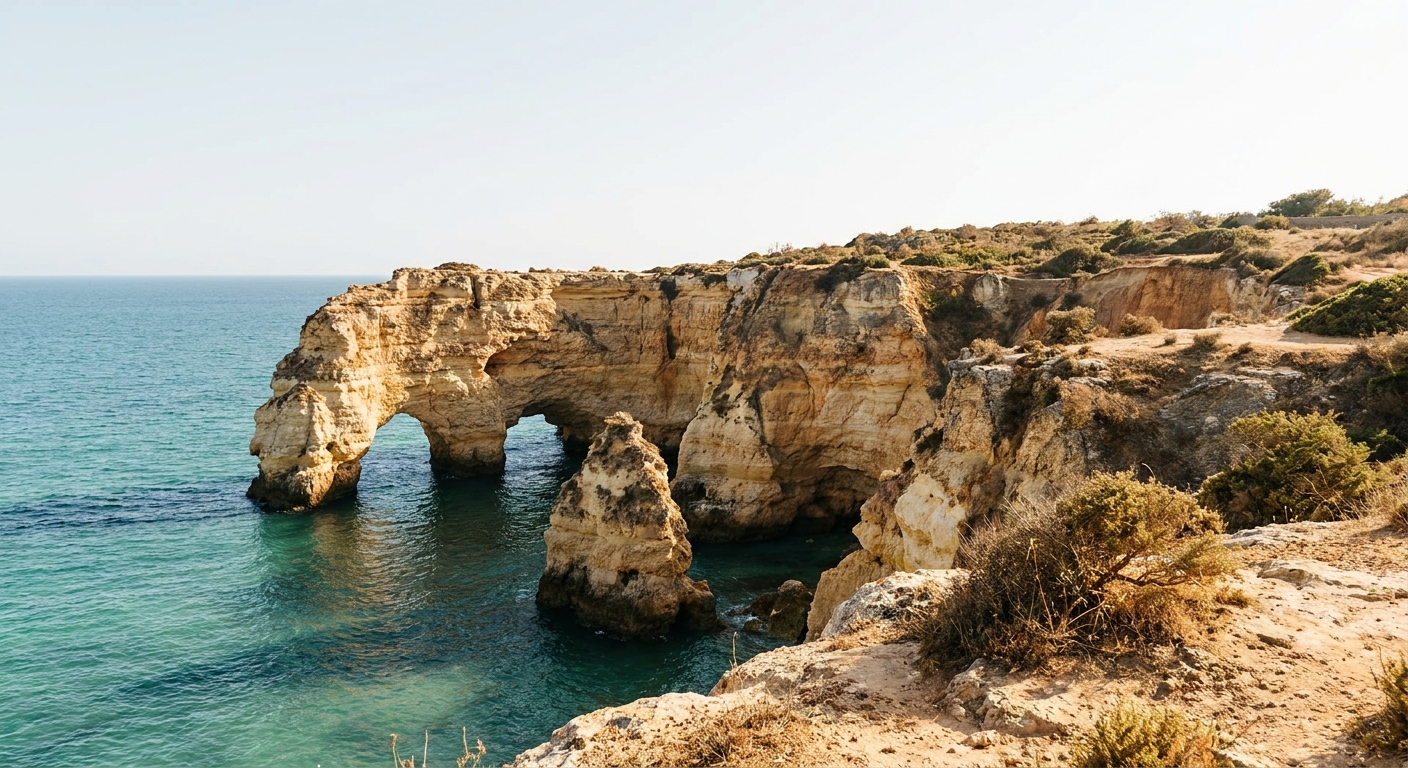
JUNE AT A GLANCE · PONTA DA PIEDADE
June gives the cliffs their longest days and almost no rain, and asks you to accept a sea at 65.3°F.
HIGH 75.0°F · LOW 61.2°F · 0.15 IN OF RAIN · SEA 65.3°F · 14 H 45 OF DAYLIGHT
Go for: long evenings on the clifftop path, a dry month by the numbers, and the warmest sea of the May-June-July trio.
Think twice before: planning a boat morning around the air temperature: at Sagres, where these normals are measured, wind and sea state cancel trips, not the thermometer.
Air normals: IPMA station 533, Sagres, 1991-2020 · Sea: Open-Meteo Marine, 2015-2024 · Light: sunrise-sunset.org · full sources at the end
On this page
- Average highs, lows and rain daysPonta da Piedade weather in June
- Is the water warm enough to swim?A sea at 65.3°F, and how it feels
- Crowds and what a June booking involvesWhat we can and cannot tell you about prices
- Things to do at the cliffs in JuneCamilo, Dona Ana and the lighthouse path
- A two-day plan around the lightTwo days, hour by hour
- Should I shift to May or July?How the three months compare
- Is June a good time to visit?The verdict, for and against
Every figure here for air and rain comes from one instrument: IPMA’s station 533 at Sagres, a real thermometer 22.9 m above the sea, further west along the same coast. That matters twice. Sagres is the windiest corner of this shoreline, so the station reads a breezier version of a sheltered cove. And the readings describe the coast, not the hills behind it, where the air runs colder and far wetter. Pack for an inland walk on a coastal number and you will be wrong by a layer.
Ponta Da Piedade weather in June: average highs, lows and rain days
| Measure | June |
|---|---|
| Average high | 75.0°F (23.9°C) |
| Average low | 61.2°F (16.2°C) |
| Precipitation, whole month | 0.15 in |
| Days with 1 mm (0.04 in) or more | 0.7 |
| Days with 10 mm (0.39 in) or more | 0.1 |
| Sea surface, mean of daily maxima | 65.3°F |
| Daylight on June 15 | 14 h 45 min |
The 1991-2020 normals put June at a 75.0°F average high and a 61.2°F average low, with 0.15 inches of precipitation for the month. These are station normals from IPMA, the Portuguese national weather service, measured by instrument rather than pulled from a model grid cell. The distinction earns its sentence: a reanalysis and a real thermometer can disagree by several degrees on a minimum, and the minimum is what decides whether you eat outside at ten at night.
Rain barely turns up. In an average June, 0.7 days record at least 1 mm (0.04 inch) and 0.1 day records 10 mm (0.39 inch) or more. Read that as most Junes passing without a single wet day on the cliffs, and roughly one June in ten delivering one proper soaking. Watch the arithmetic before you compare: IPMA counts at its own thresholds of 1 mm and 10 mm, while American tables usually start at 0.10 inch, so this 0.7 does not stack against a US figure for your hometown.
Highs and lows sit 13.8 degrees apart, and the low lands on a headland with nothing between it and the Atlantic. Climbing back up from a cove at midday is hot work in 75-degree air. At ten at night on a terrace in Lagos, 61 degrees plus the coastal breeze makes a long-sleeve evening. One light layer per person, carried every day, covers the whole spread. Our packing guide handles the rest of the suitcase.
June 15 runs 14 hours 45 minutes between sunrise and sunset. On the clock you will actually be reading, one hour ahead of UTC through the summer, that means a 6:14 a.m. sunrise and an 8:58 p.m. sunset. The last hour of light therefore falls after eight in the evening. Portuguese kitchens serve late, so take the viewpoint first and the table afterward, and the day gains an hour nobody planned for.
Can you swim in Ponta Da Piedade in June? Sea temperature and what it feels like
The marine figure for June off this coast is 65.3°F, averaged over 2015-2024 from the Open-Meteo Marine dataset. One nuance travels with it: that is the mean of daily maxima, the warmest reading of each day, so it sits a shade above a true 24-hour average. Tables built on daily means will show you a slightly cooler ocean for the same month off the same cliffs, and neither version is wrong.
Sixty-five degrees is bracing rather than cold. Most swimmers gasp on entry, settle quickly, and come out sooner than they would from a hotel pool. Children lose heat faster and last less. The coves under the headland are sheltered and shallow at the edge, so the standard June routine is short swims broken by long spells on warm sand. Anyone planning a real snorkel session or a long swim should bring a shorty wetsuit.
Wind is the variable the air temperature hides. The station supplying these normals sits at the windiest point of the coast, and along this shoreline the sea state, not the thermometer, decides whether the small boats reach the grottoes. We did not find a verified June wind or wave series for the headland, so we quote none. Book the boat for the morning and treat the operator’s call on the day as the forecast that counts.
How busy is Ponta Da Piedade in June? Crowds, prices and the demand peak
We found no occupancy series and no monthly room-rate series for Lagos or the headland, so we crown no month cheap and no month expensive. June sits on the Algarve calendar between the spring shoulder and high summer, and that is a statement about dates rather than about rooms. For the year-round shape of Portuguese demand, our best-time guide and the Algarve overview carry what we have.
Without a rate series, the useful advice is about supply. Fixed capacity goes first: a small boat leaving at a set hour, a rental car in a summer week, a terrace table facing the water. Open capacity never sells out, and the cliff path, the viewpoints and the beaches are all open capacity. If a car is in the plan, our car guide covers the fuel policies and tolls that cost more than the daily rate.
On the municipal tourist tax, we could not verify a current rate for Lagos, so we give no per-night amount and list no exemptions. Rates of this kind are set locally in Portugal and change by council decision, so ask the property when you book and expect a separate line at check-in rather than a figure folded into the room price. Budgeting for the rest of the trip lives in our Portugal cost guide.
One upgrade genuinely changes June: a bed within walking distance of the cliffs. Sunrise at 6:14 and last light at 8:58 hand you an early hour and a late one, and both are worth more than a pool you will use twice. Staying on the Ponta da Piedade side of Lagos turns them into a walk. Staying twenty minutes inland turns them into two drives, and the late one happens in the dark.
Things to do in Ponta Da Piedade in June
June lines up water and light in a way its neighbors do not. The sea reaches 65.3°F, the warmest of the May-to-July run, the month’s rain total is 0.15 inches, and June 15 offers 14 hours 45 minutes of daylight to spend on it. May brings more than five times as many days with measurable rain, 3.9 against 0.7. July is drier still but gives back the water, at 63.3°F on the same marine average.
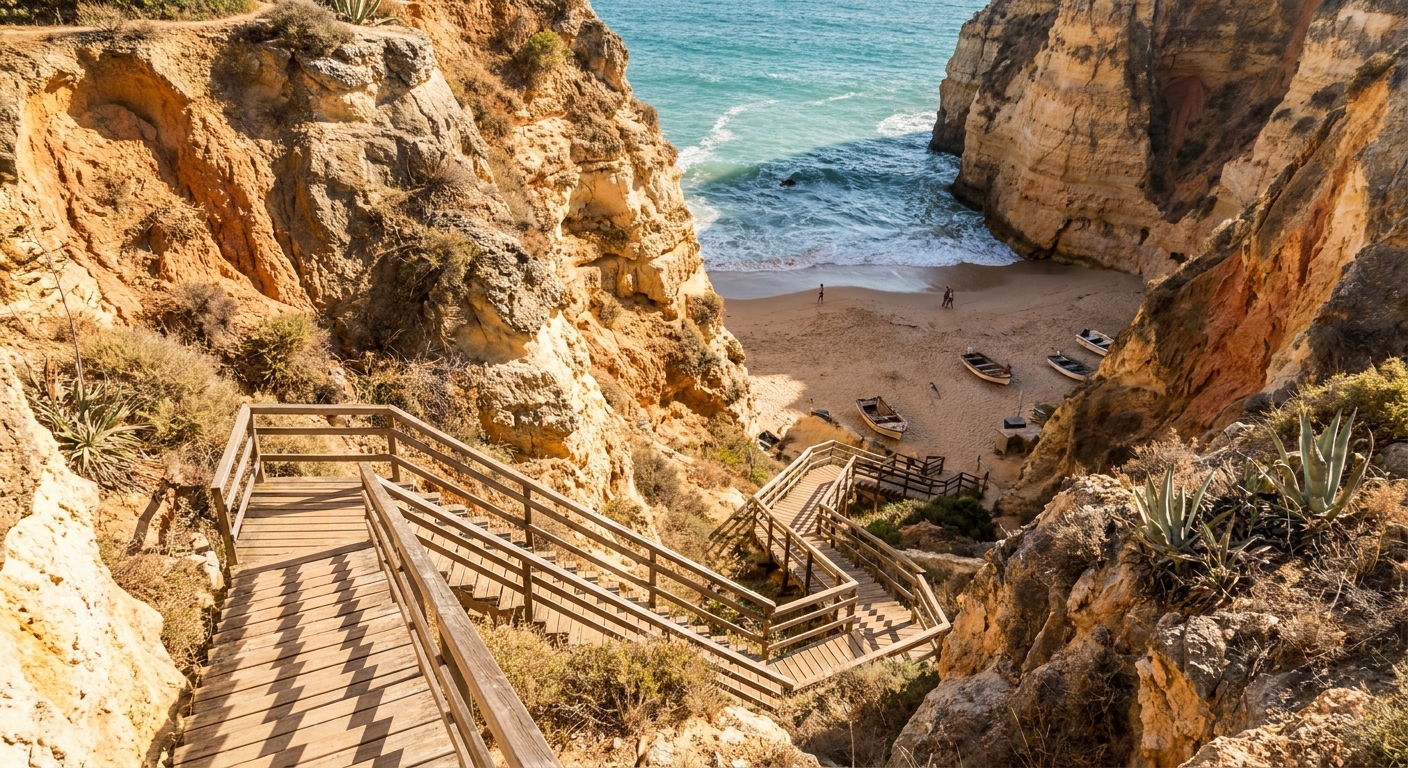
Walk the coast path out of Lagos past Praia Dona Ana and Praia do Camilo, where a long wooden staircase drops to a pocket of sand between cliff walls, and finish at the lighthouse above the stacks. Grotto trips run from the water below the headland and from town. We did not verify any 2026 fares, so we print none. East along the coast, Benagil holds the cave everyone photographs; west, Sagres is where the weather station stands, 22.9 m up at the end of the land.
The rock ignores the calendar. What the month moves is the gap between air at 75.0°F and water at 65.3°F, just under ten degrees, and that spread is exactly what makes a cove pleasant and a swim short. It moves the climb, too: the staircases back up from the sand are a sweat in July’s 77.4°F average high and merely warm in June’s 75.0.
Nothing on the headland charges admission. The clifftop path, the viewpoints over the stacks, the beaches and the walk out to the lighthouse are open through every hour the light allows, and in June that runs from 6:14 to 8:58. Parking is the one place a charge can appear, and we did not verify the current arrangements at the headland, so put a line in the budget rather than assume it is free.
Ponta Da Piedade in June: a two-day itinerary
Day one follows the light. Be on the clifftop path by 7, with the air still near its 61-degree overnight low and the sun on the east faces of the stacks. Take the boat between 9 and 11, before the afternoon breeze builds. Keep 1 to 4 for lunch and shade, because 75 degrees on exposed rock reads hotter than 75 degrees anywhere else. Swim at Camilo or Dona Ana around 5, when the sand has had all day. Return to the headland by 8 for the last of the light, and eat after 9.
Day two loosens up: the old town in the morning, the long flat sand of Meia Praia after lunch, or the drive west to the cliffs at Sagres. Should the weather turn, and 0.7 rain days says it probably will not, the swap is mechanical. Wet limestone on the path is slippery and the boats stay in, so spend the morning in Lagos and keep the headland for the clear afternoon behind the front. Our Lagos guide lists what works indoors.
Ponta Da Piedade in June vs May and July
| Measure | May | June | July |
|---|---|---|---|
| Average high | 70.7°F | 75.0°F | 77.4°F |
| Average low | 57.0°F | 61.2°F | 62.6°F |
| Precipitation | 0.87 in | 0.15 in | 0.04 in |
| Days with 1 mm (0.04 in) or more | 3.9 | 0.7 | 0.2 |
| Sea surface, mean of daily maxima | 62.2°F | 65.3°F | 63.3°F |
Air climbs steadily across the three: 70.7°F in May, 75.0 in June, 77.4 in July, with lows going 57.0, 61.2, 62.6. Rain thins out fast, from 0.87 inches and 3.9 wet days in May to 0.15 inches and 0.7 days in June, then 0.04 inches and 0.2 days in July. The sea keeps its own schedule. On the 2015-2024 marine average June leads at 65.3°F, ahead of July at 63.3 and May at 62.2, and we found no verified explanation for the July dip, so we offer none.
Shift four weeks earlier and you give up 4.3 degrees of daytime warmth and 3.1 degrees of sea, and take on more than five times as many days with measurable rain. Shift four weeks later and July returns 2.4 degrees of air and the driest month of the three, at 0.04 inches, while handing you a sea two degrees cooler than the one you left behind. Our May page makes the spring case with the same instruments.
Is June a good time to visit Ponta Da Piedade?
Yes for most travelers. June delivers a near-dry month at 0.15 inches, the longest days of the year, and a 75.0°F average high that lets you walk the cliff path at noon without suffering for it. No, if the trip is built around hours in the water: 65.3°F suits a dip and a snorkel, not an afternoon of floating. It is also the wrong month for anyone who needs a guaranteed boat morning, since the wind on this coast makes that call, not the calendar.
If the water is the sticking point, later summer is the obvious direction, and we will not promise a number we have not read: our verified marine averages cover May, June and July only, and July comes in cooler than June at 63.3°F. If you want the coast at its quietest instead, we have no attendance data to steer you, and the most we can say is that May runs cooler and wetter at 70.7°F air, 62.2°F sea and 3.9 wet days.
No other month on this headland pairs 14 hours 45 minutes of daylight with the warmest sea of the spring-to-midsummer run and a rainfall total of 0.15 inches.
The last word
Book the bed within walking distance of the cliffs and let the rest float. June asks very little of a plan: about a sixth of May’s rainfall, 0.15 inches against 0.87, falls on this coast in an average year, and the single variable that moves your days is the wind that keeps the small boats in. Go up to the headland at seven on your first morning, before you have decided anything else, when the east faces of the stacks take the light and the air is still in the low sixties.
Sources & data for this guide
- June air normals, 75.0°F high, 61.2°F low, 0.15 in of precipitation · IPMA, climate normals 1991-2020, station 533 Sagres, altitude 22.9 m · checked Sep 23, 2026
- Rain-day counts, 0.7 days at 1 mm or more and 0.1 day at 10 mm or more · IPMA, same station and period. These thresholds are not the 0.10-inch threshold used in US tables · checked Sep 23, 2026
- Scope caveat: the station stands at Sagres, 23 m, the windiest point of the coast, and its readings do not describe high ground inland, which is colder and far wetter · IPMA · checked Sep 23, 2026
- Sea surface 65.3°F, mean of daily maxima 2015-2024 · Open-Meteo Marine API · checked Sep 23, 2026
- May and July figures, air from IPMA 1991-2020 at the same station, sea from Open-Meteo Marine 2015-2024 · checked Sep 23, 2026
- Sunrise 05:14 UTC and sunset 19:58 UTC on June 15, converted to local summer time · sunrise-sunset.org · checked Sep 23, 2026
- Editorial note: we found no occupancy series and no monthly room-rate series for Lagos, could not verify a municipal tourist-tax rate, and verified no 2026 boat fares, so we give no prices, no percentages and no crowd ranking. Hours and fares change · check with operators when you book.