
DOURO VALLEY · MAY · VILA REAL · 561 M
May is the month the terraces are green and the walking is still easy. At Vila Real, the Portuguese weather service puts the average May high at 70.2°F (21.2°C), the average low at 49.5°F (9.7°C) and the month’s rain at 2.50 inches over about eight and a half days. The vines are in leaf, the schist walls still read from across the river, and an afternoon spent climbing between rows costs you sweat rather than suffering.
For an American trip that shapes up simply: fly into Porto, pick up a car, and give the valley two nights at minimum before you turn back toward the coast. Nothing in May is dictated by a festival date, so your itinerary is set by two things only, the light and the rain. Both are counted below, and both point the same way.
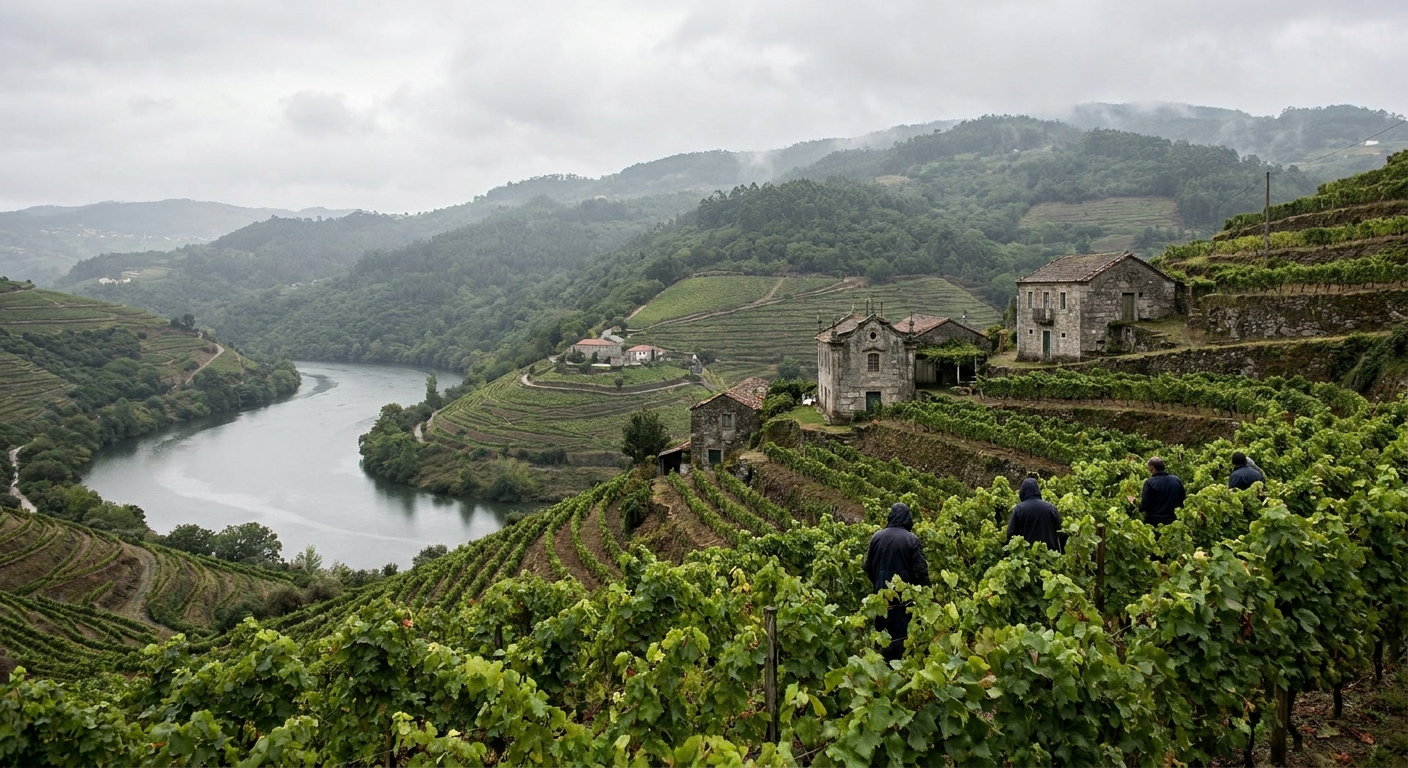
THE MONTH AT A GLANCE · DOURO VALLEY IN MAY
May pairs 70.2°F afternoons with 49.5°F nights and eight and a half wet days, the last month before June’s 77.5°F afternoons settle on the valley floor.
IPMA NORMALS 1991-2020 · VILA REAL STATION, 561.5 M · 8.5 WET DAYS · 14H 34M OF DAYLIGHT
Go for: vineyards in leaf, evenings that hold light until 8:44 pm, and terrace walking before the summer heat arrives.
Think twice before: packing for summer alone. Nights average 49.5°F at 561 m, and 2.3 days in the month deliver 0.39 inch of rain or more.
Normals: IPMA station 567, Vila Real · Daylight: sunrise-sunset.org · Landscape: UNESCO file 1046 · full sources at the end
On this page
- Douro Valley weather in May70.2°F highs, 2.50 inches, 8.5 wet days
- How warm it gets, and what to packThe 20.7°F gap between afternoon and night
- Crowds, prices and booking in MayWhat we verified, and the quinta appointments to fix first
- Things to do in the Douro Valley in MayQuintas, the socalcos terraces, the five tributary valleys
- A two-day Douro itineraryTwo days set to a 6:10 am sunrise and an 8:44 pm sunset
- May vs April and June63.3°F, 70.2°F and 77.5°F, with the rain counts
- Is May a good time to visit?Yes for drivers and walkers, no for harvest travelers
Every figure here comes from IPMA station 567 at Vila Real, a real thermometer at 561.5 m standing in the Douro country rather than on the coast. That distinction matters more in this region than almost anywhere else in Portugal: the valley floor along the river runs hotter than these readings, Porto runs cooler and wetter, and the high ground above the vineyards is colder again. Pack for the altitude where you sleep, not for the postcard.
The Douro Valley weather in May: average highs, lows and rain days
| May at Vila Real | Normal, 1991-2020 |
|---|---|
| Average high | 70.2°F (21.2°C) |
| Average low | 49.5°F (9.7°C) |
| Precipitation | 2.50 in |
| Days with 0.04 in or more | 8.5 |
| Days with 0.39 in or more | 2.3 |
| Daylight on May 15 | 14h 34m |
Those normals belong to IPMA, the Portuguese institute for the sea and the atmosphere, and to its 1991-2020 series at station 567 in Vila Real. It is an instrument on the ground at 561.5 m, not a reanalysis grid cell averaged over a square of map, and the difference is the one worth knowing when two websites give you two different Mays. May measures a 70.2°F average high, a 49.5°F average low and 2.50 inches of rain.
Rain arrives on 8.5 days of an average May at 0.04 inch or more, and on 2.3 of those days it reaches 0.39 inch or more. Across a two-week trip that works out to roughly four damp days, most of them the sort that sends you into a cellar for an hour rather than the sort that cancels a drive. Watch the yardstick, though: those are IPMA’s thresholds, not the 0.10-inch cut-off American tables use, so the counts do not swap cleanly with a US city’s rain-day figure.
Between the average afternoon and the average night sits 20.7°F, and that spread is the packing list. A single layer works from late morning to dinner, then a fleece or a light jacket earns its place the moment the sun drops behind the ridge. Add a rain shell for the 2.3 heavier days and shoes with grip, because schist steps and terrace walls are not forgiving in smooth soles. Our Portugal packing guide has the full kit.
Light is the month’s real luxury. On May 15 the sun comes up at 6:10 am and goes down at 8:44 pm local time, giving 14 hours 34 minutes of daylight. That is enough for two quinta appointments, a long lunch, a drive up a side valley and a dinner that begins while the terraces are still lit. The last hour before 8:44 pm is when the walls throw shadows and the river goes the color the photographers came for.
How warm is the Douro Valley in May?
The month’s average high of 70.2°F and average low of 49.5°F leave a daily swing of 20.7°F. That is an inland, upland number: the valley here is walled off from the harsh Atlantic winds by the Marão and Montemuro mountains, so the sea does not moderate the nights the way it does on the coast. Warm afternoon, cold morning, and the two separated by about four hours of climbing sun.
In practice you leave the room at eight in a fleece and carry it by eleven. Lunch is a shirt-sleeves affair on a terrace. By the time the plates come out for dinner the jacket is back on, and anyone sitting outside above the river will want long sleeves. Rental cars in the valley get sun on one side and shade on the other all day, so the cabin temperature is its own small weather system.
We found no frost-day count for May at the Vila Real station, so we give no number. With an average low of 49.5°F the typical night stays well clear of freezing, though a monthly mean never rules out one cold night at 561 m. On water: we verified no temperature series for the Douro or its tributaries, so no swimming figure appears from us. Where river and sea temperatures are published elsewhere they are usually averages of daily maxima, a touch warmer than a true 24-hour mean.
How busy is the Douro Valley in May? Crowds, prices and the harvest calendar
May sits ahead of both of the valley’s busy seasons, the summer road-trip months and the grape harvest that fills every estate later in the year. We found no occupancy series and no monthly room-rate data for the Douro, so we crown no month cheap and none expensive. What is certain is the calendar: nothing in May pulls a national crowd up the river, and the working vineyards are between tasks rather than mid-vintage.
Visits here run by appointment far more often than by turnstile, and that changes the booking order. We could not verify a single tasting price or opening hour for any quinta, so treat every schedule you read as something to confirm with the estate directly. Our own working rule, and not a published figure: fix the quinta appointments and the beds before you fly, then build the driving around them. The car is the piece to reserve earliest, since a valley trip without one becomes a different trip.
We could not verify a lodging-tax rate for the Douro municipalities, so we quote no percentage and no per-night amount. If a tax applies at your hotel it will show up at check-in rather than in the online total, which is worth a question at the desk when you hand over the card.
One line of the budget does change the month, and it is the bed. Daylight holds until 8:44 pm in mid-May, so a room with a terrace facing the river buys you two hours of the day you would otherwise spend driving back to town in the dark. Everything else, the fuel, the lunches, the roads themselves, costs what it costs in any month. Our Portugal trip-cost guide handles the wider budget.
Things to do in the Douro Valley in May: quinta tours, vineyard terraces and river trips
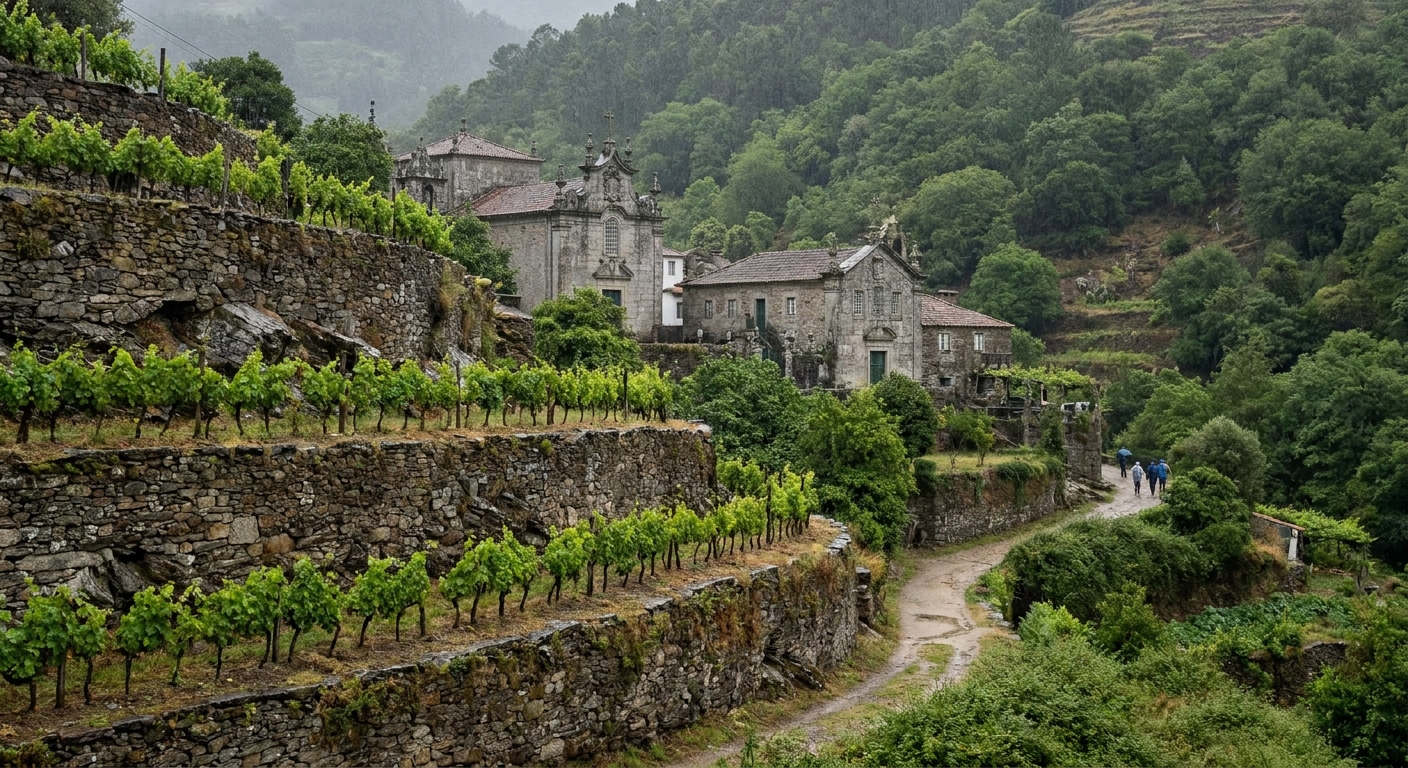
May is the walking month in a landscape built entirely of stairs. At 70.2°F an afternoon on the terraces is pleasant work, where June’s 77.5°F pushes the same climb to dawn or to the end of the day. The vines have their leaves, the estates are not yet running vintage operations around visitors, and the roads carry traffic without carrying the summer volume. April is greener and June is drier, but neither hands you this particular combination of long light and mild air.
The Alto Douro Wine Region joined the UNESCO list in 2001 under criteria three, four and five, and the scale is part of the point: 24,600 hectares of terraced vineyard as the property itself, wrapped in a buffer zone of 225,400 hectares, nine times the core, which UNESCO itself describes as difficult to manage. Wine has been made here by traditional landholders for some 2,000 years, and port has been a defined, regulated quality since 1756. Drive the five tributary valleys, the Varosa, Corgo, Távora, Torto and Pinhão, for the shape of the whole thing.
What May changes is the air around stonework that never changes. The oldest terraces, the socalcos, predate the phylloxera of 1860: narrow, irregular, carrying only one or two rows of vines each behind schist walls that need constant maintenance. The long, regular, slightly sloping terraces came after, rebuilt at the turn of the twentieth century, tilted so the vines catch more sun. Those walls are working structures, not decoration. Torrential rain in late January 2001 badly damaged some of them, and UNESCO noted that a special effort would be needed to bring parts of the vineyards back into working order.
Free in May, as in any month: the viewpoints and the back roads. Orange groves, some of them walled, grow along the lower banks and beside the hillside watercourses among brushwood, scrub and coppices, with stone channels that once collected the water. White-walled villages sit midway up the valley sides around parish churches of the eighteenth century, several of them imposing out of all proportion to the houses below. We verified no admission price for any quinta, so we name none, and the landscape itself costs only fuel.
The Douro Valley in May: a two-day itinerary
Day one starts easily, because the sun is already up at 6:10 am and nothing needs a dawn alarm. Be on the road by eight, take the first quinta appointment at ten while the air is still in the fifties, then eat late and slowly through the warmest hours. Mid-afternoon belongs to a drive up one tributary, the Corgo or the Pinhão, when the light starts crossing the terraces sideways. Dinner outside works until the sun goes at 8:44 pm, after which the 49.5°F night arrives quickly.
Day two swaps the car for the river and the second appointment for a village: a boat leg on the Douro in the morning, lunch above the water, an afternoon on foot between wall lines. If the sky turns, and 8.5 days a month it does, the plan holds with the order reversed. Cellars, churches and the drive itself absorb an hour of rain without complaint. On one of the 2.3 heavier days, make the whole afternoon indoors and keep the terrace walk for the clearing evening.
The Douro Valley in May vs April and June
| Normal, 1991-2020 | April | May | June |
|---|---|---|---|
| Average high | 63.3°F | 70.2°F | 77.5°F |
| Average low | 44.8°F | 49.5°F | 54.7°F |
| Precipitation | 3.34 in | 2.50 in | 1.15 in |
| Days with 0.04 in or more | 10.3 | 8.5 | 4.0 |
| The month in short | Cool, green, wettest of the three | Warm afternoons, cool nights | Hot afternoons, driest of the three |
Across the three months the climb is steady: 63.3°F, then 70.2°F, then 77.5°F on the afternoons, with the nights tracking it at 44.8°F, 49.5°F and 54.7°F. Rain falls away faster than the heat builds, from 3.34 inches over 10.3 wet days in April to 2.50 over 8.5 in May and 1.15 over 4.0 in June. We verified no river or reservoir water temperature for any of the three, so none of them gets a swimming figure from us.
Shift four weeks back to April and you give up 6.9°F on the afternoons and take on 1.8 more wet days, in exchange for the greenest hillsides and the quietest roads. Shift four weeks forward to June and you gain 7.3°F and lose 4.5 wet days, which is a real gain for a photographer and a real cost for anyone planning to climb terraces at two in the afternoon. May is the middle term, and on these numbers the middle term is the comfortable one.
Is May a good time to visit the Douro Valley?
Yes, for the traveler who intends to drive, walk and taste. Warm afternoons at 70.2°F, cool sleeping weather at 49.5°F, 14 hours 34 minutes of daylight and roads that are not yet full make this a straightforward month to plan. It is a weaker month for anyone who wants guaranteed dry weather for a week of photography, since rain lands on roughly one May day in four.
If that risk is the deciding factor, take June: 1.15 inches over 4.0 wet days is a different proposition, paid for with 77.5°F afternoons on a valley floor that runs hotter than the station reading. And if the trip you really want is the vintage, that belongs to another season entirely, laid out in our Douro harvest guide. The 12-month view for Portugal sets the region against the rest of the country.
Of these three months, May is the only one that hands you more than fourteen and a half hours of daylight while the afternoons stay under 71°F.
The last word
Book the car, then the quinta appointments, then the bed with a view of the water, and the rest of a May trip arranges itself around a 6:10 am sunrise and an 8:44 pm sunset. One thing worth knowing as you drive: this landscape is actively administered. An Intermunicipal Spatial Plan approved in 2003 governs the region, and a body called the Douro Mission was set up in 2006 to safeguard it. That is why the terraces you photograph in May still look like terraces, and not like a hillside that gave up.
Sources & data for this guide
- May normals, rain-day counts and thresholds · IPMA, climate normals 1991-2020, station 567 Vila Real, 561.5 m · checked Sep 23, 2026
- April and June normals, same station and same 1991-2020 period · IPMA · checked Sep 23, 2026
- Sunrise 05:10 UTC, sunset 19:44 UTC and 14h 34m of daylight on May 15, converted to local time · sunrise-sunset.org · checked Sep 23, 2026
- Inscription in 2001, criteria (iii), (iv) and (v), 24,600 ha property and 225,400 ha buffer, socalcos and post-phylloxera terraces, tributaries, quintas and villages, the January 2001 storm damage, the 2003 spatial plan and the 2006 Douro Mission · UNESCO World Heritage Centre, file 1046 · checked Sep 23, 2026
- We found no quinta opening hour, no tasting price and no boat or train fare, so we name none. We also found no occupancy or room-rate series for the valley, so we crown no month cheap or expensive, and we could not verify a lodging-tax rate for the Douro municipalities.
- The two-day shape, the packing advice and the booking order are editorial. Hours and prices change, so confirm with each estate before you drive.
To plan your stay
- Things to Do in the Douro Valley: Quinta Tastings, the River Train, Boats and Miradouros
- Douro Valley vs Alentejo: Monthly Temperatures, Rain Days and Daylight
- Best Time to Visit the Douro Valley: Month-by-Month Weather, Harvest Season and the Quiet Months
- The Douro Valley in April: Weather, Crowds, Prices and a Two-Day Plan