
PONTA DA PIEDADE · FEBRUARY · THE DATED GUIDE
February hands you the Algarve’s most photographed headland at its quietest, with an average afternoon of 61.3°F and a sea sitting at 61.1°F. That is sweater-and-windbreaker weather on the cliff path, and a swim only if you are the sort who counts cold water as a story. The gold sandstone stacks, the arches, the staircase down to the boat landing: all of it stands there in low winter light with room to breathe.
What the month takes away is reliability. Rain reaches the ground on roughly one day in four, and off Sagres the swell, not the thermometer, decides whether a grotto boat leaves the dock. Plan February as a walking trip with a boat attached if the water behaves, rather than the reverse, and the month rarely disappoints.
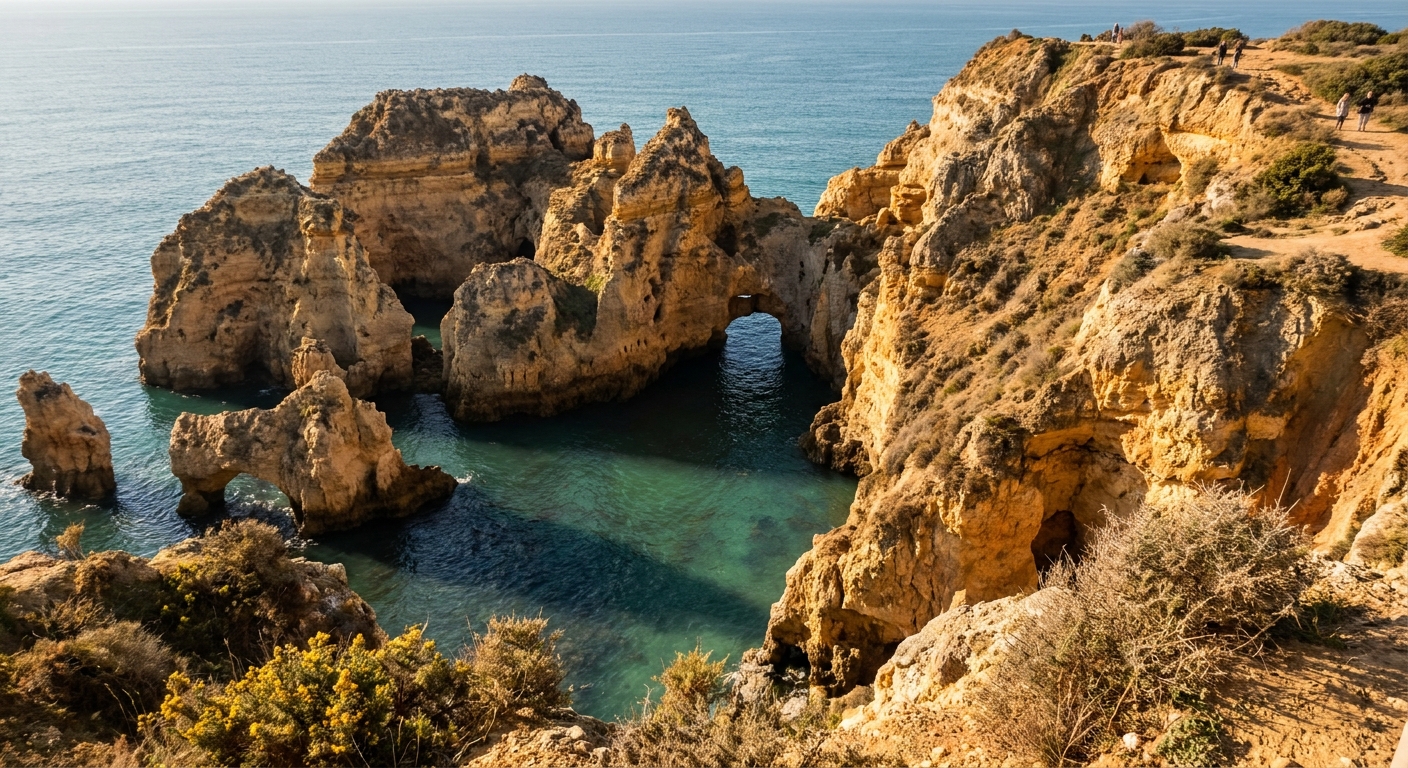
FEBRUARY AT A GLANCE · PONTA DA PIEDADE
February gives you an almost empty headland, a 61.3°F afternoon and a sea at 61.1°F, against measurable rain about one day in four and boats that run only when the swell allows.
IPMA NORMALS 1991-2020 · STATION 533 SAGRES · SEA FROM OPEN-METEO MARINE
Go for: the clifftop paths and viewpoints with nobody on them, low sun on the stacks all day, and water that is still 0.9°F warmer than it will be in March.
Think twice before: building the trip around a grotto boat or a beach day. At 61.1°F the swim is brief, and the sea state runs the boat schedule.
Air: IPMA station 533 Sagres, 1991-2020 · Sea: Open-Meteo Marine, 2015-2024 · full sources at the end
On this page
- Ponta da Piedade weather in February61.3°F by day, 47.8°F at night, 6.3 rain days
- Can you swim in February?A 61.1°F sea, and what it feels like
- Crowds, prices and the lodging taxLow season on the Algarve, with what we could not verify
- Things to do in FebruaryThe headland path, Praia do Camilo, Sagres and Cabo de São Vicente
- A two-day plan around 10 h 53 min of daylightDay one and day two, hour by hour
- February vs January and MarchHow the three months compare on air, rain and water
- Is February a good month to visit?Who should come now, who should wait
Every figure here comes from a single thermometer: IPMA station 533 at Sagres, 22.9 m above the water, reading the 1991-2020 normals. Sagres is the windiest point of this coast, and its readings describe the headland and the coastal strip rather than the whole region. Inland and on high ground the air is colder and considerably wetter, so pack for a hill walk from hill data, not from a clifftop reading.
Ponta da Piedade weather in February: average highs, lows and rain days
| February at Sagres | Value |
|---|---|
| Average high | 61.3°F (16.3°C) |
| Average low | 47.8°F (8.8°C) |
| Monthly precipitation | 1.91 in |
| Days with 0.04 in (1 mm) or more | 6.3 |
| Days with 0.39 in (10 mm) or more | 1.5 |
| Sea surface, mean of daily maxima | 61.1°F (16.2°C) |
| Daylight on February 15 | 10 h 53 min |
IPMA, Portugal’s national weather service, puts February here at an average high of 61.3°F and an average low of 47.8°F, with 1.91 inches of precipitation over the month. Those are station normals for 1991-2020, measured by an instrument at 22.9 m on the cape, not a reanalysis averaged across a grid cell that mixes ocean, cliff and hinterland. When you read a warmer February figure elsewhere for the same coast, the gap is usually that distinction rather than a disagreement about the weather.
6.3 days in an average February record at least 0.04 inch of rain, so something measurable falls about one day in four. Of those, 1.5 days bring 0.39 inch or more, the kind of hours that keep you off the cliff edge and inside a café in Lagos. One caution on the counting: IPMA uses 1 mm and 10 mm thresholds, while American tables usually start at 0.10 inch, so the two sets of rain-day numbers are not interchangeable.
Day and night are 13.5°F apart, and the cape adds wind to the arithmetic. A morning that starts near 47.8°F warms into the low sixties by mid-afternoon and drops away fast once the sun leaves the stacks. Layers do the work: a base layer, a fleece, a windproof shell, and shoes with grip for sandstone that stays damp after rain. Our packing guide covers the rest of the Portugal winter kit.
On February 15 the sun rises at 7:23 a.m. and sets at 6:16 p.m. local time, mainland Portugal running on UTC through the winter, for 10 hours 53 minutes of daylight. The practical shape of that: the stacks catch warm light for the first hour and the last, and you can be on the clifftop for sunset and still at a dinner table in Lagos by seven.
Can you swim in Ponta da Piedade in February? Sea temperature and what it feels like
The sea off the headland averages 61.1°F in February. That figure comes from the Open-Meteo Marine API as a mean of daily maxima over 2015-2024, so it reads a shade warmer than a true 24-hour average would: it is the afternoon peak, not the dawn value. Other tables built on 24-hour means will show the same water a little cooler, and both are describing the same ocean.
In practice, 61.1°F water sits almost exactly at air temperature, since the average high is 61.3°F. There is no warm air waiting to reward you when you climb out, and that is the part swimmers underestimate. Locals in wetsuits swim and surf through the month without drama. Without one, reckon on a fast, loud, five-minute dip from the little beach below the stacks, towel and fleece ready on the sand.
Wind and swell are the real variable, and we could not verify a February wave-height or wind-speed series for this stretch of coast, so we give no figure. What the IPMA record does establish is that this is the windiest point of the Algarve coast, where sea state rather than air temperature decides whether a boat goes out. Ask at the harbor the evening before, and keep the grotto trip as a movable item.
How busy is Ponta da Piedade in February? Crowds, prices and the demand peak
February falls inside the Algarve’s low season, which is a fact of the calendar rather than a claim about money. We found no monthly occupancy series and no room-rate series for Lagos, so we crown no month cheapest and quote no nightly figure. What is visible on the ground: the clifftop paths carry a fraction of their summer traffic, and the parking above the lighthouse behaves like a parking lot instead of a lottery.
Lead time is the wrong lever this month anyway. We could not verify booking-window data for the town’s hotels, so we give no number of weeks. The weather record points somewhere else: with 6.3 rain days and boats tied to the swell, flexible dates beat early dates. Book a room you can move, then decide the boat, the beach day and the drive west the night before, once you have looked at the water.
On the municipal lodging tax, we could not verify the current rate for Lagos, so no percentage appears above and none should be inferred. Portuguese towns on the coast commonly add a per-person, per-night charge collected at the property, and the amount is the sort of thing that changes by council vote. Ask when you book, and budget for a small line on the final bill rather than a surprise.
One outlay genuinely changes February, and it is the car. With rain landing about one day in four, a vehicle lets you drive away from a gray headland toward whatever stretch of the coast is clear, from Carvoeiro east to Sagres in the west. Our car guide covers tolls and pickup, and getting around Portugal handles the train alternative.
Things to do in Ponta da Piedade in February
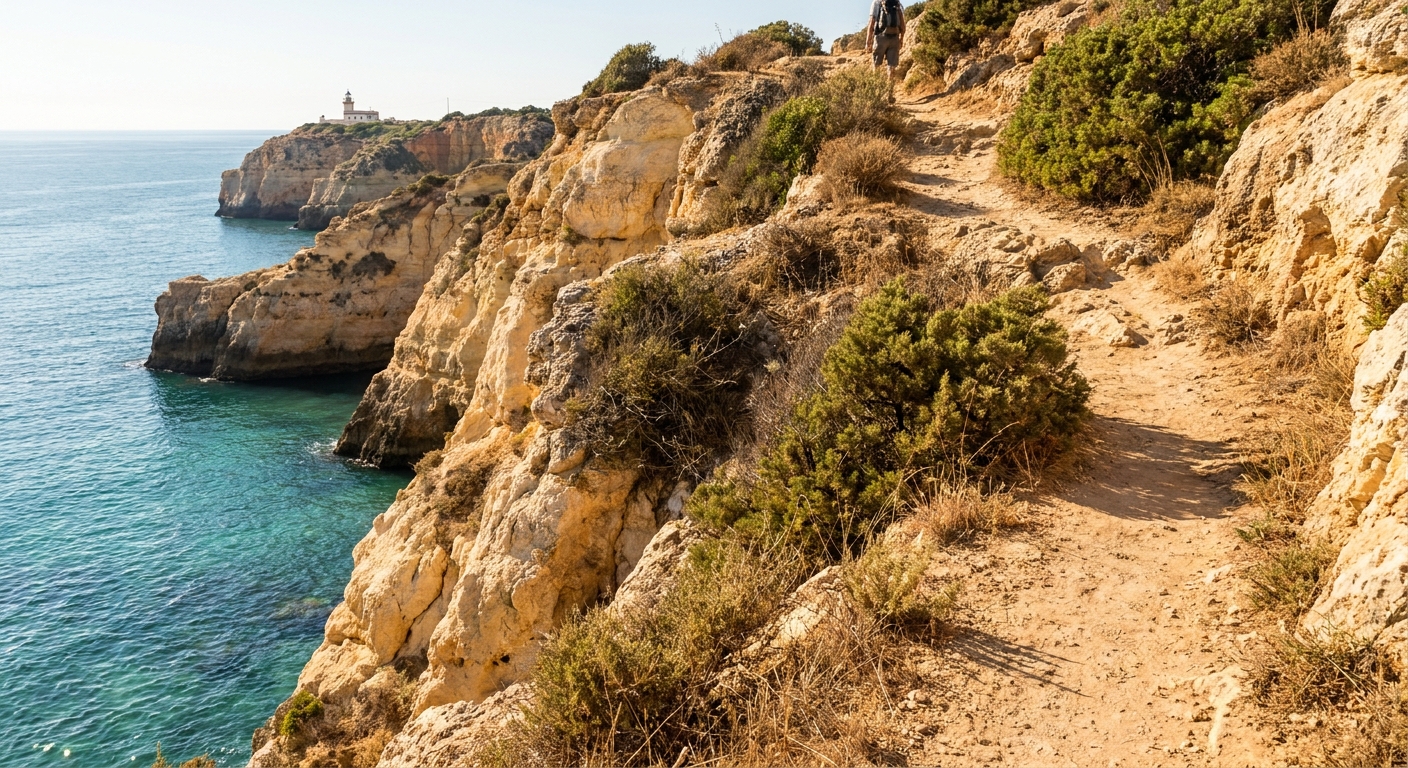
The month buys you space and light. At 61.3°F you can walk the full clifftop circuit at midday without the heat that turns the same walk into an endurance test later in the year, and the sun never climbs high enough to flatten the sandstone, so the stacks hold texture from 7:23 a.m. to 6:16 p.m. The sea also runs 0.9°F warmer now than it will in March, which surprises most first-time winter visitors.
The fixed points: the headland itself with its small lighthouse and the long staircase down to the boat landing, the neighboring beach coves of Praia do Camilo and Praia Dona Ana, and the walled old town of Lagos twenty minutes away on foot along the cliffs. West lies Sagres with its fortress headland and Cabo de São Vicente, the southwestern corner of Europe. East, the sea cave at Benagil runs on the same swell rules as the grottoes here.
February changes these places mostly through the air, not the water. The sea barely moves across the winter, from 61.4°F in January to 61.1°F now, while the air climbs 2.7°F between this month and March. Underfoot, the cliff grass is green and soft after January’s 2.10 inches of rain, and the same rain means the paths above the drop can be slick in the hour after a shower.
Most of what you came for costs nothing: the clifftop paths, the viewpoints over the arches, the staircases down to the coves and the walk along the shore into Lagos are all open access. For the boat trips through the grottoes we could not verify a current fare, so we quote none. Prices are posted at the landing and at the Lagos marina, and they move with the season and the operator.
Ponta da Piedade in February: a two-day itinerary
Day one, start slowly, because sunrise is at 7:23 a.m. and the air is near 47.8°F until mid-morning. Coffee in Lagos at eight, then the cliff walk out to the headland by nine while the light is still low on the stacks. Late morning, take the staircase down to the boat landing and the cove. Lunch indoors around one, afternoon on Praia do Camilo in the warmest part of the day, and back on the clifftop before the 6:16 p.m. sunset.
Day two goes west if the sky is clear: the drive to Sagres and Cabo de São Vicente for the Atlantic edge, wind included, then back for an early dinner. Keep the grotto boat for whichever of the two days the sea allows. If the weather turns, and it does on 6.3 days in an average February, spend the morning inside the Lagos old town and save the cliffs for the clearing that usually follows a front through.
Ponta da Piedade in February vs January and March
| Measure | January | February | March |
|---|---|---|---|
| Average high | 61.0°F | 61.3°F | 64.0°F |
| Average low | 47.3°F | 47.8°F | 51.1°F |
| Precipitation | 2.10 in | 1.91 in | 1.92 in |
| Days with 0.04 in or more | 7.4 | 6.3 | 6.3 |
| Sea surface (daily maxima mean) | 61.4°F | 61.1°F | 60.2°F |
Across the three months the air barely moves and then jumps. January and February sit 0.3°F apart by day, while March adds 2.7°F on the highs and 3.3°F on the lows, the first real warmth of the year. Rain tells a similar story: January is the wettest of the three at 2.10 inches over 7.4 days, February and March both settle at 6.3 rain days. The water runs the other way, cooling from 61.4°F in January to 60.2°F in March.
Shift four weeks later and you gain evenings you can sit outside in, nights that start at 51.1°F instead of 47.8, and longer days on the cliffs. You lose a degree of sea temperature and you lose the emptiness, since March is when the coast begins to fill. Shift four weeks earlier and January gives the warmest water of the winter, paid for with an extra inch of rain and one more wet day per month.
Is February a good time to visit Ponta da Piedade?
Yes, if you are here to walk, look and photograph. A 61.3°F afternoon is close to ideal for the clifftop circuit, the viewpoints are unpressured, and the low sun works the sandstone all day. No, if the trip’s center of gravity is a beach day or a guaranteed boat through the grottoes. At 61.1°F the swim is a dare rather than a pleasure, and a February booking that depends on calm sea is a booking that may not sail.
If that second description fits, take March or later. The air rises to a 64.0°F average high with the same 6.3 rain days and 1.92 inches, and the evenings stretch well past a February sunset at 6:16 p.m. You trade a little water temperature for a much more comfortable day outdoors, and our month-by-month verdict for Portugal lays out how the rest of the year runs.
What February alone offers is an empty headland with water still warmer than March’s, a pairing that the calendar does not repeat once the air catches up.
The last word
Book the room you can move and keep the boat undecided until the night before: that single choice is what separates a good February here from a frustrating one. Reckon on one and a half days in an average month bringing 0.39 inch of rain or more, the sort that genuinely cancels a plan, and let the other twenty-six days carry the walk out to the lighthouse. Bring a fleece for the 47.8°F mornings, and start early enough to have the stacks to yourself.
Sources & data for this guide
- February normals: high 61.3°F, low 47.8°F, 1.91 in · IPMA (Instituto Português do Mar e da Atmosfera), 1991-2020 normals, station 533 Sagres, altitude 22.9 m · checked Sep 23, 2026
- Rain days, 6.3 at 1 mm (0.04 in) and 1.5 at 10 mm (0.39 in) · IPMA, same station and period · thresholds are IPMA’s, not the 0.10-inch cut used by US tables · checked Sep 23, 2026
- Sea surface 61.1°F, mean of daily maxima 2015-2024 · Open-Meteo Marine API · checked Sep 23, 2026
- Daylight 10 h 53 min, sunrise 07:23 and sunset 18:16 UTC on February 15 · sunrise-sunset.org · checked Sep 23, 2026
- January and March figures (air) · IPMA, same station and 1991-2020 period · sea temperatures for both months from Open-Meteo Marine, 2015-2024 · checked Sep 23, 2026
- Scope caveat, served in full: the Sagres readings describe the cape and the coastal strip · high ground nearby is colder and wetter
- Editorial admission: we could not verify grotto-boat fares, the Lagos municipal lodging tax, booking lead times or any monthly occupancy series, so no price, rate or percentage appears above · check operators and your property when you book