
ALENTEJO · JULY · IPMA 1991–2020 NORMALS
July hands the Alentejo its hottest, driest weeks and its longest evenings. IPMA, Portugal’s national weather service, puts the July normal at a high of 91.9°F and a low of 60.1°F, with 0.11 inch of rain for the entire month, averaged 1991 to 2020 at its Évora station, 247.6 m up on the plain itself rather than at a coastal stand-in.
What that buys is a day in two halves: a bright, walkable morning, a shuttered middle, and four hours of gold after six. What it costs is the afternoon, and any plan involving a hilltop at 3 p.m. Where to sleep across the region and what a week costs sit in our stay guide and the cost page. The question below is the date: what July gives, what it takes, and whether four weeks either way would serve you better.
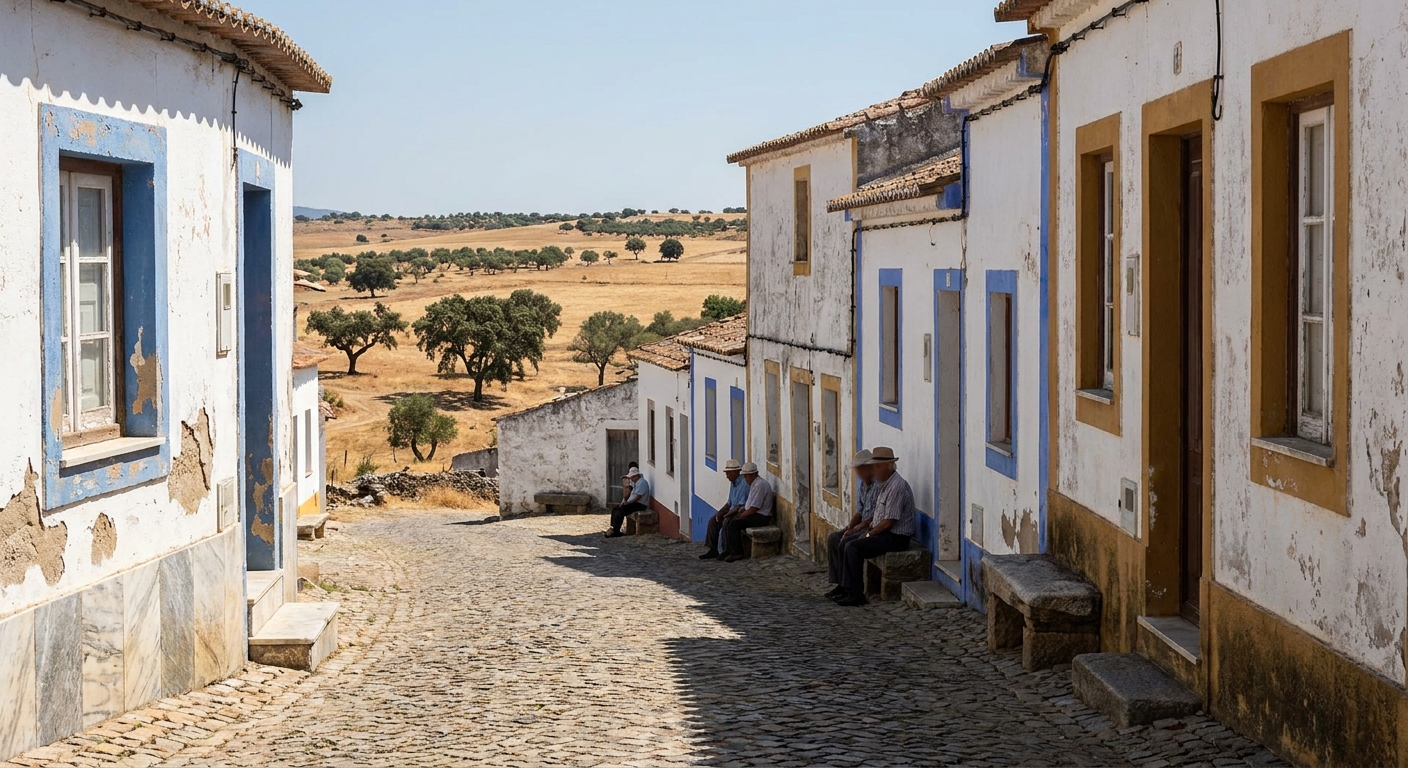
THE MONTH AT A GLANCE · ALENTEJO IN JULY
July is the Alentejo at full strength: 91.9°F afternoons, 0.6 rain days and light until 8:56 p.m., which works beautifully once you treat one o’clock to five as indoor time.
IPMA 1991–2020 NORMALS · ÉVORA STATION AT 248 M · SUNSET 8:56 P.M. ON JULY 15
Go for: long dry evenings, empty back roads at seven in the morning, fresh-water swimming at Alqueva, and a walled town you can cross before breakfast.
Think twice before: booking a walking-heavy midday or a room without real air conditioning: the normal high is 91.9°F and the plain holds it into the night.
Normals: IPMA station 558, Évora · Daylight: sunrise-sunset.org · full sources at the end
On this page
- Alentejo weather in July91.9°F highs, 0.11 inch of rain
- How hot it gets, morning to afternoonThe 31.8°F day-night swing
- Crowds, tourist tax and booking aheadWhat we verified and what we did not
- Things to do in Alentejo in JulyÉvora, Monsaraz, Alqueva and the coast
- A two-day plan built around the heatFrom a 6:18 a.m. start to a 8:56 p.m. sunset
- July, June or August?How the three months compare, degree by degree
- Is July a good time to visit Alentejo?Who should go, who should shift
June’s full figures live on the June page, and the country-wide calendar is in our best-time verdict.
Alentejo weather in July: average highs, lows and rain days
| July at Évora (1991–2020) | Value |
|---|---|
| Average high | 91.9°F (33.3°C) |
| Average low | 60.1°F (15.6°C) |
| Day-night spread | 31.8°F |
| Precipitation | 0.11 in |
| Days at 0.04 in or more | 0.6 |
| Daylight, July 15 | 14h 38m |
| Sunrise / sunset, July 15 | 6:18 a.m. / 8:56 p.m. local |
Every figure here comes from one instrument: IPMA station 558 at Évora, 247.6 m above sea level, averaged over the thirty years from 1991 to 2020. That matters, because it is a real thermometer standing on the Alentejo plain and not a model grid cell borrowed from the coast. It also means the numbers describe the country around Évora rather than the whole region. High ground runs colder and considerably wetter, and the Atlantic edge keeps its own weather, so pack for a beach week on an inland reading and you will misjudge the evening breeze.
The month’s normal total is 0.11 inch, and 0.6 days reach 1 mm (0.04 inch), which works out at roughly three such days spread across five Julys. One caution on the counting: IPMA uses its own thresholds of 1 mm and 10 mm, not the 0.10-inch line American tables use, so these day counts do not swap cleanly with the ones you know from a US city.
The gap between the 91.9°F afternoon and the 60.1°F night comes to 31.8°F, and on open ground you feel all of it. A linen layer for seven in the morning, a hat and a liter of water for noon, something with sleeves for a terrace at ten at night: that is the July suitcase, plus swimwear. Our packing guide handles the rest of the trip.
On July 15 the sun comes up at 6:18 a.m. and goes down at 8:56 p.m. local time, 14 hours and 38 minutes apart. Dinner at nine therefore happens in daylight, and the best hour on the plain falls between eight and nine, when the cut wheat turns copper and the walls stop radiating.
How hot is Alentejo in July? The 91.9°F day and the 60.1°F night
The normal July afternoon at Évora reaches 91.9°F and the normal night falls to 60.1°F. August runs hotter by four tenths of a degree at the top and seven tenths at the bottom, so July is not the cooler alternative people assume it is: it is the same heat carrying less rain, 0.11 inch against August’s 0.24.
In practice, seven in the morning needs no jacket and asks for nothing more than cotton, while four in the afternoon asks for shade, which is why every old town here keeps its arcades. About the water: we found no sea-surface series we trust for the Alentejo coast, so we give no swimming temperature. One thing to keep in mind when you read one elsewhere, published sea figures are usually averages of daily maxima, a touch warmer than a true 24-hour mean.
Freezing nights never enter the July conversation. Our IPMA sheet carries no count of them for the month, and an average low of 60.1°F settles the question anyway. The nights that shape a July trip are the warm ones: stone and whitewash release the day slowly, and squares that were empty at five in the afternoon fill up again after nine.
How busy is Alentejo in July? Crowds, tourist tax and booking ahead
July falls inside the northern summer holidays, and the coast fills before the interior does. We found no occupancy or room-rate series for the Alentejo, so we crown no month expensive and quote no peak percentage. What we can state is calendar rather than price: European schools are out for most of the month, and the region shares its high summer with the Algarve next door.
Our own habit is to settle a July room six to eight weeks ahead (est.), and the car before the room, since automatics are the first category to run short in summer (est.). A manual compact is easier to find and cheaper to fuel across long, empty roads. Tolls and fuel cards are covered in our car guide.
On the tourist tax, we could not verify a rate for the Alentejo’s municipalities, so we give no percentage and no per-night amount. Ask at check-in and expect it outside whatever total you paid online. The broader budget picture, meals included, sits in what a week in Portugal costs.
If one line of the July budget deserves an upgrade, it is cooling. With a normal high of 91.9°F and stone that holds heat overnight, the gap between a room with working air conditioning and a room with a ceiling fan decides whether the one-to-five window is a rest or a write-off. A pool comes second, a view a distant third.
Things to do in Alentejo in July
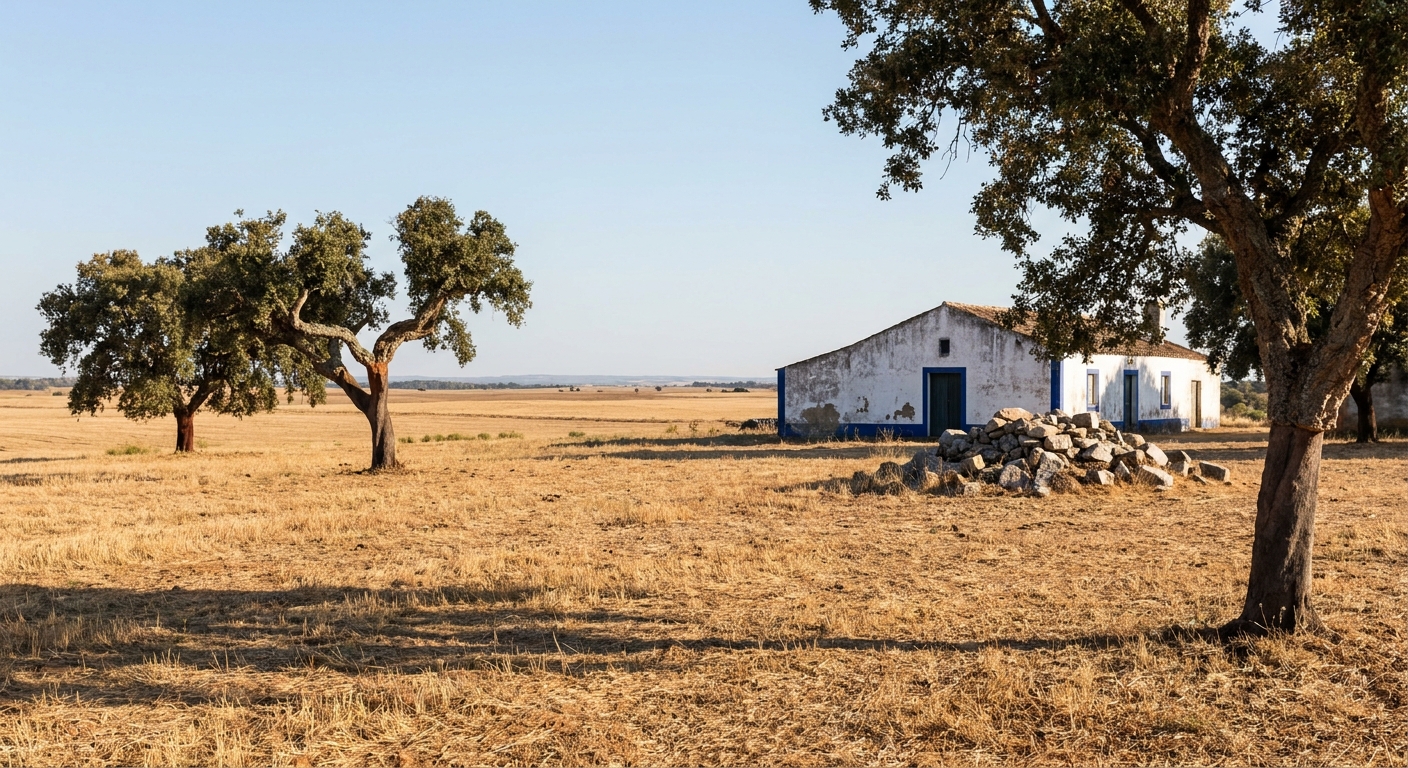
July puts 0.11 inch of rain on the whole month against June’s 0.42, and that is what makes the outdoor half of the day dependable: dirt tracks stay firm, reservoir shores stay usable, and a table booked outside at nine stays outside. June’s 1.7 rain days do not offer the same guarantee.
Évora is the anchor, a walled center small enough to cross on foot in a morning, with its Roman temple and the same 248 m elevation that hosts the thermometer behind every number above. East of town, the Alqueva reservoir spreads below Monsaraz’s hilltop wall, and swimming there is fresh water rather than sea. West, the rice country around Comporta and the river mouth at Vila Nova de Milfontes sit on the Atlantic edge, where the coast keeps its own weather and these inland normals stop applying.
The reservoir hardly notices the month. The air above it does: the same circuit of Monsaraz that happens at 86.4°F in June happens at 91.9°F in July, and those 5.5°F are the margin between a pleasant hour on an unshaded wall and a punishing one. Start any hilltop before nine or after seven, and keep the ruins and the wine cellars for the middle.
We could not confirm free-entry days or free evening hours at any Alentejo monument, so we name none and send you to each ticket desk. What is free in July without any checking at all: the hour between eight and nine on a town wall, a reservoir shore with no gate, and a market square at a temperature you can finally sit in.
Alentejo in July: a two-day itinerary
Day one runs on the light. Up with the 6:18 a.m. sunrise and inside Évora’s walls by seven, while the lanes are still in shade, with the temple, the cathedral roof and coffee done by eleven. Lunch long and indoors. Spend one to five horizontal, in a pool or a museum. Out again at six for the drive east, up Monsaraz’s hill at half past seven, and dinner after the 8:56 p.m. sunset, which in July is when the square finally cools.
Day two goes to water: the Alqueva shore in the morning, or the coast at Vila Nova de Milfontes if you want Atlantic swell and a breeze, with the same midday rule applied without negotiation. If the sky does turn, the fallback is short, since only 0.6 days a month reach 0.04 inch. A July shower usually means forty minutes under an arcade rather than a rewritten day, and Évora’s covered streets and cellars absorb the wait.
Alentejo in July vs June and August
| Normal (Évora, 1991–2020) | June | July | August |
|---|---|---|---|
| Average high | 86.4°F | 91.9°F | 92.3°F |
| Average low | 56.8°F | 60.1°F | 60.8°F |
| Precipitation | 0.42 in | 0.11 in | 0.24 in |
| Days at 0.04 in or more | 1.7 | 0.6 | 0.7 |
Set side by side, June is the mild one and August is the twin. June’s 86.4°F high sits 5.5°F below July, and its 56.8°F nights run 3.3°F cooler. August, at 92.3°F and 60.8°F, is July plus a rounding error. Rain separates the three far better than heat does: 0.42 inch over 1.7 days in June, 0.11 inch over 0.6 days in July, 0.24 inch over 0.7 days in August. None of the three carries a water temperature from us, for want of a series we trust.
Move four weeks earlier and you trade 5.5°F off the afternoon for nearly three times as many rain days. Move four weeks later and you keep the heat, double the rainfall, and add the month when Portugal itself is on vacation. Neither shift changes the fundamental shape of an Alentejo summer day, which is why the real alternative lives outside this trio, in our month-by-month verdict.
Is July a good time to visit Alentejo?
Yes, if you build the day around the heat instead of against it. July rewards early risers, reservoir swimmers, late-dinner people and anyone who wants the back roads to themselves at seven in the morning. It punishes a walking tour scheduled for two in the afternoon, a room with only a fan, and any traveler who wilts above 85°F: the normal high clears that line by almost seven degrees.
If the answer is no, the fix is not June. June buys 5.5°F and costs nearly three times the rain days, which is a poor trade for a week of driving. Look at the shoulder end of the year instead, and take those figures from our best-time guide and the getting-around page for the driving distances that come with them.
No other month combines this much dryness with this much evening: 0.11 inch of rain across all of July, under half of August’s total, with the sun still up at 8:56 p.m. on the 15th.
The last word
Book the room with real cooling, set the alarm for six, and give the middle of the day away without guilt. The odds do the rest in a month this dry: across those thirty Julys, IPMA logged an average of 0.1 days at 10 mm (0.39 inch) or more at Évora, which amounts to one proper downpour about every tenth July. Reserve the outdoor table.
Sources & data for this guide
- July normals, rain-day counts and station altitude · IPMA, Normais Climatológicas 1991–2020, station 558 Évora, 247.6 m · checked Sep 23, 2026
- June and August normals (86.4/56.8/0.42 in and 92.3/60.8/0.24 in), same station and same 1991–2020 period · IPMA · checked Sep 23, 2026
- Sunrise 05:18 UTC and sunset 19:56 UTC on July 15, converted to local time at UTC+1 · sunrise-sunset.org · checked Sep 23, 2026
- Sea temperature: we found no series we trust for the Alentejo coast, so we give no water temperature for any of the three months.
- Prices: we found no occupancy or room-rate series for the region, and we could not verify a municipal tourist-tax rate, so we rank no month by price and quote no percentage.
- Booking windows marked (est.) are our editorial judgment rather than measured data · monument hours and ticket prices change, so check operators when you book.
To plan your stay
- Things to Do in the Alentejo: Évora, the Almendres Stones, Alqueva's Dark Sky and the Wine Towns
- Best Time to Visit the Alentejo: Weather Month by Month, Summer Heat and the Quiet Season
- Alentejo in June: 86°F Afternoons, 1.7 Rain Days and How It Compares to May and July
- Alentejo in August: Weather, Crowds and 92.3°F Days vs July and September