
ÉVORA, PORTUGAL · JUNE · 1991-2020 NORMALS
June hands Évora its longest light and takes back almost all of its rain. The national weather service keeps a thermometer inside the city, station 558 at 247.6 m, and its 1991-2020 normals put the June high at 86.4°F (30.2°C), the low at 56.8°F (13.8°C) and the whole month’s rainfall at 0.42 inches. On June 15 the sun is up for 14 hours 54 minutes.
The city under that sky went onto the UNESCO World Heritage List in 1986, under criteria (ii) and (iv). It is still standing to be walked through because the earthquake of 1755 that destroyed much of Lisbon mostly spared it, leaving Roman ruins, a 13th-century cathedral and a 17th-century wall inside one compact center.
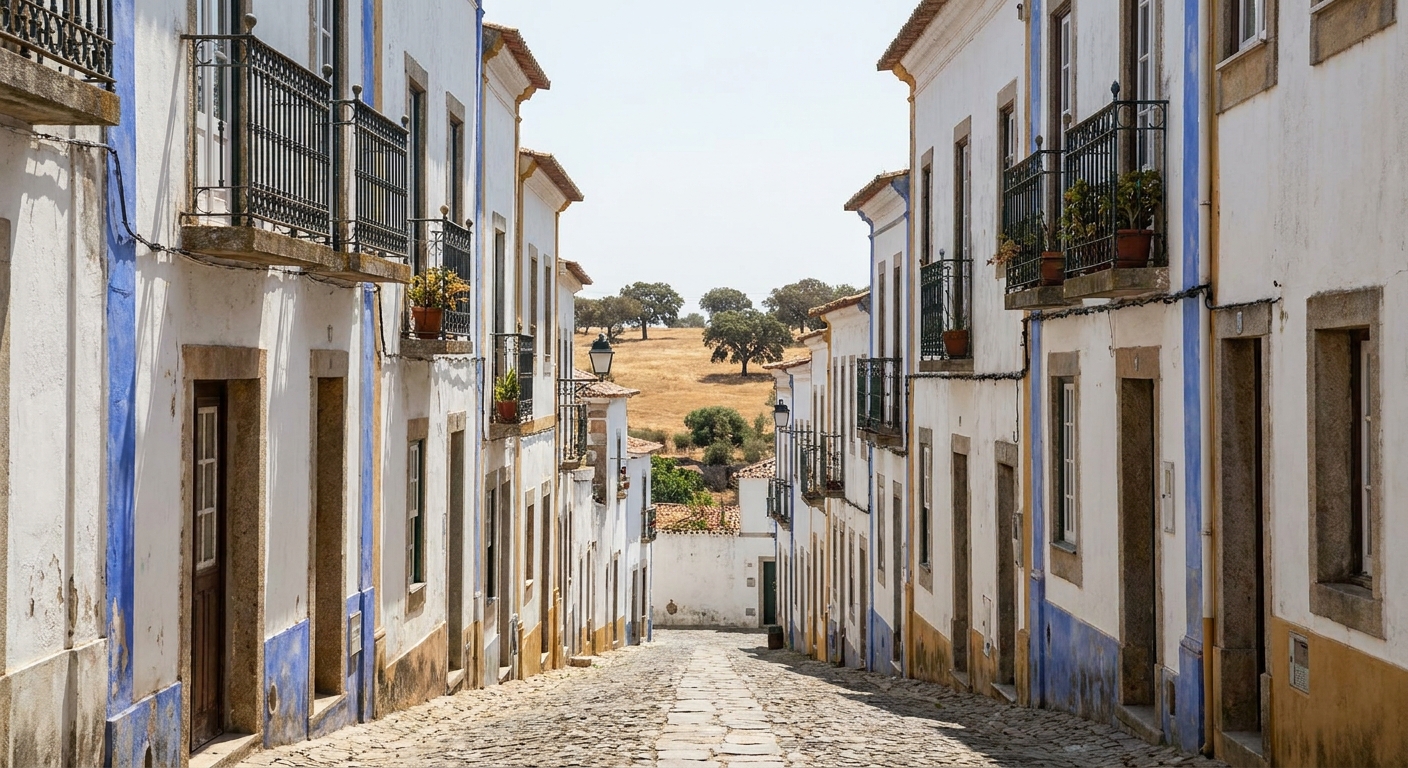
ÉVORA IN JUNE · AT A GLANCE
June gives Évora 14 hours 54 minutes of daylight and only 1.7 rain days, at the price of 86.4°F afternoons that push sightseeing to either end of the day.
IPMA 1991-2020 · STATION 558 AT 247.6 M · UNESCO SINCE 1986 · INLAND ALENTEJO
Go for: dry stone and late light: 0.42 inches of rain across the whole month, and cobbles still lit at 8:30 p.m.
Think twice before: booking a 2 p.m. walking circuit, because the normal high is 86.4°F and the shade inside the walls is narrow-street shade.
Normals: IPMA station 558 · Daylight: sunrise-sunset.org · Monuments: UNESCO file 361 · full sources at the end
On this page
- Average highs, lows and rain daysÉvora weather in June
- How hot the afternoons get86.4°F days, 56.8°F nights
- Crowds, booking and the lodging taxWhat we can and cannot price
- What to see inside the wallsTemple of Diana, Cathedral, Os Loios
- A plan for two daysThe two-day itinerary, hour by hour
- June, May or July?How the three months compare
- Is June a good month here?The June verdict
- Évora in any other monthOur Évora guide
Four weeks either way moves this more than most travelers expect. May’s normal high is 77.0°F with 6.0 rain days, July’s is 91.9°F with 0.6. June sits between them at 86.4°F and 1.7 rain days.
Évora weather in June: average highs, lows and rain days
| June at Évora | Normal, 1991-2020 |
|---|---|
| Average high | 86.4°F (30.2°C) |
| Average low | 56.8°F (13.8°C) |
| Precipitation | 0.42 in |
| Days with 1 mm (0.04 in) or more | 1.7 |
| Days with 10 mm (0.39 in) or more | 0.3 |
| Daylight, June 15 | 14 h 54 min |
Every figure here comes from one instrument: IPMA, the Portuguese national weather service, station 558 inside Évora at 247.6 m, normals computed over 1991-2020. That is a real thermometer with an address, not a model grid cell averaged across a wide box, and the difference is worth knowing when two websites disagree by a few degrees. It also fixes the limits of what these numbers describe. They cover inland Alentejo at Évora and nothing else. High ground runs colder and far wetter, and a coastline has weather of its own.
Rain in June is a rumor rather than a plan. The month collects 0.42 inches, and 1.7 days in an average June record at least 1 mm (0.04 inch), which works out to roughly one wet day in eighteen. Only 0.3 day reaches 10 mm (0.39 inch), so a genuine soaking turns up about one June in three. Those thresholds are IPMA’s own, not the 0.10-inch line that American tables use, so the counts do not swap across the two systems.
Between the 86.4°F afternoon and the 56.8°F dawn sits 29.6°F of daily swing, and a June suitcase has to answer both ends. Something with sleeves for a 7 a.m. start and for a late dinner outdoors, then a hat, sunglasses and a refillable bottle for the stretch from noon to six. Our Portugal packing guide runs the full list.
Light is the month’s real gift. On June 15 the sun rises at 6:05 a.m. and sets at 8:59 p.m. local time, 14 hours 54 minutes of daylight. You can leave a monument at six, sit down outside, and still be walking cobbles in full daylight when the plates are cleared.
How warm is Évora in June?
The normal high is 86.4°F (30.2°C) and the normal low 56.8°F (13.8°C), a spread of 29.6°F inside a single day. Évora is an inland Alentejo city, and we found no sea-surface series to quote for it, so no water temperature appears anywhere in these figures. When we do give sea temperatures on coastal pages such as the Algarve, they are averages of daily maxima and run a little warmer than a 24-hour mean, which is why they rarely match other tables.
In practice the day splits in two. Mornings start cool enough for a light layer that you will carry by ten, and the walking hours are the ones before lunch. From roughly one o’clock the granite and whitewash throw the heat back at you, and the sensible move is an indoor lunch, a shaded square or a room with a fan running until the sun drops off the rooftops.
We found no daily-minimum series for the station, so we count no cold nights and give no record low. What the normals do say is that a June low of 56.8°F sits far from freezing, and nothing in an Évora June asks for more than a sweater after dark.
How busy is Évora in June? Crowds, prices and the demand peak
June opens the European summer travel season, and we offer that as a calendar fact rather than a measurement. We found no occupancy series and no monthly room-rate series for Évora, so we crown no month cheap and no month expensive. What we can say with numbers is that the weather stops being a gamble: 1.7 rain days against May’s 6.0 removes the main reason a visitor cancels a walking day.
Without rate data we will not dress a booking window up as arithmetic. Our working habit for a walled city with a small historic core is to fix the Friday and Saturday nights first and leave the weekday nights flexible, since the center holds a limited number of beds inside the walls. Where to stay in Portugal and what a trip costs carry the regional picture.
We could not verify a lodging-tax rate for Évora, so we give no percentage and no per-night figure. Ask at check-in whether a municipal tax applies and whether it was included in the rate you booked, and read our know-before-you-go page for the national paperwork that does not change by month.
One spending line genuinely changes June, and it is cooling. A room that actually cools at 86.4°F buys you the afternoon back, and a rental car whose air-conditioning works turns the surrounding Alentejo into an option instead of an endurance test. Our car guide covers the tolls and the paperwork.
Things to do in Évora in June: the Temple of Diana, the Cathedral and the Vauban wall
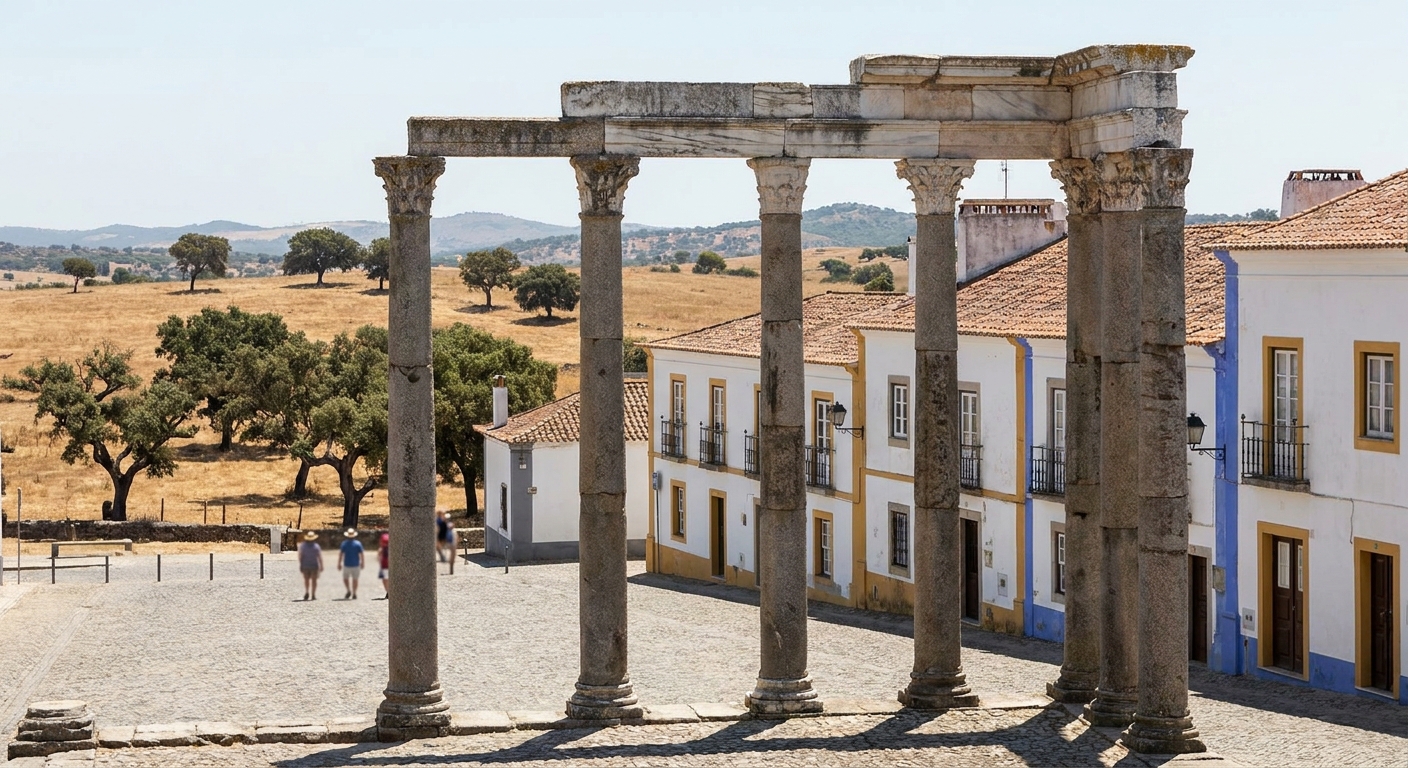
June is the month the whole city becomes an outdoor exhibit with a reliable roof of blue. With 1.7 rain days against May’s 6.0, a full day of streets, walls and open ruins is close to a safe bet, and 14 hours 54 minutes of daylight means you can split that day around the heat instead of surrendering it. Neither of those two things is true in the same way four weeks earlier.
The named set inside the walls is dense. The ruins of the Temple of Diana still stand, along with stretches of Roman wall reworked in the Visigothic period, plus a fortified gate and the remains of the Kasbah left behind when Moorish rule ended in 1165. The Cathedral, the best known of the medieval buildings, was completed in the 13th century. The golden-age layer arrived with the 15th-century kings: the Convent of St Claire, the royal church and convent of São Francisco, and Os Loios with the church of São João Evangelista. Jesuits taught at the University of the Holy Spirit from 1553 until the Company was expelled in 1759.
None of that stone moves with the season, but the air around it does, and that is what makes a June visit a different visit. At 86.4°F outside, a convent interior becomes a destination in its own right at two in the afternoon. UNESCO’s argument for the city is not one monument anyway but the coherence of its 16th, 17th and 18th-century minor architecture: low whitewashed houses with Dutch tiles and wrought-iron balconies on narrow medieval streets, including the Cordovil house and the house of Garcia de Resende. Narrow streets hold shade, and in June you will use it.
We could not verify a single opening hour or admission price for any Évora monument, so we quote none: check each door before you build a morning around it. What costs nothing is the part June rewards most, the 17th-century Vauban-style wall built to the plans of the French engineer Nicolas de Langres, classified under national law in 1920 and preserved in part by the 20th-century ring road laid around it.
Évora in June: a two-day itinerary
Day one runs early and late, with a hole punched in the middle. Out by 7:30 while the air still remembers 56.8°F, walking the wall ring and the streets it holds. By nine, the Temple of Diana and the Cathedral quarter, with any ticketed interior taken between ten and noon, hours permitting. Long lunch indoors from one. Back out at six for São Francisco and the convent streets, then dinner outside, because the sun on June 15 holds until 8:59 p.m.
Day two goes to the golden-age buildings, Os Loios and São João Evangelista, the old university quarter, and the Cordovil and Garcia de Resende houses, with the afternoon given to the Alentejo by car. If the rain does land, and it lands on 1.7 days in an average June, it costs you very little: swap the driving hours for interiors and keep the walking for the evening, when the pavement dries within an hour of the shower.
Évora in June vs May and July
| Normal, 1991-2020 | May | June | July |
|---|---|---|---|
| Average high | 77.0°F (25.0°C) | 86.4°F (30.2°C) | 91.9°F (33.3°C) |
| Average low | 51.6°F | 56.8°F | 60.1°F |
| Precipitation | 1.83 in | 0.42 in | 0.11 in |
| Days with 1 mm (0.04 in) or more | 6.0 | 1.7 | 0.6 |
All three columns come from the same station and the same 1991-2020 period, so the comparison is clean. June’s daytime normal of 86.4°F runs 9.4°F above May and 5.5°F below July. Nights climb in even steps, 51.6°F to 56.8°F to 60.1°F. Rainfall is where the three months separate hardest: May collects 1.83 inches over 6.0 wet days, June 0.42 inches over 1.7, July 0.11 inches over 0.6. No sea figure belongs to any of them, since the thermometer is inland.
Shift four weeks earlier and you trade 9.4°F of afternoon heat for more than three times as many wet days, which is the deal Évora in May offers. Shift four weeks later and you buy near-total dryness at 91.9°F, the bargain laid out in Évora in July. June is the narrow band where the rain has stopped and the thermometer has not finished climbing.
Is June a good time to visit Évora?
Yes, for a traveler willing to start at half past seven and treat two in the afternoon as indoor time. A walled city of granite and whitewash with 0.42 inches of rain in the month and daylight until nine is close to ideal for anyone who wants monuments plus long evenings. No, for anyone who needs to sightsee between one and five, or who travels with small children who wilt above 85°F.
If that is you, May is the month to take instead, at 77.0°F by day and 51.6°F at night. The cost is written in the same table: 6.0 days with measurable rain and 1.83 inches, so roughly one May day in five interferes with a walking plan. That is the exchange, and it is a fair one for heat-sensitive visitors.
No other month pairs 14 hours 54 minutes of daylight with fewer than two wet days and afternoons still 5.5°F short of July’s.
The last word
Book the June trip, then split every day in two and stop apologizing for the siesta: the 29.6°F gap between dawn and mid-afternoon is doing the scheduling for you. One line worth carrying through the gate, from UNESCO’s own file: Évora is called the finest example of a city of the golden age of Portugal after the destruction of Lisbon by the 1755 earthquake. It survived because the shock that leveled the capital barely touched it, and in June you get almost fifteen hours of daylight to walk what survived.
Sources & data for this guide
- June normals, high 86.4°F, low 56.8°F, 0.42 in, rain-day counts · IPMA (Instituto Português do Mar e da Atmosfera), 1991-2020 normals, station 558 Évora, altitude 247.6 m · checked Sep 24, 2026
- May and July normals used in the comparison table · same IPMA station and same 1991-2020 period, not estimates · checked Sep 24, 2026
- Daylight of 14 h 54 min, sunrise 05:05 UTC and sunset 19:59 UTC on June 15, converted to Europe/Lisbon · sunrise-sunset.org · checked Sep 24, 2026
- UNESCO inscription of 1986 under criteria (ii) and (iv), Temple of Diana, Roman and Moorish remains, 13th-century Cathedral, golden-age convents, University of the Holy Spirit, Cordovil and Garcia de Resende houses, Vauban-style wall by Nicolas de Langres, 1920 classification · UNESCO World Heritage Centre, file 361 · checked Sep 24, 2026
- Rain-day thresholds are IPMA’s 1 mm and 10 mm, not the 0.10-inch threshold of US tables · the counts are not interchangeable
- We could not verify any opening hour or admission price for an Évora monument, nor an occupancy series, a monthly room rate or a lodging-tax rate · no such figure appears above