
LAGOS · AUGUST · THE ALGARVE
The town is settled: you are going to Lagos. August is the part still open, and the month hands this coast three things at once. Air that runs warmer than July or September. A rain total of 0.06 inches for the whole month. And an Atlantic at 62.1°F, cooler in August than in either neighbor month, which is the one line of the forecast nobody expects.
Most American trips land at Faro and reach Lagos by train or rental car, so the August decision is really a booking decision: how many nights, how early you lock the room, and whether four weeks either way buys you a better trip. We found no occupancy or room-rate series for Lagos, so no month gets crowned the year’s priciest here. What we do have is the climate record, the sea record, and the museum’s own hours.
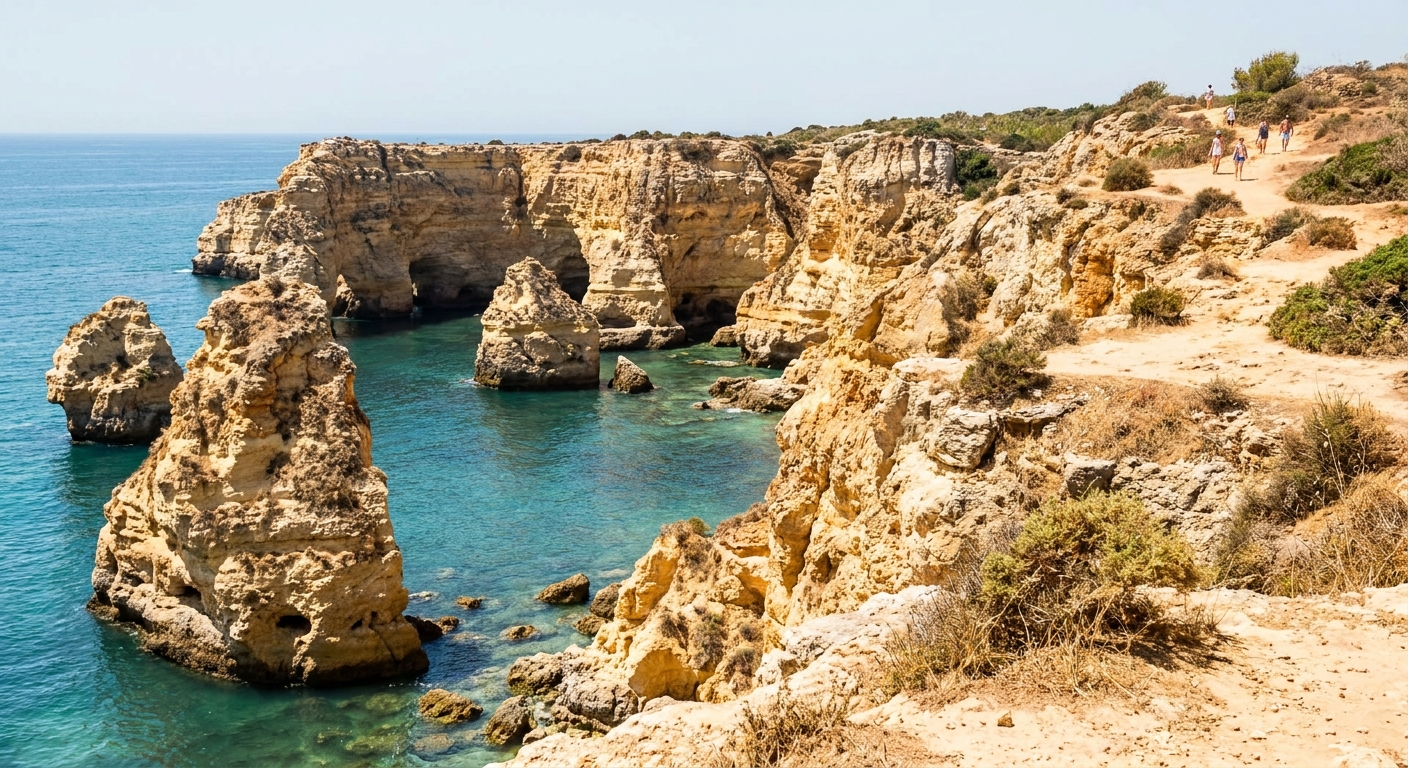
THE MONTH AT A GLANCE · LAGOS · AUGUST
August gives Lagos its warmest air of the midsummer trio and a rain column that barely registers, and the ocean, at 62.1°F, is the one thing the month does not warm up.
WARMEST AIR OF THE THREE · COOLEST SEA OF THE THREE · LIGHT UNTIL 8:28 P.M.
Go for: dry, warm, predictable days, evenings that run to 8:28 p.m., and indoor museum hours from 2 p.m. to 6 p.m. exactly when the air is at its worst.
Think twice before: promising anyone a warm sea. At 62.1°F, and that is a mean of daily maxima, the Atlantic here is a quick swim, not a soak.
Air and rain: IPMA 1991-2020, station 533 Sagres · Sea: Open-Meteo Marine, 2015-2024 · Hours: Museu de Lagos · full sources at the end
On this page
- Lagos weather in August78.6°F highs and 0.06 inches of rain
- Sea temperature in August62.1°F, cooler than July and September
- Crowds and prices in AugustWhat we verified, and what we could not
- Things to do when it is hotRota da Escravatura, Praia da Luz, Ponta da Piedade
- A two-day plan for LagosHour by hour, from 6:51 a.m. to 8:28 p.m.
- August, July or September?How the three months compare, in figures
- Is August the right month?Our answer, and who should shift dates
One caveat before the figures. Every number here for air and rain comes from one official station, and every number for the sea comes from a marine model offshore. Neither is a thermometer on your balcony, and the gap between them is worth knowing before you pack.
Lagos weather in August: average highs, lows and rain days
| August in Lagos | The figure |
|---|---|
| Average high | 78.6°F |
| Average low | 63.3°F |
| Rainfall for the month | 0.06 in |
| Days with 1 mm (0.04 in) or more | 0.4 |
| Days with 10 mm (0.39 in) or more | 0.0 |
| Sea surface, mean of daily maxima | 62.1°F |
| Daylight on August 15 | 13 h 37 min |
| Sunrise and sunset, August 15 | 6:51 a.m. · 8:28 p.m. local |
The 1991-2020 normals published by IPMA, Portugal’s national weather service, put August at an average high of 78.6°F and an average low of 63.3°F, with 0.06 inches of rain across the entire month. The instrument behind those figures is station 533 at Sagres, 22.9 m above sea level, roughly 75 feet, a real thermometer rather than a model grid cell. Sagres is also the windiest point of the Algarve and the nearest published station to Lagos, so these numbers describe the coast. Higher ground inland runs colder and a good deal wetter.
Rain, in practice, is not a factor. An average August records 0.4 days with at least 1 mm (0.04 inch) and zero days with 10 mm (0.39 inch) or more, which works out to one lightly wet day every two or three Augusts and no real soaking on record for the period. Watch the threshold: IPMA counts from 1 mm, while American tables usually start at 0.10 inch, so the two sets of rain-day counts are not interchangeable and should never be averaged together.
The spread between day and night is 15.3°F, and that is the whole packing argument. Afternoons sit near 78.6°F with almost no cloud to soften them, then the coast gives the heat straight back after dark, down to a 63.3°F average low, with wind coming off the same Atlantic the station sits above. Pack a real layer for evenings on a terrace, plus something that stops wind rather than rain. Our packing guide covers the rest of the suitcase.
August still has long days, though the year has started taking them back. On August 15 the sun is up for 13 hours 37 minutes, rising at 6:51 a.m. and setting at 8:28 p.m. local time (05:51 and 19:28 UTC). Dinner outdoors starts in daylight and ends in it. More usefully, the last two hours before sunset are the only stretch of the afternoon when the cliff paths are comfortable, and that stretch is dependable every single evening of the month.
Can you swim in Lagos in August? Sea temperature and what it feels like
The sea surface off Lagos averages 62.1°F in August. That figure is not from the weather station: it comes from the Open-Meteo Marine model, averaged over 2015-2024, and it is a mean of daily maxima, so it reads a shade warmer than a true 24-hour average would. Treat 62.1°F as the friendly end of the range, not the middle of it, and expect the early morning water to sit under that number rather than over it.
Swimming is entirely possible and nobody lingers. At 62.1°F the first thirty seconds are sharp, the next ten minutes are fine, and most adults come out before they planned to. Children go in faster and stay in longer, which is the usual injustice. The air does the recovery work: 78.6°F on a towel warms you back up quickly, and that contrast, cold water and hot air, is the actual August experience on this coast. A shorty wetsuit changes a swim into an afternoon.
On wind and swell we have nothing to quote. We could not verify a wave-height or wind series for August at Lagos, so we give no figures and no averages. Sagres is the windiest point of the Algarve. Check a marine forecast the morning of a boat trip out to Ponta da Piedade, because that is a decision made on the day, not from a monthly table.
How busy is Lagos in August? Crowds, prices and the demand peak
August is the top of the European summer holiday calendar, and the Algarve is one of the places that calendar points at. That much is a fact of the school year. What we cannot do is rank the month by money: no occupancy series and no monthly room-rate series for Lagos passed through our hands, so we call no month the year’s most expensive and we publish no percentage. The demand signal we can defend is the weather itself, 0.4 wet days and 78.6°F, which is precisely what draws the crowd.
Booking lead time follows from that. We have no booking-window data for Lagos either, so here is the reasoning rather than a number: August dates are the least flexible of the year in a town of this size, and a room with free cancellation held early costs nothing to abandon later. Lock lodging before flights if the trip is built around Lagos rather than around a fare. Where to stay in Portugal sorts the bases, and the flights guide handles the transatlantic half.
On the municipal lodging tax, our cards are on the table: we could not verify whether Lagos charges one, or at what rate, so no amount appears anywhere here. Ask the property directly at booking and read the confirmation line by line, since this kind of charge is normally collected at the accommodation rather than online. What a week in Portugal costs carries the budget framework we do stand behind.
One spend genuinely changes August: a rental car with working air conditioning. It turns the 2 p.m. to 6 p.m. dead zone into travel time, puts Praia da Luz and Sagres within an easy afternoon, and lets you chase the wind rather than sit in it. We carry no rental prices for the month, so we quote none. Our car guide covers insurance and the toll system, which is where the real money hides.
Things to do in Lagos in August: the Rota da Escravatura, Praia da Luz and Ponta da Piedade
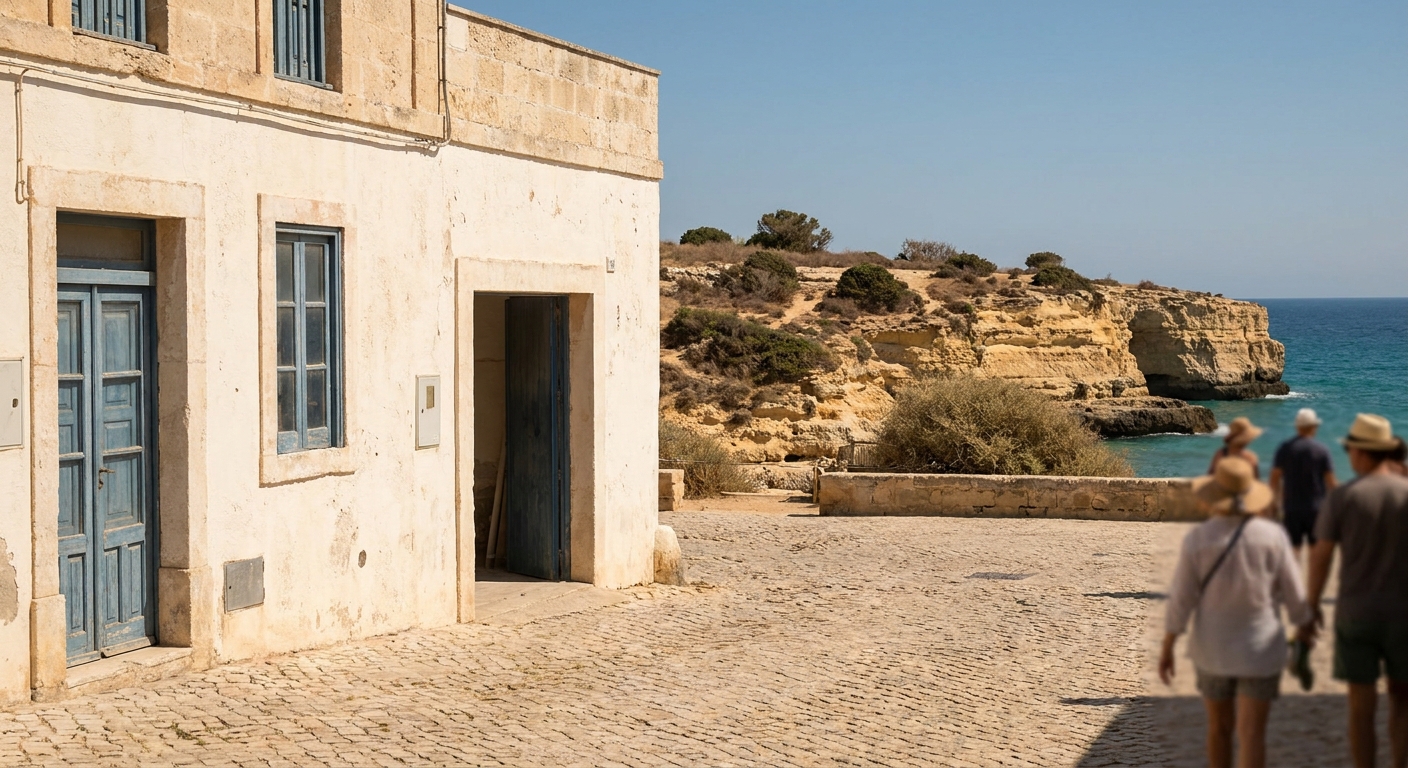
What August gives that September cannot is a schedule that holds. With 0.4 wet days in the average month, an outdoor plan made on Monday is still the plan on Thursday, and 13 hours 37 minutes of daylight on the 15th leaves room for three separate acts in one day: a cool start, a long indoor middle, and an evening outdoors. September brings 2.5 wet days and 0.73 inches of rain, enough to rearrange a week that was built around cliffs and boats.
The Museu de Lagos is not one address but seven: the main museum, the Dr. José Formosinho collection, the Forte Ponta da Bandeira, the Rota da Escravatura, the Centro de Documentação, the Armazém do Espingardeiro, and the Roman bath house at Praia da Luz. The Rota da Escravatura, also called the Mercado de Escravos, stands on Praça do Infante and opens Tuesday to Sunday, 10:00 to 13:00 and 14:00 to 18:00, with last admission half an hour before each close.
Stone does not have a season, but air does, and that gap is what makes these sites an August asset rather than a rainy-day fallback. The 14:00 to 18:00 session lands exactly on the hottest block of a 78.6°F day. Two planning notes. The museum’s published closure dates (1 January, Easter Sunday, 25 April, 1 May, and 1, 24 and 25 December) include no August date, so Tuesday to Sunday holds all month, with Mondays shut. And the Forte Ponta da Bandeira is temporarily closed, per the museum’s own page of 16 July 2026.
We would like to tell you what is free in August and we cannot. Our sources carry no admission price and no free-admission day for any of the seven museum sites, and no figure at all for Ponta da Piedade or the town beaches, so we invent none and quote none. The museum publishes hours and closures, not a stable price list. Bring cash for a small counter, check prices at the door, and treat the cliff path and the wider Algarve coast as the unbookable part of the trip.
Lagos in August: a two-day itinerary
Day one. Sunrise is at 6:51 a.m., so be walking the cliffs toward Ponta da Piedade by 7:30 and back in town before 11:00, while the air is still well under its 78.6°F average high. Take the Rota da Escravatura on Praça do Infante at 11:30, with last admission at 12:30 before it shuts for lunch. Eat long, sit still from 13:00 to 16:00, then take the water in late afternoon at 62.1°F when the sand has stopped burning. Dinner outdoors, light until 8:28 p.m.
Day two heads west to Praia da Luz for the morning swim and the Balneário Romano, the Roman bath house that is one of the museum’s seven sites. Keep the 14:00 to 18:00 block free and spend it indoors at whichever site you skipped. What turns a day here is not rain, given 0.4 wet days, but wind off a coast whose nearest station is the windiest point of the Algarve: if it gets up, drop the boat trip, move the museum session forward, and save the cliffs for the calm hour before sunset.
Lagos in August vs July and September
| July | August | September | |
|---|---|---|---|
| Average high | 77.4°F | 78.6°F | 76.8°F |
| Average low | 62.6°F | 63.3°F | 62.1°F |
| Rainfall | 0.04 in | 0.06 in | 0.73 in |
| Days at 1 mm (0.04 in) or more | 0.2 | 0.4 | 2.5 |
| Sea surface (daily maxima) | 63.3°F | 62.1°F | 64.2°F |
Read the columns and the trio sorts itself. August wins the air by 1.2°F over July and 1.8°F over September, and it keeps nights warmest too, 0.7°F above July and 1.2°F above September. It loses the water to both: September’s 64.2°F is 2.1°F warmer, July’s 63.3°F is 1.2°F warmer. Rain is where September parts company, with 0.73 inches against 0.06 and 2.5 wet days against 0.4, a step up of roughly twelvefold in total and sixfold in wet days. All air figures share one station and one 1991-2020 period.
Shift four weeks forward and you trade 1.8°F of daytime warmth for the warmest sea of the three, at the cost of a genuine chance of a wet afternoon. Shift four weeks back into July and you give up 1.2°F of air but pick up 1.2°F of water and the driest month of the trio, 0.2 wet days against 0.4. Neither move is dramatic. The one that actually changes the trip is September, because 2.5 wet days rewrite a cliff-and-boat week.
Is August a good time to visit Lagos?
Yes, for anyone whose trip runs on reliability. Dry days, 78.6°F afternoons, a museum block that opens at exactly the hour the sun becomes unfriendly, and light on the water until 8:28 p.m. No, for two groups: anyone expecting Mediterranean bathwater, since 62.1°F is a bracing swim even read from daily maxima, and anyone who wants a quiet old town during the busiest school-holiday stretch on the European calendar.
If the sea is the point, go in September. The water reaches 64.2°F, its warmest of the three months, and daytime air only drops to 76.8°F, which you will barely feel. The price is written in the rain column: 0.73 inches and 2.5 days at 1 mm or more, against nearly nothing in August. For a broader view across the whole year, the twelve-month verdict for Portugal and the Algarve guide take it from there.
What no other month in the trio offers is this exact combination: the warmest air of the three at 78.6°F, a monthly rain total of 0.06 inches, and 13 hours 37 minutes of usable daylight on the 15th.
The last word
Decide the water first and the month decides itself: if a 62.1°F swim sounds fine, August is the sturdiest three weeks on this coast, and if it does not, September buys you 2.1°F and a weather risk. Then give one August afternoon to the harder history. In 2009, a dig at Vale da Gafaria outside the walls, run ahead of an underground car park, turned up a modern-era refuse tip holding more than 150 human skeletons: African people brought to Lagos as merchandise and discarded with the town’s waste. The museum on Praça do Infante tells that story, Tuesday to Sunday.
Sources & data for this guide
- August air normals (78.6°F / 63.3°F, 0.06 in) and rain-day counts (0.4 days at 1 mm, 0.0 at 10 mm) · IPMA, 1991-2020 normals, station 533 Sagres, altitude 22.9 m · checked Sep 23, 2026
- July and September air normals used in the comparison table · same IPMA station and same 1991-2020 period · checked Sep 23, 2026
- Sea surface 62.1°F (August), 63.3°F (July), 64.2°F (September), mean of daily maxima 2015-2024 · Open-Meteo Marine API · checked Sep 23, 2026. Different from the IPMA source above, and read on a different period
- Daylight 13 h 37 min, sunrise 05:51 UTC and sunset 19:28 UTC on August 15, converted to local time · sunrise-sunset.org · checked Sep 23, 2026
- Rota da Escravatura hours and annual closure dates, the seven museum sites, the Forte Ponta da Bandeira closure and its 1680-1690 construction, the Balneário Romano at Praia da Luz, and the 2009 Vale da Gafaria excavation · Museu de Lagos, Câmara Municipal de Lagos, page updated Jul 16, 2026 · read Sep 22, 2026
- We could not verify admission prices for any Lagos museum site, a municipal lodging-tax rate, occupancy or room-rate series, or any wave and wind series for August. No figure is given for those, and none is estimated. Hours and closures change: confirm with the museum before you go.