
SINTRA · MARCH · THE MONTH IN NUMBERS
Sintra’s March sits between a normal high of 65.1°F and a normal low of 50.5°F, with 2.63 inches of rain falling on 7.2 wet days. Those are the official 1991-2020 normals from IPMA, the Portuguese weather service, read off a thermometer at Lisbon’s airport, 20 km away and 103.9 m up. The Serra de Sintra manufactures its own cloud, and the hill itself runs several degrees colder and a great deal mistier than that reading.
What March hands a visitor is daylight and a climbable temperature: about 12 hours of it on the 15th, sun up at 6:45 a.m. and down at 6:45 p.m., with palace gates opening at 9:00 and 9:30. Afternoons run 4.8°F warmer than February. The rain has not finished, and the ticket ladder at Pena starts at €12.
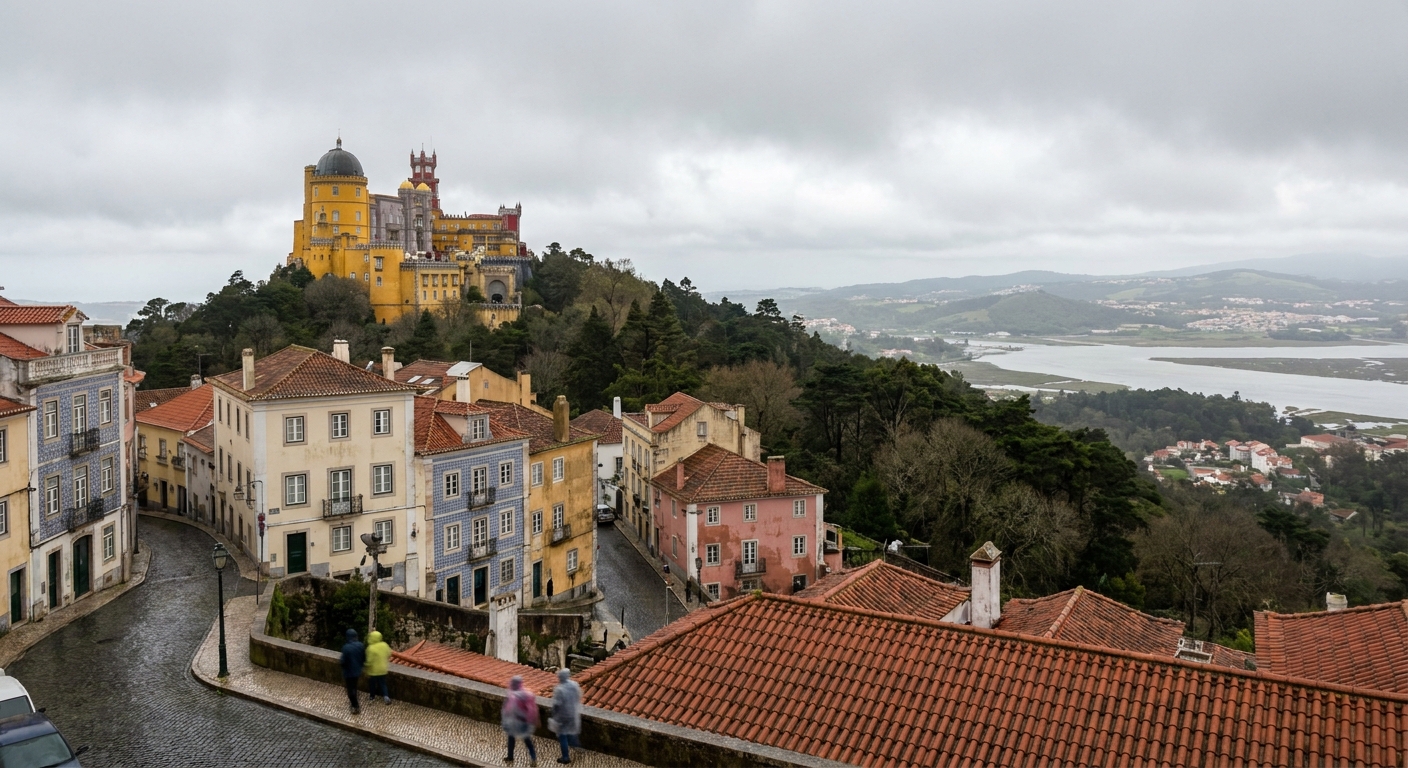
THE MONTH AT A GLANCE · SINTRA IN MARCH
March gives Sintra 65.1°F afternoons, about 12 hours of daylight and 7.2 wet days, warmer than February by 4.8°F and cooler than April by 2.7°F.
AVG HIGH 65.1°F · 7.2 WET DAYS · DAYLIGHT 12 HOURS · PENA PARK FROM €12
Go for: palace parks at walking temperature, 210 hectares at Pena and 50 at Monserrate, and gardens that open at 9:00 while the light holds until 6:45 p.m.
Think twice before: building a coast day around swimming. We found no sea-surface series for this shore, and 2.3 March days bring 0.39 inch of rain or more.
Air normals: IPMA station 579, 1991-2020 · Tickets and hours: Parques de Sintra, Sept 22, 2026 · full sources below
On this page
- Average highs, lows and rain days in March65.1°F days, 7.2 wet days
- Morning and afternoon temperatures50.5°F at dawn, 65.1°F by mid-afternoon
- Crowds and ticket prices€12 to €45 at Pena, €13 at the National Palace
- Things to do in Sintra in MarchPena, Monserrate, the Capuchos and Cabo da Roca
- A two-day plan for SintraHour by hour against a 6:45 p.m. sunset
- March vs February and AprilHow the three months compare, in numbers
- Is March a good month to visit?Our verdict, and when to shift four weeks
The palace-by-palace ranking lives in our Sintra guide, and the country-wide calendar in the 12-month verdict. March changes two things about both: 12 hours of daylight against a 6:00 p.m. last admission at Pena’s park gate, and an entry ladder that runs from €12 to €45.
Sintra weather in March: average highs, lows and rain days
| Measure | March normal, 1991-2020 |
|---|---|
| Average high | 65.1°F (18.4°C) |
| Average low | 50.5°F (10.3°C) |
| Day-to-night spread | 14.6°F |
| Precipitation | 2.63 inches |
| Days with 1 mm (0.04 in) or more | 7.2 |
| Days with 10 mm (0.39 in) or more | 2.3 |
| Daylight on March 15 | About 12 hours, 6:45 a.m. to 6:45 p.m. |
Every figure here comes from one source, and it deserves naming: IPMA’s 1991-2020 climatological normals for station 579, Lisboa Gago Coutinho, a real instrument at an altitude of 103.9 m. That is a station record, not a reanalysis grid cell, so the precision is genuine. The location is not. The station sits at Lisbon’s airport, 20 km east and far lower than the Serra, and the Sintra ridge is colder and mistier than its own numbers suggest. Pack for a hill, read a coastal thermometer.
IPMA counts 7.2 March days with 1 mm (0.04 inch) or more, which works out to measurable rain roughly one day in four, and 2.3 days with 10 mm (0.39 inch) or more. Those thresholds are the Portuguese service’s own, not the 0.10-inch cutoff American tables use, so the counts do not swap across borders. Translated into a visit: most wet days damp a jacket between palace gates, and twice in the month the paths get properly soaked.
The 14.6°F gap between 50.5°F at first light and 65.1°F in mid-afternoon is what decides the bag. A fleece or light down for the 9:00 opening, a shell for the ridge, and a shirt you can strip to by two o’clock. Cotton that has absorbed hill mist stays cold all morning. Our packing guide covers the rest of the country; Sintra’s addition is a hat that survives wind on the ramparts.
On March 15 the sun rises at 6:45 a.m. and sets at 6:45 p.m. local time, an even 12 hours. Portugal has not yet moved its clocks at mid-month, so evening light arrives late by American standards but the gates close first: Pena’s park takes its last admission at 6:00 p.m. and the palace at 5:30, the Moorish Castle at 5:30, Monserrate’s palace at 6:00. Sunset outlasts the final ticket by three quarters of an hour.
How warm is Sintra in March?
A normal March day climbs from 50.5°F to 65.1°F and comes back down, a swing of 14.6°F inside twelve hours of light. In American terms that is a Carolina spring morning turning into a mild San Francisco afternoon, except that the afternoon happens on a ridge that catches Atlantic cloud. February’s high was 60.3°F, so this is the month the thermometer crosses into comfortable climbing territory for the first time since autumn.
Dress it in two halves. At the 9:00 park openings you want sleeves, a layer over them and shoes that cope with wet granite steps. By the time you come out of Pena’s interiors around noon the shell is in the bag, and lunch in town is a shirt-sleeve affair on a clear day. Reverse the order at 5:00 p.m., when the ramparts cool faster than the town below.
Frost is not a normal March concern at a low of 50.5°F, though we could not verify a count of freezing nights for the Serra itself, and the hill runs colder than the airport thermometer that produced that figure. One more reserve while we are counting: we found no sea-surface temperature series for this coast, so we quote no water temperature and make no claim about swimming at Cascais or below Cabo da Roca.
How busy is Sintra in March, and what do tickets cost?
Start with what is actually priced. Parques de Sintra published these on September 22, 2026: €12 for the Park of Pena alone, €20 for the Essential visit to park and palace, €45 for the Full Tour, children under 6 free. The Moorish Castle is €12 for adults and €10 for youths 6 to 17 and visitors over 65. Monserrate is €12, the Convent of the Capuchos €11, the National Palace of Sintra €13. We found no occupancy or room-rate series for Sintra, so we crown no month cheap and none expensive.
We also could not verify advance-booking windows or sell-out patterns for any of the eleven parks and monuments Parques de Sintra runs, so we give no number of weeks. Two practical things can still be settled from home: which tier of Pena ticket you want, and how you reach the hill. On that second point our reading came up short. We could not read a Lisbon-to-Sintra train fare or journey time from an operator page, nor a bus timetable inside the Serra, so budget that leg separately and check it against the transport guide.
We could not verify a Sintra lodging-tax rate either, so no per-night amount appears above or below. If your hotel adds one at checkout, it is not in our arithmetic.
One upgrade genuinely changes a March day: the €4.50 round-trip transfer between the park entrance and the palace door. The Park of Pena covers 210 hectares of walled hillside, and on a morning when the cloud is sitting on the ridge, €4.50 converts a cold uphill walk into ten dry minutes. On a clear day it is the walk you came for, and the money stays in your pocket.
Things to do in Sintra in March: Pena, Monserrate and Cabo da Roca
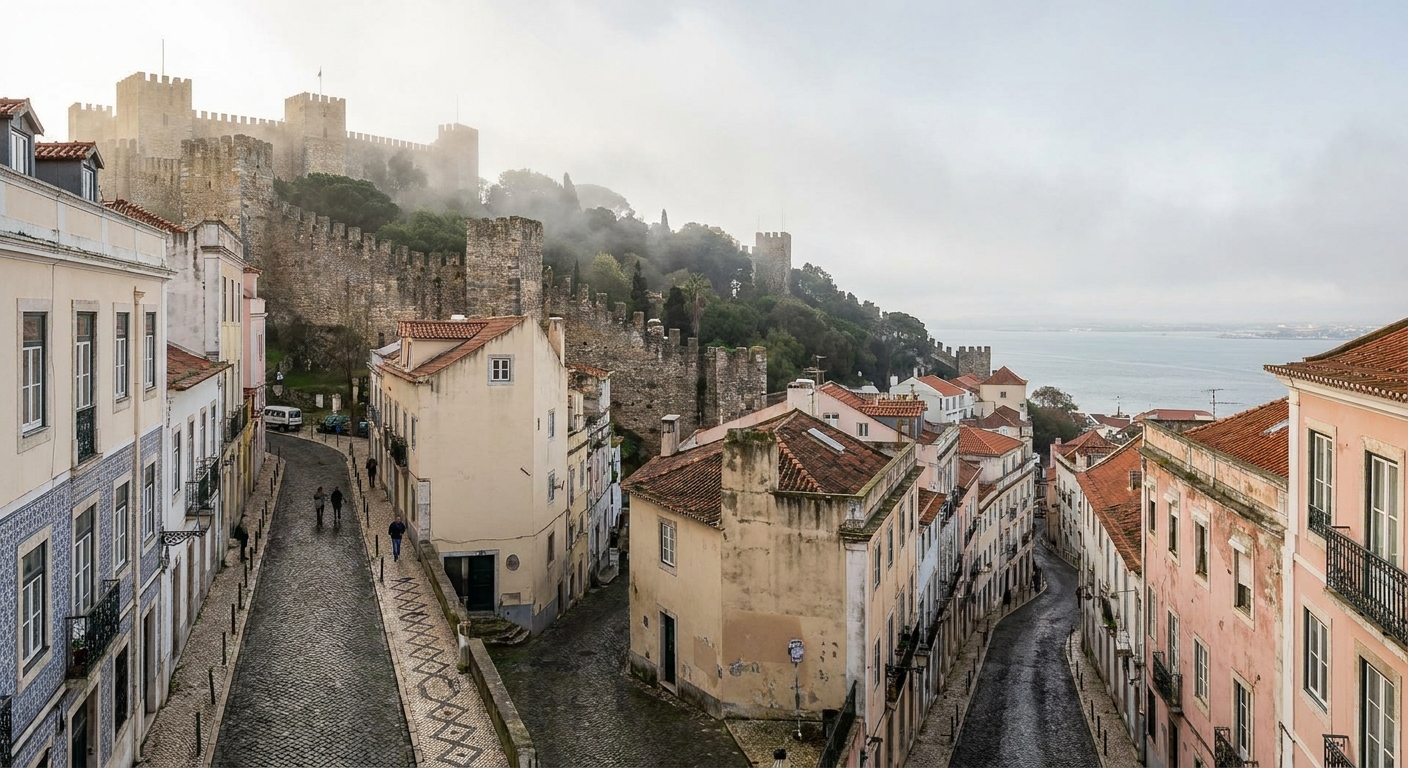
March is the month for covering ground on foot. The UNESCO Cultural Landscape of Sintra, inscribed in 1995, takes in 946 hectares with a 3,641-hectare buffer zone around it, all of it inside the Sintra-Cascais Natural Park and protected by national legislation since 1994. Walking a serious share of that at 65.1°F, with twelve hours of light to spend, is a different proposition from doing it in August heat or on a seven-hour December afternoon.
The Park of Pena runs to 210 walled hectares and swallows the Tapada do Mocho and the Moorish Castle inside it; Ferdinand II started planting it around 1840 with species shipped from North America, Asia and New Zealand. Monserrate adds 50 hectares on the northern slopes, holding over 3,000 exotic species set out after a study of the ground’s microclimatic zones. The Convent of the Capuchos closes earliest on the hill, at 5:30 p.m., for €11. West at the edge of the continent, the Cabo da Roca lighthouse opens its courtyard and interpretation center 9:30 to 5:30, €5 for the Essential visit and €10 to go up the tower.
None of those collections changes with the calendar. The air around them does, and that is the whole seasonal argument: a 14.6°F daily swing, mist that forms and burns off on the ridge, and gardens laid out by microclimate showing the difference between a sheltered hollow and an exposed slope more plainly than they will in July. Monserrate’s park gate opens at 9:00 and stays open until 7:00 p.m., a full hour past its own palace.
Villa Sassetti charges nothing between 10:00 and 6:00, and the gardens of the National Palace of Sintra are free to enter. Both work as the spine of a walking day when the €20 and €12 tickets have already done their damage.
Sintra in March: a two-day itinerary
Day one begins at Pena’s park gate at 9:00, half an hour before the palace opens at 9:30, so the wooded 210 hectares are yours before the interior queue forms. Give the rooms an hour on the €20 Essential ticket, cross to the Moorish Castle ramparts at €12 with its last admission at 5:30, then come down through Villa Sassetti, free from 10:00, into town. The National Palace of Sintra holds its doors until 6:30 p.m. at €13, and the light on March 15 lasts until 6:45.
Day two goes west. Monserrate opens its park at 9:00 and its palace at 9:30 for €12; the Convent of the Capuchos shuts at 5:30 for €11, so it goes before lunch, not after. Finish at Cabo da Roca, open to 5:30, €5 below and €10 up the tower. If the cloud drops onto the ridge, and 2.3 days a month it drops hard, trade the outdoor half for interiors and let the free palace gardens in town absorb the last hour.
Sintra in March vs February and April
| Measure | February | March | April |
|---|---|---|---|
| Average high | 60.3°F | 65.1°F | 67.8°F |
| Average low | 47.1°F | 50.5°F | 53.2°F |
| Precipitation | 2.80 in | 2.63 in | 2.50 in |
| Days with 1 mm (0.04 in) or more | 7.8 | 7.2 | 7.7 |
| Sea temperature | Not verified | Not verified | Not verified |
All three columns come from the same IPMA station and the same 1991-2020 period, so the gaps are real rather than an artifact of mixed sources. February to March is the bigger jump: 4.8°F on the high and 3.4°F on the low. March to April adds 2.7°F on each. Total rainfall falls steadily across the three, 2.80 to 2.63 to 2.50 inches, while the count of wet days dips in March to 7.2 and climbs back to 7.7 in April.
Shift four weeks later and you buy 2.7°F of afternoon and slightly less water overall, at the cost of half a wet day more on the calendar and whatever Easter demand does to rooms, which we have no series to measure. Shift four weeks earlier and the bill is 4.8°F off every afternoon and the coldest mornings of the three, 47.1°F before the hill’s own correction. Our February page carries that trade in full.
Is March a good time to visit Sintra?
Yes, if your trip is built on legs and gardens. Climbing 210 hectares at Pena, walking the Monserrate slopes and holding a rampart for the view all work better at 65.1°F than they will in midsummer, and the palaces keep their doors open on the same schedule whatever the sky does. No, if you need dry certainty for a fixed date, or if the coast is meant to be swimmable: 7.2 wet days is roughly one in four, and we have no water temperature to offer you.
If that tips you off March, take April rather than February. It brings 67.8°F afternoons and 53.2°F nights, the warmest of the three on both counts, and 2.50 inches of rain, the lowest. The wet-day count barely moves, so you are buying warmth rather than dryness, and you will be buying it alongside more company.
Of the three months, March spreads its rain across the fewest days: 7.2, against 7.8 in February and 7.7 in April, which is the closest this shoulder gets to a run of usable mornings.
The last word
Decide the ticket tier before you decide the day. The €20 Essential at Pena with a 9:00 park entry is the version of Sintra that March was built for, and the €4.50 transfer is the cheap insurance against a ridge under cloud. Parques de Sintra runs eleven sites in all, from the Chalet of the Countess of Edla to the Cabo da Roca lighthouse, and two days touches perhaps five of them. UNESCO listed the landscape in 1995 under criteria (ii), (iv) and (v). Book the hill for your clearest forecast morning and keep the town’s free palace gardens in reserve for the wet one.
Sources & data for this guide
- March, February and April normals: highs, lows, precipitation and wet-day counts · IPMA, normais climatológicas 1991-2020, station 579 Lisboa Gago Coutinho, altitude 103.9 m · checked Sep 22, 2026
- Wet-day thresholds of 1 mm and 10 mm, which are not the 0.10-inch threshold used in US tables · IPMA · checked Sep 22, 2026
- Sunrise 6:45, sunset 18:45 and daylight length on March 15 · sunrise-sunset.org · checked Sep 22, 2026
- Opening times and ticket prices at Pena, the Moorish Castle, Monserrate, the Capuchos, the National Palace, Villa Sassetti and Cabo da Roca · Parques de Sintra – Monte da Lua · checked Sep 22, 2026
- 1995 inscription, criteria, 946-hectare property and 3,641-hectare buffer, park areas and plantings · UNESCO World Heritage Centre, file 723 · checked Sep 22, 2026
- We could not read a Lisbon-to-Sintra train fare or journey time, nor a bus timetable inside the Serra, from an operator page · checked Sep 22, 2026
- We found no sea-surface temperature series for this coast and no occupancy or room-rate series for Sintra, so we quote neither · checked Sep 22, 2026
- Prices and hours change · confirm with Parques de Sintra when you book.