
JAMAICA · PORT ANTONIO · 18.18° N
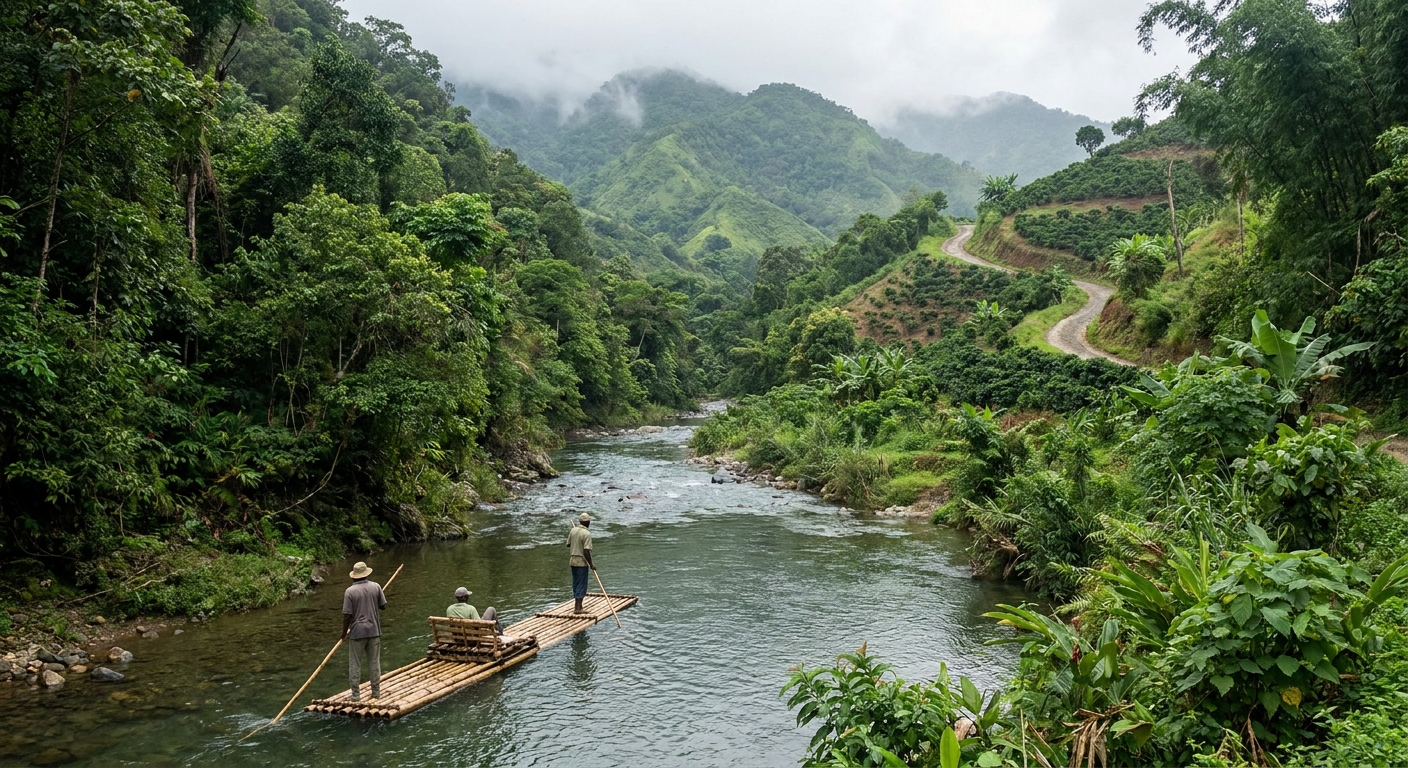
Port Antonio keeps Jamaica’s north-eastern corner to itself: the Blue Lagoon under its wall of green, Frenchman’s Cove where a cold river slides into the sand, Winnifred Beach on a Sunday, bamboo rafts poling down the Rio Grande, jerk pork smoking over pimento wood at Boston Bay. It is also the rainiest corner of the island, and a week here stands or falls on the month you book.
Across a year, 56.44 inches of rain fall on this stretch of coast, and the total is spread very unevenly: April takes 2.58 inches of it, October 7.19, which is the gap between a week of beach mornings and a week of waiting out squalls. The sea barely moves by comparison, averaging between 81.4°F and 87.9°F in all twelve months.
THE YEAR AT A GLANCE · PORT ANTONIO
April is the pick for a first trip: 82.1°F days, 2.58 inches of rain, the year’s fewest wet days at 7.6, and a sea averaging 82.9°F.
DRIEST: APRIL · WETTEST: OCTOBER, 7.19 IN · SEA FROM 81.4°F · ERA5 MODEL REANALYSIS, GRID CELL
Go for: April and February, when rain drops to 2.58 and 2.63 inches and the water still reads in the low 80s.
Think twice before: booking October on fixed dates: 17.8 days record at least 0.10 inch of rain, roughly four days in seven.
Normals: Open-Meteo / ECMWF ERA5 1991-2020 · Sea: Open-Meteo Marine 2015-2024 · full sources at the end
On this page
- Port Antonio weather month by monthHighs, lows, rain and sea, all twelve
- The best month to visit Port AntonioApril: 2.58 inches, 7.6 wet days
- Sea temperature in Port Antonio81.4°F in February, 87.9°F in September
- The quietest time of yearLate April to June, September to early December
- The month to avoidOctober, and who it hurts
- Is the shoulder season worth it?June: 5.01 inches, 13 h 15 of daylight
- When to go elsewhere in JamaicaThe island-wide verdict
Most visitors fly into Kingston or Montego Bay and drive in from there (transfers are covered here). Two dates frame the choice of month before any thermometer does: Jamaica’s winter high season runs from mid-December to mid-April, and the Atlantic hurricane season covers June 1 through November 30 (the storm-season guide).
Port Antonio weather month by month: highs, lows, rain and sea
| Month | Avg high | Avg low | Rain | Days ≥0.10 in | Sea |
|---|---|---|---|---|---|
| January | 79.5°F | 72.2°F | 3.75 in | 9.9 | 82.4°F |
| February | 79.7°F | 72.0°F | 2.63 in | 7.7 | 81.4°F |
| March | 80.4°F | 72.2°F | 3.81 in | 8.6 | 81.8°F |
| April | 82.1°F | 73.5°F | 2.58 in | 7.6 | 82.9°F |
| May | 83.1°F | 75.3°F | 5.99 in | 13.3 | 84.4°F |
| June | 84.1°F | 76.9°F | 5.01 in | 13.0 | 84.8°F |
| July | 84.9°F | 77.2°F | 4.13 in | 11.4 | 85.7°F |
| August | 85.4°F | 77.4°F | 5.20 in | 12.9 | 87.1°F |
| September | 85.1°F | 77.1°F | 6.14 in | 14.5 | 87.9°F |
| October | 83.8°F | 76.0°F | 7.19 in | 17.8 | 87.4°F |
| November | 81.9°F | 74.6°F | 5.43 in | 13.4 | 85.1°F |
| December | 80.4°F | 73.4°F | 4.58 in | 11.5 | 83.2°F |
January through April each stay under 3.81 inches of rain, and the four together take 12.77 inches, less than a quarter of the year’s 56.44. May opens the wet half of the year, and it runs through November with a midsummer dip to 4.13 inches in July.
April hands over to May with 3.41 more inches of rain and 5.7 more wet days, 7.6 rising to 13.3. October then tops the twelve months at 7.19 inches over 17.8 wet days. November eases back to 5.43 inches, December to 4.58, and January reopens the drier stretch at 3.75.
October is the hardest month for anyone locked into one fixed week: 17.8 of its 31 days record at least 0.10 inch of rain, about four days in seven, and 0.9 day records an inch or more, the highest count of the year on both measures. Hikers heading up to the Blue Mountains and campers near the coast feel it first. Beach travelers who can shuffle a day feel it least, with the water at 87.4°F.
Every figure here comes from the ERA5 grid cell over Port Antonio at 18.18°N, 76.45°W, a model reanalysis rather than a reading from an airport station. That cell sits at the wet north-eastern end of Jamaica, the rainiest corner of the island, so these totals belong to Portland parish and not to Negril or the south coast. Sea temperatures come from a separate marine dataset averaged over 2015 to 2024, not from the 1991 to 2020 normals.
When is the best time to visit Port Antonio?
April, and not by a hair. The month averages a high of 82.1°F and a low of 73.5°F, 2.58 inches of rain, the fewest wet days of the year at 7.6, a sea of 82.9°F and 12 hours 36 minutes of daylight on the 15th. Only 0.1 day in an average April records an inch of rain or more, the lowest count of the twelve months.
March is the near miss, with 3.81 inches over 8.6 wet days, 1.23 inches more than April for a sea a degree cooler at 81.8°F. Waiting past April costs more: May brings 5.99 inches over 13.3 wet days, 3.41 inches and 5.7 days above the month before it.
April also closes the winter high season, which ends in mid-April, so the last fortnight keeps the dry weather once the peak calendar has turned (the island-wide timing). February runs a close second at 2.63 inches over 7.7 wet days, with a sea 1.5°F cooler at 81.4°F. For the rest of the trip, what to pack and what to do carry the detail.
When can you swim in Port Antonio? Sea temperature month by month
The water off Port Antonio never drops below 81.4°F, which is February’s figure and the coolest of the twelve months. September peaks at 87.9°F, with October at 87.4°F and August at 87.1°F, so the whole annual span is 6.5°F. January reads 82.4°F, March 81.8°F and April 82.9°F. No month falls below the 80°F line most swimmers treat as warm, which makes rain, not water, the thing that decides a beach day here.
One qualifier on those numbers: each is the mean of daily maxima over 2015 to 2024, the warm end of the day rather than a 24-hour average. A dawn swim reads below the figure in any month, and the Blue Lagoon, fed by cold freshwater springs, runs cooler than the open sea whatever the table says for the coast.
When is Port Antonio quietest?
Jamaica’s winter high season runs mid-December to mid-April, and American school vacation fills mid-June to late August. That leaves two quiet stretches on the calendar: late April into early June, and September through early December. Both sit partly inside the Atlantic hurricane season, June 1 to November 30 (the storm guide).
Quiet buys practical things in a town this small: Winnifred Beach on a weekday with the fishing boats, a Rio Grande raft trip arranged the evening before instead of a week ahead, rooms still open at the harbor hotels, jerk at Boston Bay without a wait. What a week runs in these stretches is covered in our Jamaica trip-cost guide.
September and October are the two wettest months of the twelve, 6.14 and 7.19 inches, and October alone records 17.8 wet days. Daylight shortens along with it: 11 hours 46 minutes on October 15 against 13 hours 15 minutes on June 15. A storm week can take the whole vacation, so a September or October booking wants a refundable rate and insurance.
Which month should you avoid in Port Antonio?
October, and it matters for whom: anyone with a single fixed week, campers, and hikers aiming at the mountains behind town. October gives the wettest ground of the twelve months, 7.19 inches of it, spread over 17.8 days at 0.10 inch or more and 0.9 day at an inch or more, the year’s highest count on both. Four days in seven, on average, catch measurable rain.
Of those 17.8 wet days, fewer than one records an inch or more, which puts most of them in the shower category rather than the washout category. The sea reads 87.4°F, the second-warmest figure of the year, days still average 83.8°F, and the rivers and falls behind Port Antonio run at their fullest. Travelers who can move a plan by a day lose very little.
Is the shoulder season worth it in Port Antonio?
The shoulder months here are May, June and November. Measured against April, the last dry month of the high season, May adds 3.41 inches of rain and 5.7 wet days, June adds 2.43 inches and 5.4 wet days, and November adds 2.85 inches and 5.8 wet days.
June averages a sea of 84.8°F and November 85.1°F, against 82.9°F in April, a gain of nearly two degrees on the best winter month. June 15 carries 13 hours 15 minutes of daylight, 2 hours 3 minutes more than January 15, so an afternoon on the river still leaves an evening swim. Raft trips also run on fuller water than they do in April.
Wet days climb from 7.6 in April to 13.3 in May and 13.4 in November, and the nightly low rises from 73.5°F in April to 76.9°F in June, the difference between a fan and air conditioning. June 1 opens hurricane season, so a June or November booking wants a rate you can cancel.
Come in the shoulder if the water is the point, and take June over May: 0.98 inch less rain, a sea 0.4°F warmer and the longest daylight of the year. Come in April if the rain is the point, and accept a sea 1.9°F cooler than June. November splits the two, with 85.1°F water, 13.4 wet days and hurricane season running to the 30th.
The last word
Book April and stop optimizing: 2.58 inches of rain, 7.6 wet days, water at 82.9°F. One more April number worth carrying into the itinerary is the light. On the 15th the sun sets at 6:23 p.m. local, which leaves room for a swim at Frenchman’s Cove after a morning on the Rio Grande and jerk at Boston Bay on the drive back.
Sources & data for this guide
- Monthly normals 1991-2020, highs, lows, rain and wet days · Open-Meteo / ECMWF ERA5, grid cell 18.1789°N 76.4522°E · checked Sep 12, 2026
- These are model reanalysis values for one grid cell, not readings from a Port Antonio weather station: read them as the shape of the year, not as a station record, and remember the cell sits in the rainiest corner of Jamaica.
- Sea surface temperature · Open-Meteo Marine API, 2015-2024, mean of daily maxima · checked Sep 12, 2026
- Daylight, sunrise and sunset · sunrise-sunset.org, computed for the 15th of each month and converted to local time (UTC-5) · checked Sep 12, 2026
- High-season and hurricane-season dates are calendar facts covered in our Jamaica guides. Hotel openings, raft operators and road conditions change, so check locally before you book.