
JAMAICA · THE LUMINOUS LAGOON · 18.49° N
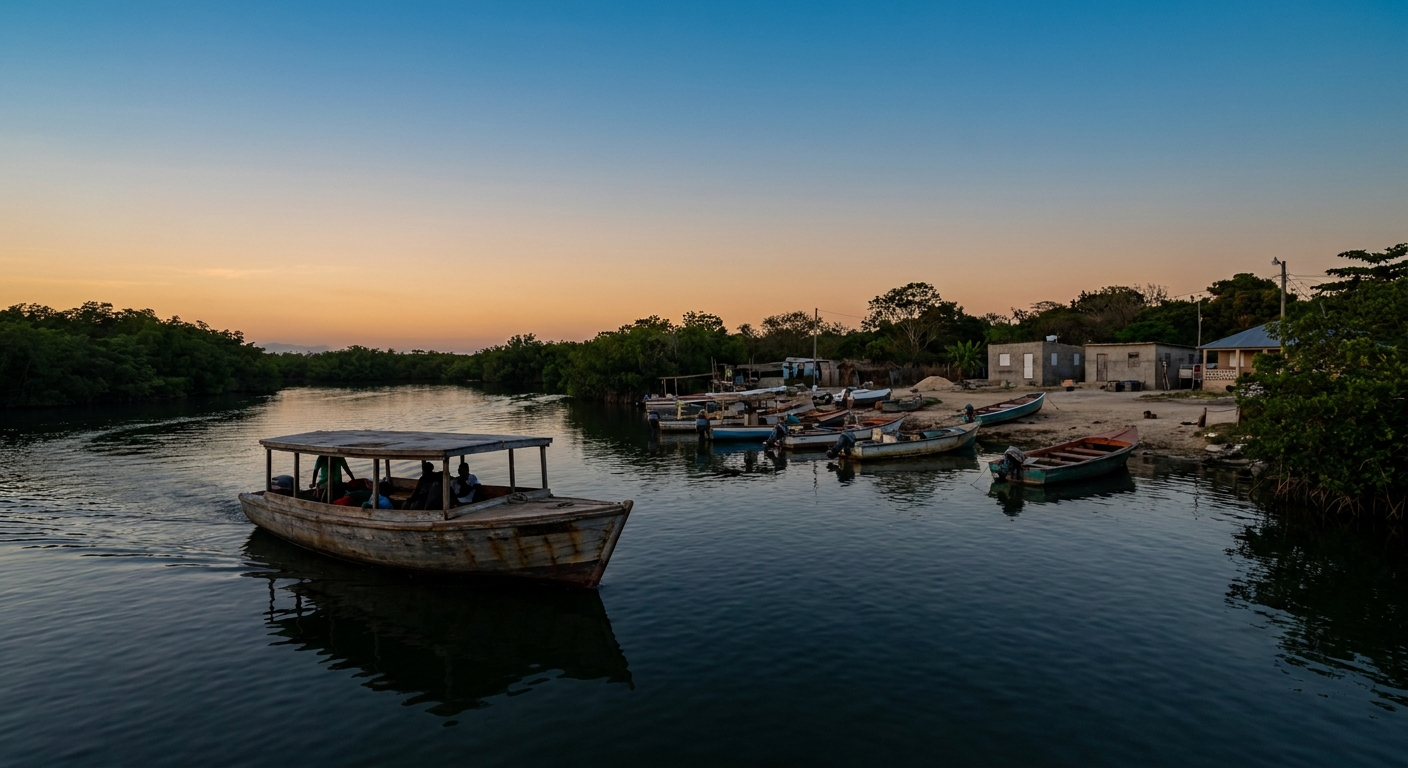
Falmouth’s lagoon does its trick after dark, when a boat cuts the water and the glow rises around the hull. The boats run year round, so the question is never whether the trip exists in your month. It is whether the drive over from your hotel, the night you booked and the water you may swim in are the ones you wanted.
Heat is not the variable here. Average highs run from 82.0°F in January to 88.4°F in July and August, a spread of 6.4°F across the whole year. Rain is the variable, from 1.62 inches in February to 7.60 inches in May, and so is water temperature, from 81.2°F in February to 87.7°F in September. Those two swings are what separate a February week from a September week at the same address.
THE YEAR AT A GLANCE · THE LUMINOUS LAGOON
February is the pick for a trip built around one night on the water: 1.62 inches of rain and 3.9 wet days, the driest month of the twelve, paid for with the year’s coolest sea at 81.2°F.
DRIEST: FEBRUARY · WETTEST: MAY AND SEPTEMBER · SEA NEVER BELOW 81°F · BOATS RUN ALL YEAR
Go for: February or March if a canceled boat night would spoil the trip, with 3.9 and 6.1 wet days respectively.
Think twice before: locking one non-refundable September night on the water, in a month averaging 19.6 days that record 0.10 inch of rain or more.
Normals: Open-Meteo / ERA5, Falmouth grid cell · Sea: Open-Meteo Marine API · full sources at the end
On this page
- Twelve months of highs, rain and sea temperatureThe full table, February 1.62 in to May 7.60 in
- The single best month for a lagoon nightFebruary, with 3.9 wet days
- Sea temperature by month81.2°F in February to 87.7°F in September
- The quietest weeks of the yearSeptember and October, and what they cost
- Which month to avoid on fixed datesSeptember, 19.6 wet days
- Is April or November worth booking?How the two shoulder months compare
Nobody flies to Jamaica for the lagoon alone. It is one evening inside a bigger trip, and most visitors drive in from Montego Bay hotels about 19 miles west or from Ocho Rios further east. If the base is still undecided, those two guides compare the drives, the transfer page covers the run in from the Montego Bay airport, and the seven-day itinerary shows where a lagoon night slots into the week.
The Luminous Lagoon weather month by month: highs, rain and sea temperature
| Month | Avg high | Avg low | Rain | Days ≥ 0.10 in | Sea |
|---|---|---|---|---|---|
| January | 82.0°F | 72.3°F | 2.02 in | 5.0 | 82.3°F |
| February | 82.9°F | 72.0°F | 1.62 in | 3.9 | 81.2°F |
| March | 84.0°F | 72.3°F | 2.27 in | 6.1 | 81.7°F |
| April | 85.7°F | 73.6°F | 3.23 in | 9.0 | 82.7°F |
| May | 86.4°F | 75.5°F | 7.60 in | 17.4 | 84.7°F |
| June | 87.9°F | 77.4°F | 4.77 in | 13.5 | 85.4°F |
| July | 88.4°F | 77.8°F | 4.41 in | 12.9 | 85.2°F |
| August | 88.4°F | 78.0°F | 5.55 in | 16.5 | 86.8°F |
| September | 87.7°F | 77.5°F | 7.02 in | 19.6 | 87.7°F |
| October | 85.9°F | 76.5°F | 6.57 in | 17.3 | 87.5°F |
| November | 83.6°F | 75.2°F | 3.54 in | 9.4 | 85.3°F |
| December | 82.5°F | 73.7°F | 2.30 in | 5.1 | 83.2°F |
The shape of the year is a flat temperature line under a violently uneven rain line. Every month averages a daytime high between 82.0°F and 88.4°F, while wet days run from 3.9 in February to 19.6 in September, a factor of five. Water never drops below 81.2°F. Nothing in the table argues against a lagoon trip on comfort grounds, and everything in it argues about how likely your one booked evening is to be rained on.
May is the flip. April’s 3.23 inches become 7.60, and 9.0 wet days become 17.4, the biggest single step in the table. November flips it back the other way, 3.54 inches and 9.4 wet days after October’s 6.57 inches and 17.3. The August to September step is smaller, 16.5 wet days rising to 19.6, and it matters mostly because it lands exactly where the American summer vacation ends.
September is the hardest month of the twelve for a traveler on fixed dates, averaging 19.6 days that record 0.10 inch of rain or more and 7.02 inches in total. For a family with two weeks and several free evenings, that is an inconvenience. For a couple flying down for a long weekend with one night set aside for the boat, it is the difference between seeing the glow and reading about it.
Every figure here comes from a single ERA5 grid cell centered over Falmouth, where the lagoon is, about 30 km (19 miles) east of Montego Bay. That is model reanalysis, a reconstruction rather than a thermometer at an airport fence, and it describes the lagoon’s own corner of the coast, not the whole north shore. A wet day counts any day recording at least 0.10 inch, so a five-minute shower and a gray afternoon both score one.
When is the best time to visit the Luminous Lagoon?
February. An average high of 82.9°F, an average low of 72.0°F, 1.62 inches of rain across the month and 3.9 days recording 0.10 inch or more, the fewest wet days of the twelve months. It is also the only month in the table where an average year brings 0.0 days of an inch or more. The bill comes as the coolest sea of the year, 81.2°F.
March is the obvious rival and loses on rain, with 2.27 inches and 6.1 wet days, which is 0.65 inch and 2.2 days more than February in exchange for 1.1°F on the daytime high. January runs closer, 2.02 inches and 5.0 wet days, and it brings warmer water at 82.3°F. Book January if the flights and the holiday calendar are setting your dates, February if the boat night is the reason you came.
The island-wide verdict, with the regional differences that this one cell cannot show, sits in our best time to visit Jamaica guide, the storm months and their booking rules in the hurricane season guide, and the route options in flights from the US. Whatever month you pick, put the lagoon on an early night of the stay so a washed-out evening can be retried later in the week.
When can you swim at the Luminous Lagoon? Sea temperature month by month
No month closes the water. The coolest average is February at 81.2°F, and the warmest is September at 87.7°F, a swing of 6.5°F across the year. Six months sit at 85°F or above: June 85.4, July 85.2, August 86.8, September 87.7, October 87.5 and November 85.3. The winter run from December through March, 83.2°F down to 81.7°F, is the stretch most American swimmers read as pleasant rather than warm.
One caveat travels with those numbers. Each is an average of daily maximum sea surface temperature over 2015 to 2024, taken from the Marine API, which sits a shade above a full 24-hour mean, so water at eight in the morning is cooler than the column suggests. The readings are also sea surface off the lagoon rather than inside the lagoon basin itself, and the night tours are the boat operators’ call, not a swimming forecast.
When is the Luminous Lagoon quietest?
The quiet stretch is late summer into fall. September and October read as the low season on the calendar rather than on any price list: American and Canadian schools are back in session, the winter vacation wave has not started, and the Atlantic hurricane season is running, with its dates and its insurance advice set out in the hurricane guide. We hold no price series for the lagoon or its tours, so nothing here ranks months by cost.
Boats go out less full in those weeks, a same-week booking is realistic rather than hopeful, and the warmest water of the twelve months arrives with them, 87.7°F in September and 87.5°F in October. Daylight on September 15 runs 12 hours 16 minutes against 11 hours 35 minutes on February 15, which leaves an unhurried afternoon before the tour. The crowd read is our editorial judgment, not a measured series.
What the quiet takes away is reliability. October averages 17.3 days recording 0.10 inch or more and 6.57 inches of rain, September 19.6 days and 7.02 inches, so a one-night plan with no spare evening is a gamble in both. A tropical system does not have to cross Jamaica to cancel a night on the water, which makes refundable hotel nights and a look at travel insurance worth more in this pair of months than in any other.
Which month should you avoid at the Luminous Lagoon?
September is the month to skip if your trip hangs on one fixed evening, averaging 19.6 days that record 0.10 inch of rain or more, the most of the twelve months, plus 7.02 inches in total, second only to May’s 7.60. It also falls inside the hurricane season. For a traveler with a loose fortnight and refundable nights, none of that disqualifies the month.
September pays some of it back. The sea is at its yearly warmest, 87.7°F, and only 0.5 days in an average September reach a full inch of rain, which means most of those 19.6 wet days are short. Daylight holds at 12 hours 16 minutes on the 15th, so you are not choosing between a beach afternoon and the boat.
Is the shoulder season worth it at the Luminous Lagoon?
The shoulder months here are April and November. April averages 3.23 inches of rain and 9.0 wet days, November 3.54 inches and 9.4, against February’s 1.62 inches and 3.9 days at the dry end of the table. April sits 4.37 inches and 8.4 wet days below May. November sits 3.03 inches and 7.9 wet days below October.
Warmer water is what the winter cannot match. November’s sea averages 85.3°F, which is 4.1°F above February’s 81.2°F, and April’s 82.7°F still clears the February floor. April also holds the light longer: 12 hours 37 minutes on the 15th, with sunset at 6:28 p.m. local, against 11 hours 35 minutes and a 6:12 p.m. sunset on February 15.
Wet days more than double. April’s 9.0 and November’s 9.4 both sit above twice February’s 3.9, which puts rain on roughly one day in three, and November falls inside the hurricane season while April sits clear of it. Neither month averages more than 0.1 days of an inch or more, so the rain that comes is usually light.
November wins the shoulder argument at the lagoon. Its 85.3°F water beats April’s 82.7°F by 2.6°F for the price of 0.31 inch and 0.4 wet days more rain, and a north coast week in November is a quieter week than a February one. April is the weaker option, drier on paper but only 1.5°F above the coolest sea of the year. Take November for the swim, February for the certainty, and a refundable rate in either.
The last word
If the glow is the anchor of the trip rather than a bonus, book February and put the boat on an early night of the stay. One figure worth checking before you settle the dates is the sunset: on February 15 the sun goes down at 6:12 p.m. in Falmouth, against 6:51 p.m. on July 15. That is nearly forty minutes handed back at the end of a winter day, and it means full dark arrives before dinner rather than after it.
Sources & data for this guide
- Monthly normals 1991-2020, highs, lows, precipitation and wet days · Open-Meteo / ECMWF ERA5, grid cell 18.4936 N, -77.6559 E, over Falmouth · model reanalysis, not an airport station record · checked Sep 12, 2026
- Sea surface temperature, mean of daily maxima 2015-2024 · Open-Meteo Marine API · checked Sep 12, 2026
- Daylight, sunrise and sunset on the 15th of each month · sunrise-sunset.org, converted from UTC to Jamaica time · checked Sep 12, 2026
- Wet days are counted at the 0.10 inch and 1 inch thresholds used by the source, not at any other service’s thresholds.
- Season and crowd framing is editorial calendar judgment: we hold no price or occupancy series for the lagoon, and we say so rather than rank months by cost.
- Boat schedules, capacity and night-tour timing change · confirm with the operator when you book.