
FLORIDA · MADISON BLUE SPRING · THE 12-MONTH VERDICT
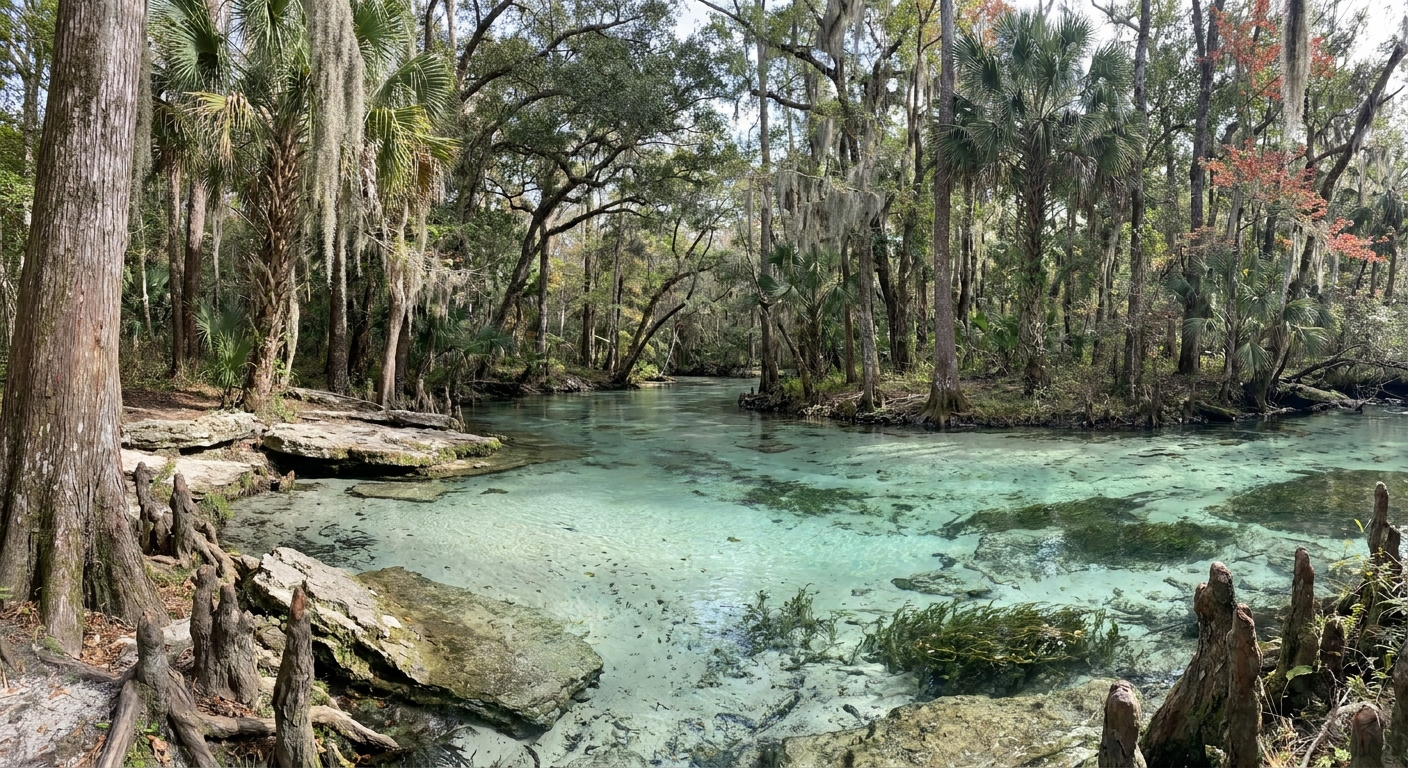
Madison Blue Spring is a bowl of clear water in the limestone country of north Florida, a short walk from a state park lot. The air above it swings 29.3°F between January and July. The water does not swing at all: the spring has no season, and that is the strangest, most useful thing about planning a visit. So the month you pick is not really a decision about the swim. It is a decision about the air you stand in afterward, the daylight you get with it, and how many cars are parked next to yours.
The air’s season, though, is sharp. January afternoons average 62.8°F, and 8.6 January nights fall to freezing. July afternoons average 92.1°F, and the nights only ease to 70.1°F. Rain keeps its own schedule: June drops 7.08 inches across 8.4 wet days, while November manages 2.47 inches across 3.6. Line those series up and the year sorts into a summer built for swimmers, a winter that suits divers more than sunbathers, and two shoulder windows most travelers would enjoy more than either.
THE YEAR AT A GLANCE · MADISON BLUE SPRING
April is the pick: 79.6°F afternoons, 52.8°F nights and 12 hours 59 minutes of daylight, with a spring that will be exactly the same temperature it was in January.
BEST: APRIL & OCTOBER · WETTEST: JUNE, 7.08 IN · HOTTEST: JULY, 92.1°F
Go for: April and October afternoons around 80°F, 4.5 and 4.1 wet days respectively, and a spring whose water has no season.
Think twice before: booking June or July, when 7.08 and 5.33 inches fall across 8.4 and 9.0 wet days and afternoons average 90.1°F and 92.1°F.
Air normals 1991-2020: NOAA NCEI, Valdosta Rgnl AP · Daylight: sunrise-sunset.org · full sources at the end
On this page
- Month-by-month highs, lows and rainfallThe 12-month table
- The single best month to goApril, with the figures
- How hot it gets in summerJune to August, 90.1°F to 92.1°F
- When the spring is quietestNovember, January, February
- The month to avoidJune, 7.08 inches of rain
- March or October for a shoulder tripWhat the shoulder costs
- When to visit Florida overallThe statewide dry season
If you are building a weekend around the spring, the fast version is April and October on the calendar, June and July off it, and a water temperature that makes none of that matter once you are in. Every temperature below is an air temperature, and the thermometer that recorded it is not at the spring.
Madison Blue Spring weather month by month: highs, lows and rainfall
| Month | Avg high | Avg low | Rain | Days ≥ 0.10 in |
|---|---|---|---|---|
| January | 62.8°F | 38.6°F | 3.83 in | 4.1 |
| February | 67.0°F | 42.2°F | 3.31 in | 5.4 |
| March | 72.9°F | 47.2°F | 3.73 in | 5.6 |
| April | 79.6°F | 52.8°F | 3.66 in | 4.5 |
| May | 86.4°F | 60.3°F | 2.84 in | 4.6 |
| June | 90.1°F | 67.9°F | 7.08 in | 8.4 |
| July | 92.1°F | 70.1°F | 5.33 in | 9.0 |
| August | 91.5°F | 71.0°F | 5.11 in | 8.0 |
| September | 87.8°F | 66.5°F | 4.22 in | 5.2 |
| October | 80.5°F | 56.8°F | 3.71 in | 4.1 |
| November | 71.4°F | 46.6°F | 2.47 in | 3.6 |
| December | 65.0°F | 41.3°F | 3.12 in | 5.0 |
The temperature year makes one clean arc: highs climb from 62.8°F in January to 92.1°F in July, then slide back to 65.0°F by December. Rain refuses that shape entirely, peaking at 7.08 inches in June and bottoming at 2.47 inches in November, a month whose afternoons still average 71.4°F.
Between March and April the afternoon gains 6.7°F, 72.9 to 79.6, and the cold nights thin out: March still averages 1.5 nights at 32°F or below, while our April normals carry no freezing count. Rain’s hinge comes a month later. May holds 2.84 inches over 4.6 wet days, June brings 7.08 over 8.4, and 2.1 of those June days deliver an inch or more, the highest such count of the twelve. Autumn reverses everything fast: October into November takes 9.1°F off the average high.
Which month is hardest depends on what you drove out for. For anyone planning a full day on the bank with a cooler and a picnic table, July is the worst of it: 92.1°F afternoons, 9.0 days with measurable rain, and nights averaging 70.1°F, so the air never resets overnight. For a swimmer who intends to be in the water from eleven to four, July is the reason to come at all.
Every figure here comes from NOAA’s 1991-2020 normals recorded at Valdosta Rgnl AP in Georgia, about 44 km (27 miles) from the spring, and a wet day means 0.10 inch or more, not a passing drop. They describe the air. The spring water holds its own steady temperature all year, a figure our data set does not carry, and that is why a 62.8°F January afternoon and a 92.1°F July afternoon can produce exactly the same swim.
When is the best time to visit Madison Blue Spring?
April is the answer for most people. Afternoons average 79.6°F, nights 52.8°F, and the month collects 3.66 inches of rain across 4.5 wet days. On April 15 the sun is up at 7:03 a.m. and down at 8:02 p.m. local, 12 hours 59 minutes of daylight, enough to swim, dry off, eat and still drive home before dark.
March is the tempting alternative and the wrong one for most trips: 72.9°F afternoons, 47.2°F nights, an average of 1.5 nights still at freezing, and 57 minutes less daylight on the 15th. May swings the other way, to 86.4°F afternoons and 60.3°F nights, warm enough that the bank empties into the water by noon. April sits between them with no freezing count in its normals and a full extra hour of evening over March.
The spring is rarely a whole trip. It is a morning inside a longer north Florida drive, and the statewide pattern that governs the rest of that drive, dry season November through April and wet season May through October, sits in our Florida timing guide. If the spring is one stop on a loop, the road-trip guide carries the driving legs and know before you go carries the practical layer we do not price on this subject.
How hot does Madison Blue Spring get in summer?
Summer afternoons run 90.1°F in June, 92.1°F in July and 91.5°F in August. The nights are the part travelers underestimate: 67.9°F, 70.1°F and 71.0°F on average, so an early start offers less relief than people expect, and a car left in the lot never truly cools. Daylight is the compensation. On July 15 the sun rises at 6:40 a.m. and sets at 8:37 p.m. local, 13 hours 58 minutes, leaving room for a long late afternoon in the water after the drive over.
Our data set carries no humidity, dew point or heat index for this station, and we are not going to invent one. What the normals do show is August nights averaging 71.0°F, and air that warm overnight is rarely dry air. Plan your land time for the morning, treat the felt temperature as higher than the 91.5°F figure, and let the spring do the cooling: the water is the one part of a July visit that behaves like October.
When is Madison Blue Spring quietest?
We hold no attendance figures for the park, so this is calendar reading, not a count. The thin weeks are the ones with no school break attached: mid-January through late February, and the stretch from early November to the week before Christmas. Those are also the coldest weeks on record, with 8.6 freezing nights in January, 6.0 in December and 3.8 in February. Nothing about the water changes across them; what changes is how many cars are in the lot.
November is the practical reward: 71.4°F afternoons, 2.47 inches of rain over 3.6 wet days, the driest and least interrupted month of the twelve. A Tuesday there buys you the bank, water at its usual temperature, and 10 hours 39 minutes of daylight on the 15th, with sunrise at 6:58 a.m. and sunset at 5:37 p.m. For a photographer, or a diver with gear to haul from the car, that combination beats anything June offers.
What you give up is the afternoon. December brings 10 hours 14 minutes of daylight against June’s 14 hours 09, a loss of 3 hours 55 minutes, and the sun is gone by 5:35 p.m. on December 15. Add 41.3°F December nights, 6.0 of them at freezing, and the ten minutes between climbing out and reaching dry clothes turn into the memory you take home. Pack a parka, a thermos, and park where you can run the heater while you change.
Which month should you avoid at Madison Blue Spring?
June is the month to skip, and rain volume does more of the damage than heat: 7.08 inches, 8.4 days at 0.10 inch or more, and 2.1 days at an inch or more, the year’s highest. A swimmer can shrug at that. Someone driving in from Tallahassee or Gainesville for one Saturday, a diver holding a booked slot, or a family with a single free day is looking at a real threat to the plan, and 90.1°F afternoons do nothing to soften it.
June also holds the year’s longest days: 14 hours 09 minutes on the 15th, sunrise at 6:29 a.m., sunset at 8:38 p.m., three hours later than December 15. Florida’s summer rain tends to arrive as afternoon storms rather than all-day gray, the pattern we describe statewide in the Florida calendar, so a 6:30 a.m. start can bank a full morning in the water. If June is the only week you have, go early and be back in the car by two.
Is the shoulder season worth it at Madison Blue Spring?
The shoulders here are March and October, with November as a cooler extension. October runs 80.5°F afternoons against July’s 92.1, a gap of 11.6°F, with 4.1 wet days against 9.0. March goes further down, to 72.9°F, 19.2°F below the July peak, though it carries 5.6 wet days and 3.73 inches, a shade more rain than October’s 3.71.
October gives you a whole day outside the water, and July does not. Afternoons in the low 80s, nights at 56.8°F and less than half the wet days mean the picnic, the walk along the river and the drive both ways stop competing with the heat. Sunset on October 15 falls at 7:02 p.m., late enough for a swim after work if you live within range, early enough that the lot is empty well before dark.
The cost lands on the exit, not the entry. March nights average 47.2°F, 1.5 of them still at freezing, so a swim in March is a short one unless the sun stays out. October’s 11 hours 28 minutes of daylight is 2 hours 41 minutes short of June 15. And November, the driest and quietest of the three, pulls afternoons down to 71.4°F, 9.1°F below October.
Take October if you want a full day at the spring with one long swim inside it. Take March if the bank matters more to you than the tan: 19.2°F cooler than July, 3.4 fewer wet days, and the same water you would be swimming in August. Skip November only if daylight is the thing you need most.
The last word
The decision is smaller than it looks: April for everything at once, October for the same day with fewer people, and no reason to worry about the water, which will be what it always is. September deserves a second look too, at 87.8°F afternoons, 66.5°F nights, 5.2 wet days against July’s 9.0 and 12 hours 23 minutes of daylight on the 15th, summer heat with June’s rain gone. Check the park’s hours and fees before you drive, and go on a weekday.
Sources & data for this guide
- Monthly air normals 1991-2020, highs, lows, precipitation, days at 0.10 inch and at 1 inch, freezing nights · NOAA NCEI, station USW00093845, Valdosta Rgnl AP, GA, about 44 km (27 miles) from the spring · checked Sep 12, 2026
- Daylight, sunrise and sunset on the 15th of each month · sunrise-sunset.org, converted from UTC to local Eastern time · checked Sep 12, 2026
- The spring’s own water temperature, the park’s hours, fees, capacity and diving rules are not in our data set · check Florida State Parks before you drive out
- Crowd levels: no attendance count was available to us. The quiet-season reading above is calendar-based editorial, not a measurement
- Statewide dry and wet season framing · our Florida timing guide · checked Sep 12, 2026