
FLORIDA · MADISON BLUE SPRING · NOVEMBER
The USGS gauge at Madison Blue Spring read 73.2°F on September 11, 2026, and it reads close to that on a July afternoon or a January dawn. What moves in November is the air above it: an average high of 71.4°F, an average low of 46.6°F at the nearest official weather station. For the first time since spring, the water is the warmer of the two on an ordinary afternoon.
That one fact reorganizes the visit. Florida’s own facilities inventory records no designated swimming area at Madison Blue Spring State Park, and no canoe, kayak or tube launch either, so the state does not count what you drive here for as a swim. November is also the driest of the fall months at 2.47 inches against October’s 3.71. If you want warm air over the same water, October is four weeks and nine degrees away.
THE MONTH AT A GLANCE · NOVEMBER
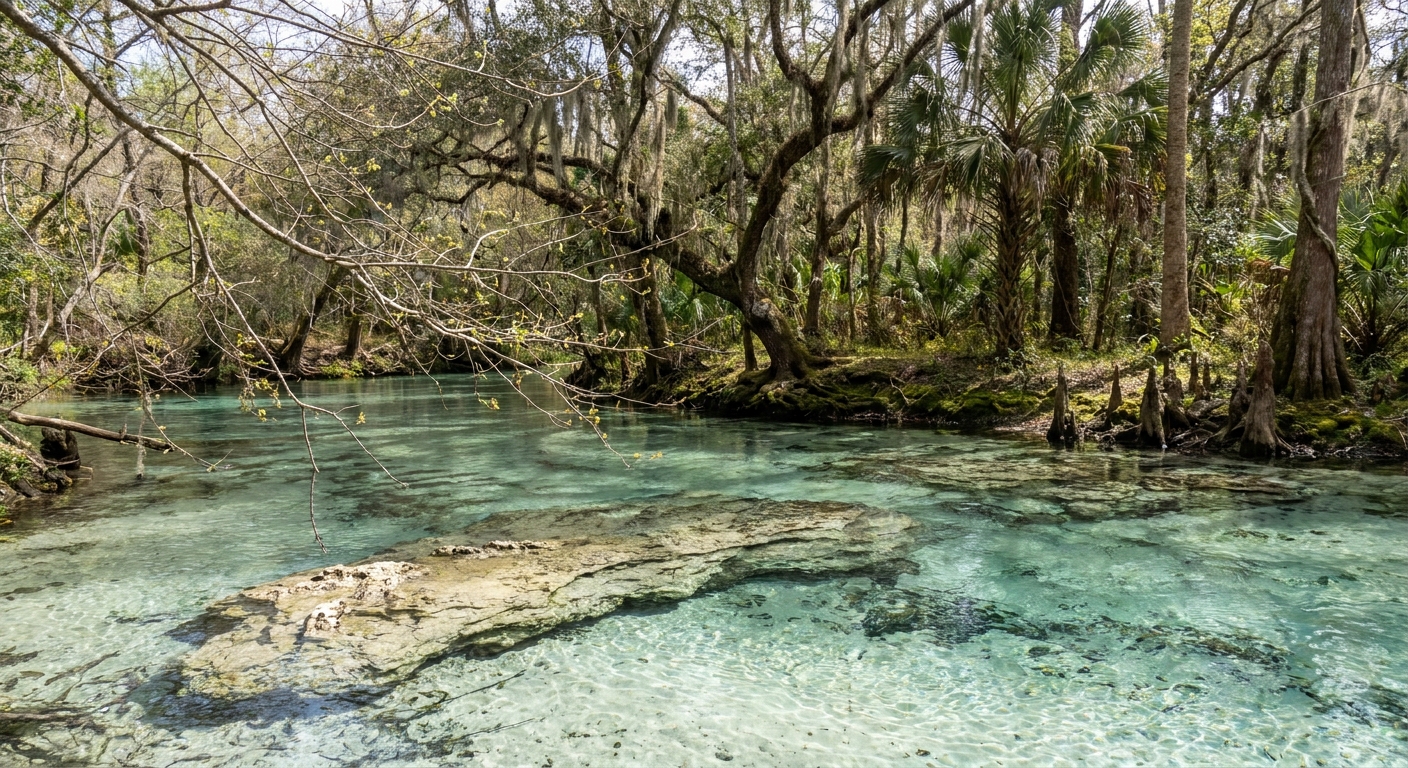
Come for water holding near 73°F while the average afternoon tops out at 71.4°F, pack for a 46.6°F dawn, and know that Florida lists no designated swim area at this park.
AIR 71.4°F / 46.6°F · WATER ABOUT 73°F · 3.6 WET DAYS · DAYLIGHT 10H39M
Go for: water that holds near 73°F while the air cools, the lowest rainfall of the three fall months at 2.47 inches, and a 5:37 p.m. sunset that puts you back on the road early.
Think twice before: booking a weekend around a swim. Florida’s recreational facilities inventory records no designated swimming area and no paddle launch at this park, and we could not verify an entrance fee or an opening hour.
Air normals: NOAA NCEI 1991-2020, Valdosta Regional Airport · Water: USGS station 02319302 · full sources at the end
On this page
- Madison Blue Spring weather in NovemberThe 1991-2020 normals, 71.4°F and 46.6°F
- How cold does it get at night?1.9 nights at or below 32°F
- Crowds and what a November trip costsWhat we verified, and what we could not
- Can you swim at Madison Blue Spring?No designated swim area in the state inventory
- A two-day plan around a 5:37 p.m. sunsetTwo days, hour by hour
- November, October or December?How the three months compare
- Is November a good time to go?Who should come and who should wait
Every air figure here comes from one instrument: NOAA’s 1991-2020 normals for station USW00093845 at Valdosta Regional Airport, Georgia, about 27 miles (44 km) north of the spring. It is a real thermometer at a real airport rather than a modeled grid cell, and it is still 27 miles away. Read the highs and lows as the weather of the surrounding county, and the 73.2°F as the one number measured in the spring itself.
Madison Blue Spring weather in November: average highs, lows and rain days
| November normal | Value |
|---|---|
| Average high | 71.4°F |
| Average low | 46.6°F |
| Precipitation | 2.47 in |
| Days with 0.10 in or more | 3.6 |
| Days with 1 in or more | 0.6 |
| Nights at 32°F or below | 1.9 |
| Daylight on Nov 15 | 10 h 39 min |
| Spring water (gauge reading) | 73.2°F |
NOAA’s National Centers for Environmental Information put the November normal high at 71.4°F and the normal low at 46.6°F over the 1991-2020 period, with 2.47 inches of precipitation across the month. Those come from Valdosta Regional Airport, the closest station carrying a full normals record. None of it describes the spring. A thermometer beside a runway 27 miles north measures air, and the water rising through the vent comes from the aquifer at a temperature the sky has no say in.
Measurable rain falls on 3.6 days in an average November, roughly one day in eight, and 0.6 day reaches a full inch, a genuine soaking in about three Novembers out of five. October runs 4.1 wet days and December 5.0, so this is the least interrupted of the three. The shape of the interruption matters as much as the count: a 2.47-inch month delivered over four days is a band of weather you sit out, not a week of gray.
Between the average low and the average high sits 24.8 degrees, and a day here crosses all of it. At 46.6°F a dawn arrival wants a fleece, long pants and closed shoes. At 71.4°F the same person by two o’clock wants a T-shirt. Pack both in one bag, add a towel that dries fast and a change of clothes you can get into fast, because there is nothing between the water and the car but open air.
On November 15 the sun rises at 6:58 a.m. and sets at 5:37 p.m. Eastern, giving 10 hours 39 minutes of daylight. Shadows are long over the water by four. Anyone still in at five climbs out into air already sliding toward the overnight 46.6°F, which is a colder five minutes than the swim ever was. Put your last time in the water at three and the drive home starts in daylight.
How warm is Madison Blue Spring in November?
The month averages 71.4°F by day and 46.6°F by night, a 24.8-degree spread inside twenty-four hours. The water ignores both. The USGS gauge at station 02319302 read 73.2°F on September 11, 2026, and that is an instantaneous reading rather than a monthly average, the only form the gauge publishes. Taken at face value it puts the spring about 1.8 degrees above the average November afternoon and better than 26 degrees above the average November night.
In practice you dress for two days. Morning is jacket weather with the heater on for the last mile, and the water at 73.2°F is the warmest thing you will touch before nine. By early afternoon the air catches up to within a couple of degrees and the exit stops being the hard part. Late afternoon reverses it again, which is why the towel matters more here than the wetsuit.
Frost is on the table: 1.9 nights in an average November drop to 32°F or below at the Valdosta station. That is two mornings of scraped windshield in a typical month, not two weeks of winter, and it changes nothing under the surface. The gauge reads the same on a 32°F dawn as on an August one.
How busy is Madison Blue Spring in November? Crowds, prices and the demand peak
We found no occupancy series and no monthly room-rate series for this stretch of north Florida, so we crown no month cheap and no month expensive. The calendar is public, though. Most of November is a school month, the Thanksgiving holiday loads its final week, and the first two weekends are the quiet ones by simple arithmetic of who is free to travel.
Before you commit a weekend, call the park. We could not verify an entrance fee, an opening hour or a closing day: floridastateparks.org answered our automated reads with a 403 error on September 11, 2026, and a fee found for another Florida park does not transfer, because they are set park by park and by season. For the bed, the lead time that matters is driven by Thanksgiving week rather than by the spring, and our where-to-stay guide covers the regional pattern.
We could not verify a lodging-tax rate for this county either, so we give no percentage. Budget from the rate you are quoted, then add whatever the confirmation screen names before you decide the trip is cheap. What a Florida trip costs lays out the other line items, and the driving guide handles the tolls you will cross on the way up.
Spending more changes exactly one thing in November: how close you sleep to the vent. Sunset at 5:37 p.m. ends the day whether you are ready or not, and an hour of night driving back to a cheaper room costs you the following morning as well. Gear is a year-round decision instead of a seasonal one, since the water sits at 73.2°F in every month of the calendar.
Things to do in Madison Blue Spring in November
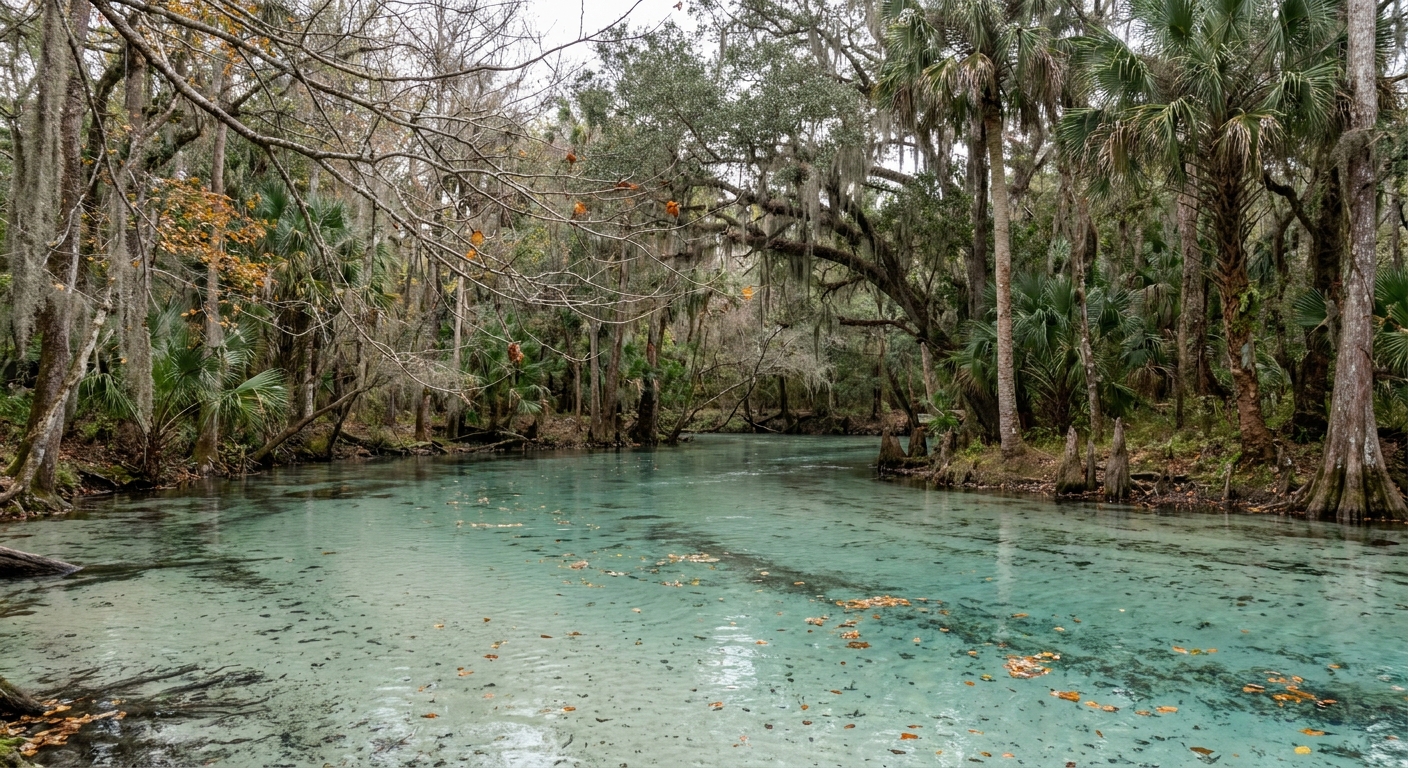
October afternoons average 80.5°F, so 73.2°F water reads as cold relief. November reverses the sign. At a 71.4°F average high the spring is the warmer of the two, and the first step in is a small gain in temperature rather than a shock to the chest. December pulls the air down to a 65.0°F average high, and the contrast returns, except now you are climbing out into air eight degrees below the water.
Madison Blue Spring State Park is the whole destination, and its measured numbers are few and specific. The vent pushes 72 cubic feet per second of water out of the limestone, gauged at USGS station 02319302, and that volume is why it stays clear: it is replaced faster than it can cloud. Florida’s Recreational Facilities Inventory, in its 2024 annual report, records no designated swimming area here and no canoe, kayak or tube launch.
The water is the constant and the air is the variable. Between October’s 80.5°F average high and December’s 65.0°F, the air over the vent swings 15.5 degrees while the gauge holds within a fraction of 73°F. November sits mid-slide, and the same site can feel like a different trip from one visit to the next without a single thing changing below the surface.
As for what costs nothing this month, we could not confirm a fee, an hour or a closing day, so we will not label anything here free. What is free and short is the light: 10 hours 39 minutes on the 15th, gone by 5:37 p.m., which makes the walk to the vent at first light the best-value hour of the day. Know before you go handles the rest of the state’s park habits.
Madison Blue Spring in November: a two-day itinerary
Leave late enough on day one that the 46.6°F dawn is behind you, and aim to be at the vent by ten as the air climbs toward its 71.4°F peak. First time in the water before noon, with the sun on the surface. Eat at one. Back in by two, out by three thirty, dry and changed by four while there is still warmth in the air. The sun is gone at 5:37 p.m. and the temperature falls from there.
Day two runs on the same clock, since daylight is what this month gives you least of. If the weather turns, the numbers say what to expect: 3.6 days in the month reach a tenth of an inch and only 0.6 day reaches a full inch, so the usual version is an hour under the tailgate rather than a lost day. If the front is a cold one, the air can sit in the fifties while the water holds 73.2°F, and the getting in gets easier while the getting out gets harder.
Madison Blue Spring in November vs October and December
| Measure | October | November | December |
|---|---|---|---|
| Average high | 80.5°F | 71.4°F | 65.0°F |
| Average low | 56.8°F | 46.6°F | 41.3°F |
| Precipitation | 3.71 in | 2.47 in | 3.12 in |
| Days with 0.10 in or more | 4.1 | 3.6 | 5.0 |
| Spring water | About 73°F | About 73°F | About 73°F |
Across the three months the air falls 15.5 degrees by day and 15.5 by night, from 80.5/56.8 in October to 65.0/41.3 in December, while the spring stays put near 73°F. Rain does not follow a straight line: November is the driest month of the set at 2.47 inches over 3.6 wet days, with October wetter at 3.71 inches and December wettest by frequency at 5.0 wet days. All of it comes from the same NOAA 1991-2020 series at Valdosta, so the three columns are comparable.
Shift four weeks earlier and you buy a 9.1-degree warmer afternoon and a 10.2-degree warmer night, paid for with 1.24 more inches of rain and an extra wet day. Shift four weeks later and you lose 6.4 degrees off the afternoon, gain 1.4 wet days, and trade the crowd of a holiday month for the shortest daylight of the year. The water is identical in all three cases, so the choice is about the ten minutes after you get out.
Is November a good time to visit Madison Blue Spring?
Yes if the water is your reason for driving, and yes if you would rather have 2.47 inches of rain than 3.71. No for a family arriving with floats and an expectation of a roped swim beach, because Florida’s inventory lists no designated swimming area and no tube launch at this park, in November or in any other month. No, too, for anyone who needs a long day outdoors: the light quits at 5:37 p.m.
If the sticking point is the air, go in October, where an 80.5°F average high makes the exit painless and the 56.8°F nights let you camp in comfort, at the price of 3.71 inches of rain. If the sticking point is the Thanksgiving-week traffic, December keeps the same water and drops the air to 65.0°F, with 5.0 wet days to plan around.
What November alone offers is the crossover: the one month of the three when the spring runs warmer than the average afternoon, by 1.8 degrees, with air still mild enough to stand around in afterward.
The last word
Decide on the water rather than the forecast and the date loses most of its power: the gauge will read near 73.2°F whichever weekend you pick, and only the 46.6°F dawn and the 5:37 p.m. sunset belong to November. One thing worth carrying north with you: Florida law protects a named class called Outstanding Florida Springs under Statute 373.802(5), covering every historic first-magnitude spring as the Florida Geological Survey determines them, plus six written into the statute by hand. Call the park for its hours, since we could not read them, then load a towel, a fleece and a plan to be off the road by dark.
Sources & data for this guide
- November air normals, 71.4°F high, 46.6°F low, 2.47 in, 3.6 days at 0.10 in, 0.6 day at 1 in, 1.9 nights at 32°F or below · NOAA NCEI monthly normals 1991-2020, station USW00093845, Valdosta Regional Airport, GA · checked Sep 24, 2026
- October and December normals used in the comparison · same NOAA NCEI 1991-2020 series, same station · checked Sep 24, 2026
- Water temperature 73.2°F (22.9°C) and discharge 72 cubic feet per second · U.S. Geological Survey, National Water Information System, station 02319302 Madison Blue Spring, instantaneous reading · checked Sep 24, 2026
- No designated swimming area, no canoe, kayak or tube launch · Florida Department of Environmental Protection, Recreational Facilities Inventory, 2024 annual report · checked Sep 24, 2026
- Outstanding Florida Springs definition · Florida Statutes 373.802(5) · checked Sep 24, 2026
- Daylight 10 h 39 min, sunrise 6:58 a.m. and sunset 5:37 p.m. Eastern on November 15 · sunrise-sunset.org · checked Sep 24, 2026
- We could not read an entrance fee, an opening hour or a manatee count: floridastateparks.org returned a 403 to our automated reads on Sep 11, 2026, and the FWC manatee page renders client-side. Call the park before you drive.
- The air normals are measured 27 miles (44 km) north of the spring; the water figure is measured at the spring itself.
To plan your stay
- Madison Blue Spring: When to Go, Month by Month Highs, Rain and Daylight
- Madison Blue Spring in October: Water Temperature, Air Normals and Rain Days
- Madison Blue Spring in December: Weather, Water Temperature and Frost Nights
- Madison Blue Spring in January: Weather, Water Temperature and Freeze Nights