
FLORIDA · MADISON BLUE SPRING · JANUARY
In January the air at Madison Blue Spring drops far below the water. The nearest official thermometer, at Valdosta Regional Airport in Georgia, averages a high of 62.8°F and a low of 38.6°F over the 1991-2020 period. The spring itself read 73.2°F when the USGS gauge in the vent was checked on September 11, 2026, and it reads close to that every day of the year. A winter trip here gets planned around that gap rather than around a forecast.
So the January question is not whether the water will be warm enough. It is whether you want to change out of thermal gear on a morning that started near freezing, in exchange for the fewest wet days of the three winter months. Four weeks in either direction move the air by a few degrees and move the water by nothing at all.
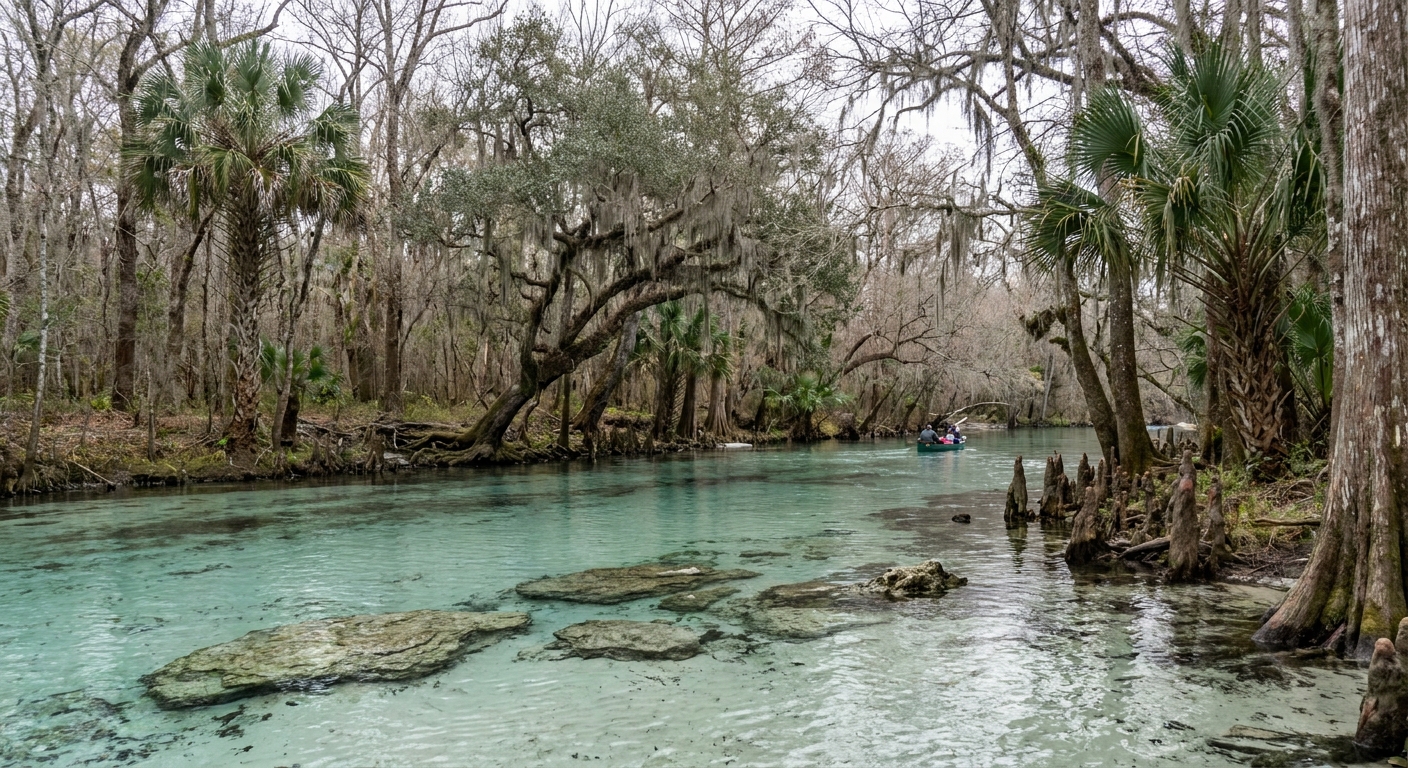
THE MONTH AT A GLANCE · MADISON BLUE SPRING · JANUARY
Come in January for the widest winter gap between 73.2°F water and cold air, and build the day around gear and daylight rather than around a swimming area the state inventory does not list.
AIR 62.8°F / 38.6°F · WATER 73.2°F · 4.1 WET DAYS · 10H 26M OF DAYLIGHT
Go for: water at 73.2°F on mornings that average 38.6°F, 4.1 wet days against December’s 5.0 and February’s 5.4, and a destination you drive to rather than fly to.
Think twice before: counting on a swim: Florida’s 2024 facilities inventory lists no designated swimming area here, and no canoe, kayak or tube launch.
Air: NOAA NCEI 1991-2020, Valdosta Rgnl AP · Water: USGS gauge 02319302 · Facilities: Florida DEP 2024 inventory
On this page
- January weather at Madison Blue Spring62.8°F days, 38.6°F nights, 4.1 wet days
- How warm the water is in winter73.2°F in the vent against a 38.6°F dawn
- Crowds, fees and prices in JanuaryDry season, and the fee we could not verify
- Things to do in JanuaryThe spring, the gauge and what the state inventory lists
- A two-day plan for a January weekendSunrise 7:29 am to sunset 5:55 pm, hour by hour
- January or February at Madison Blue SpringHow December, January and February compare
- Is January a good month to go?Who should go now, and who should wait for February
Every air figure here comes from NOAA’s 1991-2020 monthly normals at Valdosta Regional Airport, about 44 km from the spring, and not from a thermometer in the parking lot. A grid reanalysis would give you a slightly different set of numbers for the same month. The water is different: there is a real instrument in the vent, USGS gauge 02319302, and its reading is a spot measurement rather than a monthly average.
Madison Blue Spring weather in January: average highs, lows and rain days
| Measure | January | Where the number comes from |
|---|---|---|
| Average high | 62.8°F | NOAA NCEI normals 1991-2020, Valdosta Rgnl AP |
| Average low | 38.6°F | NOAA NCEI normals 1991-2020, Valdosta Rgnl AP |
| Precipitation | 3.83 in | NOAA NCEI normals 1991-2020 |
| Days with 0.10 in or more | 4.1 | NOAA NCEI normals 1991-2020 |
| Days with 1 in or more | 0.7 | NOAA NCEI normals 1991-2020 |
| Nights at 32°F or below | 8.6 | NOAA NCEI normals 1991-2020 |
| Daylight on Jan 15 | 10h 26m | sunrise-sunset.org |
| Spring water | 73.2°F | USGS gauge 02319302, Sep 11, 2026 |
Of the three winter months, January carries the lowest normals: a high of 62.8°F, a low of 38.6°F and 3.83 inches of precipitation across the month. Those are NOAA NCEI station normals, measured at an airport in south Georgia, so treat them as the regional air rather than as the microclimate of a wooded riverbank. On a clear afternoon the hollow around the water can feel a good deal cooler than the number suggests, because the sun spends the month low.
Rain arrives in few, heavy visits. An average January records 0.10 inch or more on 4.1 days, roughly one day in seven, and a full inch or more 0.7 times, about seven Januaries in ten. A three-day weekend therefore usually gets one wet stretch and two dry ones. The practical consequence is mud on the approach and a damp change of clothes, not a canceled trip.
The day-night spread is 24.2°F, wider than anything the water does all year. That single figure decides the bag: a warm hat and a real jacket for the first two hours, a shirt you can strip to by early afternoon, dry towels kept in the car rather than left on the bank, and a change of shoes. Anything wet at 9 am stays wet until noon in January.
Light is the other constraint. On January 15 the sun rises at 7:29 am and sets at 5:55 pm Eastern Standard Time, giving 10 hours 26 minutes of daylight. Usable time in and around cold water is shorter than that, since the last hour goes gray fast under trees. If your drive home is more than an hour, expect the final stretch in the dark.
How warm is Madison Blue Spring in January?
Two temperatures matter and they disagree by a wide margin. The air averages 62.8°F at its daily peak and 38.6°F at its low point, 24.2°F apart. The water sat at 73.2°F (22.9°C) at the gauge, a spot reading taken on September 11, 2026 rather than an average over 24 hours, and the spring holds close to that figure through every season. In January the water is the warmest thing on site for most of the morning.
In practice you dress for two different days. At 8 am, with frost still possible on the grass, that means a fleece, long pants and gloves you are happy to lose. By 2 pm, with the air near its 62.8°F peak, a long-sleeve shirt is enough in the sun and cold again in the shade. Anyone going into 73.2°F water for more than a few minutes wants thermal protection, not a swimsuit and optimism.
Freezing nights are normal here, not exceptional: 8.6 nights in an average January fall to 32°F or below. That is nearly one night in three. It matters if you are camping anywhere in the area, if you leave wet gear in an open truck bed, or if you plan to be standing around at first light. Our know-before-you-go notes cover the wider Florida winter picture.
How busy is Madison Blue Spring in January? Crowds, prices and the demand peak
January falls inside Florida’s dry season, November through April, and that is a calendar fact rather than a price signal. We found no occupancy series and no monthly room-rate series for this corner of north Florida, so we crown no month cheapest and no month most expensive. What the calendar does say is that the big holiday weeks sit in late December, not in the middle of January. The statewide pattern lives in our best-time guide.
Booking advice has to stay narrow for the same reason. We could not verify the park’s entrance fee or its opening hours: the state parks site returned a 403 to our reads on September 11, 2026. Call the park before you drive, confirm the gate time against a 7:29 am sunrise, and treat any price you find on a third-party page as unconfirmed. For beds and budget, start with where to stay and what a Florida trip costs.
We could not verify a lodging-tax rate for the county either, so we give no percentage. Florida lodging is normally taxed at a state rate plus a local add-on, and the add-on is set county by county, which means the figure quoted for Miami or Orlando does not transfer to a rural spring. Ask the property to show the tax line before you prepay a nonrefundable rate.
One line of a January budget genuinely changes the month, and it is thermal protection. Everything else, the drive, the bed, the food, costs what it costs in April. Being properly insulated in 73.2°F water turns a ten-minute dip into an afternoon, and it is the difference between a trip you repeat and one you cut short at noon. Rent or borrow before you buy if this is your first cold-air visit.
Things to do in Madison Blue Spring in January
January gives you the widest contrast of the winter and the driest count of wet days. Its 4.1 days at 0.10 inch or more undercut December’s 5.0 and February’s 5.4, even though January carries the most total precipitation of the three at 3.83 inches. More rain, fewer rainy days: the month concentrates its weather, so trips built on two or three flexible days usually find their clear window.
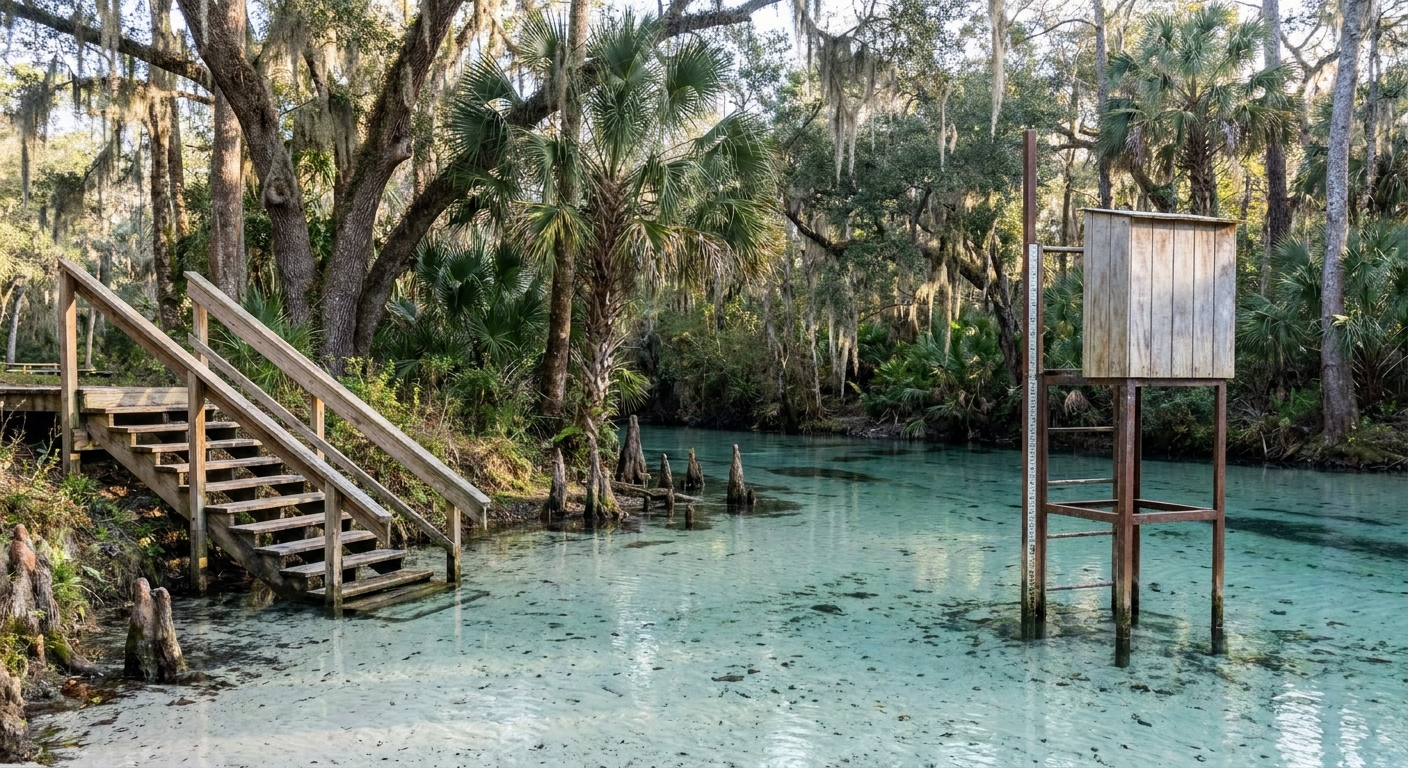
The site itself is Madison Blue Spring State Park, and the instrument that describes it is USGS gauge 02319302, reading 73.2°F in the vent. Florida law places springs of this class under the heading of Outstanding Florida Springs, defined in Florida Statutes 373.802(5). The one thing to plan around is what the state’s 2024 facilities inventory records: no designated swimming area, and no canoe, kayak or tube launch. Confirm current access with the park before you commit a weekend.
What the month changes is the air above the water, never the water. In July the surroundings are warmer than the spring; in January they are 24 degrees cooler at dawn, and steam sits over the run on the coldest mornings. That reversal is the whole seasonal story here, and it also explains why mid-winter afternoons feel empty compared with a summer Saturday.
On what is free in January, we hold back. We could not verify the entrance fee, so we will not call anything here free or cheap. What costs nothing is the preparation: the USGS gauge publishes its temperature and flow online, so you can read the water before you leave home, and the Valdosta normals tell you what the air will do while you are in it.
Madison Blue Spring in January: a two-day itinerary
Day one runs late rather than early. Sunrise is 7:29 am, but the air is still near its 38.6°F low then, so aim to arrive around 10 am with gear already sorted. Get in the water between 11 and 2, when the air climbs toward 62.8°F and the exit is bearable. Dry off and change by 3:30, walk the bank in the last flat light, and be on the road before 5:55 pm, when the sun is gone.
Day two repeats the warm window with a shorter first session and a longer second one, since gear dries slowly at these temperatures. If the weather turns, remember the shape of January rain: 0.7 day an average month brings an inch or more. Shift the water time to the far side of the front, keep the morning for the drive, and spend it on a north Florida road-trip leg instead of standing in the cold.
Madison Blue Spring in January vs December and February
| Month | Average high | Average low | Precipitation | Days with 0.10 in or more |
|---|---|---|---|---|
| December | 65.0°F | 41.3°F | 3.12 in | 5.0 |
| January | 62.8°F | 38.6°F | 3.83 in | 4.1 |
| February | 67.0°F | 42.2°F | 3.31 in | 5.4 |
January sits 2.2°F below December at midday and 4.2°F below February, with nights 2.7°F and 3.6°F colder respectively. It also carries the heaviest total, 3.83 inches, in the fewest wet days of the three. The water column does not move: the spring reads near 73.2°F in all three months, so every difference on this table is a difference in what you wear between the car and the water, and for how long.
Shift four weeks forward and February buys you 4.2°F more warmth by day and 3.6°F more at night, at the cost of 1.3 extra wet days. Shift four weeks back and December offers 2.2°F more air and 0.9 more wet days, plus the holiday weeks that crowd Florida as a whole. Neither swap changes the water by a degree, and neither adds meaningful daylight to a January afternoon.
Is January a good time to visit Madison Blue Spring?
Yes, if you come equipped and you value quiet. Anyone with thermal gear, a car and a flexible pair of days gets the best odds of the winter for a dry visit, plus water that is warmer than the air for most of the day. No, if you pictured a summer-style swim stop: the 2024 state inventory lists no designated swimming area and no paddle launch, and 8.6 freezing nights a month make casual poolside plans unrealistic.
If the answer is no, February is the month to move to. It averages 67.0°F by day and 42.2°F at night, which is 4.2 and 3.6 degrees of comfort added exactly where January hurts, in the changing and the standing around. The bill is 5.4 wet days against 4.1, and slightly more company as spring travel picks up across the state.
What no other month offers is the reversal itself: a vent holding 73.2°F while the bank above it freezes on nearly one night in three.
The last word
Decide on your gear, not on the forecast. If you own thermal protection, a January weekend here is the calmest version of this place all year, with a 62.8°F afternoon window to work inside and 10 hours 26 minutes of light to spend it in. If you do not, book February and add four degrees. One more number worth carrying: the same gauge measured 72 cubic feet per second leaving the vent, and that volume is why the water stays clear in winter, replaced faster than it can cloud.
Sources & data for this guide
- January air normals: 62.8°F high, 38.6°F low, 3.83 in, 4.1 days at 0.10 in, 0.7 day at 1 in, 8.6 nights at 32°F or below · NOAA NCEI monthly normals 1991-2020, station USW00093845, Valdosta Rgnl AP, GA · checked Sep 24, 2026
- December (65.0°F / 41.3°F / 3.12 in / 5.0 days) and February (67.0°F / 42.2°F / 3.31 in / 5.4 days) · same NOAA NCEI station and period · checked Sep 24, 2026
- Station distance: the thermometer sits about 44 km from the spring, so these normals describe regional air, not the spring hollow · NOAA NCEI · checked Sep 24, 2026
- Spring water 73.2°F (22.9°C) and discharge 72 cubic feet per second, instantaneous readings · USGS National Water Information System, station 02319302 · checked Sep 24, 2026
- No designated swimming area, no canoe, kayak or tube launch listed · Florida Department of Environmental Protection, Recreational Facilities Inventory, 2024 annual report · checked Sep 24, 2026
- Outstanding Florida Springs definition · Florida Statutes 373.802(5) · checked Sep 24, 2026
- Daylight 10h 26m, sunrise 7:29 am and sunset 5:55 pm Eastern on January 15 · sunrise-sunset.org, converted from UTC · checked Sep 24, 2026
- We could not verify the entrance fee, the opening hours or any manatee count: floridastateparks.org returned 403 to our reads on Sep 11, 2026 and the state wildlife pages render client-side. Confirm fees and gate times with the park before you drive.