
FLORIDA · MADISON BLUE SPRING · JULY
Of the three summer months on the nearest long-record station, July brings the hottest air to this corner of North Florida: an average high of 92.1°F, an average low of 70.1°F, and 5.33 inches of rain across nine wet days. The water underneath does not follow along. A USGS gauge at the vent read 73.2°F (22.9°C), and it reads close to that in February and in April just the same.
So the July question is not whether the water will be warm enough. It is whether you want the drive, the parking lot and the back half of the day under a summer sky that delivers an inch of rain or more on 1.5 days a month. June and August sit four weeks away in either direction: August is drier by a fifth of an inch, June wetter by nearly two. We line all three up below.
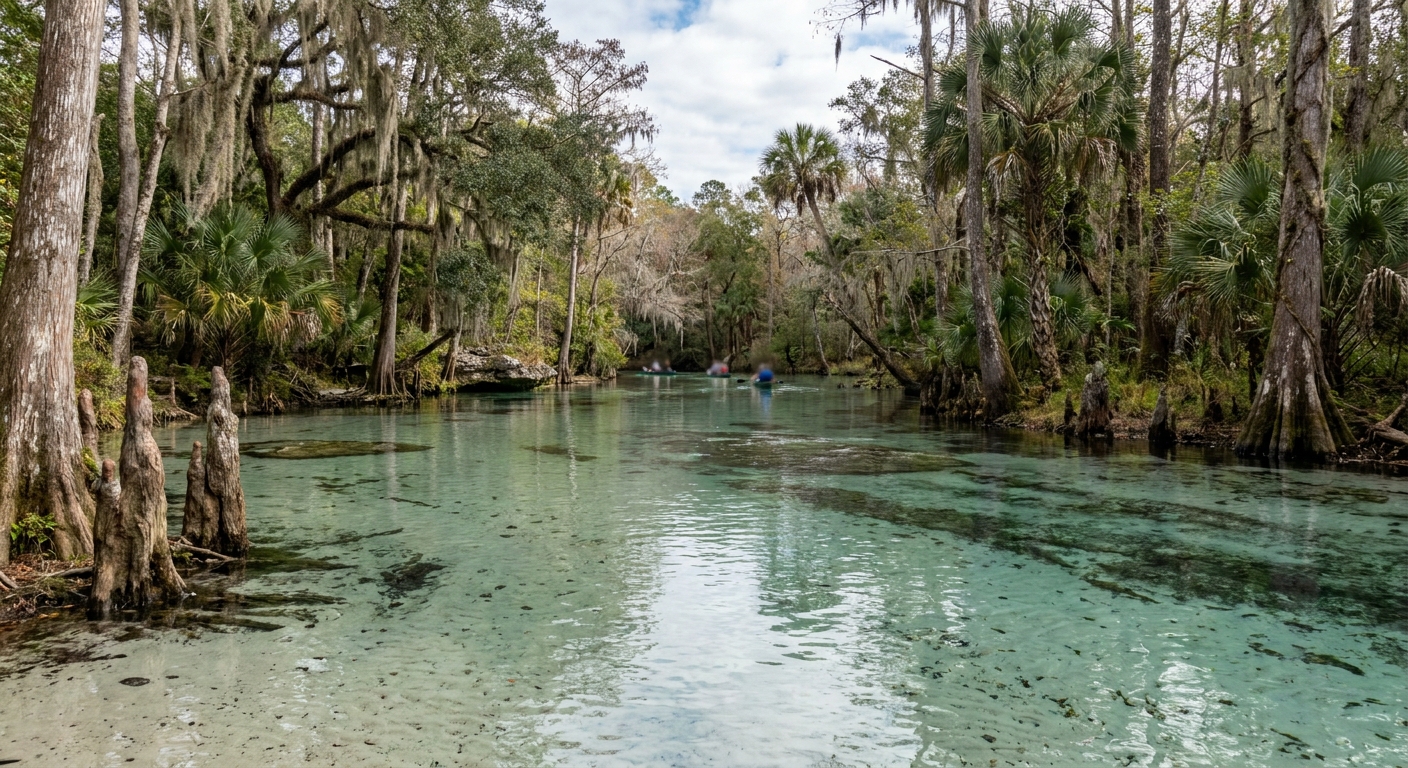
THE MONTH AT A GLANCE · MADISON BLUE SPRING · JULY
July stacks the hottest air of the three summer months over water that holds near 73.2°F all year, so take the morning and treat the afternoon as negotiable.
AVG HIGH 92.1°F · SPRING WATER 73.2°F · 9 WET DAYS · NO DESIGNATED SWIM AREA LISTED
Go for: the widest air-to-water gap of the summer, close to 19 degrees at the afternoon peak, with 13 hours 58 minutes of daylight to spend on it.
Think twice before: building a swim day around a state inventory that lists no designated swimming area here, and no canoe, kayak or tube launch.
Air: NOAA NCEI 1991-2020, Valdosta Regional · Water: USGS gauge 02319302 · full sources at the end
On this page
- Madison Blue Spring weather in JulyHighs of 92.1°F and nine wet days
- Water temperature at the spring73.2°F at the USGS gauge
- Crowds, fees and booking in JulyWhat we verified, and what we could not
- Things to do in JulyThe vent, the flow and the swim-area caveat
- A two-day plan for JulyTwo mornings built on a 6:40 a.m. sunrise
- July vs June and AugustRain of 5.33 inches against 7.08 and 5.11
- Is July a good time to visit?Yes for early risers, no for fixed afternoons
Madison Blue Spring sits inland, a detour off a longer Florida drive rather than a destination with an airport attached. The route belongs to our road trip guide, the rental car and the tolls to getting around Florida, and the budget to what a Florida trip costs. July is the part we take on here.
Madison Blue Spring weather in July: average highs, lows and rain days
| July at the nearest long-record station | Figure |
|---|---|
| Average high | 92.1°F (33.4°C) |
| Average low | 70.1°F (21.2°C) |
| Precipitation | 5.33 in |
| Days with 0.10 in or more | 9.0 |
| Days with 1 in or more | 1.5 |
| Daylight on July 15 | 13 h 58 min · 6:40 a.m. to 8:37 p.m. |
| Spring water at the USGS gauge | 73.2°F (22.9°C) |
Every figure here for the air comes from NOAA NCEI’s 1991-2020 monthly normals for station USW00093845, Valdosta Regional Airport in Georgia, about 27 miles north across the state line. That is a real thermometer at a real airport rather than a reanalysis grid cell, and it is the nearest long record we read. Take 92.1°F, 70.1°F and 5.33 inches as the regional air, not as a measurement made at the vent. No official normal exists for the spring itself.
Nine days in an average July record at least 0.10 inch, so measurable rain lands on roughly three days in ten. Spread 5.33 inches over those nine and each averages just under 0.6 inch, a wet hour rather than a wet day. The heavier version turns up 1.5 times a month at an inch or more. Florida’s wet season runs May through October with its rain loaded into the afternoon, as our month-by-month verdict lays out, so the morning is the dependable half.
Twenty-two degrees separate the average low from the average high, and the coolest hour of a July day is the one before sunrise. Nothing in that range asks for a warm layer. Pack for water and sun instead: more drinking water than you think you need, a hat, dry clothes for the car seat on the way home, and a towel you accept will still be damp at dinner.
On July 15 the sun rises at 6:40 a.m. and sets at 8:37 p.m. Eastern time, 13 hours 58 minutes of daylight by the sunrise-sunset.org calculation. That buys two easy hours in the water before the heat arrives, a long middle of the day to lose somewhere shaded, and a second swim that still ends in good light.
How warm is Madison Blue Spring in July?
The month’s two poles are 92.1°F and 70.1°F, 22 degrees apart, and the water sits below both. On September 11, 2026 the USGS gauge at station 02319302 read 73.2°F (22.9°C). That is an instantaneous reading, not the average of daily maxima that coastal sea-temperature tables publish and which runs a touch warmer than a 24-hour mean. The distinction matters less here than at a beach: 72 cubic feet per second leave the vent and get replaced faster than the water can cloud or drift off that figure.
At seven in the morning you stand in low-70s air over low-70s water, and the first minute in catches your breath. By two in the afternoon the air runs close to twenty degrees warmer than the water and the same entry becomes the point of the whole drive. A rash guard or a thin neoprene top is worth packing if you intend to float rather than swim, since 73.2°F is comfortable for ten minutes and cool enough to shorten an hour.
Nothing in July gets near freezing here. The normals we read give monthly averages rather than a count of nights at or below 32°F, and at an average low of 70.1°F that count would be zero in any case. The coldest thing you touch all day is the spring.
How busy is Madison Blue Spring in July? Crowds, prices and the demand peak
July sits inside Florida’s wet season, May through October, the stretch the coastal resorts treat as their quiet half. Inland springs run on a different calendar: this is the middle of the American school break, and weekends fill before weekdays do. We found no occupancy series and no room-rate series for Madison County, so we crown no month cheapest and no month dearest. What we can date is the school calendar, and it points at July.
That argues for a Tuesday and an early alarm more than for booking months out. We could not confirm July opening hours or any capacity closure at the park: floridastateparks.org returned a 403 to our automated reads on September 11, 2026. Phone the park before you plan a sunrise arrival. For beds, the towns nearby are small, so reserve a July weekend a few weeks ahead and check where to stay in Florida for the regional shape of it.
We could not verify the lodging-tax rate for Madison County, so no percentage comes from us. Ask any property for the all-in nightly total rather than the headline rate, and keep fuel in the column too: you will arrive by car, and there is a drive at each end of the day.
One upgrade genuinely changes July, and it is not the room. Air conditioning you trust turns a 92.1°F afternoon into somewhere to reset between swims, and a bed close enough to put you in the lot by eight buys the cooler half of the 13 hours 58 minutes of daylight. Towels, cooler and sunscreen cost the same in any month. Our getting-around guide handles the rental and the electronic tolls.
Things to do in Madison Blue Spring in July
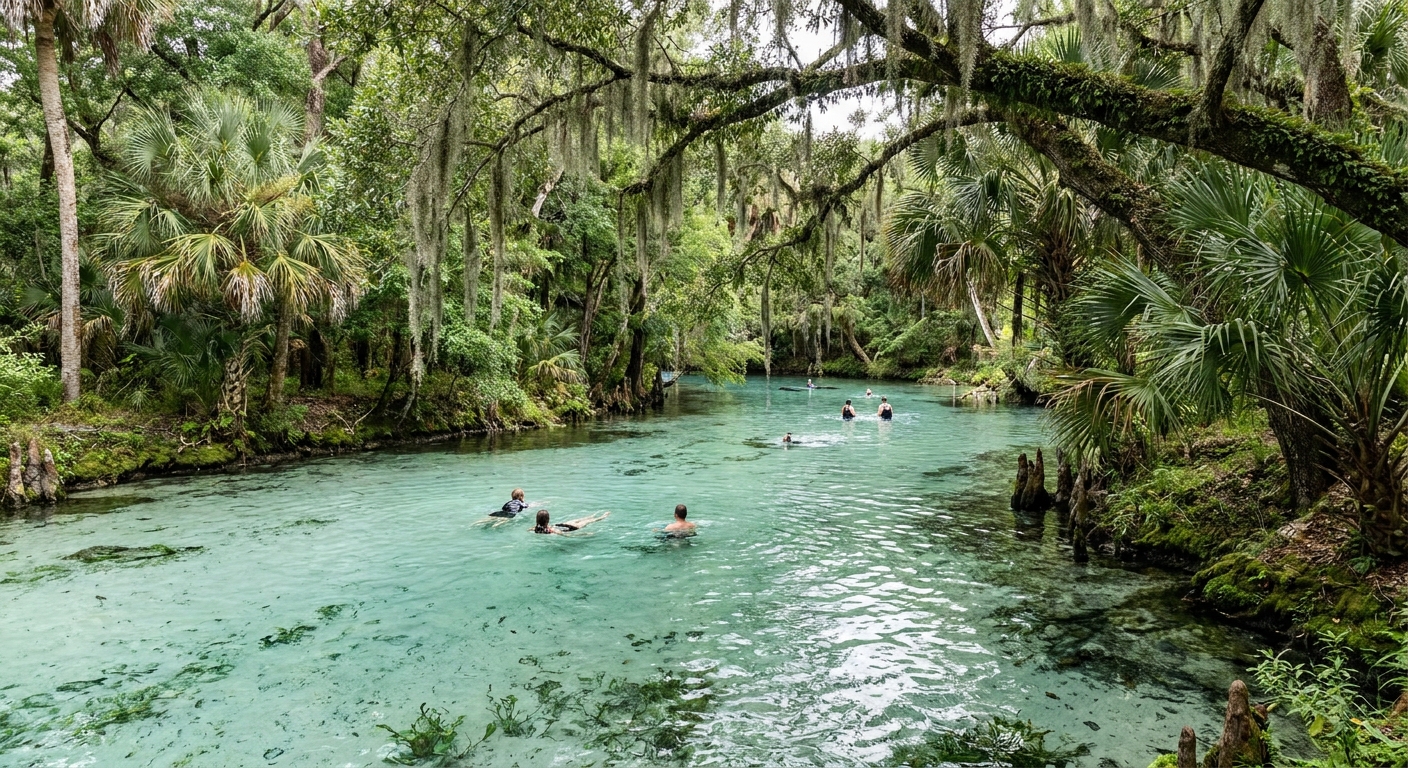
July opens the widest air-to-water gap of the three summer months on this record: 92.1°F against 73.2°F, close to 19 degrees at the afternoon peak. June manages 90.1 and August 91.5, so the difference between them is real but slim. July also runs the longest: 13 hours 58 minutes of daylight on the 15th leaves room for a slow first swim, a long shaded lunch and a second entry at four.
The spring is the attraction and the numbers belong to it: 72 cubic feet per second of groundwater at 73.2°F, measured at USGS station 02319302. Florida law keeps a protected class called Outstanding Florida Springs, defined in Florida Statutes 373.802(5) as every historic first-magnitude spring the Florida Geological Survey determines, plus six named by hand in the statute; we did not verify which line applies here. One caveat sits in the state’s own paperwork: the Florida Department of Environmental Protection’s 2024 Recreational Facilities Inventory lists no designated swimming area at this park, and no canoe, kayak or tube launch.
Month to month, the gauge reads the same. The air does the moving: 90.1°F in June, 92.1 in July, 91.5 in August, all from the same station record. So what July alters at the vent is the walk back out and how fast the bank dries you off, not the swim. Of the three, July opens the biggest spread between what you stand in and what you step into.
We could not verify an entrance fee for the park, nor an opening hour, nor a manatee count, for the reason given above: the state parks site refused our automated reads. So we promise no free day and quote no price. Fees vary by park and by season in Florida, and a figure lifted from another spring does not transfer here.
Madison Blue Spring in July: a two-day itinerary
Day one starts in the dark. Leave your bed by 6:15 and aim for the 6:40 sunrise, or as close to it as the gate allows, since the opening hour is the thing we could not confirm. Swim between seven and nine while the air still sits near 70.1°F. Sit out the middle of the day somewhere shaded with cold drinks and a dry shirt, come back around four for a second entry, and let the light go at 8:37 p.m.
Day two flips the order: drive in the morning, keep the middle of the day for the road, swim late. If the sky turns, and 1.5 days in an average July bring an inch of rain or more, the swim is the plan least affected, because you are already wet and 73.2°F water under a downpour is still 73.2°F. Get out for lightning rather than for rain. Our road trip guide carries the route north or south from here.
Madison Blue Spring in July vs June and August
| 1991-2020 normals | June | July | August |
|---|---|---|---|
| Average high | 90.1°F | 92.1°F | 91.5°F |
| Average low | 67.9°F | 70.1°F | 71.0°F |
| Precipitation | 7.08 in | 5.33 in | 5.11 in |
| Days with 0.10 in or more | 8.4 | 9.0 | 8.0 |
| Spring water at the gauge | near 73.2°F | near 73.2°F | near 73.2°F |
Side by side, July takes the hottest days (92.1°F against June’s 90.1 and August’s 91.5) and the middle spot at night (70.1°F, between 67.9 and 71.0). The rain column separates them properly: June pours 7.08 inches, July 5.33, August 5.11. July logs the most wet days of the three, 9.0 against 8.4 and 8.0, which works out at just under 0.6 inch per wet day against June’s 0.84. July’s rain comes in more frequent, lighter servings.
Shift back four weeks to June and you gain two degrees by day and 2.2 at night, paying 1.75 extra inches of rain for them. Shift forward to August and you give up 0.6 degrees on the high, take the warmest nights of the three at 71.0°F, and get the calmest rain column: 5.11 inches over 8.0 days. No shift touches the water. The spread across the three highs is two degrees, and the spring stays where it is.
Is July a good time to visit Madison Blue Spring?
Yes, for anyone whose day starts early and whose plans survive a wet afternoon. A 92.1°F high is exactly what makes 73.2°F water feel like a reward, and 13 hours 58 minutes of daylight gives the day room to breathe around the heat. No, for anyone who needs a guaranteed dry three o’clock, and no for anyone counting on a marked swim area, because the state’s 2024 inventory does not list one at this park.
If the answer came out no, take August rather than June. August runs 0.6 degrees cooler by day, logs the fewest wet days of the three at 8.0, and carries the lowest rain total at 5.11 inches. June goes the wrong way for dry weather at 7.08 inches, nearly two inches more than July. What August costs you is the night, 71.0°F, and that only bites if you plan to sleep without air conditioning.
No other month on this record hands you a 19-degree drop from air to water with almost fourteen hours of daylight left to keep using it.
The last word
Set the alarm and the rest of July sorts itself. Be in the water by eight and the 92.1°F afternoon becomes somebody else’s afternoon, spent in a cold car or under a roof while the inch of rain that falls 1.5 days a month does its work. One figure to carry down the bank with you: 72 cubic feet per second works out to roughly 46 million gallons a day of 73.2°F groundwater, arriving at the same temperature it will have in January. Call the park for its hours first.
Sources & data for this guide
- July normals (92.1°F, 70.1°F, 5.33 in, 9.0 days at 0.10 in, 1.5 days at 1 in) · NOAA NCEI monthly normals 1991-2020, station USW00093845, Valdosta Regional Airport, GA, about 27 miles from the spring · checked Sep 24, 2026
- June and August normals used in the comparison table · same NOAA NCEI 1991-2020 series, same station · checked Sep 24, 2026
- Sunrise 6:40 a.m., sunset 8:37 p.m., 13 h 58 min of daylight on July 15 · sunrise-sunset.org, converted from UTC to Eastern time · checked Sep 24, 2026
- Water temperature 73.2°F (22.9°C) and flow of 72 cubic feet per second · U.S. Geological Survey, National Water Information System, station 02319302 Madison Blue Spring, instantaneous reading · read Sep 11, 2026
- No designated swimming area, no canoe, kayak or tube launch listed · Florida Department of Environmental Protection, Recreational Facilities Inventory, 2024 annual report · checked Sep 24, 2026
- Outstanding Florida Springs definition · Florida Statutes 373.802(5), leg.state.fl.us · checked Sep 24, 2026
- Editorial admission: floridastateparks.org returned a 403 to our automated reads on Sep 11, 2026, so we carry no entrance fee, no opening hour and no manatee count. We also could not verify a Madison County lodging-tax rate. Phone the park before you travel.
To plan your stay
- Madison Blue Spring: When to Go, Month by Month Highs, Rain and Daylight
- Madison Blue Spring in June: Water Temperature, Rain Days and What the Park Lists
- Madison Blue Spring in August: 91°F Air, 73°F Water and 8 Rain Days
- Madison Blue Spring in May: Weather, Water Temperature and How May Compares to April and June