
Heraklion is a real city, not a resort. Crete's capital and largest city moves at the pace of a modern place while sitting on the remains of a very old one, and it suits travelers who like walking, history and long dinners more than sunbeds. Give it a couple of days and it pays you back with the island's most famous ancient site, a lively Venetian old town and some of the best cooking on Crete.
Where should you stay in Heraklion?
Stay in the center. Pedestrian streets, cafes, the old harbor and the main square sit within a few minutes of each other, and the core is largely free of cars. The walk from the Venetian port to Lions Square takes roughly 5 to 10 minutes. Staying near the middle puts the historic center, the harbor and the main sights within easy reach, which saves you time and bus rides.
The old center
This is where evenings happen. Cafes and restaurants ring the Morosini Fountain, the pedestrian streets stay busy, and the harbor is a short stroll away. It suits first-timers, couples and anyone who wants to leave the car behind. The catch is supply: hotels are not plentiful in the center, and chain hotels are rare, so book ahead in high season. The city does offer hotels in many categories, plus bed and breakfasts and rooms for rent, and apartment rentals widen the choice. Atrion Hotel and DOM Boutique Hotel are both close to the main sights, with the fortress, the waterfront and the Archaeological Museum on foot.
Near the harbor and bus station
If you're arriving or leaving by ferry, plane or intercity bus, look at the Hotel Poseidon, which sits basically across the street from the harbor. It's about a ten-minute walk from the main bus hub and a couple of bus stops from the airport, and the major sights in town are still within walking distance. The rooms are simply furnished but very clean, the staff is friendly, and the price is reasonable. It suits travelers who care more about logistics than atmosphere.
On the coast near Hersonissos
King Minos Retreat Resort and Spa, a 5-star hotel that opened in May 2023, is about a 30-minute drive from the center and 20 minutes from the airport, with a small beach less than a five-minute walk away. It makes a relaxed base if you have a car. The trade-off is that many city sights and dinners in town mean a drive or a tour.
What are the best things to do in Heraklion?
Start with Knossos, the most visited site on Crete. The Minoan palace complex sits about 3 miles (5 kilometers) south of the center, and it needs a couple of solid hours. Be there at opening time. The site has little shade, so the morning is far more comfortable, and tour buses tend to roll in about half an hour after opening, bringing long lines and groups that block the paths. City bus line 2 gets you there, running every 15 to 20 minutes in summer, or you can drive and use the free parking near the entrance.
Full admission to Knossos is €20 (2026), €10 reduced. The site keeps long summer hours, roughly 8 a.m. to 8 p.m. from April, and shorter winter hours, roughly 8:30 a.m. to 5 p.m. from November. Hours also change on public holidays such as Easter and Christmas, so check before you go. Entry is free on March 6, April 18, May 18, the last weekend of September and October 28. Children under 18 from outside the EU get in free at state-run sites on showing a passport. In high season tickets can sell out, so buy yours ahead at the official e-ticketing site, etickets.tap.gr.
Save the afternoon, or the next morning, for the Heraklion Archaeological Museum. A bus from Knossos drops you right in front. The museum's highlights include the bull-leaping fresco, the Snake Goddess figurines, the stone bull's head rhyton, the gold bee pendant and the enigmatic Phaistos Disc. It ranks among the most important museums in Europe, and seeing it after the site is what makes the ruins come alive. Full admission is €20 (2026). The museum shares Knossos's free days and adds the first and third Sunday of each month from November to March. It stays open until 8 p.m. in summer but closes mid-afternoon in winter, and Wednesdays run on different hours, so confirm the hours for your day and start early in the cooler months. Buy tickets at the booth or online at hhticket.gr.
Then give the city itself time. The Venetian layer is everywhere, and most of it you simply walk past. The Loggia, a 17th-century building where the nobility once gathered, now houses the town hall. The church of Saint Titus stands steps away and has been a Byzantine church, a Catholic one, a mosque and now an Orthodox church. The Morosini Fountain, with its lions, anchors Lions Square and is the city's favorite meeting spot. From there, 25th August Street runs down to the sea past souvenir shops selling olive wood bowls and spoons, ending at the old harbor and Koules, the Venetian fortress that has guarded it for centuries. Allow an hour or more to go inside and climb for the views.
The Venetian walls held out against Ottoman sieges for 21 years, and their views over the city and the sea are best in the late afternoon. The Historical Museum of Crete picks up the island's story where the archaeology museum leaves off, with a strong Venetian focus. On a bastion of the old walls lies the tomb of Nikos Kazantzakis, author of Zorba the Greek. There are no crowds or ticket lines, just quiet and a long view over the rooftops to the sea. His chosen epitaph is a short, defiant line about hope, fear and freedom, and many visitors find it moving.
Street art fans should head to Lakkos, southwest of the center. Its narrow, badly paved streets, low houses and crumbling walls are covered in colorful murals.
With a rental car and a free day, two detours stand out. Archanes, about 20 minutes from the city and less than 6 miles (10 kilometers) from Knossos, is a beautifully restored village of colorful houses, narrow lanes and vineyards, and it makes a good lunch stop after the palace. Thrapsano, 19 miles (30 kilometers) out, has been Crete's pottery center for thousands of years. Master potters still shape giant jars by hand, and you may get the chance to try the wheel yourself. Agelakis Winery is a few minutes down the road, so the two pair nicely.
What are the best beaches in Heraklion?
Heraklion is a city first and a beach destination second, and if sand is your main goal there are better places on the island. Still, a beach day is easy to arrange, and the closest one doesn't require a car.
Ammoudara
The nearest beach lies 3 miles (5 kilometers) from the center and is reached by city bus. It suits families and anyone who wants an easy day with lunch close at hand. It gets very busy in high season, so arrive early. Wind is common here and can send sand whipping across the beach.
Ligaria and Agia Pelagia
Both are popular alternatives, with clear water and sunbeds and parasols for rent. A rental car makes them simple, and in summer a seasonal bus to Agia Pelagia leaves the central bus station, with times posted by the KTEL bus company.
What should you eat in Heraklion?
Food is the high point of a stay here. Hospitality is generous: many sit-down meals end with a free dessert and a glass or small bottle of raki, the strong local spirit made from grape pomace. Don't feel obligated to finish either, since the servings can be large.
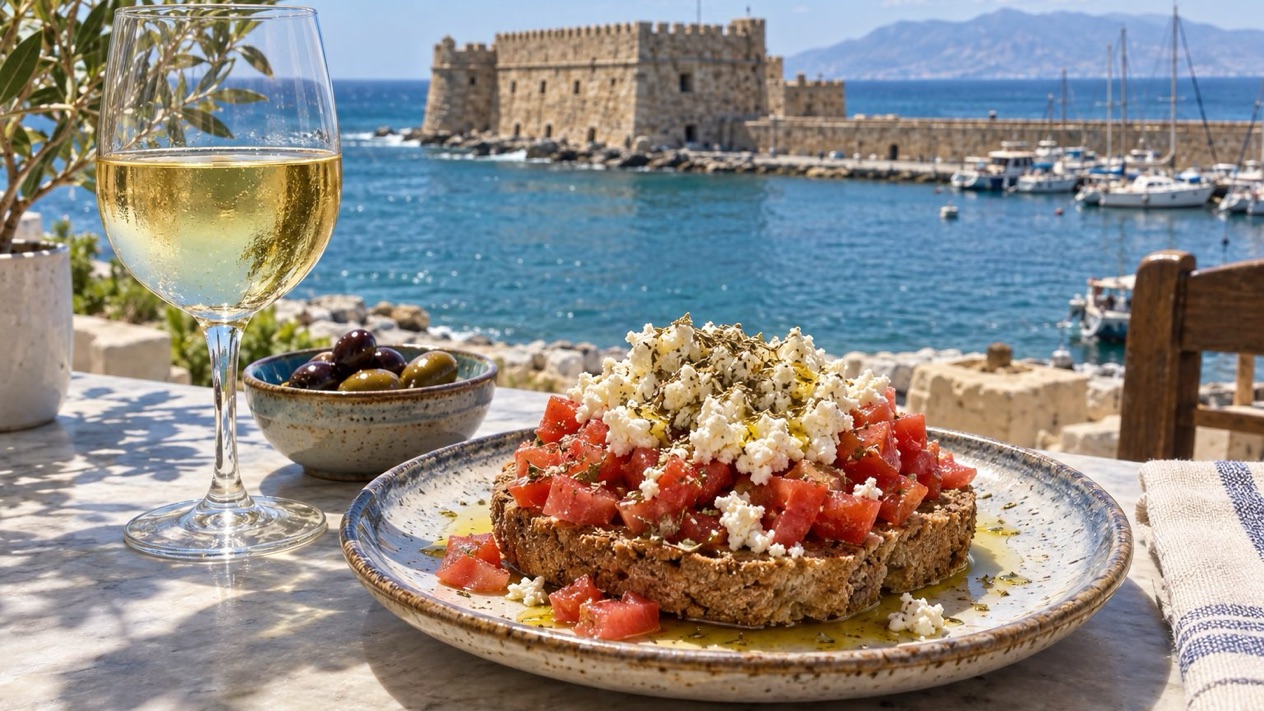
Order dakos, a barley rusk topped with grated tomato, soft mizithra cheese or feta, olive oil and oregano. Try boiled wild greens with lemon and oil, and fried seafood, especially squid and anchovies. Crete is known for its lamb, so order it in any form. Meze tables bring small pies filled with wild greens, tomato fritters, smoked pork and stuffed peppers. Snails are a local specialty if you're game, grilled corn is sold all over town, and semolina turns up in many pastries.
For a splurge, reserve a table at Peskesi, a farm-to-table restaurant in a restored mansion that sources from its own farm. For hearty Cretan cooking with huge portions and fair prices, try the tavernas along Milatou Street, especially Tempelis and O Magos toward its western end. Waterfront spots such as MARE Heraklion Riviera are worth it for the view, a coffee or a sunset drink.
Make room for one local evening. A kafeneio is a small, informal place somewhere between a taverna and a bar, where locals gather over drinks and meze to talk football and politics. A glendi, a late-night Cretan feast with live lyra music and raki, is the full-tilt version of dinner.
How many days do you need in Heraklion?
Two days covers the essentials, and three lets you add a beach or a village without rushing. The city is slow-paced, and that's part of its charm.
Day 1: The old city and the harbor
Begin with a coffee by the Morosini Fountain, then walk to the Loggia and Saint Titus. Follow 25th August Street down to the sea, browse the olive wood shops and finish at the Koules fortress. Have a long lunch in the center, then spend the afternoon on the Venetian walls or in the Historical Museum of Crete. As the light turns, settle in front of the fortress, the best spot in town for sunset, and move on to a Cretan dinner. Afterward, walk the port. Lights reflect off the water, families and teenagers stroll the quay, fishing boats come in, and the night feels calm.
Day 2: Knossos and the museum
Be at Knossos when it opens, ticket in hand, by early bus or car. Head back to the center for lunch, then spend the afternoon with the frescoes and finds at the Archaeological Museum. The order matters: the site first, the objects second. In the evening keep it casual at a taverna with a long meze menu.
Day 3: Beach or village
Pick one. For a beach day, take the bus to Ammoudara, claim chairs early, swim and have lunch on the sand. For a village day, drive to Archanes to wander and eat, then continue to Thrapsano for the pottery and the winery. Either way, end with one last walk along the harbor.
How do you get to Heraklion and around?
Heraklion Airport (Nikos Kazantzakis) lies just east of the center, roughly 15 to 20 minutes away in light traffic and up to about 30 minutes at peak hours. Heraklion's airport is the second busiest in Greece and the first for charter flights, and travelers from the U.S. reach it with a connection, for example through Athens. Flights from Athens take about 50 minutes, and from Thessaloniki 1 hour and 10 minutes. A taxi is the easiest choice on arrival: taxis pick up just outside the terminal. A bus also runs to the main bus terminal in town. Rent a car for villages and farther beaches, but you won't need one in the center.
By sea, Minoan Lines runs an overnight ferry from Piraeus every evening year-round, usually leaving around 9 p.m. and arriving early the next morning, so check the timetable before you go. It's a night crossing, so book a cabin if you want to sleep. Several lines serve the route with conventional ferries and high-speed boats, and crossing times vary with the ship. Minoan Lines gives 20% off (2026) when you buy both directions at the same time. Cruise ships dock at a port that's basically in the center, so you can walk or take a short cab ride in.
Around town, walking handles nearly everything. For Knossos, Ammoudara and the airport, take the city bus. Tickets cost noticeably less bought ahead at kiosks and mini-marts than from the driver, a day pass is a good deal, and you can buy your return ticket in the same purchase. Raise your arm at the stop so the driver pulls in. Uber doesn't operate here, and getting a ride through the local app can be unreliable, so count on taxis and buses.
Intercity buses to Rethymno, Chania, Agios Nikolaos and the south leave from the central bus station near the harbor, on seasonal schedules. For route and ticket information, call +30 2810 24 65 30. Buses are generally punctual, but if you have a flight or ferry to catch, leave two to three hours of cushion.
What is the weather like in Heraklion, and when should you go?
July is the hottest month and August the driest, which makes an early start at shadeless Knossos essential in summer. October is the peak of the harvest season, with markets full of produce and local festivals celebrating the grape harvest, and the Feast of Saint Dimitrios, the city's patron saint, on October 26 brings parades and religious ceremonies. Earlier in the year, Heraklion marks the anniversary of the Battle of Crete from May 20 to 28, and Archanes holds a wine festival in August. Whatever the month, Heraklion can be windy, which makes cool evenings feel cooler and warm ones more pleasant.
What should Americans know before going?
U.S. citizens can enter Greece without a visa for tourism or business stays of up to 90 days. Your passport should have at least three months of validity beyond your planned departure date, and you may be asked for proof of sufficient funds and a return or onward ticket. Greece is generally safe, but petty crime is common at popular tourist spots and on public transportation, so watch your bag in crowds. Thieves in Greece are known to break into rental cars to steal passports, valuables and luggage, so take your valuables with you when you park. Strikes and demonstrations can happen with little notice and may disrupt buses, taxis, ports and airports, so build slack into travel days. If you drive, Greek law requires a valid U.S. license, and insurance companies may require an international driver’s permit. Carry your passport or photo ID at all times, and validate your bus ticket as soon as you board, since riding without a valid ticket can cost up to 60 times the basic fare.
Sources
- theroyaltourblog.com (https://theroyaltourblog.com/2024/12/18/the-ultimate-guide-to-heraklion/), checked October 18, 2026
- thetravelbunny.com (https://thetravelbunny.com/things-to-do-in-heraklion-attractions-crete/), checked October 18, 2026
- byemyself.com (https://byemyself.com/guide-to-heraklion-your-perfect-base-in-the-east-of-crete/), checked October 18, 2026
- eataliantraveler.com (https://eataliantraveler.com/is-heraklion-worth-visiting/), checked October 18, 2026
- efultimatebreak.com (https://www.efultimatebreak.com/blog/ultimate-guide-to-heraklion), checked October 18, 2026
- U.S. Department of State (https://travel.state.gov/content/travel/en/international-travel/International-Travel-Country-Information-Pages/Greece.html), checked October 15, 2026
- ktelherlas.gr (https://www.ktelherlas.gr/en/timetables), checked October 15, 2026
- Hellenic Ministry of Culture, Odysseus (http://odysseus.culture.gr/h/1/eh155.jsp?obj_id=3327), checked October 15, 2026
- Hellenic Ministry of Culture, Odysseus (http://odysseus.culture.gr/h/3/eh355.jsp?obj_id=2369), checked October 15, 2026
- minoan.it (https://www.minoan.it/en/routes-fares-timetable-minoan-lines/timetable-ferry-piraeus-heraklion), checked October 15, 2026
- culture.gov.gr (https://www.culture.gov.gr/en/service/SitePages/view.aspx?iID=2695), checked October 15, 2026
- Visit Greece (GNTO) (https://www.visitgreece.gr/islands/crete/irakleio/), checked October 15, 2026
All our pages
When to go
- Best Time to Visit Heraklion: Late May, June, September and Early October for Warm Beach Days Without the Crush
- Heraklion in April: Weather, Knossos, the Archaeological Museum and Orthodox Easter
- Heraklion in August: Weather, Sea, Knossos and the Dormition Feast
- Heraklion in December: Weather, Christmas Traditions and Minoan Museums
Things to do
- Day Trips from Heraklion: Knossos, Rethymno, Agios Nikolaos and Spinalonga
- 3 Days in Heraklion: Minoan Museum, Knossos, Venetian Harbor and Phaistos
- The Heraklion Archaeological Museum: Minoan Treasures, Hours and When to Go
Where to stay
Getting there
- How to Get to Heraklion: Fly, Sail, or Both
- Heraklion Airport: What to Know Before You Land in Crete
- Heraklion to Chania: The Drive West Across Crete, the Distance and the Driver's Permit
- Heraklion to Knossos: Getting There from the City and the Airport, Driving Rules and the Palace
- Heraklion to Rethymno: Driving, the Airport Arrival and the Old Town at the End