
In December the harbor of Heraklion fills with strings of lights, and the smell of honey-soaked melomakarona (walnut-topped spice cookies) drifts out of bakery doors. Children go from door to door singing kalanda, the Christmas carols, and kafenia (the traditional coffeehouses) keep their tables full of men and women lingering over small cups of Greek coffee.
What is the weather like in Heraklion in December?
December in Heraklion is mild and damp rather than cold, with sunny stretches broken by a fair number of rainy days. Compared with the weeks on either side, it sits in the middle of a winter that never gets harsh by the numbers.
| Month | Average high (°F) | Average low (°F) | Precipitation (in) | Days with 1 mm or more of precipitation | Daylight on the 15th | Sea (°F) |
|---|---|---|---|---|---|---|
| November | 68.7 | 57.0 | 1.81 | 7.4 | 10 h 15 min | 70.3 |
| December | 62.4 | 51.6 | 2.68 | 11.5 | 9 h 47 min | 66.5 |
| January | 59.7 | 48.6 | 2.73 | 11.8 | 10 h 01 min | 63.3 |
What this means in practice is that you pack for two kinds of days. On the dry ones, a light sweater or a fleece is plenty for a walk through town, and you can sit outside a café in the sun with your jacket open. On the wet ones, which come on roughly one day in three, you want a rain jacket and shoes with some grip, because stone pavements and museum steps turn slick.
Daylight is the real constraint. The sun is up for under ten hours, so plans that depend on being outdoors, such as the ruins at Knossos, belong in the middle of the day, and the evening belongs to the lamp-lit streets, tavernas and bars. Sun protection still earns a place in the bag, since a bright winter sky over the Cretan Sea is not the same as no sun at all.
For everyone else it is simply the backdrop to the harbor and the Venetian fortress, a deep blue edge to a city whose winter weather is moderate and damp.
Can you swim in Heraklion in December?
Only for a quick dip, since the sea near Heraklion averages 66.5°F in December. That is cool enough that people who go in will want to come straight back out, and a towel and a warm layer within reach make the difference between a brisk memory and a shivering one.
This is not the month for planning the trip around the water. The sea is still a good deal warmer than you would find in many northern places at this time of year, and a swim can be a bracing pause on a sunny day in the capital of Crete. It is the sort of thing you do once, for the story, and then go and find a warm bowl of soup or a glass of raki.
The sun, when it shines, still has warmth in it, so the shore is pleasant for sitting with a coffee and looking at the water even when you have no plan to get wet. Wet days put the sea out of the picture entirely, and that is when the museums step in.
What to do in Heraklion in December
The month runs on the calendar of Greek winter customs. St. Nicholas is remembered on December 6, a date that carries weight in a port city because he is the patron saint of sailors. Christmas arrives on December 25, with carols, family tables and sweets, and New Year’s Day on January 1 brings the vasilopita, a cake with a hidden coin that gives luck to whoever finds it in their slice.
Winter is also a food season. Think of bowls of horta (boiled wild greens with olive oil and lemon), dakos (barley rusk topped with tomato and soft cheese), slow-cooked meat dishes, and fresh citrus from the island’s orchards.
The tavernas fill with locals at the long Sunday lunch, and every Sunday is a public holiday in Greece, so shops can be shut while the tables are full. Raki, the clear spirit often poured at the end of a meal, tends to arrive without being ordered.
The Heraklion Archaeological Museum
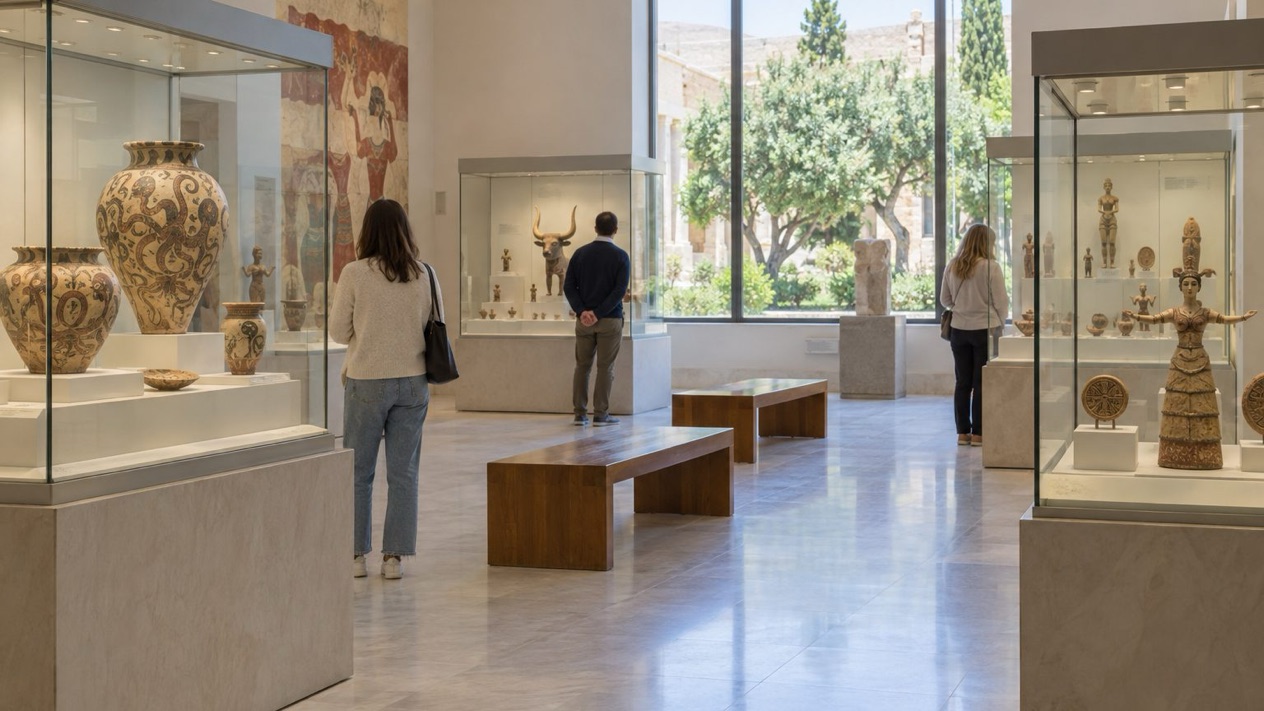
The Archaeological Museum is the best use of a rainy December day. It houses Minoan finds including the Snake Goddess, the Bull-Leaping Fresco, the Phaistos Disk, and Minoan seals and jewellery. A snake goddess statue from circa 1600 BC is among the pieces you see, a small figure that has become a symbol of the island’s ancient past.
The galleries are indoors from start to finish, which makes them a natural fit for a month with a good number of wet days. The museum is on its winter schedule from November through April, and the hours are in the table. Go through the rooms in order and let the objects speak: the tiny seals and gold jewellery reward the closest look.
| Site | Open |
|---|---|
| Heraklion Archaeological Museum (1 November to 30 April) | Monday 10:00-17:00, Tuesday-Sunday 09:00-16:00 |
Knossos and the Minoan story
Knossos lies within the Municipality of Heraklion, in the southern periphery of the city, and many consider it the oldest city in Europe. Seeing it after the museum is the logical order, because the frescoes and vessels you have just looked at come from this world of palace rooms, storage areas and courtyards.
The site is open-air, so a dry December day is the one to spend here, with layers on and a water bottle in the bag. The ruins have little shade to offer, which matters even in winter when the sun comes out. A rain jacket stays folded in the pack for the day the clouds decide otherwise.
Other museums and the city’s writers and painters
Two more museums add depth for a longer stay: the Historical Museum of Crete and the Natural History Museum of Crete, both in Heraklion. They give the island a later and a wider story than the Minoan one, and they are good places to wait out a shower.
The city has also produced figures whose names travel far. Domenicos Theotokopoulos, known as El Greco, was a world-famous painter from Heraklion, Nikos Kazantzakis, author of Zorba the Greek, was a novelist from here, and Odysseas Elytis was a Nobel Prize-winning poet. Reading a little of Kazantzakis before the trip puts a voice to the streets, and Zorba is a good companion for an evening in a kafenio.
Between the big visits, the city gives you its small pleasures: a coffee in a square, a bakery stop for sesame pastries or cheese pies, a stroll along the harbor, and the market streets where oranges, olives, herbs and cheeses are stacked up in winter abundance. Olive oil is a staple of the island’s table, and you will taste it in nearly everything you eat.
A two-day itinerary for Heraklion in December
Day 1 starts with the Archaeological Museum, which is the right opener in a month when a shower can arrive at any point. Spend the morning going through the Minoan rooms, from the seals and jewellery to the Snake Goddess, the Bull-Leaping Fresco and the Phaistos Disk. This way you arrive at the ruins the next day already knowing what you are looking at.
Take lunch at a taverna in the old center, ordering the dishes of the season: horta, dakos, a plate of grilled meat or fish, and a small carafe of local wine. In the afternoon, fit in the Historical Museum of Crete, which carries the story forward from the Minoans, and then go out and see the harbor while there is still light. Evening is for a long dinner and a glass of raki.
Day 2 is for Knossos, in the southern periphery of the city. Plan it for the middle of the day, when the sky is brightest, and wear layers you can peel off. Standing in the open palace courts with the museum’s frescoes fresh in mind is the payoff of doing the museum first.
Afterward, return to the center for a late lunch and spend the afternoon in the market streets, buying olive oil, herbs, honey and Christmas sweets to take home. If the weather turns, switch to the Natural History Museum of Crete, which is indoors. Finish with a seaside coffee if the sky clears, or a kafenio table if it does not, and keep the last evening for a taverna dinner.
Is Heraklion busy in December?
December is winter in the capital of Crete, and the rhythm of the city follows the holidays more than a visitor season. The Archaeological Museum is on its winter schedule, and the days are short, with under ten hours of daylight in the middle of the month.
What fills the calendar is the run of festive dates: St. Nicholas on December 6, Christmas on December 25, and New Year’s Day on January 1. Greek families gather around these days, and the streets and tavernas carry the sounds of carols and long meals. Because every Sunday is a public holiday in Greece, you will find the weekly rhythm slowing on that day too.
For a traveler this means planning around the opening hours of the museums, which run shorter than in the long days of late spring and summer. The Archaeological Museum, for instance, closes in the afternoon in winter, so it is the first stop of the day, not the last. The rest of the day can then be given over to the market, the harbor and the table.
What to pack for Heraklion in December
The numbers call for layers and a rain plan, with a small allowance for sun and a dip in the sea. Pack for museum floors, wet stone, and an open-air site at Knossos.
- A rain jacket, because roughly a third of the days in December bring rain.
- A fleece or sweater that goes over a shirt, since highs sit in the low 60s.
- Shoes with a good grip for wet stone and for the ruins at Knossos.
- Sunglasses and sunscreen for bright days over the open palace site.
- A swimsuit and a quick-dry towel in case you decide on a brisk dip in a sea of about 66°F.
- A small day bag for the market, where olive oil, herbs and sweets end up in your arms.
Good to know before you go
Winter timing shapes the practical side of the month. The Archaeological Museum runs its shorter winter hours from November to April, with a Monday opening that starts later than the rest of the week. Every Sunday in Greece is a public holiday, and December 25 and January 1 are festive dates, so check that the place you have in mind for lunch is open before building the day around it.
Rain falls on a good number of days, and a plan with an indoor option for each day saves the schedule. Daylight is short, which pushes outdoor visits toward the middle of the day.
Heraklion in December vs November and January
Moving the trip four weeks earlier brings you to November, which is noticeably warmer in the air and in the sea, with fewer rainy days and longer light. The Archaeological Museum is already on its winter schedule from the first of that month. What you give up is the festive run, since Christmas lights, carols and the New Year cake belong to December and the first days of January.
Moving four weeks later takes you to January, a little cooler than December, with a sea that has dropped further and a similar number of rainy days. New Year’s Day is the opening beat of the month, and after that the winter settles in. The light is a touch longer than in mid-December, though still short for a day of outdoor sightseeing.
If you want a sea you might actually swim in and the gentlest weather, November is the better choice. If the holiday atmosphere matters, with carols, sweets and festive tables, December is the one to pick.
Is December a good time to visit Heraklion?
Yes, for travelers who come for museums, ruins, food and the Greek holiday season rather than for the beach. The days are mild enough to walk around in a sweater, and the Minoan story fills hours on both wet and dry days.
Those travelers should pick a warmer month. People who enjoy the atmosphere of a city in its winter routine, with carols, sweets and tavernas full of locals, will feel at home here.
On arrival, begin with the Archaeological Museum, since the Snake Goddess, the Bull-Leaping Fresco and the Phaistos Disk set up everything else you will see. Then go to Knossos on a dry day with the museum still fresh in mind. What stays with you from a December here is the pairing of ancient Crete with the island’s own Christmas, with honey cookies in a bakery window and a raki at the end of the meal.
Sources
- Hellenic National Meteorological Service (HNMS), climatological normals 1991-2020 for Heraklion station (https://www.emy.gr/climatic-data), monthly mean daily maximum and minimum; rain from the ECMWF ERA5 reanalysis, 1991-2020, grid cell of Heraklion (Open-Meteo), checked October 12, 2026
- ECMWF ERA5 reanalysis 1991-2020, grid cell of Heraklion (Open-Meteo), checked October 12, 2026
- Open-Meteo Marine API, mean 2022-2024, checked October 12, 2026
- Computed from the date and the latitude of the place (sunrise equation, solar elevation -0.833 degrees), October 12, 2026
- Wikipedia, Christmas in Greece (https://en.wikipedia.org/wiki/Christmas_in_Greece), checked October 12, 2026
- Wikipedia, Public holidays in Greece (https://en.wikipedia.org/wiki/Public_holidays_in_Greece), checked October 12, 2026
- Wikipedia, Climate of Greece (https://en.wikipedia.org/wiki/Climate_of_Greece), checked October 12, 2026
- Wikipedia, Geography of Greece (https://en.wikipedia.org/wiki/Geography_of_Greece), checked October 12, 2026
- Wikivoyage, Heraklion (https://en.wikivoyage.org/wiki/Heraklion), checked October 12, 2026
- Wikipedia, Heraklion, section Climate (https://en.wikipedia.org/wiki/Heraklion#Climate), checked October 12, 2026
- Wikipedia, Heraklion, section Culture (https://en.wikipedia.org/wiki/Heraklion#Culture), checked October 12, 2026
- Wikipedia, Heraklion, section History (https://en.wikipedia.org/wiki/Heraklion#History), checked October 12, 2026
- Wikipedia, Heraklion, section Notable people (https://en.wikipedia.org/wiki/Heraklion#Notable_people), checked October 12, 2026