
In April, the harbor of Heraklion fills with the smell of fresh bread and strong coffee from the kafenia, and church bells carry across the old Venetian walls as Easter preparations begin. Red eggs appear in bakery windows, and the days grow long enough for a stroll along the waterfront after dinner. It is a month for Minoan ruins, a first walk beside the Koules Fortress and tables set outside again.
What is the weather like in Heraklion in April?
April in Heraklion is mild and mostly bright, warm enough for sightseeing in shirt sleeves at midday, with some rain still in the mix.
| Month | Average high (°F) | Average low (°F) | Precipitation (in) | Days with 1 mm or more of precipitation | Daylight on the 15th | Sea (°F) |
|---|---|---|---|---|---|---|
| March | 63.3 | 50.2 | 2.20 | 8.4 | 11 h 52 min | 62.2 |
| April | 68.5 | 54.1 | 1.43 | 5.9 | 13 h 02 min | 64.5 |
| May | 75.0 | 60.1 | 1.13 | 4.3 | 14 h 01 min | 67.7 |
The afternoons are comfortable for walking the city and for the ruins outside it, and a light layer is enough for most of the day. Nights are cooler, so a sweater earns its place when you sit out at a taverna after sunset. April sits between a showery March and a drier May, with fewer wet days than the first and a little more than the second.
Rain still turns up in the month, so a light rain jacket belongs in the bag. The sun is already strong enough over the open site of Knossos that a hat and sunscreen make sense. Daylight stretches well into the evening, which leaves room for a late visit to the harbor. The sea is cool at this point in spring, a few degrees warmer than in March but still short of the temperatures May brings.
Can you swim in Heraklion in April?
Swimming in April is bracing rather than relaxing: the sea near Heraklion averages 64.5°F, enough for a quick dip by the hardy and a cool one for most people.
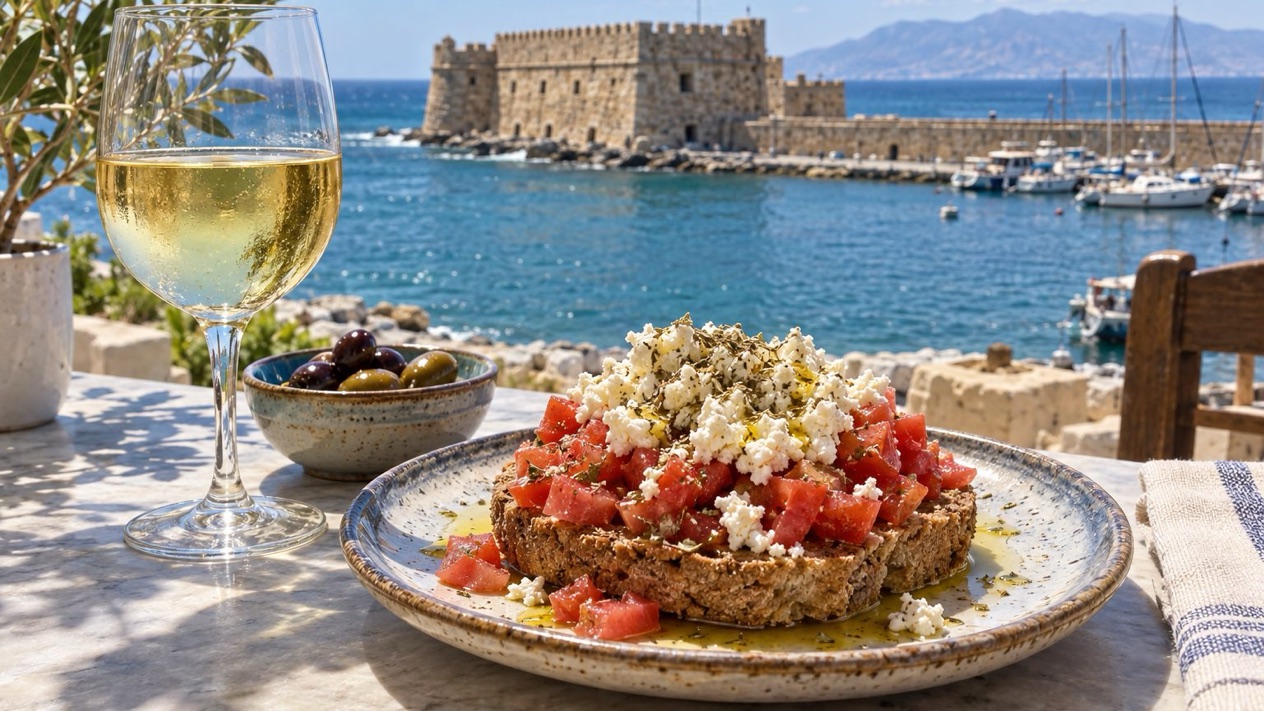
The city itself is built around its harbor, where the Koules Fortress stands over the port, and the waterfront is a place to walk more than to swim at this time of year. A sunny afternoon beside the water still feels like spring, with the sea in view and the fortress behind you.
Many visitors in April put their energy into the museum, the ruins and the old town, and treat the sea as a view. If a swim tempts you, a towel in the daypack and a warm layer for afterward cover it.
What to do in Heraklion in April
The big event of the season is Orthodox Easter, which falls between early April and early May depending on the year. In the weeks before it, the city turns toward Holy Week, with church services, bakeries making Easter breads and families preparing for the long Good Friday and Easter weekend. When it falls inside April, the whole island feels it.
Every Sunday is a public holiday in Greece, so the city moves at a slower pace on that day. In April, that means a late coffee in a kafenio, a walk along the port and long lunches that stretch into the afternoon.
The Archaeological Museum
The Heraklion Archaeological Museum holds the Minoan finds from across Crete: the Snake Goddess, the Bull-Leaping Fresco, the Phaistos Disk, and cases of Minoan seals and jewelry. It is the natural companion to a visit to Knossos, because the objects explain the place you walk through. The opening hours change on April 25, when the museum moves to its longer daily schedule.
| Site | Open |
|---|---|
| Heraklion Archaeological Museum, through April 24 | Monday 10:00-17:00, Tuesday-Sunday 09:00-16:00 |
| Heraklion Archaeological Museum, from April 25 | Daily 08:00-20:00 |
Knossos
Just south of the city lies Knossos, the site where excavations began around 1880 with the Greek Kalokairinos, and where the British archaeologist Sir Arthur Evans dug from 1900. He found a far older and more powerful civilization than he expected and named it Minoan, after the Minotaur legend. From here, Crete once dominated the eastern Mediterranean.
Walking the site in April, with the days lengthening and the air mild, is a good way to take in the place. Pair it with the museum so the frescoes and the Snake Goddess have a setting in your mind.
The harbor and the old city
The Venetian Koules Fortress, also called Castello a Mare, dominates the port, along with the ramparts and the arsenal. Walking out along the breakwater gives you the whole harbor, the fishing boats and the city climbing up behind.
The city is the capital of Crete, and its streets mix cafés, bakeries and shops. Sit down for a coffee or a plate of meze, then keep walking. Pavements are haphazard and often blocked by parked cars and bikes, so pedestrians end up on the road in places, and drivers are not careful. Stay alert at crossings.
Food in April leans toward Easter: sweet cheese pies, red-dyed eggs and lamb as the holiday approaches. Order a taverna lunch of local dishes, finish with raki if you like, and let the afternoon go.
A two-day itinerary for Heraklion in April
Day 1 starts at the Archaeological Museum, so the Minoan story is clear before you see the ruins. Go through the Snake Goddess, the Bull-Leaping Fresco and the Phaistos Disk, then break for lunch at a taverna in the center with a plate of local dishes.
In the afternoon, head to Knossos while the day is still long. Daylight lasts past 7 in the evening, so there is no rush. Come back to town for dinner at a taverna and a walk through the center as the lights come on.
Day 2 belongs to the waterfront. Walk out to the Koules Fortress, then follow the ramparts and the arsenal around the port. Stop for coffee at a kafenio and watch the harbor.
Spend the afternoon in the old streets, with a bakery stop for a spinach or cheese pie. If the sky turns gray, go back to the museum for a second look at the rooms you rushed, then finish with a long dinner indoors.
Is Heraklion busy in April?
April is a spring month in Heraklion, with the city between its quiet winter and the busier summer ahead.
The main shift in the month is Orthodox Easter, which can fall anywhere between April 4 and May 8. When it lands in April, locals travel and gather with family, and the city feels the holiday in its churches, bakeries and tavernas.
The museum extends to its longer daily hours from April 25, a sign that the season is opening up. Streets are lively without the crush of high summer, and the pace suits a visitor who likes to wander and sit down often.
What to pack for Heraklion in April
Pack for mild days and cooler nights, with a chance of rain.
- A light rain jacket, since several days in the month still bring rain.
- A warm layer or sweater for evenings at a taverna.
- Sun hat and sunscreen for the open ground at Knossos.
- Comfortable walking shoes for the ruins and the uneven streets.
- A swimsuit and towel, if you want a cool dip.
Good to know before you go
Easter shapes the month. Orthodox Easter can fall anywhere from early April to early May, and every Sunday is a public holiday in Greece, so expect a slower day then. The museum changes its hours on April 25, so check which schedule applies to your dates. Roads in Heraklion call for care, since road users are described as reckless and some streets lack pavements.
Heraklion in April vs March and May
Going four weeks earlier brings a cooler sea and more rainy days, with the museum on its shorter winter hours. The ruins and the old town are still open to wander, but the weather asks for more layers.
Going four weeks later brings warmer days, a sea closer to comfortable for swimming and fewer wet days. Daylight stretches past 14 hours, and the museum keeps its long daily schedule.
If swimming matters, May is the better pick. If you prefer mild walking weather and an Easter atmosphere, April fits, and March suits those who accept some rain in exchange for a quieter city.
Is April a good time to visit Heraklion?
Yes, April suits travelers who come for Knossos, the museum and the harbor rather than for the beach.
It is a good month for walkers, history lovers and anyone who enjoys a taverna table in spring light. Swimmers who want warm water should pick a later month.
On arrival, start with the Archaeological Museum, so the rest of the trip has context. April here means Easter bells, red eggs in the bakeries and the Koules Fortress at the end of a long, mild evening.
Sources
- Hellenic National Meteorological Service (HNMS), climatological normals 1991-2020 for Heraklion station (https://www.emy.gr/climatic-data), monthly mean daily maximum and minimum; rain from the ECMWF ERA5 reanalysis, 1991-2020, grid cell of Heraklion (Open-Meteo), checked October 12, 2026
- ECMWF ERA5 reanalysis 1991-2020, grid cell of Heraklion (Open-Meteo), checked October 12, 2026
- Open-Meteo Marine API, mean 2022-2024, checked October 12, 2026
- Computed from the date and the latitude of the place (sunrise equation, solar elevation -0.833 degrees), October 12, 2026
- Wikipedia, Easter#Orthodox Church (https://en.wikipedia.org/wiki/Easter%23Orthodox_Church), checked October 12, 2026
- Wikipedia, Greek Orthodox Church (https://en.wikipedia.org/wiki/Greek_Orthodox_Church), checked October 12, 2026
- Wikipedia, Public holidays in Greece (https://en.wikipedia.org/wiki/Public_holidays_in_Greece), checked October 12, 2026
- Computed by the Julian computus used by the Greek Orthodox Church (Meeus algorithm, plus the 13-day Gregorian offset valid from 1900 to 2099); checked against the published 2025 and 2026 dates, October 12, 2026
- Wikipedia, Climate of Greece (https://en.wikipedia.org/wiki/Climate_of_Greece), checked October 12, 2026
- Wikivoyage, Heraklion, section Sleep (https://en.wikivoyage.org/wiki/Heraklion#Sleep), checked October 12, 2026
- Wikivoyage, Heraklion, section Stay safe (https://en.wikivoyage.org/wiki/Heraklion#Stay_safe), checked October 12, 2026
- Wikivoyage, Heraklion, section Understand (https://en.wikivoyage.org/wiki/Heraklion#Understand), checked October 12, 2026
- Wikipedia, Heraklion (https://en.wikipedia.org/wiki/Heraklion), checked October 12, 2026