
Knossos is the largest Bronze Age site on Crete, about 3 miles (5 km) south of Heraklion, and an easy half-day trip from the city. Allow 1.5 to 2 hours on site. Arrive at opening or late in the day to avoid the heat and the tour buses. Save the afternoon for the Heraklion Archaeological Museum, which holds a unique Minoan collection with masterpieces of Minoan art.
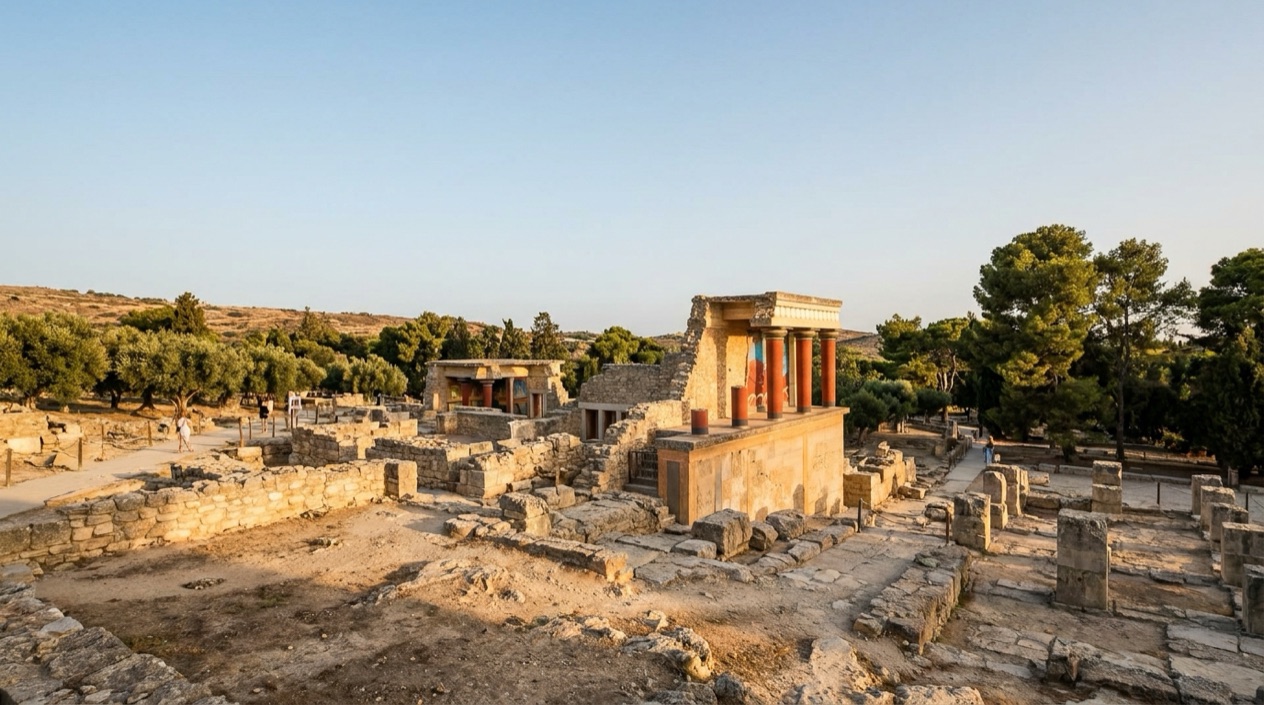
What is Knossos, and what will you actually see?
Knossos was the political and ceremonial heart of Minoan Crete. Walking through it feels like moving through a tangle of workrooms, living quarters, shrines and storerooms, all opening onto one great central court. It is easy to see why the word labyrinth stuck to the place. In July 2025 UNESCO added it to the World Heritage List as one of six Minoan Palatial Centres across the island.
The dark red columns you see here taper toward the base, carry black capitals and hold up painted upper rooms you can peer into. They come from the work of Sir Arthur Evans, who started excavating here in 1900 and later restored entire rooms and upper floors using reinforced concrete. Critics point out that some reconstructions rest on very little evidence, such as the charging bull on the north entrance bastion. Defenders answer that the rebuilding helps you grasp the height of a palace that once rose several stories. Both sides have a point. The concrete, now more than a century old, is itself being conserved as a historic layer of the site. Signs along the route tell you what is original and what is Evans.
Once, colorful frescoes decorated the walls, with scenes of dolphins, bulls and bull-leaping, a Minoan sport. Several of those on the palace walls today are replicas, and the originals are in the museum in town.
How old is the palace, and what is the story behind it?
Settlers had already made their home on this hill around 7000 BC, so Knossos ranks among the oldest inhabited places in the Aegean. Around 1900 BC its people leveled the hilltop and built the first palace. This second palace is the one whose plan survives, covering roughly 20,000 square meters (about five acres) around a great rectangular court.
Clay tablets tell the later story. Evans found them within about a week of starting work, written in a script he named Linear B. So the palace accounts in its last phase were kept by Greek-speaking administrators from the mainland, who took control after the upheaval that shook Minoan Crete around 1450 BC. The palace's final destruction is usually placed around 1350 BC, although scholars still debate the date. Linear A, the earlier Minoan script, remains undeciphered, so the language of the palace builders is still a mystery.
Greek myth took hold long after the palace fell. King Minos was said to rule here, and the craftsman Daedalus built him a labyrinth to hold the Minotaur. No maze has ever been found. The legend likely grew from the ruin itself, a bewildering spread of rooms, corridors and stairways on several levels. The double ax was a sacred symbol scratched into many of the palace stones, and it may lie behind the word labyrinth, though that derivation is debated.
What are the highlights on the walking route?
The route begins at the West Court, a public forecourt where palace met city. Three large round pits sit here, up to about 10 feet (3 m) deep. Scholars have suggested they were cisterns, granaries or rubbish pits, and their purpose remains unclear. From there the Corridor of the Procession leads to the grand southern entrance, where ancient visitors climbed a wide pillared staircase.
The Central Court is the core of the palace. Wings of rooms open onto it from several sides, and its scale suggests it was a place for gatherings and rituals. Off the court, the Throne Room is small and easy to underestimate. From the Central Court, visitors can peer into the Throne Room from a viewpoint, which gives a nice look at the space. Inside are a high-backed stone seat, benches along the walls, painted griffins and a sunken basin that may have served for ritual washing. It is often called the oldest throne room in Europe. Whether a king, a priestess or a council sat there is still argued.
Directly across the court, the royal apartments include a large share of Evans's rebuilding. From the court you look down into the Queen's Megaron with its replica dolphin frescoes, and into parts of the Hall of the Double Axes, possibly a royal audience chamber.
The royal quarters on the eastern slope also hold the drainage system. It is startlingly modern for something this old.
Back on the west side, long, narrow storerooms called magazines hold huge clay jars that once stored oil, grain and wine. Some are taller than you. They show how much of the palace's power rested on controlling food.
Your last stop before the exit is the Theatral Area at the northern edge of the palace. Its broad, shallow steps could hold up to 500 people. It may have been an open-air theater or a ceremonial reception area. The Royal Road that leads away from it is among the oldest paved roads in Europe.
How much are Knossos tickets, and when is it open?
2026 prices: full admission is €20 and reduced admission is €10.
Some visitors get in free:
- EU citizens up to age 25, with an ID card or passport.
- Non-EU visitors up to age 18, with a passport.
- March 6, April 18, May 18 and October 28.
- The last weekend of September.
Buy tickets online at www.etickets.tap.gr, the official Ministry of Culture and Sports service. Online tickets carry a 1-hour entry slot, and once inside you can explore at your own pace. Third-party sites sell the same ticket at a markup.
Knossos is open daily, and closing time moves earlier through the fall:
- From April 1 through the end of August: 8:00 a.m. to 8:00 p.m.
- Early September, the 1st to the 15th: 8:00 a.m. to 7:30 p.m.
- Late September, the 16th to the 30th: 8:00 a.m. to 7:00 p.m.
- Early October: 8:00 a.m. to 6:30 p.m.
- Late October: 8:00 a.m. to 6:00 p.m.
Last admission is 15 minutes before closing.
The site closes on January 1, March 25, Easter Sunday, May 1, December 25 and December 26. A few holidays have special hours:
- Good Friday: noon to 5:00 p.m.
- Holy Saturday: 8:00 a.m. to 4:00 p.m.
- August 15: 8:00 a.m. to 8:00 p.m.
When is the best time to visit Knossos, and what should you bring?
Arrive at opening or in the last couple of hours before closing. July and August are the busiest months, with big tour groups and long lines in the sun. July is also Heraklion's hottest month, with average highs near 85°F (29°C), and even a 9:00 a.m. start can feel hot. April, May, September and October bring lighter crowds and gentler weather. The site stays open from November to March, though many other sites, activities and transport options on Crete close for the winter.
Wear sturdy flat shoes. The original paving is worn, uneven and slippery in places, and timber walkways keep you on set routes. Bring a hat, sunscreen and water.
Restrooms are near the entrance and exit, with none inside the ruins. A small café and kiosk stand by the entrance, but they may close in the off-season (November to April). Steps and narrow passages make the site hard going with a stroller or wheelchair. The central court area is easier to manage than the rest of the site.
How do you get to Knossos from Heraklion?
Bus 2 leaves Heraklion Central Bus Station, close to the port, at regular intervals through the day, and it keeps running in the off-season too. It stops at several points in town on the way. The ride takes 15 to 30 minutes. Buy tickets from the attendant on board or at kiosks at the station. For the return, catch the same bus from the car park next to the site.
Drivers will find free parking near the entrance. Coming from Chania, you can stop at Knossos on the way into Heraklion. Many guided tours include hotel pickup. Some simpler ones cover just an entry ticket and an audio guide, so check before you book.
What else should you see near Knossos?
The Heraklion Archaeological Museum is the natural second stop and one of the most important museums in Europe. It holds the original frescoes, including the Bull-Leaping Fresco and the Prince of the Lilies. It also has the Linear B tablets, seal stones, pottery and the Phaistos Disc. Seeing the palace first gives each object a place to belong. A bus from Knossos drops you right in front of the museum at Xanthoudidou 2.
Full admission to the museum is €20, and it also has its own free admission days. Hours depend on the season:
- Summer: 8:00 a.m. to 8:00 p.m., except Wednesday, when it opens at 1:00 p.m.
- April and winter: 8:30 a.m. to 3:30 p.m., and Wednesday 10:00 a.m. to 5:00 p.m.
Lines can run long even if you already hold a Knossos ticket, so buy ahead online at hhticket.gr.
With another day, the palaces of Malia and Phaistos show the same plan around a central court in very different landscapes. Malia lies east of Heraklion on the north coast, and much of its surrounding town has been uncovered. It makes an easy stop on the way to Agios Nikolaos or Elounda. Phaistos, on the Mesara Plain in the south, has not been reconstructed, so what you see there is original. Most visitors see it on a day trip from Heraklion or from nearby Matala.
Sources
- labyrinthpark.gr (https://www.labyrinthpark.gr/en/history-of-knossos), checked October 18, 2026
- odysseytraveller.com (https://www.odysseytraveller.com/articles/knossos-palace-crete/), checked October 18, 2026
- tota.world (https://www.tota.world/article/3536/), checked October 18, 2026
- ruinsandremnants.com (https://ruinsandremnants.com/palace-of-knossos-guide/), checked October 18, 2026
- knossosguides.com (https://knossosguides.com/), checked October 18, 2026
- ktelherlas.gr (https://www.ktelherlas.gr/en/timetables), checked October 15, 2026
- Hellenic Ministry of Culture, Odysseus (http://odysseus.culture.gr/h/1/eh155.jsp?obj_id=3327), checked October 15, 2026
- Hellenic Ministry of Culture, Odysseus (http://odysseus.culture.gr/h/3/eh355.jsp?obj_id=2369), checked October 15, 2026
- minoan.it (https://www.minoan.it/en/routes-fares-timetable-minoan-lines/timetable-ferry-piraeus-heraklion), checked October 15, 2026
- culture.gov.gr (https://www.culture.gov.gr/en/service/SitePages/view.aspx?iID=2695), checked October 15, 2026
- Visit Greece (GNTO) (https://www.visitgreece.gr/islands/crete/irakleio/), checked October 15, 2026
- heraklion.gr (https://www.heraklion.gr/en), checked October 15, 2026