
In July, the sun lies hard on the stone and à l’abri, while in January the rain returns to the old streets of Rhodes. The Dodecanese, a chain of islands in the southeastern Aegean, changes character with each season, and every one of them suits a different kind of trip.
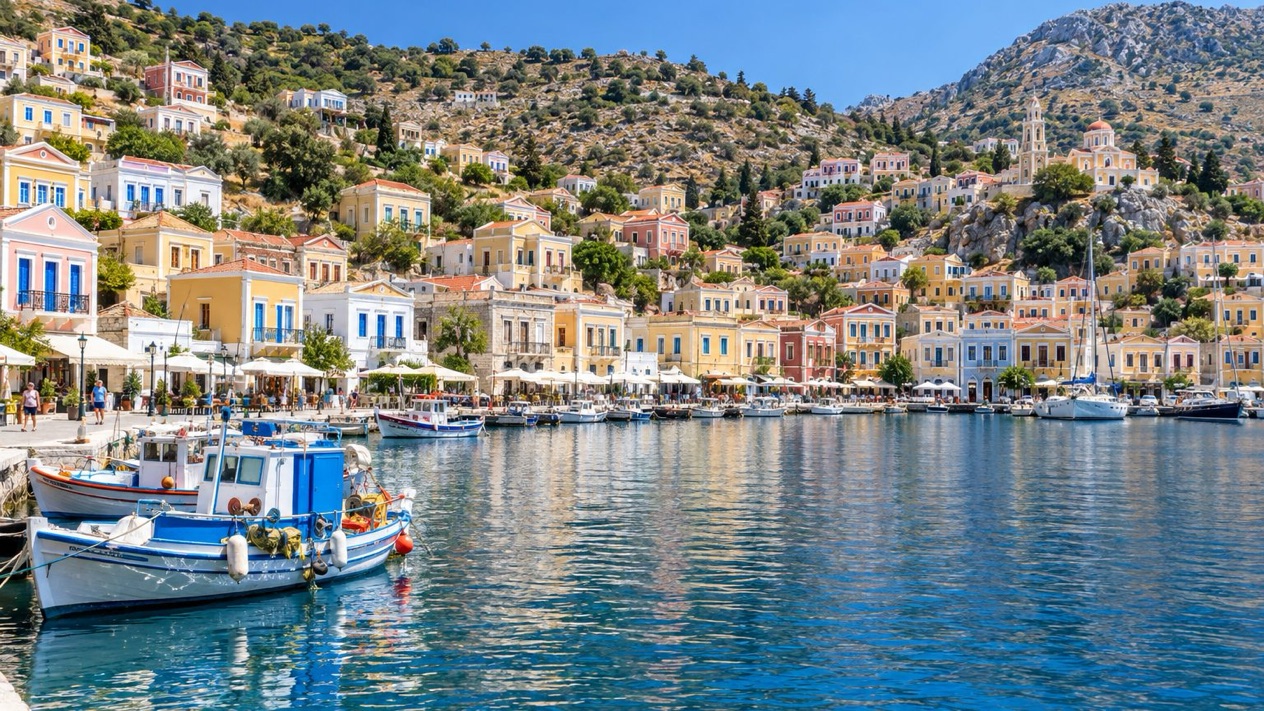
When is the best time to visit the Dodecanese?
Late spring and early fall suit travelers, from May into June and again from September into October, when the islands are warm, the days are long and the heat of midsummer has not yet settled in or has just let go. Beach swimmers lean toward the summer months, sightseers toward the shoulders, and travelers who prefer a mild, slow winter have the old town of Rhodes to themselves as a base.
For beaches, July is the month the table points to: hot, and almost without rain on Rhodes. The meltemi, the strong, dry north wind of the Aegean, blows periodically from about mid-May to mid-September and is at its strongest in the afternoon.
It often dies down at night, but sometimes it lasts for days without a break. Beach plans in summer therefore work around the wind, and a day on a sheltered shore is a different thing from a day on an open one. September keeps the warmth while the wind season is ending.
For sightseeing, April and October make the walking comfortable. The Medieval City of Rhodes, a UNESCO World Heritage Site, and the Street of the Knights are places you walk slowly, and you do that more happily when the afternoon is warm rather than punishing. October is still warm enough to sit outside for dinner.
For a lower-key trip, the cooler months and the edges of the season are the time to look at. Smaller islands such as Halki, very close to Rhodes, and Astypalaia, between Kos and Amorgos, are not much developed, and they reward a visit when the calendar is not set to full summer. Families tied to school vacations will mostly land in July and August, and the table says why a hat and sun protection belong in the bag then.
The Dodecanese weather by month
On Rhodes, January is the wettest of the months below and July is almost rainless.
| Month | Average high (°F) | Average low (°F) | Precipitation (in) | Days with 1 mm or more of precipitation |
|---|---|---|---|---|
| January | 59.4 | 50.9 | 4.19 | 11.8 |
| April | 68.0 | 57.6 | 1.22 | 5.6 |
| July | 86.0 | 75.4 | 0.04 | 0.1 |
| October | 76.1 | 66.6 | 1.85 | 5.0 |
The shape of the year is a hot, dry summer and a mild, wet winter. In January the rain falls on a good share of the days, so a rain jacket belongs in the suitcase even though the air stays mild.
Most of the Dodecanese has a hot-summer Mediterranean climate, and in the mildest part of the winter. Karpathos, Kasos and Nisyros lean toward a hot semi-arid climate, with mild winters and hot summers.
April is the turning point, with rain on far fewer days and the air warm enough for light layers. July is the opposite of January: the lows stay warm, so nights are mild for eating outside, and the days call for sun protection and a slow middle of the day.
October brings a gentle return of the rain on a handful of days, but the afternoons are still warm, which is why the month is a favorite for travelers who want one more stretch of summer.
What is there to do in the Dodecanese in each season?
Spring: walking, villages and Easter
Spring is the season for walking the old town of Rhodes, where the Street of the Knights runs through the Medieval City, and for taking a car or a bus into the villages and hills. The countryside is greener, the rain is far less frequent than in January, and the sun is warm without the weight of July. On the smaller islands, spring is the time to wander between chapels and terraced fields.
Plan around it…, is the high point of the Orthodox calendar on the islands. Services, processions and long family lunches fill Holy Week, and a visit that overlaps it gives you a side of the Dodecanese that the summer beach season never shows. Plan around it, because it is a time when Greeks are on the move and celebrating.
Summer: heat, beaches and the meltemi
Summer is the season for the sea. July on Rhodes is hot and almost dry, which suits long beach days, boat trips between islands and late dinners outside in warm nights. In the heat of the day, the habit of the islands is a long lunch in the shade of a taverna, with grilled fish, salads of tomato and cucumber, and cold drinks, before the evening walk along the harbor.
The meltemi, which blows from about mid-May to mid-September, shapes the days. It is strongest in the afternoon, and when it holds for days on end, open beaches turn lively while sheltered ones suit the day better. Sun protection and a water bottle are the plain consequences of the table.
Autumn and winter: mild days and slow travel
It is a season of long lunches outside, of walks through old towns and villages, and of the olive and wine harvest rhythm in the countryside. Ohi Day on October 28 brings school parades and flags to the towns of the islands.
Winter is mild but wet. January brings rain on many days, so the pleasures turn indoors and to the old stone streets: museums, cafés, warm bakeries and tavernas serving soups, stews and baked dishes. Rhodes is the island that suits a winter visit, with its Medieval City, the Street of the Knights and a long history as the dominant island of the group since antiquity. Leave the beaches and the island hopping for another season.
When is the Dodecanese least crowded?
The quieter stretches of the year are winter and the edges of the warm season, while the holiday weeks of Easter and mid-August are the moments when Greek families celebrate on the islands. A winter visit to Rhodes means a mild, wet January, a lower pace in the old town and plenty of room along the Street of the Knights. The summer months, with a hot and nearly rainless July, are the season built around the beach, and that is when visitors arrive.
The shoulder months of April, May, June, September and October sit between the two. Spring brings a green landscape and the Easter celebrations. Early fall holds on to the warmth of summer, with the days still long and the sea in its warm season. Planning a trip around these months means lighter summer clothes and a layer for the evening, while trips for walking and sightseeing fit them well.
The size of the islands matters as much as the calendar. Rhodes is the dominant island of the group, with the largest city and the ancient and medieval sights, while Halki and Astypalaia are small and not much developed. A traveler who wants distance from the busiest places can pick one of those smaller islands, in any month, and find a different rhythm from Rhodes in July.
Which months should you avoid in the Dodecanese?
No month rules the islands out, but July and August are the hottest months for sightseeing, and the winter months are the least suited to beaches and island hopping. The right choice depends on what you want to do rather than on a month to avoid.
Midsummer brings the heat. On Rhodes, July highs reach the mid-80s with warm nights, and rain almost never falls. The meltemi blows from about table, and it can last for days. Walking in the old towns and visiting open sites in the middle of the day asks for sun protection, water and a slower pace.
Winter has its own character. January on Rhodes is mild, but it is the wettest month in the table, with rain on many days, so the season suits city strolls and museums more than boat days or beach plans.
Expect a different island calendar in the cold months, with the seasonal rhythm of summer on pause. The shoulder months, April and October, are the ones with the fewest drawbacks: warm enough to enjoy the outdoors, with rain on only some days.
Festivals and events in the Dodecanese through the year
Winter: Epiphany, Carnival and Clean Monday
The year opens with Epiphany on January 6, when island communities bless the water. In harbor towns, a priest throws a cross into the sea and swimmers dive to retrieve it, a scene that is as much about the town gathering at the quay as about the ritual. It is a good moment to see an island as its residents do, in the mildest part of the winter.
Carnival, known as Apokries, fills the weeks before Lent with costumes, music and parties in the towns. It ends with Clean Monday, the first day of Lent, when families head outdoors for picnics of lagana (a flat bread baked for the day), taramosalata, olives and vegetable dishes without meat, and children fly kites. The date moves each year with Easter.
Spring: Holy Week and Easter
Greek Orthodox Easter is the great celebration of the year. On Good Friday, the Epitaphios, a flower-covered bier representing Christ’s tomb, is carried through the streets in the evening, with the congregation following with candles. On Saturday night, at midnight, the church bells ring, the light is passed from candle to candle, and fireworks and firecrackers break the dark.
Easter Sunday is a day for the table: lamb or goat roasted on a spit, red-dyed eggs cracked against each other, and tsoureki, a sweet braided bread. The date of Easter changes every year, and it can differ from the Western date, so check it when you plan a spring trip. Villages as well as the main towns hold their own services and meals.
Summer and autumn: August 15 and Ohi Day
August 15, the feast of the Dormition of the Virgin Mary, is one of the biggest religious days of the Greek summer. Churches dedicated to the Virgin hold services and village festivals, called panigiria, with music, dancing and shared food, often lasting into the night. Greeks travel home to their islands for it, which makes it a celebration shared with families as well as visitors.
Summer on the islands is also the time of the local saints’ day festivals, with food and dancing in village squares and the sound of the lyra and the laouto, the instruments of island music. In autumn, Ohi Day on October 28 marks the national anniversary with school parades, flags and wreaths in the town squares. It lands in the warm tail of the year, when the days on Rhodes are still mild enough to watch the parade and have lunch outside.
Sources
- Hellenic National Meteorological Service (HNMS), climatological normals 1991-2020 for Rhodes station (https://www.emy.gr/climatic-data), monthly mean daily maximum and minimum; rain from the ECMWF ERA5 reanalysis, 1991-2020, grid cell of Rhodes (Open-Meteo), checked October 12, 2026
- ECMWF ERA5 reanalysis 1991-2020, grid cell of Rhodes (Open-Meteo), checked October 12, 2026
- Visit Greece (GNTO), the Dodecanese (https://www.visitgreece.gr/islands/dodecanese/), checked October 12, 2026
- Wikipedia, Dodecanese (https://en.wikipedia.org/wiki/Dodecanese), checked October 12, 2026
- Wikivoyage, Dodecanese (https://en.wikivoyage.org/wiki/Dodecanese), checked October 12, 2026
- Wikipedia, Climate of Greece (https://en.wikipedia.org/wiki/Climate_of_Greece), checked October 12, 2026
- Wikipedia, Mediterranean climate (https://en.wikipedia.org/wiki/Mediterranean_climate), checked October 12, 2026
- Wikipedia, Meltemi (https://en.wikipedia.org/wiki/Meltemi), checked October 12, 2026