
Halfway through the week, a ferry slides out of a harbor in the southeastern Aegean while gulls wheel over the stern and the smell of grilled octopus drifts off a taverna terrace on the quay. The islands of the Dodecanese sit close to the Turkish coast, each with its own mood, from a walled medieval city to a monastery perched over the sea. This route strings four of them together, Rhodes, Symi, Kos and Patmos, for a traveler who would rather unpack twice than six times.
Is 7 Days enough for Greece?
A week is enough for one corner of Greece done well, and the Dodecanese suit that approach better than a dash across the whole country. The Dodecanese are a group of about fifteen larger islands and many smaller ones, so four stops barely scratch the surface, but they give a real sense of the chain.
Rhodes carries the first days. It has been the dominant island of the group since antiquity, it is the capital of the Dodecanese, and it is the fourth largest island in Greece.
Its Medieval City is a UNESCO World Heritage Site, which is reason enough to give it more than one night. From there the route drops to Symi, a small island with mountainous terrain, then moves on to Kos and finishes on Patmos, one of the northernmost islands of the group.
What the week leaves out is just as clear. There is no Athens, no Crete, no Delphi, no Meteora, and none of the big ancient sites of the mainland. There is also no time for the smallest Dodecanese islands, such as Astypalaia, a little developed island that lies between Kos and Amorgos and makes a natural idea for a longer stay. If your list is full of mainland ruins, a different week fits better.
Within the Dodecanese, the week trades breadth for rhythm. Each stage has a different character: a big historic town, a small harbor village, a lived-in island with Greek life beyond the resorts, and a pilgrimage island.
That variety is what keeps a trip of this shape from feeling like the same beach repeated four times. Travelers who want more beach days can stretch the Kos stage, and those who want more history can stay longer on Rhodes or Patmos, as the section on adapting the route explains.
One thing the route asks for is a taste for the sea as a road. Between the islands you travel by water, and the harbor becomes part of each day, with its cafés, its fishing boats and its small ceremonies of arrival and departure. If that sounds like part of the pleasure rather than a chore, a week in the Dodecanese will feel full instead of rushed.
The itinerary stage by stage
Days 1 and 2: Rhodes
Rhodes is the island to start on, and the city of Rhodes, home to about 56,000 people, is where you sleep. The best base is in or just outside the walls of the Medieval City, where stone lanes turn between old gates and small squares and you can step from your door into the evening stroll. Day one is for walking those lanes and the harbor, with a plate of souvlaki or a spread of meze (small shared dishes) at a table under the walls.
Day two is for the rest of the island. Rhodes is called the Emerald Island, and the green hills behind the coast, the villages and the sea give you the choice between a beach day and a drive to a hill village. Look for pitaroudia, chickpea fritters that belong to the island’s kitchen, and finish with a glass of ouzo or a cold Greek coffee at a harborside café.
Day 3: Symi
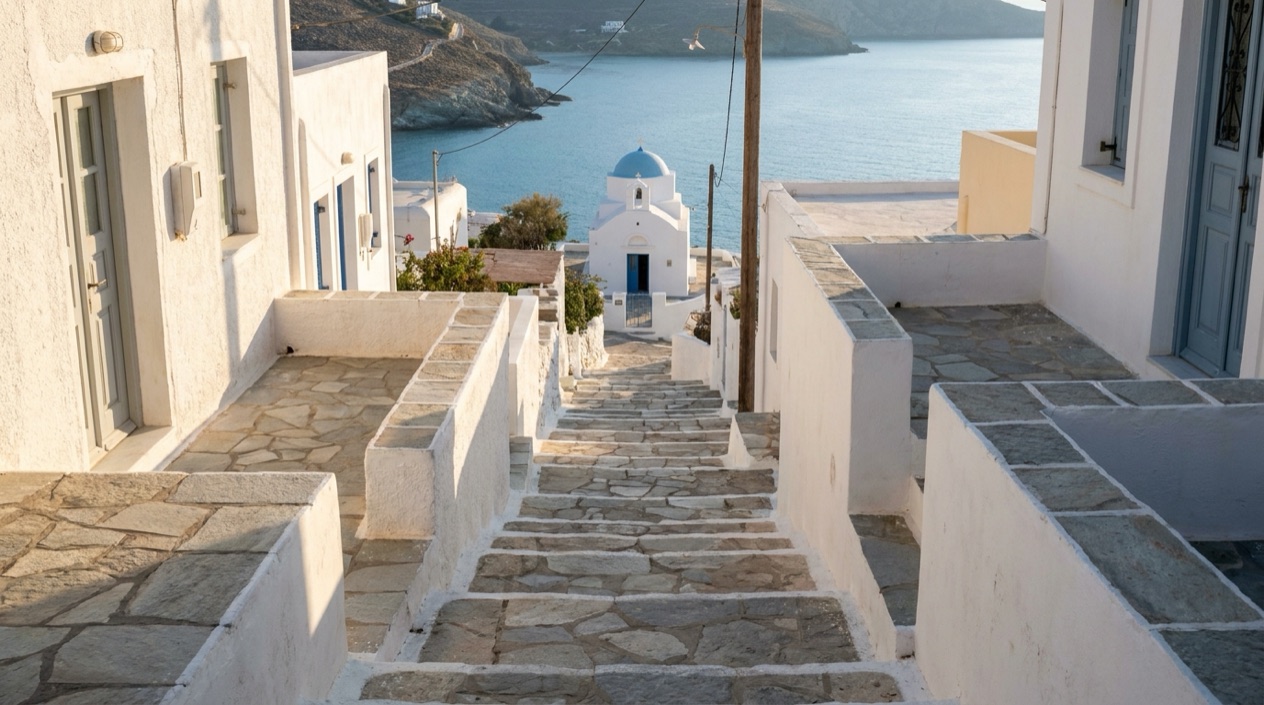
Symi lies about 15 miles north of Rhodes and has only about 2,500 residents, so the pace changes the moment you step off the boat. The harbor is ringed by tall, colorful neoclassical houses climbing the hillside, and the island is one of the most picturesque in the Dodecanese. You spend the day walking up the stairways above the harbor and sitting at waterfront tables.
Food is the draw here. Symi is known for its tiny shrimp, often fried whole and eaten with the shells on, and for fish grilled simply with olive oil and lemon. The terrain is mountainous, so the walks between the harbor and the upper streets give you views over the water. Sleep in a room near the port, where the evening lights on the harbor are part of the stay.
Days 4 and 5: Kos
Kos is the third largest island in the Dodecanese and a particularly popular holiday destination for travelers from across the globe, and the most populous of the group after Rhodes. Stay in Kos Town, which keeps a lively harbor front and cafés, with the sea close at hand. The island is about 26 miles long, so you can see a good deal of it from one base.
Kos is the birthplace of Hippocrates, the father of medicine, and the old town makes room for that story among its ruins and palm-lined streets. Spend the first day wandering the town and the waterfront, and the second on the island’s coast, choosing a beach for swimming and a village for lunch. Order grilled fish, a Greek salad with a slab of feta, and a plate of local sweets to finish.
Days 6 and 7: Patmos
Patmos is a small island that has long drawn pilgrims, as the place where John of Patmos received the vision in the Book of Revelation. Saint John the Evangelist is believed to have written the Book of Revelation in a cave here. The Holy Monastery of Saint John the Theologian and the Cave of the Apocalypse form a UNESCO World Heritage Site, and the hilltop village of Chora is part of that listing.
Sleep near the harbor or up in Chora, and spend day six on the monastery and the cave, then wandering Chora’s lanes. Day seven is yours for a last swim, a slow breakfast of yogurt and honey, and one more meal at a harbor taverna before you leave. Patmos is a fitting place to end a week of islands, because the pace here invites you to simply sit and watch the boats.
Getting between stops
| Leg | How |
|---|---|
| Rhodes to Symi | By sea |
| Symi to Kos | By sea |
| Kos to Patmos | By sea |
| Piraeus to Patmos | Blue Star Ferries |
In the Dodecanese, the sea is the connection between stops, and each leg of this route is a crossing from one island harbor to the next. Blue Star Ferries is a Greece-based company that provides ferry services between the Greek mainland and the Aegean Islands, and travelers can reach Patmos by Blue Star boat from Piraeus. That is the link to keep in mind if you are coming from Athens rather than starting from Rhodes.
Other companies serve different parts of the Aegean. ANEK Lines operates mainly on the Piraeus to Crete and Adriatic routes, and Golden Star Ferries runs from the mainland to the Cyclades, so neither belongs to this Dodecanese chain. Blue Star’s fleet serves more than 20 destinations in Greece, which is why its name turns up so often on ferry lists across the Aegean.
On the islands themselves, you move by road once you arrive, between a harbor town and a beach, a village or a monastery. The distances on Symi and Patmos are small, since both are small islands, while Kos and especially Rhodes give you more ground to cover. Think of each day as an arrival, a settled base and a few places around it, rather than as a series of long transfers.
What to book before your 7 Days in Greece
The first thing to settle is the sequence of crossings between the islands, since the whole route hangs on them, and the Patmos link from Piraeus is run by Blue Star Ferries. Next come the places you most want to see, such as the Medieval City of Rhodes and the monastery and cave on Patmos. Last comes lodging in each harbor town, chosen to match the stage you are in.
Adapting the route
With fewer days, drop Kos and keep Rhodes, Symi and Patmos, or drop Symi and give the saved day to Rhodes. A shorter version works best when it keeps two real bases instead of three rushed ones. The reverse also holds: with extra days, add nights on Patmos or Rhodes, where there is the most to see on the ground, rather than adding a fifth island.
For a longer trip, the Dodecanese offer a lot of room beyond these four. Astypalaia, between Kos and Amorgos, is a small and not much developed island that suits a slower stretch. Each addition should come with a night or two, so you are staying rather than simply passing through.
Season changes the feel of the route. Athens in July reaches an average high in the low 90s with almost no rain, so a July trip means hot days when sun protection and a hat belong in the bag, and the middle of the day is for the sea or a shaded café. October in Athens runs in the mid-70s with a few rainy days, and January brings a high in the mid-50s with more rain.
Those figures belong to Athens and are a guide to the mainland, not a forecast for each island. If you route through Piraeus, they tell you what to pack for the first day. For the rest, bring layers that match the month you travel, and a rain jacket if your trip falls in a wetter part of the year.
For families, the route works best when the days are anchored by a harbor and a swim, with one outing per day rather than three. Symi is small enough to wander on foot, and Kos and Rhodes give you the island’s coast for a beach morning. A slower version of the trip might simply stay put on Rhodes and Kos, taking Symi and Patmos only if energy allows.
Good to know before you go
Money in Greece is in euros, and the islands run on the rhythm of the harbor, so build the week around the crossings and let each island set its own pace. Pack for the month with the weather in mind, add sun protection for a summer trip, and keep a layer for the evening on the water. Greek names appear in several spellings on signs and tickets, so match the port names you see to the ones you planned, and Piraeus, Rhodes, Kos, Symi and Patmos will be your anchors.
Sources
- Wikipedia, Ancient Greece (https://en.wikipedia.org/wiki/Ancient_Greece), checked October 12, 2026
- Wikipedia, ANEK Lines (https://en.wikipedia.org/wiki/ANEK_Lines), checked October 12, 2026
- Wikipedia, Blue Star Ferries (https://en.wikipedia.org/wiki/Blue_Star_Ferries), checked October 12, 2026
- Wikipedia, Fast Ferries (https://en.wikipedia.org/wiki/Fast_Ferries), checked October 12, 2026
- Wikipedia, Golden Star Ferries (https://en.wikipedia.org/wiki/Golden_Star_Ferries), checked October 12, 2026
- Wikipedia, Greek islands (https://en.wikipedia.org/wiki/Greek_islands), checked October 12, 2026
- Visit Greece (GNTO), the Dodecanese (https://www.visitgreece.gr/islands/dodecanese/), checked October 12, 2026
- Wikipedia, Dodecanese (https://en.wikipedia.org/wiki/Dodecanese), checked October 12, 2026
- Wikivoyage, Dodecanese (https://en.wikivoyage.org/wiki/Dodecanese), checked October 12, 2026
- Rhodes official tourism site (https://www.rhodes.gr/), checked October 12, 2026
- Visit Greece (GNTO), Rhodes (https://www.visitgreece.gr/islands/dodecanese/rhodes/), checked October 12, 2026
- Wikipedia, Rhodes (city) (https://en.wikipedia.org/wiki/Rhodes_(city)), checked October 12, 2026
- Visit Greece (GNTO), Kos (https://www.visitgreece.gr/islands/dodecanese/kos/), checked October 12, 2026
- Wikipedia, Kos (https://en.wikipedia.org/wiki/Kos), checked October 12, 2026
- Wikivoyage, Kos (https://en.wikivoyage.org/wiki/Kos), checked October 12, 2026
- Visit Greece (GNTO), Patmos (https://www.visitgreece.gr/islands/dodecanese/patmos/), checked October 12, 2026
- Wikipedia, Patmos (https://en.wikipedia.org/wiki/Patmos), checked October 12, 2026
- Wikivoyage, Patmos (https://en.wikivoyage.org/wiki/Patmos), checked October 12, 2026
- Visit Greece (GNTO), Symi (https://www.visitgreece.gr/islands/dodecanese/symi/), checked October 12, 2026
- Wikipedia, Symi (https://en.wikipedia.org/wiki/Symi), checked October 12, 2026
- Wikivoyage, Symi (https://en.wikivoyage.org/wiki/Symi), checked October 12, 2026
- Hellenic National Meteorological Service (HNMS), climatological normals 1991-2020 for Elliniko station (https://www.emy.gr/climatic-data), monthly mean daily maximum and minimum; rain from the ECMWF ERA5 reanalysis, 1991-2020, grid cell of Athens (Open-Meteo), checked October 12, 2026
- ECMWF ERA5 reanalysis 1991-2020, grid cell of Athens (Open-Meteo), checked October 12, 2026
- Plan de the (duree choisie by the redaction)