
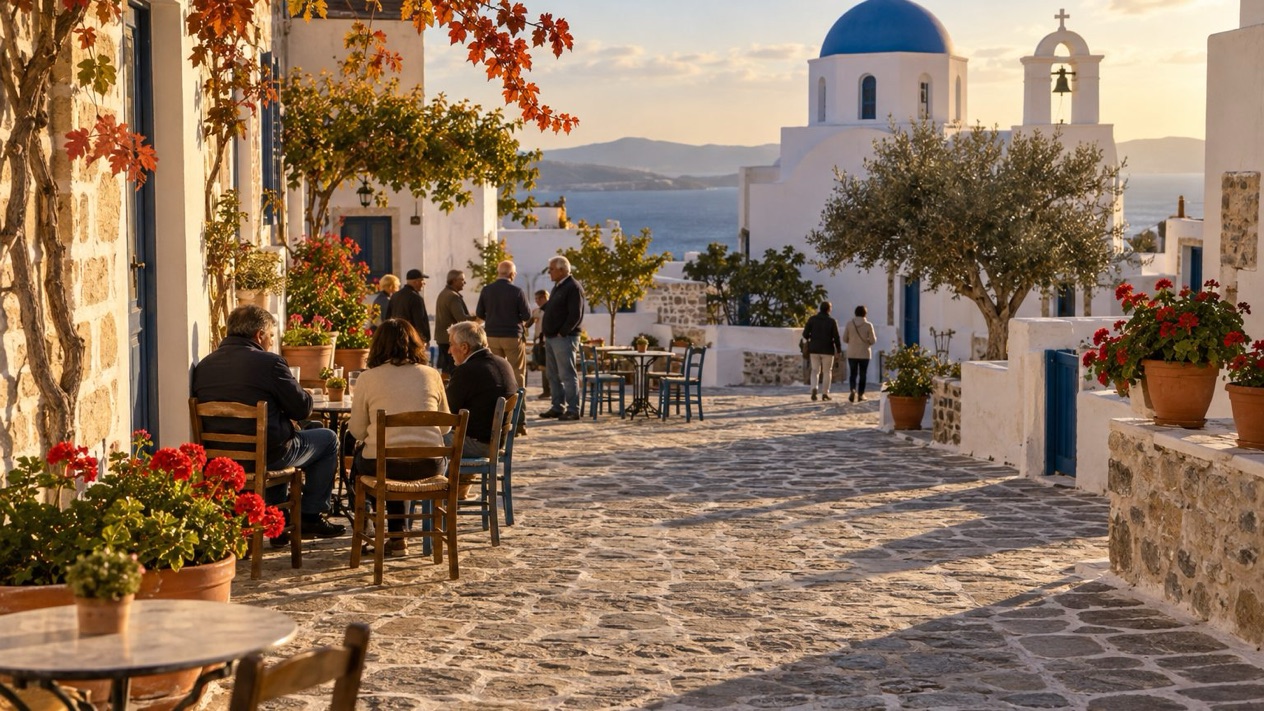
A ferry horn sounds over a harbor, a village lane climbs between low cubes of plaster, and somewhere above it a chapel bell answers the wind. In the Cyclades the days follow the same rhythm from island to island, with a coffee on a square, a long lunch of grilled fish and fresh cheese, and an evening that stretches well past dark.
Each island has its own temperament, from marble quarries and pilgrim churches to volcanic cliffs and dance floors. This is a guide for travelers who want to choose among them, whether they plan to stay on one island or to hop through several.
What are the best things to do in the Cyclades?
The best things to do in the Cyclades are to walk through island capitals and hillside villages, stand at the ruins of Delos, look into the caldera of Santorini, eat the local cheeses and sweets of each island, and spend at least one night out in a harbor town. The archipelago is a scatter of separate worlds, so a trip is really a choice of which worlds to visit.
- Delos, the sacred island at the center of the circle the other islands form, for ruins and the sense of an ancient crossroads.
- The caldera of Santorini, where an active volcano sits in the middle of a flooded crater and visitors can stay on its rim.
- Ermoupoli and Ano Syros on Syros, a cosmopolitan island capital where the Near East meets the West.
- Tinos, the largest religious center of Greece, for the pilgrimage church of Panagia Megalochari.
- Naxos, the largest island of the group, for mountain villages, farmland and the highest peak of the Cyclades.
- Paros and its marble, the stone that went into famous classical sculpture.
- Milos, where the Venus de Milo was found, for its summer beach days and island coastline.
- An evening in Ios or Mykonos, for the nightlife both islands are known for.
Only 33 of the islands in this archipelago are inhabited, which explains why each one has kept a character of its own. Andros is green and tied to the sea through its naval tradition. Kythnos has thermal springs. Mykonos is called the island of the winds. The best plan is rarely to see everything and usually to pick two or three islands that contrast with each other.
May through June and September through mid-October are the best times to visit the Cyclades, which suits both sightseeing and beach days. Regular flights from Athens reach several of the larger islands, and the rest of the map is a matter of choosing which harbors to visit. The sections below take the sights, the outdoors, the day trips, the table, the evenings and the children one by one.
Sights and landmarks in the Cyclades
The landmarks of the Cyclades are a mix of ancient sanctuaries, island capitals and pilgrimage churches, spread over a sea that once linked all of them. The group forms a circle around Delos, and that geometry still shapes how you think about the islands: every harbor is a point on a ring, and the center is a sacred island of ruins.
Delos, the sacred center
Delos is the reason the islands are called the Cyclades, the circle, since the others encircle it. What you find there is an island of ruins, a place set apart from ordinary island life, with a character quite unlike Mykonos nearby. Walking across it means reading a site of foundations, mosaics and temple remains rather than visiting a town with cafes.
Mykonos lies between Tinos, Syros, Paros and Naxos, in the heart of the group, and that placement makes it the natural base for people who care about the ancient side of the archipelago. It pairs well with a long, slow meal afterward back on Mykonos.
Santorini’s caldera and Thera
Santorini is the southernmost of the Cyclades, known in ancient times as Thera. Its great attraction is the volcano, described as a wild natural wonder, and the caldera it sits in. Visitors can stay on the caldera rim, which means the view of the crater is part of the morning coffee rather than an excursion.
The villages perched on the rim are built to look into the crater, with terraces, small churches and steps that drop toward the water. Walking the lanes between them gives you the layered, cut-stone look of a town built on the edge of a cliff. It is an island that rewards a slow wander more than a checklist, and the volcano remains the focus of nearly every view.
Ermoupoli and Ano Syros
Syros is the capital of the Cyclades and the most populated island of the group, and its town, Ermoupoli, is the chief town and administrative center of the former prefecture. The atmosphere is cosmopolitan, the place where the Near East meets the West, and that shows in the architecture of the harbor and in the mix of Orthodox and Catholic traditions.
Above the harbor, Ano Syros is a hill settlement of narrow lanes and steps that climb in circles. Exploring the two parts of the island together gives a good picture of how a Cycladic town can be both a working port and a hilltop village. It is one of the few places in the group where the feel is urban without being in any way like Athens.
Pilgrimage, marble and museums
Tinos is the largest religious center of Greece, linked to the pilgrimage of Panagia Megalochari. Around the church the island has a calm, devout rhythm of candle-lighting, processions and pilgrims on foot. The visit says as much about how the islands live their faith as any museum could.
Paros is known for the white marble that gave its name to Parian marble, used in architecture and sculpture during the classical period, including for Praxiteles’ Hermes and the Venus de Milo. Milos has its own link to that statue, since the Aphrodite was unearthed there and now stands in the Louvre. Across the islands, museums show the older Cycladic culture, whose figurines were carved from the pure white marble of the islands.
Those figurines are a good lens on the archipelago. They come from a culture that arose in the western Aegean long before the classical world, and they have been looted from burials since the early twentieth century for the antiquities market, which is why seeing them in a museum on the islands is a quiet pleasure.
Outdoor things to do in the Cyclades
The outdoors in the Cyclades means coastlines, mountain villages and farmland, and what you do depends on which island you choose. The islands are small, so one landscape quickly gives way to another, from marble slopes to terraced fields to cliffs that fall straight into the sea.
Naxos, mountains and farmland
Naxos is the largest and most fertile island of the Cyclades, covering 170 square miles. That fertility is visible in the interior, where villages sit among fields and orchards instead of bare rock. Zas, the highest mountain of the Cyclades, rises on Naxos and gives the island its sense of a real interior.
Stops at a village square, a roadside bakery or a small chapel on a hillside are the usual rhythm. The coastline offers beach time after a day among the villages.
Santorini, Milos and Mykonos coastlines
Milos is the southwestern-most of the Cyclades, set roughly midway between Piraeus and Crete, and it is a popular tourist destination during the summer. Its draw is the coastline, where beaches and rock formations take turns around the island. The pace is that of a summer island, built around a day by the water.
Mykonos is small, with a highest point of 1,119 feet, and it is the island of the winds, which gives the shore a different feel from one side to the other. Santorini adds the walk along the caldera rim, where the path links village to village and keeps the volcano in view. On each of these islands, the sea is the main outdoor setting.
Ios, Paros and the smaller islands
Ios lies between Santorini, Paros and Naxos and measures about 11 miles in length and 6 miles in width. It has an international reputation for its nightlife and is also counted among the most beautiful islands of the Cyclades.
Paros sits in the center of the Cyclades, about 93 miles from Piraeus, and is one of the most popular holiday destinations in the country. Kythnos, with its thermal springs, is one of the most authentic corners of the Aegean, and Andros stands out for its rich vegetation, different from the typical Cycladic image.
Day trips in the Cyclades
The day trips of the Cyclades are really island-to-island hops, and the geography helps, since many of the islands lie right next to each other. The ones that make the most sense are those with a clear reason to go: an ancient site, a pilgrimage, a town with a different atmosphere.
Delos from Mykonos
Delos is the classic reason to leave Mykonos for a day, since the sacred island sits at the center of the ring formed by the others. What you see are the remains of a sanctuary and its surrounding settlement, laid out on an island with no resort life to speak of. The contrast with Mykonos town is part of the appeal.
Pair it with a meal on Mykonos afterward so that the ancient and the contemporary sit side by side in the same day. Ruins like these are best read slowly, with attention to the stone and the setting.
Tinos from Mykonos or Syros
Tinos lies next to Mykonos and Syros, and it offers a completely different mood: the largest religious center of Greece, tied to the pilgrimage of Panagia Megalochari. The church draws believers from all over the country, and the town around it is shaped by that devotion.
A visit gives you a sense of living faith, with candles, icons and pilgrims, as well as the village life of an island that is not centered on resort tourism. It suits travelers curious about Orthodox Greece and about what an island looks like when pilgrimage, not the beach, sets the calendar.
Syros and its two towns
Syros is a day trip from several neighboring islands, and the draw is Ermoupoli together with the hill settlement of Ano Syros. The town is the chief town and administrative center of the former prefecture and has a cosmopolitan atmosphere, with an urban harbor life unlike the village-and-beach pattern of other islands.
A day here means wandering the harbor streets, climbing to the old hill town and stopping for the local sweets. The neighborhoods have the feel of a place with a working life of its own beyond visitors.
Santorini, Ios and Naxos as neighbors
Ios sits between Santorini, Paros and Naxos, which makes it a natural meeting point of routes through the central Cyclades.
Smaller islands such as Antiparos, Sifnos, Serifos, Folegandros and Amorgos make good additions for travelers with time to spare. Each has its own harbor, its own chora (the main hilltop town) and its own food. They reward people who prefer to see fewer places, more slowly.
What to eat in the Cyclades
Eating in the Cyclades means island produce on small plates: cheeses, capers, tomatoes, chickpeas, grilled fish and sweets made with almonds and honey. The soil is poor and the water is scarce, so what grows here tends to be concentrated in flavor, and each island has its specialties.
A typical meal starts with meze, a spread of small dishes shared at the table, such as fava (a creamy puree of yellow split peas) from Santorini, tomato fritters, grilled cheese and capers. Then come the main plates, usually grilled fish or meat, with greens, potatoes and bread. Every island has its own twists, so ordering what the table next door is eating is often the best strategy.
Cheese, vegetables and local produce
Naxos is known for its potatoes and for cheeses such as graviera and the soft, tangy xynomizithra. Santorini has cherry tomatoes, white eggplants and fava, all grown in volcanic soil that gives them a distinct flavor. Mykonos makes kopanisti, a sharp, peppery cheese, and louza, a cured pork.
Syros adds San Michali, a hard cheese, and loukoumia, a soft sweet confection related to Turkish delight that reflects the island’s connection to the east. Sifnos is linked with revithada, chickpeas baked slowly in a clay pot, and Milos with pitarakia, small savory pies. These are the dishes to look for on menus, often described simply by the island name.
Drinks and sweets
Ouzo, the anise-flavored spirit, is served with meze at harbor tavernas, usually mixed with a little water. Raki and its island cousins appear at the end of a meal, often offered as a treat. Naxos has kitron, a liqueur made from the citron tree, with a bright, herbal fragrance.
Santorini produces wines from the assyrtiko grape, grown in the volcanic soil that shapes the island. Sweets across the islands lean on almonds and honey, as in amygdalota (almond cookies), and spoon sweets, fruit preserved in syrup and served with a glass of water. A kafenio, the small coffee house on a village square, is where many of these are enjoyed with Greek coffee.
Where to eat
The main kinds of places are the taverna, a family-style restaurant with grilled food and shared plates, the ouzeri, where small dishes go with a drink, and the bakery, for pies and sweets in the morning. Harbor-side fish tavernas are common on every island, and village squares usually have at least one place where the menu depends on what is available that day.
Souvlaki and gyros, meat grilled on a skewer or roasted on a spit and wrapped in pita, are the quick lunch of any harbor. Moussaka and other baked dishes appear in tavernas as well. In the end, the best meals often come from following the island’s own produce and choosing the table with the local plates.
Things to do in the Cyclades at night
Evenings in the Cyclades are long, and what they look like depends on the island. On some, the night is a slow dinner on a harbor and a walk through lit lanes. On others, it is a full programme of bars, clubs and dancing that runs until the early hours.
Ios and Mykonos for nightlife
Ios has gained an international reputation for its nightlife, and its chora, the hilltop town, is the center of it, with bars and music packed into the village lanes. The island is also one of the most beautiful of the Cyclades, so the nightlife sits alongside a beach-and-landscape holiday.
Mykonos is the other name that comes up for nightlife in the Cyclades, with bars in the town and beach clubs along the coast. The island of the winds is also a place of long dinners and cocktails, and the atmosphere varies from a relaxed drink in town to a full night out. Both islands suit travelers who want the evening to be as much of the trip as the day.
Harbors, squares and slow evenings
On most islands, the evening begins with the volta, the stroll through the main street or harbor, followed by a table at a taverna. In Ermoupoli on Syros the town squares and harbor give the evening an urban feel, with people strolling and cafes filling up. Ano Syros, lit above the harbor, makes a different kind of walk.
On Naxos and Paros, the old towns offer lanes lined with small bars and tavernas, where you can eat late and linger. Santorini’s caldera villages face the volcano, and their terraces are where visitors spend the evening with a glass of local wine. Tinos, as a pilgrimage center, tends toward a more devout rhythm, with church life continuing into the evening.
A quieter night on a smaller island
The smaller islands, such as those among the Lesser Cyclades, have fewer places open at night, and evenings are often a matter of a meal at a harbor taverna, a drink, and a walk back in the dark. Kythnos, with its thermal springs, and Andros, with its green landscape and naval tradition, offer a different kind of evening, built around the table and conversation.
Travelers combine the two modes, spending a few nights on a lively island and a few on a smaller one. The contrast between a dance floor and a harbor with only a few lit tavernas is one of the pleasures of hopping through the group.
Things to do in the Cyclades with kids
Children in the Cyclades are most at home with the simple pleasures: boats, beaches, ice cream, and the freedom of a small island town. The islands are not built around theme parks, so a family trip is about water, stone and food, and about letting the days go slowly.
Boats, harbors and the sea
A trip between islands is already an adventure for a child, with the harbor, the ferry, the sea and the arrival at a new place. Harbor towns give children plenty to watch, from fishing boats to the loading of vehicles, and a small island’s waterfront is easy to explore as a group.
On the beach, as in any seaside holiday, the sun is a consideration, and families usually plan breaks in the shade. Milos, a popular tourist destination during the summer, and Paros, one of the most popular holiday destinations in the country, are islands where beach days are the main activity. Children who like to swim and dig will be at home on most of them.
Ruins, museums and stories
The islands give children a way into history through stories. Delos, the sacred island at the center of the Cyclades, has ruins that can spark a child’s imagination, especially with a few myths to go along with it. The Cycladic figurines in the museums, carved from white marble, look strikingly modern and often fascinate children.
Fortress walls and winding lanes in places such as Ano Syros turn a walk into exploration. Kids tend to enjoy the maze-like quality of hill villages.
What to keep in mind
The Cyclades are islands, so getting around involves ferries or flights, and regular flights from Athens operated by Olympic Air and Aegean Airlines reach Mykonos, Paros, Naxos, Santorini, Milos and Syros. Choosing fewer islands makes the trip simpler for children, and a base on one island with a rental car or local transport often works better than moving every day.
Hill villages and caldera paths involve steps and slopes, which matters with strollers and small children. Naxos, with its larger size and farmland, gives a family room to roam, while Mykonos and Ios are better known for their evenings than for family programmes. Sun protection and plenty of water are the practical basics for a day outdoors.
Good to know before you go
The Cyclades lie in the southern part of the Aegean Sea, south of Athens and north of Crete, and the best time to visit is May through June or September through mid-October. Getting around means flights and sea crossings, and regular flights run from Athens to Mykonos, Paros, Naxos, Santorini, Milos and Syros. Mykonos is called the island of the winds, so expect breeze on the shore.
Each island has its own character, and the nine regional units of the South Aegean region that now cover the group, among them Andros, Kea-Kythnos, Milos, Mykonos, Naxos, Paros, Thira, Syros and Tinos, give a useful map of where the main islands sit. Planning around two or three of them, rather than all, leaves room for the long meals and slow walks that define the place.
Sources
- Visit Greece (GNTO), the Cyclades (https://www.visitgreece.gr/islands/cyclades/), checked October 12, 2026
- Wikipedia, Cyclades (https://en.wikipedia.org/wiki/Cyclades), checked October 12, 2026
- Wikivoyage, Cyclades (https://en.wikivoyage.org/wiki/Cyclades), checked October 12, 2026
- Santorini official guide (https://www.santorini.gr/), checked October 12, 2026
- Visit Greece (GNTO), Santorini (https://www.visitgreece.gr/islands/cyclades/santorini/), checked October 12, 2026
- Visit Greece (GNTO), Mykonos (https://www.visitgreece.gr/islands/cyclades/mykonos/), checked October 12, 2026
- Wikipedia, Mykonos (https://en.wikipedia.org/wiki/Mykonos), checked October 12, 2026
- Visit Greece (GNTO), Naxos (https://www.visitgreece.gr/islands/cyclades/naxos/), checked October 12, 2026
- Wikipedia, Naxos (https://en.wikipedia.org/wiki/Naxos), checked October 12, 2026
- Visit Greece (GNTO), Paros (https://www.visitgreece.gr/islands/cyclades/paros/), checked October 12, 2026
- Wikipedia, Paros (https://en.wikipedia.org/wiki/Paros), checked October 12, 2026
- Visit Greece (GNTO), Milos (https://www.visitgreece.gr/islands/cyclades/milos/), checked October 12, 2026
- Wikipedia, Milos (https://en.wikipedia.org/wiki/Milos), checked October 12, 2026
- Visit Greece (GNTO), Ios (https://www.visitgreece.gr/islands/cyclades/ios/), checked October 12, 2026
- Wikipedia, Ios (https://en.wikipedia.org/wiki/Ios), checked October 12, 2026
To plan your stay
- Best Time to Visit the Cyclades: May Through June, Early Autumn, Weather and Festivals
- The Cyclades vs the Dodecanese: Beaches, Sights, Weather and Getting There
- The Cyclades vs the Ionian Islands: Beaches, Food, Ferries and the Best Time to Go
- 10 Days in Greece: Itinerary: Athens, Paros, Naxos, Mykonos and Santorini