
Somewhere in the middle of the trip you are sitting at a taverna table on Naxos with a plate of fried potatoes, a wedge of graviera cheese and a glass of kitron, the citron liqueur the island is known for, while the ferry that brought you in pulls away from the harbor. The route runs through the Cyclades, the island group in the southern Aegean, starting and ending in Athens.
Is 14 Days enough for Greece?
Two weeks is enough to know the Cyclades well, but not enough to see Greece as a whole, so this plan stays among the islands and leaves the rest for another trip. Five islands, plus Athens at both ends, gives each place a few nights to unpack, wander and sit down for a long lunch.
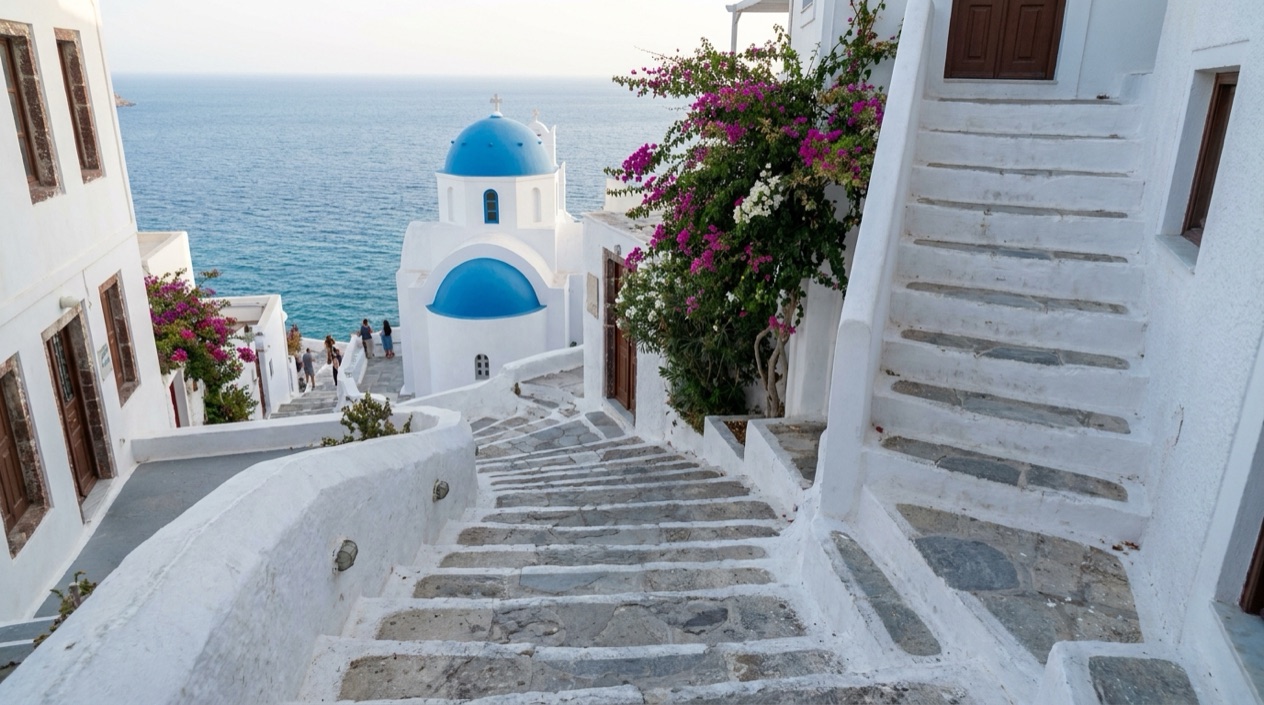
The Cyclades are a scattering of islands in the southern Aegean, south of Athens and north of Crete. Only a few dozen of them are inhabited, and every one has a different character. Andros is green and tied to the sea, Tinos draws pilgrims, Naxos is broad and fertile, and Folegandros is rocky with sheer cliffs. Fourteen days lets you taste the contrast between a few of them without turning the trip into a race.
What the route leaves out is large. Crete, the biggest of all Greek islands, is not here. Neither are the Ionian Islands, Rhodes, Lesbos, Meteora or Delphi, and Mykonos, Tinos and Syros appear only as swaps. The mainland sites outside Athens, including Mycenae, Epidaurus and Olympia, belong to a different trip built on roads rather than ferries.
The season shapes the plan too. Mykonos is best from mid-May through June or from September through mid-October, and July and August are extremely crowded there. An itinerary like this one fits the shoulder weeks well, when the islands still feel lived in rather than packed. Santorini, Milos and Paros are all busiest in summer, so the same logic applies across the route.
Think of the days as three movements. The first is Athens and the arrival, the second is the central islands of Paros and Naxos, and the third is the southern and western finish on Santorini, Milos and Sifnos. Each movement has its own food, its own landscape and its own rhythm, which is what keeps fourteen days from feeling repetitive.
The itinerary stage by stage
Days 1 and 2: Athens
Start in the capital, sleeping in the old center around Plaka and Monastiraki, where the streets bend uphill toward the Acropolis and the cafés spill onto the pavement. The first day is for the rock itself and the Parthenon, then a wander through the lanes below, with a gyros in hand or a plate of meze, the small shared dishes Greeks order in rounds.
The second day can go to the markets and the neighborhoods that locals use. Look for loukoumades, the fried dough balls drenched in honey, and for a kafenio, the traditional coffeehouse where men play backgammon over small cups of Greek coffee. Piraeus, the port of Athens, is where the island ferries leave, so the evening is best spent close to your luggage and the next morning.
Days 3 to 5: Paros
Paros is the first island, reached by sea from Piraeus. Base yourself in Parikia, the main port town, or in Naoussa, the fishing harbor with tavernas along the water. Paros sits in the center of the Cyclades and the marble quarried here shaped ancient sculpture, including the Venus de Milo, so the stone is part of the island’s story as much as its beaches.
Spend one day in Parikia and its old lanes, one in Naoussa, and one inland. The hill village of Lefkes is a good target, with marble-paved paths and a church dominating the square. Dinner can be grilled octopus, a Greek salad with a slab of feta, or whatever fish the taverna brings out that evening. Leave the last evening free for the harbor.
Days 6 to 8: Naxos
Naxos is the largest and most fertile island of the Cyclades, which you notice in the plates: potatoes, cheeses, lamb, vegetables and citrus. Stay in Chora, the main town, with its harbor, its castle quarter and the great marble gateway standing on its own islet at the edge of the water. The port is too small for cruise ships, so the old town keeps a more local feel.
The island’s interior rewards a rental or a bus ride. Mountain villages such as Apiranthos and Halki, with their stone houses and small squares, show a different Naxos from the harbor. Keep one day for the beaches and one for the villages.
Days 9 and 10: Santorini
Santorini is the southernmost of the Cyclades, the largest island of a ring formed around a flooded caldera. It has an active volcano, and you can choose to sleep on the caldera rim in Fira or Oia, or in a quieter village behind it. In ancient times the island was called Thera, a name still seen on signs and in museums.
The first day goes to the caldera edge and the paths between villages, with views across the water to the volcanic islands. The second can be a wine tasting, since Assyrtiko, the island’s crisp white, is grown on its dry volcanic soil. Eat fava, the yellow split-pea purée, and the small local tomatoes, sweet and strongly flavored, then give the last evening to a table on the rim.
Days 11 and 12: Milos
Milos is the southwesternmost island of the Cyclades, a volcanic island roughly midway between Piraeus and Crete. It is a popular summer destination and the place where the Venus de Milo was unearthed before she went to the Louvre. Base yourself in Adamas, the port, or in Plaka, the hilltop village above it, where the evening gathers around the church.
Milos is about its coastline. The fishing hamlets of Klima, with colorful boat garages opening straight onto the water, are a quiet stop, and boat trips circle the island’s rock formations and sea caves. Pitaropia, the island’s chickpea fritters, and fresh fish are the dishes to look for. Keep the second day for whichever corner of the island you liked best.
Days 13 and 14: Sifnos and the return to Athens
Sifnos belongs to the southwestern Cyclades and is known for its scenery and its food. White-washed villages, countless churches, terraced hillsides, old cobbled paths and beaches with clear water make up the island. Artemonas is the second-largest town, and the main village of Apollonia sits at the center of the island.
Day 13 is for the paths and the table. On day 14 you head back to Piraeus by sea. Fast boats and steamship ferries connect Sifnos with Piraeus in high season, and from the port you continue to Athens for your flight home.
Getting between stops
| Leg | How | Time |
|---|---|---|
| Piraeus to Sifnos (high season) | Steamship ferry | About five hours |
| Piraeus to Sifnos (high season) | Fast catamaran | About half the steamship time |
Paros has the clearest sea link in this route. Ferries and high-speed catamaran services run daily from Piraeus, from other Cyclades and from Heraklion on Crete to Paros, and the island lies about 93 miles from the port of Athens. Piraeus is also where Blue Star Ferries and ANEK Lines, whose main routes link Piraeus and Crete, operate. Golden Star Ferries runs from the mainland to the Cyclades.
The rest of the legs are made by sea, from island to island, and a few of them may also be possible by air. Santorini is about 120 miles from the mainland, Milos lies midway between Piraeus and Crete, and Sifnos is reached from Piraeus. Inside each island, buses and rental vehicles link the main town to villages and beaches, which is how the Naxos and Paros days in the plan are built.
Because schedules shift with the season, the stage lengths in this plan are set by days on the island, not by exact departure times.
What to book before your 14 Days in Greece
The first things to settle are the sea legs, since the route depends on moving between islands by ferry. After that come the places to sleep on each island, especially on Santorini and Milos, and finally the ancient sites in Athens. Leave the days on Paros and Naxos loose, because those are the stops where wandering, a bus ride or an extra beach day can replace any fixed plan.
Adapting the route
The route stretches or shrinks by dropping islands, not by rushing them. A shorter version of about ten days keeps Athens, Paros, Naxos and Santorini and drops Milos and Sifnos. A longer one adds a night or two on Folegandros, a small rocky island with almost sheer cliffs whose main village, the Hora, is built high above the sea.
By season and weather
The Athens figures give a sense of the seasons, though they describe the capital rather than the islands.
| Athens month | Average high (°F) | Average low (°F) | Precipitation (in) | Days with rain |
|---|---|---|---|---|
| January | 56.3 | 44.4 | 2.17 | 7.5 |
| April | 68.4 | 53.2 | 1.10 | 5.5 |
| July | 91.8 | 74.1 | 0.28 | 1.6 |
| October | 75.2 | 61.0 | 1.09 | 3.9 |
July is hot in the capital, so a sun hat and sunscreen belong in the bag, and the long days on the islands are better for the sea than for sightseeing in town. October is the other end of the plan, with warm afternoons and some rain, so a light rain jacket makes sense. January and April carry more rain days, which suits a trip built around Athens and a short island stay.
Mykonos is the island of the winds, and it appears as a swap for Milos or Sifnos in the right season. Mid-May through June and September through mid-October are the months to go, while July and August are extremely crowded.
For families and slower trips
A slower version trims the plan to three islands. Stay four nights on Paros, four on Naxos and four on Santorini, with the Athens days at each end. That gives children and slower walkers fewer ferry days and more time for the beach, the pool and a long dinner. The extra days on Naxos can go to a village lunch and a tour of the potato fields.
Another way to slow down is to swap Santorini for Sifnos or Folegandros. Both are small islands where days revolve around a village square, a few beaches and a short list of tavernas. Andros, the green island with its naval tradition, is a quieter alternative at the northern end of the group, with a landscape unlike the typical Cycladic picture.
Good to know before you go
Greece uses the euro, and island tavernas often serve generous plates meant to be shared, so ordering a few dishes and passing them around works well.
The Athens heat in July and August is real, which is a reason to pack sun protection and a refillable bottle.
Sources
- Wikipedia, Ancient Greece (https://en.wikipedia.org/wiki/Ancient_Greece), checked October 12, 2026
- Wikipedia, ANEK Lines (https://en.wikipedia.org/wiki/ANEK_Lines), checked October 12, 2026
- Wikipedia, Blue Star Ferries (https://en.wikipedia.org/wiki/Blue_Star_Ferries), checked October 12, 2026
- Wikipedia, Fast Ferries (https://en.wikipedia.org/wiki/Fast_Ferries), checked October 12, 2026
- Wikipedia, Golden Star Ferries (https://en.wikipedia.org/wiki/Golden_Star_Ferries), checked October 12, 2026
- Wikipedia, Greek islands (https://en.wikipedia.org/wiki/Greek_islands), checked October 12, 2026
- Visit Greece (GNTO), the Cyclades (https://www.visitgreece.gr/islands/cyclades/), checked October 12, 2026
- Wikipedia, Cyclades (https://en.wikipedia.org/wiki/Cyclades), checked October 12, 2026
- Wikivoyage, Cyclades (https://en.wikivoyage.org/wiki/Cyclades), checked October 12, 2026
- Santorini official guide (https://www.santorini.gr/), checked October 12, 2026
- Visit Greece (GNTO), Santorini (https://www.visitgreece.gr/islands/cyclades/santorini/), checked October 12, 2026
- Wikipedia, Santorini (https://en.wikipedia.org/wiki/Santorini), checked October 12, 2026
- Visit Greece (GNTO), Mykonos (https://www.visitgreece.gr/islands/cyclades/mykonos/), checked October 12, 2026
- Wikipedia, Mykonos (https://en.wikipedia.org/wiki/Mykonos), checked October 12, 2026
- Wikivoyage, Mykonos (https://en.wikivoyage.org/wiki/Mykonos), checked October 12, 2026
- Visit Greece (GNTO), Naxos (https://www.visitgreece.gr/islands/cyclades/naxos/), checked October 12, 2026
- Wikipedia, Naxos (https://en.wikipedia.org/wiki/Naxos), checked October 12, 2026
- Wikivoyage, Naxos (https://en.wikivoyage.org/wiki/Naxos), checked October 12, 2026
- Visit Greece (GNTO), Paros (https://www.visitgreece.gr/islands/cyclades/paros/), checked October 12, 2026
- Wikipedia, Paros (https://en.wikipedia.org/wiki/Paros), checked October 12, 2026
- Wikivoyage, Paros (https://en.wikivoyage.org/wiki/Paros), checked October 12, 2026
- Visit Greece (GNTO), Milos (https://www.visitgreece.gr/islands/cyclades/milos/), checked October 12, 2026
- Wikipedia, Milos (https://en.wikipedia.org/wiki/Milos), checked October 12, 2026
- Wikivoyage, Milos (https://en.wikivoyage.org/wiki/Milos), checked October 12, 2026
- Visit Greece (GNTO), Sifnos (https://www.visitgreece.gr/islands/cyclades/sifnos/), checked October 12, 2026
- Wikipedia, Sifnos (https://en.wikipedia.org/wiki/Sifnos), checked October 12, 2026
- Wikivoyage, Sifnos (https://en.wikivoyage.org/wiki/Sifnos), checked October 12, 2026
- Visit Greece (GNTO), Folegandros (https://www.visitgreece.gr/islands/cyclades/folegandros/), checked October 12, 2026
- Wikipedia, Folegandros (https://en.wikipedia.org/wiki/Folegandros), checked October 12, 2026
- Wikivoyage, Folegandros (https://en.wikivoyage.org/wiki/Folegandros), checked October 12, 2026
- Hellenic National Meteorological Service (HNMS), climatological normals 1991-2020 for Elliniko station (https://www.emy.gr/climatic-data), monthly mean daily maximum and minimum; rain from the ECMWF ERA5 reanalysis, 1991-2020, grid cell of Athens (Open-Meteo), checked October 12, 2026
- ECMWF ERA5 reanalysis 1991-2020, grid cell of Athens (Open-Meteo), checked October 12, 2026
- Plan de the (duree choisie by the redaction)
To plan your stay
- Best Time to Visit the Cyclades: May Through June, Early Autumn, Weather and Festivals
- The Cyclades vs the Dodecanese: Beaches, Sights, Weather and Getting There
- The Cyclades vs the Ionian Islands: Beaches, Food, Ferries and the Best Time to Go
- Things to Do in the Cyclades: Delos, Santorini's Caldera, Island Food and Nightlife