
In September, the steam from the bun stalls in Chinatown feels different once the worst of the summer sultriness lets go, and the harbor front fills with people walking after dinner with their jackets over an arm. Yokohama sits on Tokyo Bay, and the water view that was a glare in August turns softer as the days shorten. This is a month for the waterfront, the noodle and dumpling streets and the museums, with the city easing from hot summer toward autumn.
What is the weather like in Yokohama in September?
September in Yokohama is still warm and humid, but the stifling edge of August is gone and the month is clearly wetter.
| Month | Average high (°F) | Average low (°F) | Precipitation (in) | Days with 1 mm or more of precipitation | Hours of sunshine | Daylight on the 15th |
|---|---|---|---|---|---|---|
| August | 87.8 | 75.7 | 5.47 | 7.5 | 206 | 13 h 32 min |
| September | 81.1 | 69.8 | 9.51 | 11.5 | 141 | 12 h 27 min |
| October | 71.6 | 60.3 | 9.46 | 10.7 | 137 | 11 h 21 min |
Highs in the low 80s mean short sleeves are still the right start, and the nights stay mild enough that you never need more than a thin layer for the evening. The humidity stays high, so cotton and linen feel better than anything heavy, and a small towel or handkerchief in the bag is a habit you will see among locals.
Rain falls on more than a third of the days, and the month holds a lot more water than August. Plan for showers and a few gray, soaking days rather than a constant downpour, and keep an umbrella within reach. The sunshine is noticeably lower than in summer, so the light is softer for photographs of the harbor and the brick warehouses.
Daylight has shrunk by about an hour since mid-August, which pulls dinner and the evening walk a little earlier. The skyline lights come on while you are still in a light layer, and that is the moment the waterfront belongs to Yokohama’s evening crowd.
What to do in Yokohama in September
The month’s own tradition is tsukimi, moon viewing, when Japanese households set out pampas grass and rice dumplings (dango) to honor the harvest moon. Seasonal sweets and café menus lean on chestnut and sweet potato as autumn approaches. Two public holidays arrive in September, Respect for the Aged Day and Autumnal Equinox Day, and the second one is also the time when families visit graves and eat ohagi, sweet rice balls coated in bean paste.
Yokohama’s attractions suit a month with some rain, because several of the best ones are under a roof. The harbor, the Chinatown streets, the noodle museum and the shopping towers give you a full range of choices when the sky turns gray.
Minato Mirai and the harbor front
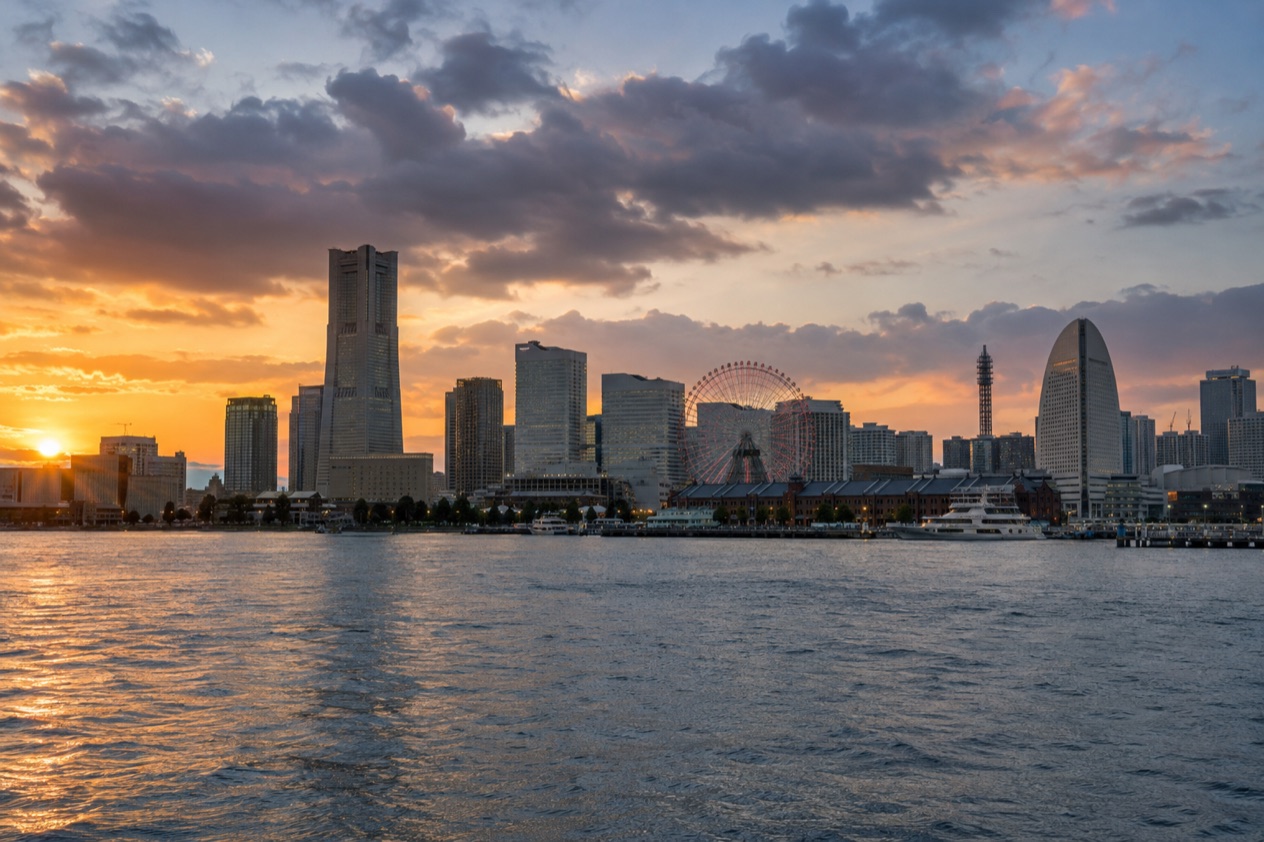
Minato Mirai 21 is the waterfront district whose construction began in 1983 and which now forms the skyline of Yokohama. You see towers of glass, a Ferris wheel, shopping complexes and promenades that run along the water. It reads as a modern district laid out for strolling and shopping, and a rainy afternoon is easily spent moving from one indoor complex to the next.
The history of the port gives the place its character. The Port of Yokohama opened on June 2, 1859, and that opening is why red brick warehouses, a seaside park and foreign-style streets sit here at all. Walking the quay in September, with the air a little less heavy than in August, you feel the trading-port past behind the new towers.
Evenings are the time to come back. Once the lights are on, the boats and the Ferris wheel are reflected on the bay, and the benches along the water fill with couples and families. It suits anyone who likes a city walk that finishes with a view rather than a checklist.
Chinatown, a meal in the streets
Yokohama Chinatown is the largest Chinatown in Japan, larger than the ones in Kobe and Nagasaki. Its gates are painted in red and gold, and the lanes are lined with restaurants, shops selling tea and sweets, and stalls with steaming trays. You smell sesame oil, roasting chestnuts and frying dough before you see the first sign.
Eating here is the activity. Nikuman, the fluffy steamed buns with pork filling, are eaten out of a paper wrapper as you walk, and shops make dumplings, fried sesame balls and pots of noodles. In a warm but not scorching September the street food is a pleasure rather than a sweaty challenge, and a sit-down meal under a ceiling fan makes a good shelter when showers pass.
It suits groups who like to graze and share, and anyone who would rather taste a place than tick off sights. Bring a little appetite and plan to eat in two or three stops rather than one large meal.
CupNoodles Museum
The CupNoodles Museum in Yokohama is one of two in Japan, the other being in Osaka Ikeda. It is devoted to instant noodles, and the idea is playful: you follow the story of the product and see how a cup of noodles comes together. For a wet September afternoon, it is the kind of indoor stop that works for children and adults alike.
Pair it with an evening meal in Chinatown or Minato Mirai and you have a day that covers the city’s quirky side and its harbor. The museum’s hours and admission are not set out here, so look at the museum’s own information before you plan the day around it.
Beyond these, Yokohama rewards the sort of wandering that September weather allows. Park paths near the water, tea at a café with a harbor view and the coffee-and-sweets tradition of the port city all fit the quieter pace that comes as the heat eases.
A two-day itinerary for Yokohama in September
Day 1 is for the modern waterfront. Reach Yokohama Station by JR from central Tokyo, which takes about an hour, and head to Minato Mirai for the morning. Walk the quay and the shopping complexes while the day is still fresh, and keep the late morning for the CupNoodles Museum, which gives you a roof if the clouds thicken.
Lunch can be a noodle or rice-bowl place in one of the towers. Spend the afternoon along the water, in the park by the harbor and by the old brick warehouses. With daylight shorter than in summer, aim to be on the waterfront as the lights come on, then have dinner nearby.
Day 2 belongs to Chinatown. Start with a pork bun from a stall, wander the lanes and gates and decide on a proper lunch among the restaurants. Afterward, take a tea and sweets stop, since this is a month when a cool drink or a warm pot of tea both feel right.
If it rains on either day, swap the order: the museum and the shopping complexes take the wet hours, and a long Chinatown meal in a restaurant becomes the plan for the afternoon. Finish with a quieter evening in a café or izakaya, a casual Japanese pub, before heading back to the station.
Is Yokohama busy in September?
September has no cherry blossom or leaf-color draw in Yokohama, so it is a month defined by the harbor, the food and the lingering warmth rather than by a seasonal rush. Autumn color in this part of Japan comes much later, around the end of November, and the Pacific coast of Kanto gets it in early to mid December.
The Japan National Tourism Organization describes autumn as the season when Japan becomes gradually milder after summer, with moderate temperatures ideal for walking. That is the mood in the city as September moves along, with the harsh heat easing and the outdoor spaces becoming more pleasant.
The two public holidays of the month, Respect for the Aged Day and Autumnal Equinox Day, make for long weekends in Japan, and families head out on those days. The harbor and Chinatown are places where a holiday weekend is likely to feel livelier than a weekday.
Beyond that, the pace is set by the weather. Rain keeps some visitors at the indoor attractions, and the wetter days send people to the shopping complexes and restaurants, so the city feels more varied than a single peak would suggest.
What to pack for Yokohama in September
Pack for warm, humid days with some rain, and a thin layer for evenings by the water.
- Light, breathable shirts, because the humidity stays high and the days remain warm.
- A compact umbrella or a light rain jacket, for the showers that fall on many days.
- Comfortable walking shoes that can handle wet pavement, for the harbor and the Chinatown lanes.
- A thin sweater or overshirt for evenings along the bay.
- A small towel or handkerchief for the sticky hours.
- A sun hat for the brighter hours on the waterfront.
Good to know before you go
September is a rainy month in Yokohama, with more water than in August and nearly as much as in October. Rain is the main thing to plan around, so keep part of each day flexible and have an indoor stop in mind.
The Japan Meteorological Agency runs an Emergency Warning System, launched on August 30, 2013, to alert people to the significant likelihood of catastrophes from natural phenomena of extraordinary magnitude. The Japan National Tourism Organization also runs a Japan Safe Travel Information page with safety tips and government information for travelers. Respect for the Aged Day and Autumnal Equinox Day fall in September and can change the rhythm of a weekend.
Yokohama in September vs August and October
Moving the trip four weeks earlier brings you into a hotter, sunnier and drier Yokohama. August days are longer and the heat is stronger, which suits people who want long bright evenings and do not mind the sultry air that Honshu is known for in summer. September loses some of that glare and gains more rain.
Moving four weeks later gives cooler weather and shorter days, with rain at about the same level as September. October is the month to choose if heat is your main worry, since walking becomes more comfortable, though you will want a proper layer for the evenings.
Choose August if you want the strongest summer feel and the most sunshine. Choose September if you want warmth with a hint of easing, and you are comfortable carrying an umbrella. Choose October if you want milder temperatures for long walks and are fine with early dusk. Autumn color is still weeks away in all three cases.
Is September a good time to visit Yokohama?
Yes, for travelers who like city walking, harbor views and food, and who accept some rain. September suits people who want a warm, relaxed city break built around the waterfront, Chinatown and the museums, without a bloom or leaf season steering the plans.
It is a weaker fit for anyone who wants dry, sunny days for photographs or outdoor plans, or who dislikes humidity. Those travelers will be happier in a month with fewer rainy days.
On arrival, start with the harbor front at Minato Mirai and see how the day is shaping up. If the sky is clear, spend it outside by the water, and if it is not, move straight to the noodle museum and Chinatown lunch. What makes September in Yokohama its own is the turn of the season at the water’s edge: the harbor still warm, the evenings arriving a little sooner, a steaming bun in your hand under a gray sky.
Sources
- Japan Meteorological Agency (JMA), Normal values 1991-2020, monthly (https://www.data.jma.go.jp/stats/etrn/view/nml_sfc_ym.php?prec_no=46&block_no=47670), station Yokohama, elevation 39 m, checked October 11, 2026
- Computed from the date and the latitude of the place (sunrise equation, solar elevation -0.833 degrees), October 11, 2026
- Japan Meteorological Agency, Emergency Warnings (https://www.jma.go.jp/jma/en/Emergency_Warning/ew_index.html), checked October 11, 2026
- Japan National Tourism Organization, safety information (https://www.japan.travel/en/japan-safe-travel-information/), checked October 11, 2026
- Japan National Tourism Organization, weather and seasons in Japan (https://www.japan.travel/en/plan/weather/), checked October 11, 2026
- Japan National Tourism Organization, summer in Japan (https://www.japan.travel/en/guide/summer-guide/), checked October 11, 2026
- Wikipedia, Climate of Japan (https://en.wikipedia.org/wiki/Climate_of_Japan), checked October 11, 2026
- Japan Meteorological Agency, maple color-change dates 2025-2026 with difference from the 1991-2020 normal (https://www.data.jma.go.jp/sakura/data/phn_014.html), checked October 11, 2026
- Japan Meteorological Agency, kaede2020.pdf (https://www.data.jma.go.jp/sakura/data/kaede2020.pdf), checked October 11, 2026
- Japan National Tourism Organization, autumn in Japan (https://www.japan.travel/en/guide/autumn-guide/), checked October 11, 2026
- Japan National Tourism Organization, spring in Japan (https://www.japan.travel/en/guide/spring-guide/), checked October 11, 2026
- Wikipedia, Yokohama (https://en.wikipedia.org/wiki/Yokohama), checked October 11, 2026
- Wikivoyage, Yokohama (https://en.wikivoyage.org/wiki/Yokohama), checked October 11, 2026
- Japan National Tourism Organization, Yokohama (https://www.japan.travel/en/destinations/kanto/kanagawa/yokohama-and-around/), checked October 11, 2026
- Wikipedia, CupNoodles Museum (https://en.wikipedia.org/wiki/CupNoodles_Museum), checked October 11, 2026
- Wikipedia, Minato Mirai 21 (https://en.wikipedia.org/wiki/Minato_Mirai_21), checked October 11, 2026