
Steam rises from bamboo baskets at the street stalls, the smell of roasted chestnuts and sesame drifts between the red lanterns, and painted gates in bright colors frame every approach. Yokohama Chinatown is a neighborhood you eat your way through, with temples tucked between the restaurants. It suits travelers who like to wander, snack and take their time over lunch.
Is visiting Yokohama Chinatown worth it?
Yes, if you like food, color and the feeling of a district that has been mixing cultures for generations. It suits couples, families with curious eaters, friends who want to graze from stall to stall, and anyone spending a day in Yokohama who wants a meal with some atmosphere. It is less of a fit if you want a single landmark to tick off, because the pleasure here is in the walking itself.
Scale is the first thing that sets it apart. Yokohama Chinatown is the largest Chinatown in Japan, bigger than the ones in Kobe and Nagasaki, and about 250 Chinese-owned or Chinese-themed shops and restaurants are scattered through its streets. That density means you never run out of options: a dumpling stall gives way to a sit-down banquet room, then a shop of tea, a shop of chopsticks, a fortune teller, a bakery with steamed buns.
It is also a real neighborhood, not only a visitor attraction. Between 3,000 and 4,000 people live here, which you notice in the side streets, where daily life goes on behind the lanterns. Yokohama itself is the second largest city in Japan, and a trip here slots naturally into a day by the bay, with the port, the waterfront parks and the shopping districts all part of the same city.
The history gives the visit some depth. The Port of Yokohama opened in 1859, and Chinese merchants and interpreters arrived with the foreign trading houses, settling close to the harbor. Their community grew into the district you walk through today, with its own temples, schools, associations and kitchens.
What to see at Yokohama Chinatown
The gates and the main streets
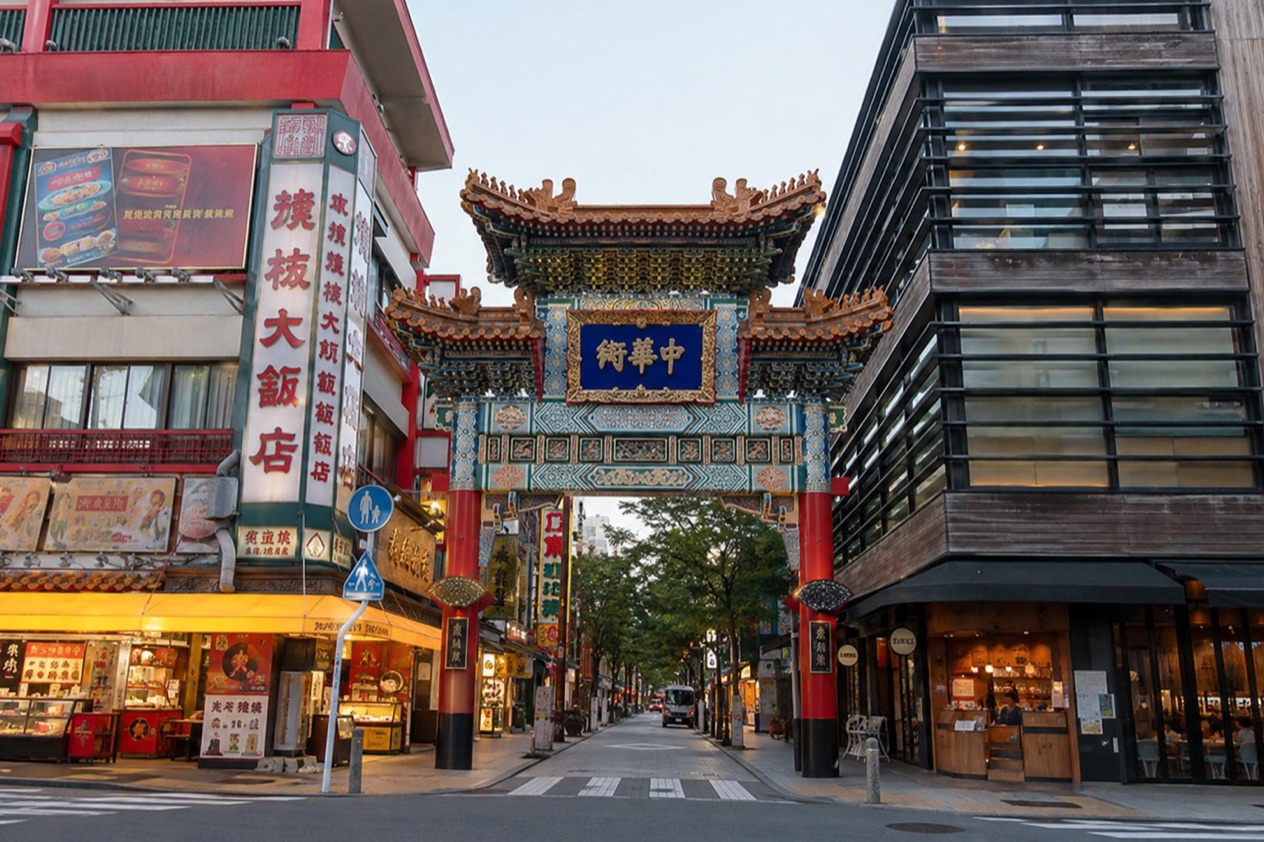
The gates are the signature of the neighborhood. Tall, ornate and painted in strong colors, with gilded details and rooflines that curl at the corners, they mark the entrances and give the streets a ceremonial feel. The large goodwill gate built in 1955 is tied to the moment the district was officially recognized and called Yokohama Chukagai, the Japanese name for Chinatown.
Take your time under each gate and look up. The ceilings are decorated, the pillars carry inscriptions, and the lanterns hang so thickly in places that they form a red ceiling of their own.
Street food and restaurants
Eating is the center of the visit. Stalls sell nikuman, the fluffy steamed buns filled with seasoned pork, along with fried dumplings, sesame balls, almond tofu, mango pudding and skewers of candied fruit. People walk with a paper tray in hand and share a few things from different stalls before deciding where to sit down for a proper meal.
The sit-down restaurants cover the range of Chinese regional cooking as Japanese kitchens have adapted it: fried rice, wonton soup, stir-fried vegetables, noodle bowls, dim sum baskets, and set menus meant for sharing around a round table. Look for window displays of glazed ducks and steaming baskets, and for menus with photos if you want to point rather than read.
Mazu Miao temple
Mazu Miao was established in 2006 to mark the 150th anniversary of the district. It is dedicated to Mazu, the sea goddess who is honored by Chinese communities as the protector of sailors and travelers. In a port city built on shipping, the choice of deity fits the place.
Expect bright reds and golds, carved dragons, incense smoke and offerings laid before the altar. Worshippers come to pray and visitors come to look, and the contrast with the food streets outside is part of the charm. Keep your voice low and watch how others behave before you take photographs.
Kwan Tai Temple
Kwan Tai Temple is the second temple worth seeking out. The temple keeps an official website in Japanese, which is useful if you read the language and want to know more before or after your visit.
Look at the details of the roof, the statues and the altar offerings. Small shrines like this one tell you as much about the community as the restaurants do, because they show what the people who built this neighborhood held dear.
How to get to Yokohama Chinatown
Two train lines serve the district directly. The Minatomirai Line runs to Motomachi-Chukagai Station, and the Negishi Line runs to Ishikawacho Station. From Tokyo, the first connects with Shibuya and the second with Shinagawa.
| From | Route | Time |
|---|---|---|
| Shibuya Station, Tokyo | Minatomirai Line to Motomachi-Chukagai Station | 35 minutes |
| Shinagawa Station, Tokyo | Negishi Line to Ishikawacho Station | 35 minutes |
| Central Tokyo | JR train or private railway line to Yokohama Station | About 1 hour |
| Haneda Airport | Keikyu line to Yokohama Station | 20 minutes |
| Haneda Airport | Shuttle bus to Yokohama Station | 30 minutes |
| Nagoya | Nozomi Shinkansen to Shin-Yokohama Station | 1 hour 25 minutes |
| Kyoto | Nozomi Shinkansen to Shin-Yokohama Station | 2 hours |
| Osaka | Nozomi Shinkansen to Shin-Yokohama Station | 2 hours |
| Hiroshima | Nozomi Shinkansen to Shin-Yokohama Station | 3 hours 40 minutes |
Travelers coming from central Tokyo can also ride to Yokohama Station on a JR train or on one of several private lines. Yokohama Station is more central than Shin-Yokohama, which is the stop for the Nozomi Shinkansen coming from western Japan. If you arrive by Shinkansen, you will need a second train into the city center.
Buses are another option. Six routes run from the Yokohama Station East bus depot and from Sakuragicho Bus Depot, and in total sixteen bus routes go to Yokohama Chinatown.
By car, the route follows the Shuto Expressway K1 Yokohane Route and leaves at the Yokohama Koen (Yokohama Park) Exit. Yokohama sits on Tokyo Bay in the Kanto region of Honshu, directly south of Tokyo, which is why so travelers fit it into a day out from the capital.
When to visit Yokohama Chinatown
There is no wrong season for a neighborhood where much of the pleasure is food and lanterns, but the weather changes how the walk feels. Spring and autumn give mild air for strolling from stall to stall. Midsummer brings heat and thick humidity that make a long outdoor wander slower, while January is cold enough that a hot bun in your hand becomes a small treat in itself.
| Month | Average high (°F) | Average low (°F) | Precipitation (inches) | Days with rain | Sunshine (hours) |
|---|---|---|---|---|---|
| January | 50.4 | 36.9 | 2.55 | 5.1 | 193 |
| April | 66.0 | 51.3 | 5.63 | 9.5 | 181 |
| July | 84.9 | 73.2 | 7.19 | 10.3 | 171 |
| October | 71.6 | 60.3 | 9.46 | 10.7 | 137 |
January is the driest and sunniest of the four, with cold air that suits heavier clothes, and now and then a day of snow or sleet. April warms up noticeably and brings rain on a good number of days, usually as showers rather than a full washout. July is hot and sticky, and the daily stroll goes better at a slow pace with something cold to drink.
October is mild, with comfortable temperatures for walking, but it is also the wettest month in the table, with rain on more than ten days. Plan for gray spells and an umbrella. The covered restaurants, tea shops and temples give you places to wait out a shower, and the lanterns look lovely on a damp afternoon.
The most useful question is whether you want to eat outdoors at a leisurely pace, in which case spring and autumn are the natural choices, or whether you are happy to duck into restaurants for most of the visit.
Tips for your visit
Arrive hungry and resist the urge to eat a full meal at the first place you see. The best approach is to graze: one bun here, a plate of dumplings there, a sweet at the end. With so many shops and restaurants to choose from, sharing dishes with your companions lets you taste far more.
Bring a small bag, a pack of tissues and a light layer, depending on the month. In the wetter months the climate table is your guide, so an umbrella is worth carrying. In the cooler months, bring warmer clothes for the time spent outdoors between meals.
Plan the visit around a meal or two and a slow walk, and leave room to follow your nose down the side streets. The temples reward a few quiet minutes each, and the gates reward a camera.
Chinatown pairs naturally with the rest of Yokohama. The city has the port that brought the Chinese community here, along with waterfront parks and shopping districts, so you can spend the morning elsewhere and come for a late lunch, or the reverse. Yokohama has been twinned with San Diego since October 1957, a small curiosity if you are coming from the United States.
Souvenir shops sell tea, sweets, chopsticks and small gifts, and browsing is as much a part of the outing as eating.
Good to know before you go
Rain can fall in any month here, and October in particular brings damp days, so a folding umbrella earns its place in your bag. Stay aware of your belongings in the thicker stretches of the crowd, as you would in any busy district, and take your time at each temple.
Sources
- Wikipedia, Yokohama Chinatown (https://en.wikipedia.org/wiki/Yokohama_Chinatown), checked October 11, 2026
- Japan National Tourism Organization, Yokohama (https://www.japan.travel/en/destinations/kanto/kanagawa/yokohama-and-around/), checked October 11, 2026
- Wikivoyage, Yokohama (https://en.wikivoyage.org/wiki/Yokohama), checked October 11, 2026
- Japan Meteorological Agency (JMA), Normal values 1991-2020, monthly (https://www.data.jma.go.jp/stats/etrn/view/nml_sfc_ym.php?prec_no=46&block_no=47670), station Yokohama, elevation 39 m, checked October 11, 2026