
Once you leave the arrivals hall at Narita, the signs start to point toward the railway platforms, and the first decision of the trip is which line carries you into the city. The airport sits out in Chiba Prefecture, so the ride is also your first long look at the suburbs and rail yards that surround Tokyo before the towers of Shinjuku or the brick front of Tokyo Station appear. Three railways serve the airport, and each one ends in a different part of town.
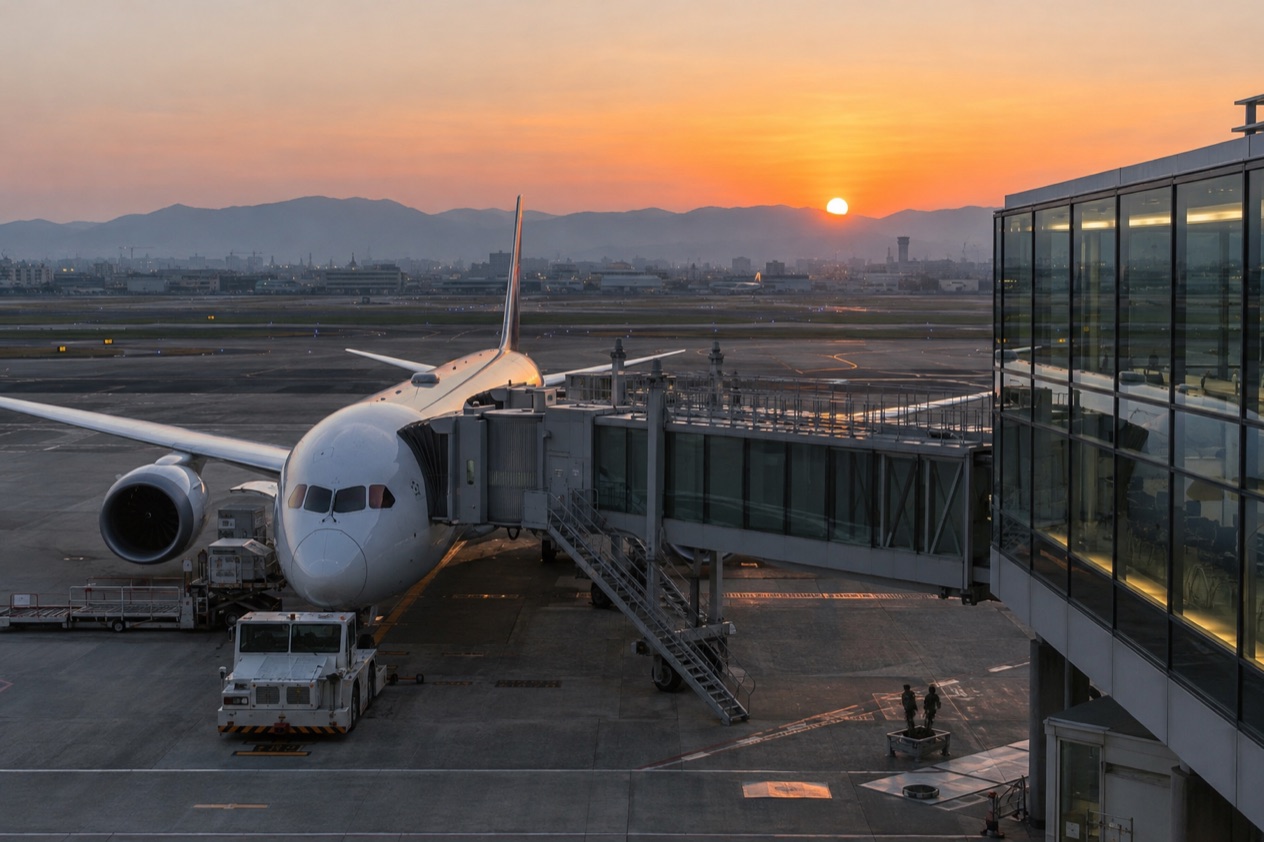
How do you get from the airport to Tokyo?
You get there by train, on one of three railways: the Keisei Skyliner to Ueno, JR East’s Narita Express to Tokyo Station and beyond, or a slower Keisei or JR service that stops at more stations along the way. The Skyliner is the fastest of the limited express trains into central Tokyo, while the Narita Express reaches the big western hubs of Shibuya and Shinjuku without a change.
What decides is where you sleep. Narita is about 37 miles east of central Tokyo, and the train you choose determines which side of the city you step into.
A hotel near Ueno, Nippori or the old shitamachi neighborhoods of the east is a natural match for the Keisei lines. A hotel around Tokyo Station, Shinagawa, Shibuya, Shinjuku or Yokohama points you toward the JR trains, and the Narita Express stops at every one of those stations.
Your terminal matters too, because the stations are spread out. Terminal 1 has its own station, Terminals 2 and 3 share another, and both Keisei and JR trains call at both. The hour you land plays a part as well: Narita does not allow aircraft operations between midnight and 6 a.m., so every arrival falls between those hours, and your plans for the first evening in the city can be made around that window.
If you prefer a seat that is yours from the moment you board, the Narita Express offers one, since every seat on it is reserved, in Standard or Green (first class). If you are heading to a district that sits on neither line, you can use either railway as far as a hub and then switch to the city’s subway or commuter lines with an IC card.
Your options from the airport
Keisei Skyliner
The Skyliner is a limited express that links Narita with Keisei Ueno Station, calling at Narita Airport Station for Terminal 1 and Airport Terminal 2 Building Station for Terminals 2 and 3. It also stops at Nippori, and on certain trains at Aoto and Shin-Kamagaya. Ueno is a good place to start a trip: the park with its museums and pond is close, and the lanes of the Ameyoko market bring a tumble of dried fish, sneakers and snacks.
Nippori, the stop before Ueno, is the gateway to the old neighborhoods of Yanaka, where low houses, temples and small craft shops line the streets. A Skyliner Discount Ticket exists for the run between Narita Airport Station and Keisei Ueno, and a Face Check in Go service lets passengers board at a discount using facial recognition. The Shitamati Biyori Pass covers one day of unlimited travel on all Keisei lines in Tokyo, a handy companion if your first day stays in the east.
JR Narita Express
The Narita Express, known as N’EX, has been run by JR East since 1991 and carries travelers from Narita to Tokyo, Shibuya, Shinjuku and the western suburbs. It stops at Narita Airport Station (Terminal 1) and Airport Terminal 2 Building Station (Terminals 2 and 3), then continues to Narita, Chiba, Tokyo, Shinagawa, Shibuya, Shinjuku, Yokohama and Ofuna. For anyone staying in the western wards or in Yokohama, the stations at the far end of the line are the reason to choose it.
Trains run about every half hour in the mornings and evenings and hourly through the middle of the day. Every seat is reserved, and the cars are entirely no-smoking. Tokyo Station, where the line reaches the center of the city, is a destination in its own right, with a red-brick Marunouchi building on one side and long underground arcades of food stalls and shops on the other.
Keisei Access Express and Keisei Main Line
Keisei also runs ordinary services along two routes. The Access Express serves Narita Airport Station, Airport Terminal 2 Building Station, Shin-Kamagaya, Higashi-Matsudo, Keisei Takasago, Aoto, Nippori and Keisei Ueno. The Keisei Main Line serves the two airport stations, Keisei Narita, Keisei Funabashi, Keisei Takasago, Aoto, Nippori and Keisei Ueno.
These trains call at more stops than the Skyliner, which is useful if your hotel lies in Chiba or in the eastern wards rather than at Ueno. Keisei Funabashi and Higashi-Matsudo, for example, put you in suburban neighborhoods that most visitors never see. All of them end at Keisei Ueno, so you can ride through to the city center whenever you wish.
JR Line
The JR Line from Narita serves Tokyo, Shinagawa, Shibuya, Shinjuku, Ikebukuro, Yokohama and Ofuna, so it reaches Ikebukuro, a big hub in the northwest of the city, as well as the stations the Narita Express also covers. Ikebukuro is known for its department stores and for the anime shops around Otome Road.
The same JR network lets you carry on from Tokyo, Shinagawa or Shinjuku to nearly anywhere else in the metropolitan area, which makes it handy if your hotel lies off the Narita Express route. An IC card such as Suica or Pasmo works on the connecting lines.
Airport transfer options compared
| Option | Best for | Time to town |
|---|---|---|
| Keisei Skyliner | Keisei Ueno, Nippori and the east of the city | As little as 36 minutes to Nippori, about 43 minutes between Ueno and Terminal 1 |
| Morningliner and Eveningliner | Keisei Ueno or Keisei Narita | Fastest journey 72 minutes |
| JR Narita Express | Tokyo Station, Shinagawa, Shibuya, Shinjuku, Yokohama | As little as 53 minutes to Tokyo Station, usually 55 minutes to an hour |
The trade-off comes down to where each line leaves you. The Skyliner gets you to Ueno and Nippori in the least time, and from there the Yamanote loop line and the subway take you onward. The Narita Express takes longer to Tokyo Station, but it carries on to Shibuya and Shinjuku, so a hotel in either of those saves you a transfer.
The Morningliner and the Eveningliner cover the same route as the Skyliner, between Keisei Ueno and Keisei Narita or Narita Airport Terminal 1, and take a little longer. The slower Access Express, Keisei Main Line and JR Line trains stop at more stations, which can put them closer to a hotel outside the central wards.
A reserved seat on the Narita Express is a point in its favor if you like to know exactly where you will sit, and the Skyliner offers a discount ticket and a facial recognition option for the Ueno run. Whichever you pick, look at the end of the line first, because that decides the rest of your day.
Arriving at the airport
Narita has three terminals, and the rail stations match them: Terminal 1 sits at Narita Airport Station, while Terminals 2 and 3 share Narita Airport Terminal 2・3 Station. Terminal 1 and Terminal 2 are each a five-minute walk from their station, and Terminal 3 is a ten-minute walk from the same station as Terminal 2.
Terminal 1 is the larger of the first two, with 40 gates, and Terminal 2 has 32 boarding gates. Terminal 3 was built for low-cost airlines, was voted the best terminal for such carriers in Asia by Skytrax in 2024, and has a 24-hour food court, the largest airport food court in Japan. That makes it a fine place to eat a bowl of ramen or curry rice if you land hungry.
Both the Skyliner and the Narita Express stop at Terminal 1 and at the Terminal 2 stop, so whichever terminal you land at, you can board either without a transfer. The Skyliner’s Terminal 1 stop is its terminus on the Narita side, while the Narita Express starts out here and continues through Chiba to Tokyo.
The airport covers a wide area and is still growing, which explains the walk between terminals and stations. It also has one of Japan’s longest runways, a four-kilometer stretch that welcomes long-haul flights. Because the airport closes to aircraft between midnight and 6 a.m., the terminal falls silent for those hours.
Good to know before you go
An IC card works on trains, buses and boats, in vending machines and convenience stores, and in some taxis, and the regional cards (Suica, Pasmo, ICOCA) can be used throughout Japan. Passes also exist for rides around the capital. The Greater Tokyo Pass offers unlimited travel for three days on railway lines and streetcars of 13 companies and on buses of 31 companies in the Kanto area.
Tokyo sits on Tokyo Bay in the Kanto region, and Haneda is the other airport that serves it. Keep your hotel’s station name written down in both English and Japanese before you board, because the ends of the lines are many and the names look alike on a departures board.
Sources
- Narita International Airport, Access by rail (https://www.narita-airport.jp/en/access/train/), checked October 11, 2026
- Keisei Electric Railway, Skyliner (https://www.keisei.co.jp/keisei/tetudou/skyliner/us/), checked October 11, 2026
- Wikipedia, Keisei Skyliner (https://en.wikipedia.org/wiki/Keisei_Skyliner), checked October 11, 2026
- Wikipedia, Narita Express (https://en.wikipedia.org/wiki/Narita_Express), checked October 11, 2026
- Wikipedia, Narita International Airport (https://en.wikipedia.org/wiki/Narita_International_Airport), checked October 11, 2026
- Japan National Tourism Organization, Tokyo (https://www.japan.travel/en/destinations/kanto/tokyo/), checked October 11, 2026
- Japan National Tourism Organization, IC cards, Suica, Pasmo, ICOCA, how to use (https://www.japan.travel/en/plan/ic-card/), checked October 11, 2026