
In May, Tokyo hangs carp-shaped streamers from towers and rooftops, and they flap in the breeze like a school of bright fish above the city. Golden Week fades, the festival drums of old Asakusa start up, and the days are long enough to wander well into the evening. It is a month for walking, for shrine festivals and for eating outdoors, for anyone planning a first or a return trip to the city.
What is the weather like in Tokyo in May?
May in Tokyo is warm and mostly pleasant, with comfortable afternoons, cool mornings and only a moderate amount of rain.
| Month | Average high (°F) | Average low (°F) | Precipitation (in) | Days with 1 mm or more of precipitation | Hours of sunshine | Daylight on the 15th |
|---|---|---|---|---|---|---|
| April | 66.9 | 49.6 | 5.26 | 9.5 | 179 | 13 h 04 min |
| May | 74.5 | 58.3 | 5.50 | 10.1 | 180 | 14 h 01 min |
| June | 79.0 | 65.3 | 6.61 | 11.6 | 124 | 14 h 33 min |
Afternoons reach the mid-70s, which is shirt-sleeve weather for walking between districts, while mornings and late evenings feel noticeably cooler. A light jacket or a simple sweater is enough to carry in the bag, and it comes off and goes back on as the day moves along.
Rain falls on roughly one day in three, so an umbrella that folds small earns its place. Humidity is moderate, a step up from April but well short of the sticky feeling that settles in as June approaches. Sunshine is as plentiful as in April, which makes May one of the brighter months for photographs of gardens, shrines and the skyline.
The days are long now. Daylight stretches past fourteen hours in the middle of the month, and in summer in Tokyo it is light out until around 19:30, so there is time for a temple in the afternoon and a stroll in the early evening before dinner.
What to do in Tokyo in May
The month opens inside Golden Week, a holiday period running from the end of April to May 5. Four of its days are official public holidays: Showa Day, Constitution Memorial Day, Greenery Day and Children’s Day. When a holiday falls on a Sunday, the next working day becomes a holiday as well, and a day wedged between two holidays turns into one too.
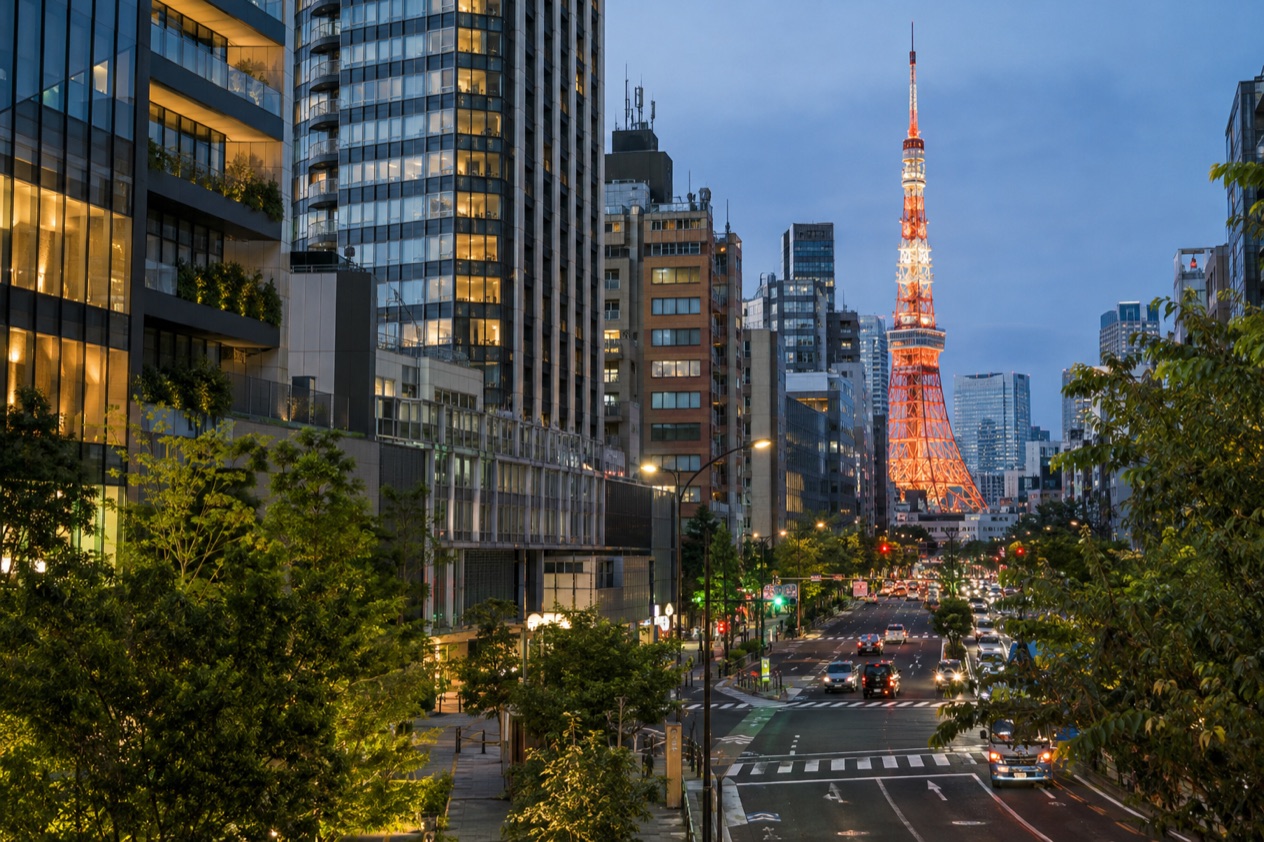
Children’s Day on May 5 is the festival you will see everywhere in the sky. Koinobori, the carp streamers, are flown for boys and girls alike as a wish for strength and growth. At Tokyo Tower, 333 of them are displayed, matching the tower’s height of 333 meters, and at TOKYO SKYTREE TOWN more than 1,000 fly together.
Sanja Matsuri and the festivals of the old city
Sanja Matsuri is one of the three largest Shinto festivals in Tokyo, and it is held at Asakusa Shrine. Its mood is loud and joyful, with drums, whistles, crowds in festival coats and portable shrines carried through the streets of old Asakusa. Around it, food stalls sell grilled skewers, shaved ice and sweet bean-filled treats.
The Kanda Matsuri, another of the big Tokyo festivals, began in the early 17th century as a celebration of Tokugawa Ieyasu’s victory at Sekigahara. Its current form also honors the kami of Kanda Myojin, the shrine at its center. Festival dates shift with the calendar, so if you want to see a procession, look up the schedule for the year of your trip.
Another May tradition is the Kurayami Matsuri, which offers exciting events every evening from May 3, with plenty of stalls. Festival evenings in the warm air, with paper lanterns and the smell of grilled food, are among the most pleasant things the month offers.
Asakusa, Senso-ji and the Skytree
Senso-ji is the oldest temple in Tokyo, set in Asakusa. You pass through a gate hung with a huge lantern, walk down a lane of snack and souvenir stalls, and arrive at a hall wreathed in incense smoke. In May the festival season gives the whole neighborhood extra energy, and the long daylight allows an unhurried visit.
Tokyo Skytree stands 634 meters tall in Sumida, and the koinobori at its base make a lively foreground in early May. Seen together, the old temple and the new tower show two sides of the city in a single afternoon, with the river between them.
Meiji Jingu and the green parts of the city
Meiji Shrine is a Shinto shrine in Shibuya dedicated to the deified spirits of Emperor Meiji and Empress Shoken. With fresh leaves overhead, May is a good month to walk its approach under the trees. Mild mornings suit the long gravel paths, and you can pair the visit with the cafés and shops of the surrounding districts.
Greenery Day on May 4 is a reminder that the month belongs to the trees and gardens. Beyond the center, the Tama Area has its own mountain and valley landscapes, including Mt. Takao and Okutama, for a day in the hills when the weather is clear.
Central Tokyo includes Ginza, Akihabara, Tokyo Station and Marunouchi, Nihonbashi, Tsukiji, Kanda and Jimbocho, and more, which makes for good indoor and outdoor wandering when showers pass. Roppongi and Akasaka are two more districts to explore, reached from Shibuya Station in about 10 minutes by train.
Shops in urban areas are generally open from 10:00 a.m. to 8:00 p.m. every day, so an evening of browsing fits easily into the day. For those interested in handmade objects, the Japan Hobby Show is an annual showcase held at Tokyo Big Sight.
A two-day itinerary for Tokyo in May
Day 1 belongs to the old east side. Start early at Senso-ji, when the incense smoke drifts and the stalls along the approach are still opening. If the Sanja Matsuri is on, the shrine next door fills with drums and portable shrines, so spend the late morning there. Lunch can be noodles or tempura in one of the small restaurants around Asakusa.
In the afternoon, head to Tokyo Skytree and its koinobori, then wander the shops at its base. As the long light fades, which is well after 6:30 p.m. in the warm season, walk along the river and have dinner at an izakaya, a casual pub serving small plates. If rain arrives, the shops and food floors under the tower give you plenty to do indoors.
Day 2 moves west. Begin with Meiji Jingu in the cool of the morning, walking its tree-lined approach before the sun is high. Then continue into Shibuya for a coffee and a browse, and have lunch at a ramen or sushi counter nearby.
In the afternoon, take the train to Roppongi and Akasaka and explore the streets and museums there. Finish with an evening in Ginza or Marunouchi, when the shops are open until 8:00 p.m. and restaurants fill. On a rainy day, trade the park paths for galleries, department stores and the covered arcades of Central Tokyo.
Is Tokyo busy in May?
The first days of May are lively, because Golden Week is a holiday period in Japan and many residents are out and about, and the pace calms as the month moves on.
Golden Week runs from April 29 to May 5, with four official public holidays among its days. Expect festivals, parks and popular sights to feel the effect of the holiday, while the city itself keeps running, with urban shops generally open from 10:00 a.m. to 8:00 p.m. every day.
Once Children’s Day has passed, the rhythm of the city steadies. The cherry blossoms are long gone in Tokyo, since the Somei-Yoshino reach the Kanto region in late March, so the spring crowds that follow the blooms have moved on. Festivals such as Sanja Matsuri and Kanda Matsuri still draw crowds to their neighborhoods, but those are concentrated in a few streets. If you want a quieter experience, look beyond the headline sights to the parks, shrine paths and neighborhood streets, where the long evenings and mild temperatures invite a slower pace.
What to pack for Tokyo in May
May calls for layers, since mornings and evenings are cooler than the afternoons and rain turns up on about one day in three.
- A light jacket or a simple sweater, for cool mornings and evenings
- Short sleeves, for afternoons in the mid-70s
- A compact umbrella, for passing showers
- Comfortable walking shoes, for temple grounds and long strolls between districts
- Sunglasses and a hat, for bright days with plenty of sunshine
- A small day bag, to carry layers as the temperature shifts
Good to know before you go
The main thing to know in May is Golden Week, which runs from April 29 to May 5 and brings four public holidays. Holiday rules add a day off when a holiday falls on a Sunday, and a day between two holidays also becomes one. Urban shops are generally open from 10:00 a.m. to 8:00 p.m. every day, while rural shops often close earlier, sometimes as early as 6:00 p.m., which matters if you head out to the hills of the Tama Area.
June brings more rain and humidity, so May is the last month before the weather turns heavier.
Tokyo in May vs April and June
Going four weeks earlier puts you in April, when the days are cooler and the nights can feel chilly. The cherry blossoms of the Kanto region come in late March, so April trips catch the tail of the blossom season, while May belongs to festivals, fresh leaves and long daylight.
Going four weeks later brings June, which is warmer, wetter and far less sunny. Rain falls on more days, humidity is higher, and the sky turns grayer, so outdoor walking becomes less comfortable. The festivals of May are behind you by then.
If you love temples, parades and outdoor evenings, choose May. If cherry blossoms are the reason for the trip, aim earlier, and if you prefer to avoid holiday-period energy, plan for the second half of the month.
Is May a good time to visit Tokyo?
Yes, May is a very good time to visit Tokyo, especially for travelers who like festivals, walking and long days without much heat.
It suits those who want to see shrine festivals such as Sanja Matsuri, to stroll under fresh green leaves at Meiji Jingu and to eat outdoors in the evening. It is less ideal for anyone who wants to see cherry blossoms, who should come earlier, or anyone hoping for the driest weather, since showers are part of the month.
On arrival, start with a walk through Asakusa or the paths of Meiji Jingu to settle into the rhythm of the city. May in Tokyo is a month of carp streamers overhead, drums in the old neighborhoods and daylight that lasts well into the evening.
Sources
- Japan Meteorological Agency (JMA), Normal values 1991-2020, monthly (https://www.data.jma.go.jp/stats/etrn/view/nml_sfc_ym.php?prec_no=44&block_no=47662), station Tokyo, elevation 25 m, checked October 11, 2026
- Computed from the date and the latitude of the place (sunrise equation, solar elevation -0.833 degrees), October 11, 2026
- Japan National Tourism Organization, shop and attraction hours, national holidays (https://www.japan.travel/en/plan/business-hours-and-holidays/), checked October 11, 2026
- Wikipedia, Golden Week (Japan) (https://en.wikipedia.org/wiki/Golden_Week_(Japan)), checked October 11, 2026
- Wikipedia, Public holidays in Japan (https://en.wikipedia.org/wiki/Public_holidays_in_Japan), checked October 11, 2026
- Japan National Tourism Organization, flowers by season: cherry blossom, plum, wisteria, hydrangea, where and when (https://www.japan.travel/en/see-and-do/flowers/), checked October 11, 2026
- Wikipedia, Wisteria (https://en.wikipedia.org/wiki/Wisteria), checked October 11, 2026
- Japan Meteorological Agency, sakura2020.pdf (https://www.data.jma.go.jp/sakura/data/sakura2020.pdf), checked October 11, 2026
- Japan National Tourism Organization, spring in Japan (https://www.japan.travel/en/guide/spring-guide/), checked October 11, 2026
- Wikipedia, Kanda Matsuri (https://en.wikipedia.org/wiki/Kanda_Matsuri), checked October 11, 2026
- Wikipedia, Sanja Matsuri (https://en.wikipedia.org/wiki/Sanja_Matsuri), checked October 11, 2026
- Japan National Tourism Organization, festivals and events (https://www.japan.travel/en/see-and-do/festivals-and-events/), checked October 11, 2026
- Wikipedia, Gion Matsuri (https://en.wikipedia.org/wiki/Gion_Matsuri), checked October 11, 2026
- GO TOKYO, best things to do and see in Tokyo in May (https://www.gotokyo.org/en/story/guide/may/index.html), checked October 11, 2026
- Japan National Tourism Organization, Tokyo (https://www.japan.travel/en/destinations/kanto/tokyo/roppongi-and-akasaka-area/), checked October 11, 2026
- GO TOKYO, the official Tokyo travel guide (https://www.gotokyo.org/en/), checked October 11, 2026
- GO TOKYO, getting around (https://www.gotokyo.org/en/plan/index.html), checked October 11, 2026
- GO TOKYO, spots (https://www.gotokyo.org/en/spot/index.html), checked October 11, 2026
- GO TOKYO, Tokyo in autumn (https://www.gotokyo.org/en/story/guide/autumn/index.html), checked October 11, 2026
- Asakusa Kannon Sensoji (https://www.senso-ji.jp/english/), checked October 11, 2026
- Wikipedia, Sensō-ji (https://en.wikipedia.org/wiki/Sens%C5%8D-ji), checked October 11, 2026
- Wikipedia, Meiji Shrine (https://en.wikipedia.org/wiki/Meiji_Shrine), checked October 11, 2026
- Tokyo Skytree, official site (https://www.tokyo-skytree.jp/en/), checked October 11, 2026
- Wikipedia, Tokyo Skytree (https://en.wikipedia.org/wiki/Tokyo_Skytree), checked October 11, 2026