
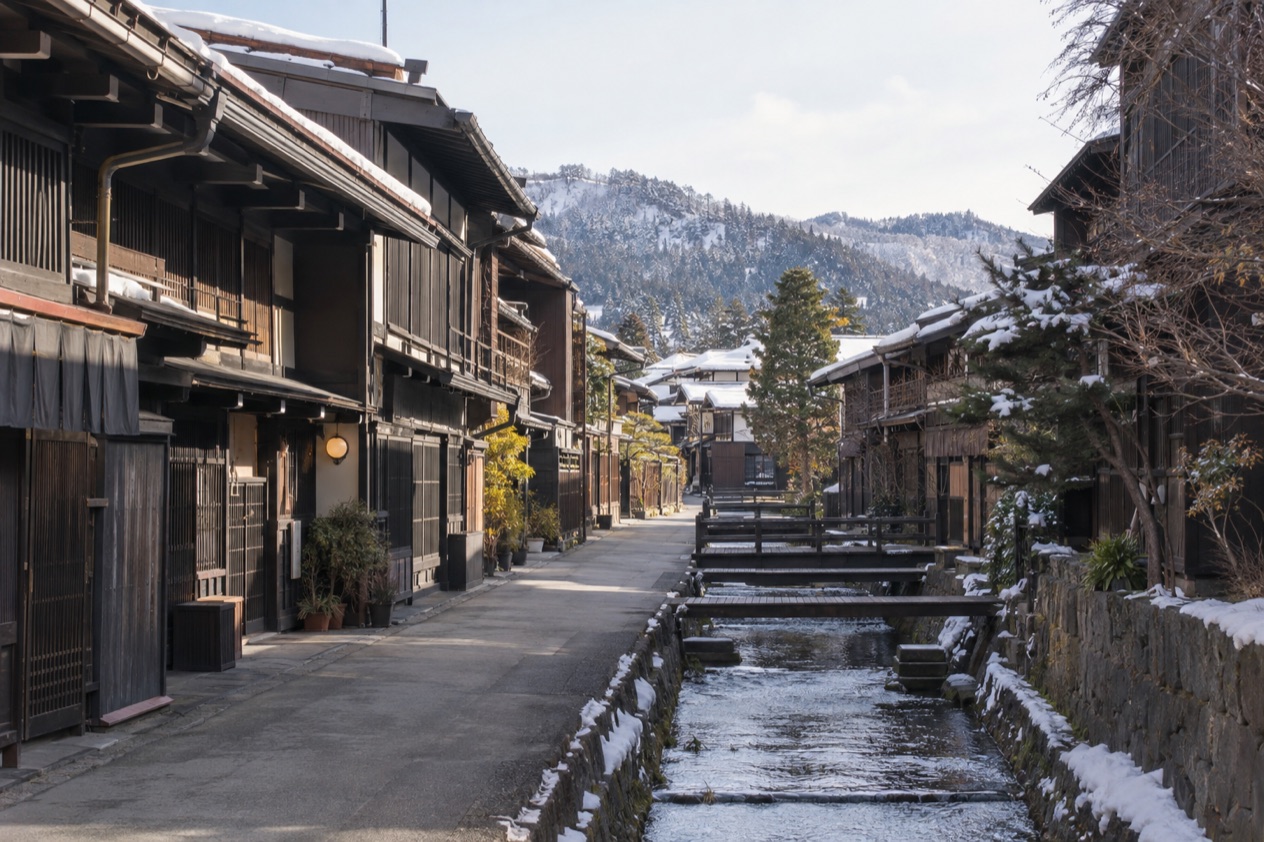
In March, meltwater runs along the narrow channels beside the lanes of Takayama’s old town, and a last dusting of snow still sits on the dark wooden eaves of the merchant houses. Sake breweries hang their balls of cedar boughs over the doorways, and the smell of miso grilling on a magnolia leaf drifts out of the dining rooms. Takayama, in the Japanese Alps of Gifu Prefecture, is a town where winter is loosening its grip, and this is the month for old streets, hot bowls of noodles and mountain air before the cherry blossoms of April.
What is the weather like in Takayama in March?
March in Takayama is cold but clearly on its way out of winter, with snow and rain trading places and the days finally stretching.
| Month | Average high (°F) | Average low (°F) | Precipitation (in) | Days with 1 mm or more of precipitation | Hours of sunshine | Daylight on the 15th | Snowfall (in) |
|---|---|---|---|---|---|---|---|
| February | 40.5 | 23.2 | 3.68 | 11.7 | 116 | 10 h 51 min | 35.4 |
| March | 49.6 | 29.1 | 4.82 | 13.0 | 154 | 11 h 54 min | 11.4 |
| April | 62.6 | 38.1 | 4.88 | 11.0 | 174 | 13 h 05 min | 1.2 |
Afternoons rise above the freezing point and feel like a raw early spring, which is why a wool sweater under a windproof jacket does the job. Nights still drop below freezing, so the wet patches of the day can turn to ice by the next morning. Wet snow and cold rain are both part of the month, and snow or sleet falls on more than half the days, so a waterproof shell matters more than an umbrella you have to hold in gloved hands.
Precipitation arrives on most days in one form or another, but it does not mean gray weather all the time. Sunshine returns for a good part of the month, and the light is noticeably longer than in February, which gives you real room to wander outdoors before dinner. Humidity is high, so the cold feels damp, and boots with a good grip are worth more than fashionable shoes on slushy lanes.
Indoors, expect warm wooden dining rooms, heated museums and baths where the steam rises in the cold air. Layers that come off easily suit the way you move between the street and a restaurant, and a hat and gloves earn their place in the bag.
What to do in Takayama in March
March belongs to the old town, because snow and meltwater make the Edo-style streets look their part. Takayama is sometimes called the Little Kyoto of Hida for its well-preserved quarter, and the comparison makes sense when you stand in a lane of lattice-fronted wooden houses with a thin white line of snow along the roofs.
There are no big festivals in the town this month. The Spring Takayama Festival comes in April, so March is for ordinary life in a mountain town: shopkeepers sweeping slush, sake being poured, steam coming from the noodle shops.
The old town on foot
The core of the visit is the quarter of merchant houses, with dark timber fronts, deep eaves and small shops selling sake, pickles, lacquerware and local sweets. Many of the old houses were breweries, and you can tell them by the cedar balls hanging at the entrances. Inside, tasting counters let you try sake from the mountain water, and the sweet, warm smell of rice hangs in the air.
Walk the lanes slowly, ducking into shops to warm up, and look down at the narrow channels of water beside the streets, which run with snowmelt this time of year. Snow outlines the roof lines and the wooden latticework, which is what many photographers come for. The cold keeps the pace slow, and a warm cup of something in hand matters more than a plan.
Keep the walk loose, with a few shops, a brewery stop and a break at a café. This suits anyone who likes to wander with no agenda, and it is a good first afternoon after arriving.
What to eat in a mountain town
Hida beef is the local luxury, served as steak, grilled over charcoal, in a bowl on rice, or as skewers from street stalls. In cold weather the richest versions taste best, especially in a small restaurant with a charcoal grill at the counter. Takayama ramen is another winter pleasure, a light soy broth with thin curly noodles that suits a damp, cold day.
Look for hoba miso, a sweet-salty paste grilled on a dried magnolia leaf with mushrooms and vegetables, which is a mountain dish through and through. Mitarashi dango, rice dumplings grilled and glazed with soy sauce, are sold as snacks in the old town. The local sake is meant to be sipped with that food, and a small cup in a brewery tasting room is a good way to warm up after the cold.
In March, the mountain vegetables are not yet at their peak, so the table is built on beef, miso, pickles and noodles. That suits the weather perfectly, and a heavy lunch followed by a slow afternoon is a very good rhythm here.
Between plum and cherry
March sits in a gap in the flower calendar. Plum trees in East Asia usually flower from January until late February, so the plum season is over or ending, and in Takayama itself cherry blossoms appear from the middle to the end of April, around three weeks after Nagoya. At Gifu, the reference station for blooms in this region, the first cherry blossoms usually open around the end of March, which gives you a sense of how the season moves from the lowlands up toward the mountains.
Do not plan a March trip around flowers. Plan it around bare branches and snow, and treat any early bud as a bonus.
Beyond the old town, the rest of Takayama is an enormous city by area, stretching deep into the mountains of the Japanese Alps, so the surroundings reward a day outside the center when the weather clears. Snowy ridges and farmhouse villages are the scenery of the season. In bad weather, the museums, breweries and restaurants of the center give you plenty to do.
A two-day itinerary for Takayama in March
Day 1 starts in the old town with a slow morning among the merchant houses, when the lanes are wet with melted snow and the shops are just opening. Browse the sake breweries and sample a cup or two, then stop at a street stall for mitarashi dango to eat while it is still hot. Keep the pace unhurried, because the ground is slippery and you will want to stop often to warm up.
At midday, sit down for a lunch of Hida beef, either grilled at the table or on rice, and linger over it while the weather outside does what it likes. In the afternoon, go back to the lanes and the channels beside them for photographs, since the days now run nearly twelve hours and there is light into the evening. For dinner, choose a small restaurant with hoba miso and local sake, and finish with a warm bath at your inn if it has one.
Day 2 is for the surroundings of the old town and a different kind of food. Start with a bowl of Takayama ramen for breakfast or an early lunch, then head out to the quieter edges of the city, where farmhouse roofs and snowy fields give a sense of the Alps around you. If the sky is bright, this is the day to be outside, and if it turns to snow or sleet, move indoors without regret.
The rain card is simple: spend the afternoon in a museum, a craft shop, a café or a brewery tasting room, all places where you can stay dry and warm. Come back to the old town for a last dinner, perhaps a charcoal grill with Hida beef again or a small izakaya (a casual pub) with sake. Local line tickets at Takayama Station on the JR Takayama Line must be bought in cash, so keep some yen ready for the departure.
Is Takayama busy in March?
March sits between the snow season and the big April weeks, so the town’s pace depends on what the weather does from one day to the next.
The two events that shape Takayama’s visitor calendar come later. The cherry blossoms appear from the middle to the end of April, and the Spring Takayama Festival takes place in mid-April, with the Autumn Takayama Festival in October. Neither falls in March, so the month does not carry the festival draw of the weeks to come.
What March offers instead is the winter version of the town, with snow on the roofs, steam from the food stalls and a rhythm set by the weather. The snowy backdrop and the Edo-style streets are the draw, and the town does not depend on flowers or floats.
If you want the town without a festival crowd, this month lets you see the streets as the residents do, and you can take your time in the shops and brewery tasting rooms. If you want blossoms or floats, look at April. Rooms and tables are not something to speak of with certainty here, so plan around the weather and the pace of the day.
What to pack for Takayama in March
Pack for cold, wet ground and warm interiors, with clothes that layer and shoes that grip.
- Waterproof boots with good grip, because meltwater and slush cover the old-town lanes.
- A warm, waterproof jacket, since snow, sleet and rain all fall in March.
- Thin layers such as a sweater and a fleece, which come off easily in heated restaurants.
- A hat and gloves for the freezing nights.
- Sunglasses for bright days when sun hits the snow.
- Some cash in yen, because local line tickets at Takayama Station must be bought that way.
Good to know before you go
March brings late snow and wet roads, so plan outdoor time with a margin and keep an indoor option in mind for each day. Takayama Station on the JR Takayama Line does not accept IC cards, which means tickets for the local line are paid for in cash. The festivals of the town fall in April and October, not in March, so do not count on floats or processions on this trip.
Takayama in March vs February and April
February is deep winter, with much more snow, colder nights and daylight under eleven hours. The streets look their most wintry, but the cold is harder on long outdoor walks, and fewer of the days are bright. March keeps the snowy look but softens it, with longer days and more room to be outside.
April is a different town, with snow nearly gone, daylight past thirteen hours and the cherry blossoms opening from the middle to the end of the month. The Spring Takayama Festival takes place on April 14 and 15, so a trip timed to it adds floats and a festival mood that March does not have. Highs reach the low 60s, so a light jacket becomes enough for the day.
If you want the snowy Edo look with a bit more comfort than February, stay in March. If you want blossoms and the festival, move to April. If winter scenery is the whole point, February delivers the most snow.
Is March a good time to visit Takayama?
Yes, for travelers who like cold, atmospheric streets, hot food and a town that is not waiting for a festival to be itself.
You will love March if you enjoy wandering in boots, ducking into sake breweries and eating grilled beef and miso in a warm room. It also suits those who want snow-edged rooftops without the deepest cold of midwinter. Skip it if blossoms, floats or mild spring weather are the reason for the trip, and choose April instead.
On arrival, start with the old town while the light is up, then settle into a long dinner of Hida beef or hoba miso with a cup of local sake. That first evening sets the tone for the whole stay. What is special about March in Takayama is the in-between feeling, with snow still on the eaves, meltwater in the channels and the first real length to the days.
Sources
- Japan Meteorological Agency (JMA), Normal values 1991-2020, monthly (https://www.data.jma.go.jp/stats/etrn/view/nml_sfc_ym.php?prec_no=52&block_no=47617), station Takayama, elevation 560 m, checked October 11, 2026
- Computed from the date and the latitude of the place (sunrise equation, solar elevation -0.833 degrees), October 11, 2026
- Japan Meteorological Agency, cherry blossom first-bloom dates 2021-2026 and 1991-2020 normal (https://www.data.jma.go.jp/sakura/data/sakura003_07.html), checked October 11, 2026
- Japan Meteorological Agency, cherry blossom full-bloom dates 2021-2026 and 1991-2020 normal (https://www.data.jma.go.jp/sakura/data/sakura004_07.html), checked October 11, 2026
- Japan Meteorological Agency, sakura2020.pdf (https://www.data.jma.go.jp/sakura/data/sakura2020.pdf), checked October 11, 2026
- Japan National Tourism Organization, flowers by season: cherry blossom, plum, wisteria, hydrangea, where and when (https://www.japan.travel/en/see-and-do/flowers/), checked October 11, 2026
- Wikipedia, Prunus mume (https://en.wikipedia.org/wiki/Prunus_mume), checked October 11, 2026
- Japan National Tourism Organization, spring in Japan (https://www.japan.travel/en/guide/spring-guide/), checked October 11, 2026
- Japan National Tourism Organization, autumn in Japan (https://www.japan.travel/en/guide/autumn-guide/), checked October 11, 2026
- Japan National Tourism Organization, summer in Japan (https://www.japan.travel/en/guide/summer-guide/), checked October 11, 2026
- Japan Meteorological Agency, biological season observations (https://www.data.jma.go.jp/sakura/data/index.html)
- Wikipedia, Takayama, Gifu (https://en.wikipedia.org/wiki/Takayama,_Gifu), checked October 11, 2026
- Wikivoyage, Takayama (https://en.wikivoyage.org/wiki/Takayama), checked October 11, 2026
- Japan National Tourism Organization, festivals and events (https://www.japan.travel/en/see-and-do/festivals-and-events/), checked October 11, 2026
- Wikipedia, Takayama Festival (https://en.wikipedia.org/wiki/Takayama_Festival), checked October 11, 2026
To plan your stay
- Things to Do in Takayama: Old Town Streets, Morning Markets, Hida Beef and Festival Floats
- Where to Stay in Takayama: Station Area, Old Town Streets, Morning Market and Ryokan
- Takayama from Nagoya: The Hida Limited Express, Ways to Go and a Day in the Old Town
- Takayama Festival: Yatai Floats, Lantern Processions and Spring and Autumn Dates