
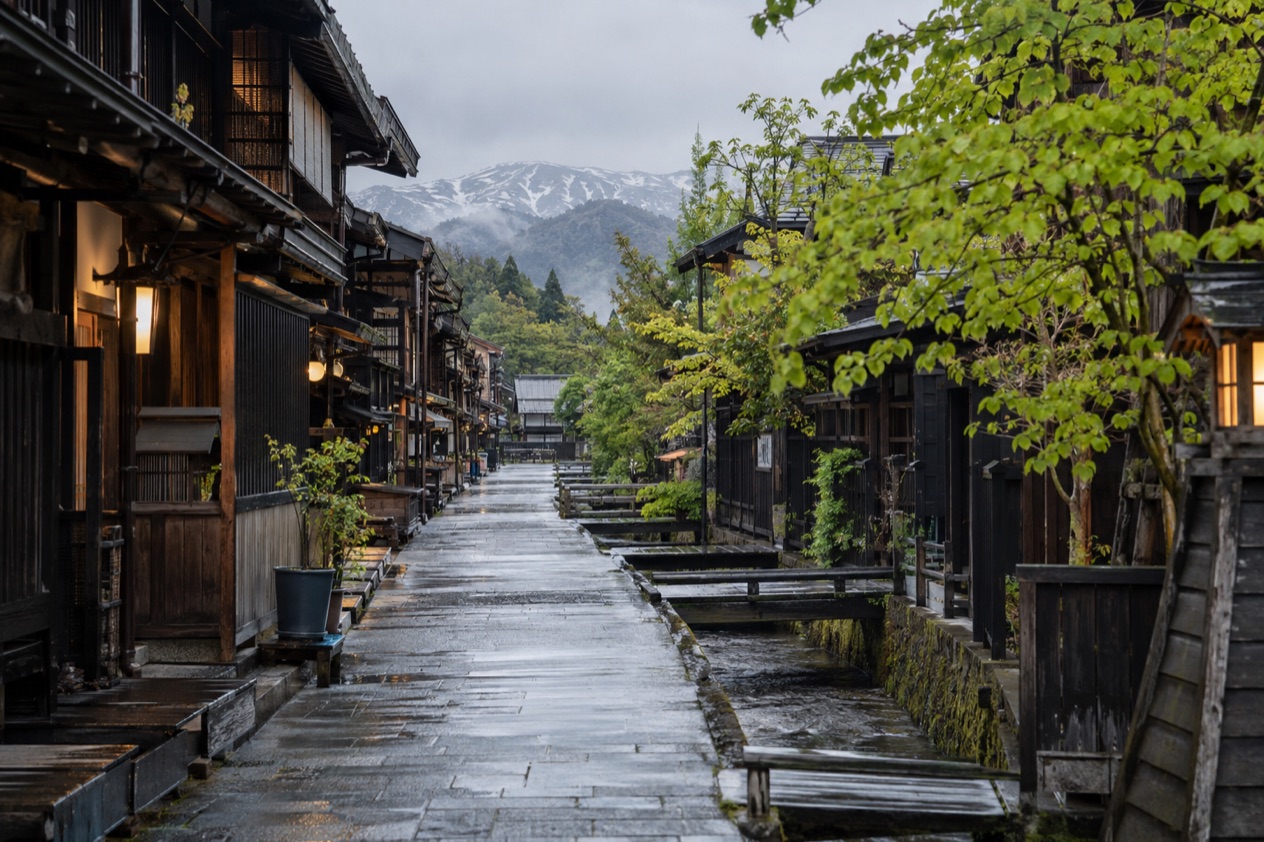
In June, rain drips from the low eaves of the old merchant houses in Takayama, and the dark timber lattices turn a deeper brown. Umbrellas drift along streets lined with sake breweries, and the hills around town are a thick, wet green. It is the month of early-summer showers in the Hida mountains, a good time for slow indoor stops, bowls of hot noodles and the soft light of a rainy day in a well-kept wooden town.
What is the weather like in Takayama in June?
June in Takayama is warm and humid with regular rain, a clear step up from the fresh feel of May and not yet the sticky heat of July.
| Month | Average high (°F) | Average low (°F) | Precipitation (in) | Days with 1 mm or more of precipitation | Hours of sunshine | Daylight on the 15th |
|---|---|---|---|---|---|---|
| May | 73.2 | 48.9 | 4.93 | 10.6 | 189 | 14 h 03 min |
| June | 79.0 | 58.8 | 6.71 | 11.7 | 144 | 14 h 36 min |
| July | 85.1 | 66.9 | 10.27 | 14.1 | 147 | 14 h 24 min |
Afternoons are warm enough for short sleeves, and the nights stay mild enough that a thin layer is plenty. The town sits in the mountains of Gifu Prefecture, so the air feels clearly cooler than in the big cities of the plains. Humidity builds through the month, and a cotton shirt that dries quickly will be more comfortable than anything heavy.
Rain falls on a good share of the days, and June has noticeably less sunshine than May. Expect gray skies, soft drizzle and the occasional heavier shower rather than one long washout. A light rain jacket or a compact umbrella is part of the daily kit, and shoes that tolerate wet pavement will serve you better than canvas sneakers.
The days are long, with daylight stretching well into the evening even under cloud. That leaves room for a late stroll after dinner, when the lanterns come on and the wet streets pick up the glow of the shop windows.
What to do in Takayama in June
Takayama is known as the Little Kyoto of Hida, and June suits its preserved quarter of Edo-style streets. Wet wood looks richer, the lattice fronts glisten, and you can duck from one shop or brewery to the next when a shower passes. The mood is unhurried, built around browsing, tasting and looking up at the deep eaves.
The old town in the rain
The heart of a visit is the old quarter, where merchant houses with dark latticed fronts now hold sake breweries, craft shops, small museums and cafés. Look for the cedar balls hung under brewery eaves, the traditional sign that a new sake is being made. Many breweries pour small tastings, so a rainy afternoon can turn into a gentle tour of local rice wine.
Along the river, morning market stalls sell pickles, fresh vegetables, flowers and handmade souvenirs such as sarubobo, the faceless red dolls of the region. Wander without a plan. The streets are small, and the pleasure lies in ducking into doorways, watching craftspeople, and stopping when something smells good.
If the rain comes down hard, a covered shop arcade or a teahouse with a window onto the street makes a good pause. In this season, a pot of hot green tea beside a rain-streaked pane is half the experience.
Hydrangeas and green hillsides
June is the time of hydrangeas across Japan, which has several native species. Rain suits them, and gardens, temple grounds and roadside verges in the Hida region take on shades of blue, violet and pink.
Japan even has a drink made from a local hydrangea: ama-cha, or sweet tea, brewed from the leaves of Hydrangea serrata, which develop a sweet taste. You may come across it around the country in early summer, and it is worth trying if you spot it.
The hills around the city are lush, and the air smells of cedar and wet earth. On a day when clouds lift, the surrounding ridges of the northern Japan Alps appear in layers of soft green and gray, a pleasing backdrop to a walk.
Eating the Hida way
Rainy weather calls for something warm. Takayama is known for Hida beef, grilled over charcoal, served as sushi or simmered in a miso-based hot pot on a ceramic leaf. Local ramen has a clear, soy-based broth with thin curly noodles, and it fits a damp afternoon well.
Street snacks are an easy way to taste the town between stops. Skewers of grilled beef, rice crackers, mitarashi dango (rice dumplings glazed with sweet soy) and local sake in tiny cups are all part of strolling the old streets. Mountain vegetables, river fish and pickles appear on set meals at small restaurants, and in June the plates tend to taste light and fresh.
Evenings are for izakaya, the small pubs where plates arrive one after another beside a glass of sake. It is a relaxed way to end a wet day, with a counter seat and a view of the cook at work.
Cherry blossoms are long gone by now, since they show here from the middle to the end of April. What June offers in their place is deep green, rain and a calmer rhythm of sightseeing than the festival months can give.
A two-day itinerary for Takayama in June
Day 1 is for the old quarter. Start on foot at the river and its morning market, where you can pick up a snack and a small souvenir. Then move into the lattice-fronted streets, going shop by shop and brewery by brewery, with a tasting or two as the weather allows. The long June daylight means you do not need to rush.
For lunch, choose a small restaurant serving Hida beef or a bowl of local ramen. Spend the afternoon in the museums and craft houses, which are good shelter if rain sets in, then return to the streets as the lamps come on. Dinner can be at an izakaya, with grilled skewers and sake from the breweries you passed earlier.
Day 2 is for greenery and slower pleasures. Begin with a walk in a temple garden or along a lane lined with hydrangeas, where wet leaves and blooms are best. Follow it with a tea stop and a sweet, such as dango, to rest your legs.
If the sky clears, spend the afternoon out among the hills around the city, with the northern Japan Alps behind them. If rain stays, go back to the covered shops and cafés and take your time over a long meal. Local line tickets at Takayama Station are bought in cash, so keep some yen on you if you leave town by rail on the JR Takayama Line.
Is Takayama busy in June?
June is a rainy, green month in Takayama, and it feels like the calm between the spring blossoms and the heat of high summer.
The big draws of the cherry blossom weeks are over, since the trees flower here in the second half of April. What remains is a town where visitors come for its old streets, its sake and its mountain food, and where the pace is set mostly by the weather. Rain showers send people into shops, museums and restaurants and then out again when the sky lightens.
There is no festival to plan around in June, so the rhythm is yours to choose. Without a fixed event pulling everyone to the same corner, you can follow your own taste, from a brewery tasting to a hot bowl of noodles to a slow walk under an umbrella.
Takayama is the largest city in Japan by area, but the sights you came for sit together in the old quarter, so a short stay covers a lot. Pairing the town with the surrounding mountains turns it into a base for a few unhurried days.
What to pack for Takayama in June
Pack for warm, damp days that sometimes turn gray and wet, and for a town explored on foot.
- A light rain jacket or compact umbrella, because showers come often and cobbled lanes get slick.
- Quick-drying shirts, since the humidity makes cotton slow to dry.
- Comfortable shoes that handle wet pavement, for hours of walking through the old streets.
- A thin layer for the evenings, when the mountain air cools.
- A small bag with a waterproof lining, to protect a camera and phone when you duck between shops.
- Some cash in yen, for station tickets and small stalls.
Good to know before you go
June brings the early-summer rains, so build a few indoor stops into each day and treat clear spells as a bonus rather than a promise. Takayama Station on the JR Takayama Line does not accept IC cards, so local line tickets must be bought in cash. Even if you carry a Suica or Pasmo for the big cities, bring yen for the ticket counter here.
The town lies near the northern Japan Alps in Gifu Prefecture, so it is cooler than the cities of the plains. Allow for that when you plan your clothes, and leave room in the day for tea and rest when the humidity rises.
Takayama in June vs May and July
Moving four weeks earlier brings you to May, with clearly more sunshine, less rain and cooler nights. The blossoms are over by then as well, so you gain brighter days and a lighter wardrobe, though you lose the lush wet green of June and the hydrangeas that come with it. May suits people who want clear skies for the surrounding hills.
Moving four weeks later brings July, which is warmer, wetter and more humid, with the heaviest rain of the three months. The air feels heavy, and showers can be long. Mount Fuji’s climbing season starts at the beginning of July, which matters if your trip combines Takayama with a Fuji ascent.
Choose June if you like rainy-day atmosphere, green hillsides, hydrangeas and warm, not yet sultry, days. Choose May for brighter skies and cooler air, and July only if you can handle humidity and frequent rain.
Is June a good time to visit Takayama?
Yes, June is a good time to visit Takayama for travelers who enjoy a damp, green, slow-paced town and do not need constant sunshine. It rewards people who like to browse, taste and sit with a cup of tea while rain taps the roof.
It suits food lovers, who can spend days on Hida beef, ramen, sweets and sake, and photographers who like wet wood and hydrangeas. It is less suited to anyone who wants wide mountain views on every day, or who dislikes humidity and an umbrella in hand.
On arrival, start in the old quarter and the riverside market, then let the sky decide the rest of the plan. Keep a few indoor options in reserve, and pick outdoor stops when the clouds lift. What stays in the mind from June in Takayama is the sight of dark timber streets under a gray sky, lanterns glowing on wet stone, and a cup of sake or a bowl of noodles warming your hands.
Sources
- Japan Meteorological Agency (JMA), Normal values 1991-2020, monthly (https://www.data.jma.go.jp/stats/etrn/view/nml_sfc_ym.php?prec_no=52&block_no=47617), station Takayama, elevation 560 m, checked October 11, 2026
- Computed from the date and the latitude of the place (sunrise equation, solar elevation -0.833 degrees), October 11, 2026
- Japan National Tourism Organization, weather and seasons in Japan (https://www.japan.travel/en/plan/weather/), checked October 11, 2026
- Wikipedia, Climate of Japan (https://en.wikipedia.org/wiki/Climate_of_Japan), checked October 11, 2026
- Japan National Tourism Organization, flowers by season: cherry blossom, plum, wisteria, hydrangea, where and when (https://www.japan.travel/en/see-and-do/flowers/), checked October 11, 2026
- Wikipedia, Hydrangea (https://en.wikipedia.org/wiki/Hydrangea), checked October 11, 2026
- Japan National Tourism Organization, summer in Japan (https://www.japan.travel/en/guide/summer-guide/), checked October 11, 2026
- Wikivoyage, Takayama (https://en.wikivoyage.org/wiki/Takayama), checked October 11, 2026
- Wikipedia, Takayama, Gifu (https://en.wikipedia.org/wiki/Takayama,_Gifu), checked October 11, 2026
To plan your stay
- Things to Do in Takayama: Old Town Streets, Morning Markets, Hida Beef and Festival Floats
- Where to Stay in Takayama: Station Area, Old Town Streets, Morning Market and Ryokan
- Takayama from Nagoya: The Hida Limited Express, Ways to Go and a Day in the Old Town
- Takayama Festival: Yatai Floats, Lantern Processions and Spring and Autumn Dates