
Once dusk settles over the old town, paper lanterns begin to glow along the carved wooden floats, and the sound of flutes and drums drifts down streets of dark timber houses. Takayama holds its festival twice a year, once to ask for a good harvest and once to give thanks for it. It is a visit built around floats, music and light rather than around any one sight, and it suits travelers who like to watch a town celebrate in its own streets.
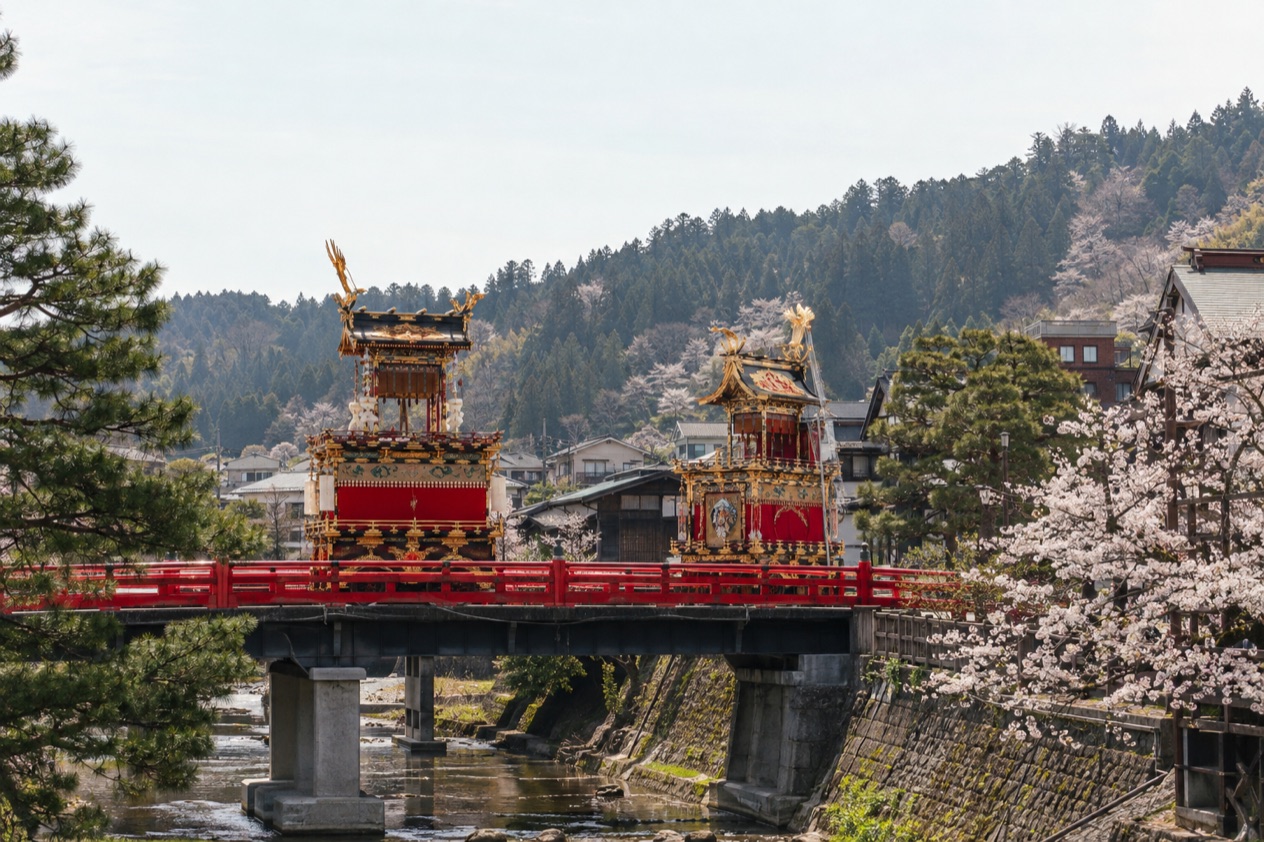
Is visiting the Takayama Festival worth it?
Yes, if you enjoy craftsmanship, music and a town that dresses up for its own tradition, and it suits both first-time visitors to Japan and people who already know the Kyoto circuit. The festival centers on the yatai, ornate floats pulled through the old quarter, and it comes in two seasons: a spring one tied to prayers for the harvest and an autumn one held after the crops are in. Each has its own shrine and its own mood.
What sets it apart from other Japanese festivals is its focus. Spring in much of the country means cherry blossom parties, and Hirosaki and Mito draw people for their trees and plums. Takayama’s spring festival is about music and floats rather than blossoms. Elsewhere you find other kinds of spectacle: portable shrines (mikoshi) carried through Asakusa at the Sanja Festival, samurai re-enactments in Kanazawa, or the dances you can learn at the Gujo Odori Festival in Gifu.
Takayama’s pleasure is quieter and more detailed. You look closely at the carving, the lacquer and the puppets, and then you watch the same floats glow after dark. Takayama is also called the Little Kyoto of Hida for its well-preserved quarter of Edo-style streets, so the festival unfolds in a setting that already feels like a stage.
What to see at the Takayama Festival
The festival is a set of parts that fit together: the floats themselves, the lantern-lit evening, the two shrines that give the festival its meaning, and a hall where floats can be seen when no procession is passing. Together they fill a visit with things to look at slowly.
The yatai floats and their marionettes
A yatai is a tall, multi-tiered wooden float, decorated with carving, metalwork and lacquer, and each belongs to a neighborhood of the old town that looks after it through the year. Look up at the upper tiers, where the detail is densest, and at the wheels and the curtains, which are often as carefully made as the carved panels.
Some floats carry mechanical puppets called karakuri. On the Hotei Tai float, three marionettes representing the god of fortune are operated by nine puppet masters using thirty-six strings. The figures move with a lifelike ease, and the performance is the clearest reminder that these floats are theater as much as decoration. Watching the puppeteers’ coordination is as much a part of the spectacle as the puppets.
The lantern procession after dusk
After dusk, each float is lit with as many as 100 chochin, the round paper lanterns of Japan. The carved wood turns from daytime browns and golds into a moving tower of warm light, and the floats are pulled slowly through the narrow lanes of the old town to the sound of flutes and drums.
This is the part of the festival that most people picture when they think of Takayama. The old streets, with their dark eaves and latticed windows, frame the floats closely, so the lanterns glow against timber on both sides. Plan to stay into the evening rather than leaving after the daytime procession.
Hie Shrine and Sakurayama Hachiman Shrine
Each festival belongs to a shrine. The spring festival is centered on Hie Shrine, also known as Sanno Shrine, and is held to pray for a good harvest. The autumn festival is centered on Sakurayama Hachiman Shrine and is held after the crops are harvested, to give thanks.
That difference gives the two seasons a different feel. Spring is a festival of hope with the first soft light of the year, while autumn is a festival of gratitude, with cooler air and mountain color around the town. Knowing which shrine you are following also helps you read the day: the floats and the processions are an offering as much as a show, and the shrine grounds are where that purpose is easiest to see.
Takayama Matsuri Yatai Kaikan
The Takayama Matsuri Yatai Kaikan is the place to see the floats when the festival is not on. It stands at the northern end of the old town, so it fits naturally into a walk through the historic quarter. Seeing a yatai at close range, without a procession moving past, lets you take in details you would miss from the street, such as the carving and the metalwork on the upper tiers.
It is also a good place to understand what you will be watching on festival days: the scale of a float, how the tiers rise, and why each neighborhood takes such pride in its own. It works as a preparation before the procession or as a substitute for people who visit in another season.
Hours, tickets and rules
The processions take place in the streets of the old town on the festival days, while the Takayama Matsuri Yatai Kaikan keeps regular hours through the year, with a slightly shorter day in winter. The hall’s schedule changes with the season, so the hours below depend on the month of your visit.
| Site | Open |
|---|---|
| Takayama Matsuri Yatai Kaikan | 08:30 to 17:00 (March to November); 09:00 to 16:30 (December to February) |
One practical rule applies to the local trains: Takayama Station on the JR Takayama Line does not accept IC cards, so local line tickets must be bought in cash.
How to get to the Takayama Festival
Takayama lies in Gifu Prefecture, in the heart of the Japanese Alps, and the town is served by the JR Takayama Line. Takayama Station is the rail gateway, and from there the festival unfolds in the old town. Because the station does not accept IC cards, local line tickets must be bought with cash.
From the station, the Takayama Matsuri Yatai Kaikan is a 15 to 20 minute walk, at the northern end of the old town. That walk takes you toward the historic quarter, with its Edo-style streets, which is where the festival is centered.
Takayama is a city of very large area, and the old town is only one part of it. The festival is held in that old quarter and around the shrines that anchor each season, so staying in or near the old town puts you close to the action. Arriving by rail, you step into the setting of the festival soon after leaving the station.
When to visit the Takayama Festival
The festival falls on fixed dates: the Spring Takayama Festival is held on April 14 and 15, and the Autumn Takayama Festival on October 9 and 10. Those are the days when the floats are out and the processions run, so they are the days to aim for if you want the full festival rather than the hall.
Spring coincides with the cherry blossom season in Takayama, which runs from the middle to the end of April, about three weeks later than in Nagoya. That means you may see blossoms around the town while the festival takes place, even though the festival itself centers on music and floats. The air is cool and snow is still possible in April, so spring suits travelers who like a crisp day and a bright sky.
Autumn brings milder days and cooler evenings, with showers on a good share of days. The table gives a sense of how the two festival months compare with deep winter and midsummer.
| Month | Average high (°F) | Average low (°F) | Days with rain (1 mm or more) | Sunshine (hours) |
|---|---|---|---|---|
| January | 37.8 | 23.4 | 14.6 | 93 |
| April | 62.6 | 38.1 | 11.0 | 174 |
| July | 85.1 | 66.9 | 14.1 | 147 |
| October | 67.8 | 48.6 | 10.3 | 129 |
In words: April afternoons are cool and bright, with the sunniest hours of the four months, while evenings are cold. October afternoons are mild, but nights are cool enough for a sweater once the lanterns are lit. The evening procession is the reason to think about layers in either season.
Tips for your visit
Bring layers. Evenings in Takayama are cool in both festival seasons, and a procession by lantern light means standing outdoors after dark. In April, a trace of snow can still fall, and in October, showers come on many days, so a light rain jacket is worth packing. Comfortable shoes help, because the old town is explored on foot.
Plan to spend both the daytime and the evening in town. Visit the old streets while the floats are out, then stay for the moment the lanterns are lit, which is when the floats look their most striking. The two shrines, Hie Shrine in spring and Sakurayama Hachiman Shrine in autumn, give the day its purpose, so build them into your route.
If you want to understand the floats before you see them in motion, the Takayama Matsuri Yatai Kaikan, at the northern end of the old town, fits naturally into a walk through the historic quarter. It also works as a fallback if your dates miss the festival itself.
Pair the festival with the old town’s Edo-style streets, which are the reason for the Little Kyoto of Hida nickname, and with a slow stop at a local café or a meal after the procession. Arrive in Takayama by rail, carry cash for local line tickets, and leave time to wander.
Good to know before you go
Carry cash for local rail tickets, since Takayama Station does not accept IC cards. Keep in mind that rain falls on roughly a third of October days, and that April and October evenings turn chilly once the lanterns are lit. Dress for standing outside after dark, move through the old town at the pace of the floats, and let the festival set the rhythm of the day.
Sources
- Japan National Tourism Organization, festivals and events (https://www.japan.travel/en/see-and-do/festivals-and-events/), checked October 11, 2026
- Wikipedia, Takayama Festival (https://en.wikipedia.org/wiki/Takayama_Festival), checked October 11, 2026
- Wikipedia, Takayama, Gifu (https://en.wikipedia.org/wiki/Takayama,_Gifu), checked October 11, 2026
- Wikivoyage, Takayama (https://en.wikivoyage.org/wiki/Takayama), checked October 11, 2026
- Japan Meteorological Agency (JMA), Normal values 1991-2020, monthly (https://www.data.jma.go.jp/stats/etrn/view/nml_sfc_ym.php?prec_no=52&block_no=47617), station Takayama, elevation 560 m, checked October 11, 2026
To plan your stay
- Best Time to Visit Takayama: Cherry Blossoms, Autumn Color, Snow and Festivals
- Where to Stay in Takayama: Station Area, Old Town Streets, Morning Market and Ryokan
- Takayama from Nagoya: The Hida Limited Express, Ways to Go and a Day in the Old Town
- Takayama in January: Snow, Weather, Old Town Food and a Two-Day Plan