
On a winter morning in Tokyo, the platforms at the Shinkansen gates fill with people carrying ski bags and boot cases, and the talk is all about whether the snow has come. Within the same morning they will be stepping off a train into a mountain town, boots clomping on the platform. Skiing from Tokyo means a train line that ends at a ski resort, buses that head into the Nagano mountains, and a few far-off islands of powder worth planning a longer trip around.
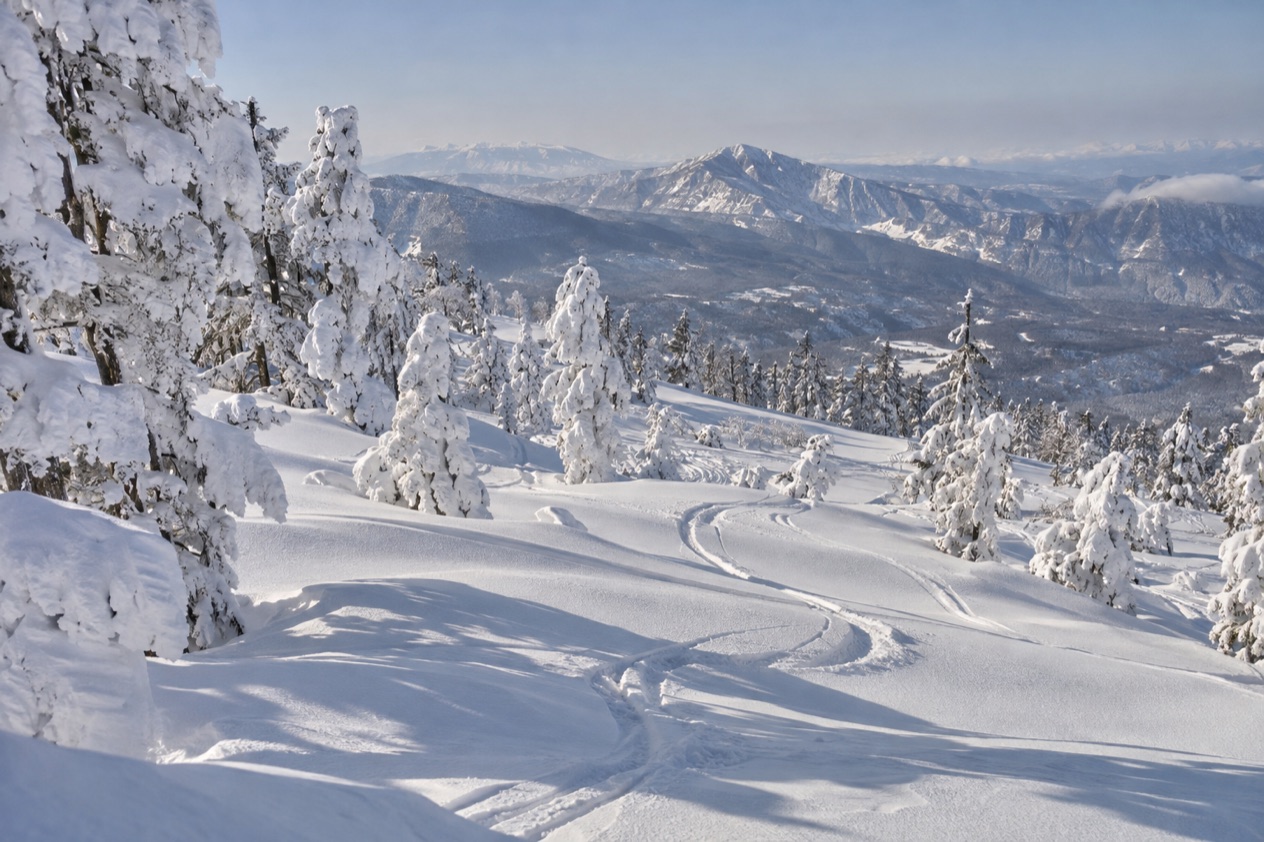
What is skiing like in ski day trips from Tokyo?
A ski day from Tokyo is mostly a train story: you leave a city of glass towers and arrive at a slope-side station, and the main skiing destination reached this way is Gala Yuzawa in Niigata. The resort sits right beside its own railway stop, so the step from carriage to snow is short in a way few places in the world manage. What follows is a day built around lifts, a hot lunch in a resort building and a ride back to the capital.
Japanese ski areas have their own rhythm. Gondolas carry skiers up through forest, lunch is often a steaming bowl of ramen, curry rice or katsudon eaten at a long communal table, and the afternoon ends with the pleasant tiredness of cold air and sore legs. People think about a soak in an onsen (a hot spring bath) as the natural ending to a ski trip, and Niigata’s mountain towns are used to guests arriving in exactly that mood.
Gala Yuzawa, the resort with its own Shinkansen stop
Gala Yuzawa holds the unique distinction of being Japan’s only ski resort with a dedicated Shinkansen station. Gala-Yuzawa Station is a seasonal stop on the Gala-Yuzawa Line, in the town of Yuzawa in Niigata, and it serves the ski resort next door. It is the only station on a branch line of 1.1 miles that leaves from Echigo-Yuzawa Station, so the whole line exists for skiers.
Services here are operated as extensions of Joetsu Shinkansen Tanigawa trains to and from Tokyo, and they are classed as limited express services. On arrival you find a single island platform serving two tracks, with a staffed Midori no Madoguchi ticket office, ticket vending machines and automatic ticket gates. The station opened on December 20, 1990, and it is operated by the East Japan Railway Company, known as JR East.
For a visitor, the picture is simple: you ride the Shinkansen out of the city, and the line takes you past the last of the suburbs into snow country. The resort is the reason the station exists, and everything around the platform is set up for people in ski clothes.
Nagano and the buses from the capital
There are also long-distance buses from Tokyo direct to major ski resorts, particularly those around Nagano, with services operated by Nagano Snow Shuttle and other companies. These routes lead to the larger mountain areas, where the slopes are spread over several peaks and a trip can last more than a single day. Hakuba, in the Nagano mountains, is the name many skiers have in mind.
Hakuba and Rusutsu are both resorts where the Epic Pass is valid, which matters to anyone who already holds one from North America. Rusutsu is in Hokkaido, so it belongs to a different kind of trip than a day out of Tokyo. Still, it is useful to know that a pass bought at home can follow you onto Japanese slopes.
Reading the runs and the trees
Japanese resorts have a particular love for tree runs, where skiers weave between birches and cedars in loose snow. Tree run grading varies by resort, but the grades are typically numeric, starting from 1 as the easiest. That means a skier standing at the top of a wooded line should read the local sign rather than assume that one resort’s number matches another’s.
Japan is considered an ideal destination for winter sports enthusiasts because of the exceptional quality of its snow, its infrastructure and its accommodations. The Japan National Tourism Organization names Sahoro, Rusutsu and Hoshino Resorts Tomamu among its recommended ski resorts, all of them on Hokkaido. They are a reminder that the snow country stretches far beyond the mountains within reach of Tokyo.
When is the season?
The Japanese ski season lasts from early December to late April, and the lifts and trains that serve Tokyo skiers follow that calendar fairly closely. Winter in the mountains begins with the first heavy snowfalls and ends in the soft, wet snow of spring, when the sun gets warm enough to open jackets at lunch. Both ends of the season have their own feel, and neither is quite the middle of winter.
| Place | Season |
|---|---|
| Japan, most ski areas | Early December to late April |
| Gala-Yuzawa Station | Typically mid-December to early May |
| San’in region (Shimane and Tottori) | Late December to March |
| Hokkaido, most reliable powder | January to February |
The Gala Yuzawa calendar
Gala-Yuzawa Station is open only during the winter ski season, typically from mid-December until early May. Outside those weeks the branch line has no passenger trains at all, because the station exists for the resort and for nothing else. A trip planned for the very start or the very end of the winter should keep that window in mind, since the dates follow the season and not the calendar.
Some weekend-only services from Gala-Yuzawa Station may terminate at Ueno instead of Tokyo. That detail matters to anyone whose hotel sits near Tokyo Station, because the last stretch of the trip home changes. On the way out in the morning, the same trains carry skiers whose bags are propped on the racks above their seats.
Hokkaido in January and February
On the northern island of Hokkaido, skiers aim for January and February for the most reliable powder. That is the stretch of winter when the cold holds the snow light and dry, and people who have saved a long vacation for Japan tend to plan around it. Hokkaido is far enough from Tokyo that it makes a separate trip and not a day out of the capital.
Sapporo’s New Chitose Airport is the closest major airport to ski fields on Hokkaido. Resorts like Sahoro, Rusutsu and Hoshino Resorts Tomamu sit in that island’s winter landscape, and they suit a stay of several days. Travelers who base themselves in Tokyo for the first part of a trip can think of the northern island as the second chapter.
A shorter season in the west
The local season in the San’in region of Shimane and Tottori is a bit shorter than the rest of the country, running from late December to March. Daisen is the largest ski area in the Chugoku region, with 14 lifts on the slopes of Mt Daisen. It is a reminder that the season depends on where you are, and a Tokyo skier looking at a map of the whole country should not assume every area opens and closes together.
How do you get there and what does it cost?
From Tokyo, the way to a ski slope is by Shinkansen to Gala-Yuzawa Station or by long-distance bus toward the Nagano resorts. Fares, lift tickets and rentals vary, and the sources used here give no amounts for them.
By Shinkansen to Gala-Yuzawa
All passenger services at Gala-Yuzawa Station are operated as extensions of Joetsu Shinkansen Tanigawa services to and from Tokyo. The trains are classed as limited express services, and they run to the single island platform at the end of the branch line from Echigo-Yuzawa Station. You do not change to a local line at the resort end.
Outside train operating hours during the winter season, free shuttle buses operate between Gala-Yuzawa Station and Echigo-Yuzawa Station. That is the link between the resort and the main Shinkansen stop when the trains are not running to the branch. At the station itself, the Midori no Madoguchi ticket office is staffed, and ticket vending machines and automatic gates handle the usual passengers.
By bus toward Nagano
There are also long-distance buses from Tokyo direct to major ski resorts, particularly those around Nagano, with services operated by Nagano Snow Shuttle and other companies. A bus ride suits skiers who want to reach a larger resort and to stay overnight, since these areas are more spread out than a single resort with its own station.
Both routes lead to the snow, but they feel different. The train drops you at a resort that was built around it, and the bus carries you into mountain valleys where villages, lodges and lifts are scattered along the road. Which you prefer depends on whether you want a single day on the slopes or a few nights in a ski town.
Beyond Tokyo: flying to Hokkaido
Skiers heading to Hokkaido arrive by air, and Sapporo’s New Chitose Airport is the closest major airport to ski fields there. The resorts recommended by the Japan National Tourism Organization, Sahoro, Rusutsu and Hoshino Resorts Tomamu, lie on that island. The Epic Pass is valid at Rusutsu, which is one reason the resort is on the list of many North American skiers.
Good to know before you go
Skiing carries real risks, and 30 to 40 skiers are killed in Japan every year, around 40 percent from head trauma and another 40 percent from asphyxiation. Tree runs, where a fall can end head-first in deep snow, are the places where that matters most. Resorts use their own numeric grades for these lines, so reading the sign at the top is part of the day.
Winter weather can change the plan for a day in the mountains, and the trains and buses described above follow the ski season, not the calendar year. Holding a seasonal pass from North America can be useful at Hakuba and Rusutsu, where the Epic Pass is valid. Beyond that, the day is the one you see in most ski towns: gear, lifts, a hot lunch and a train home.
Sources
- Japan National Tourism Organization, skiing and snowboarding in Japan: regions, resorts, seasons (https://www.japan.travel/en/sports/snow/), checked October 11, 2026
- Wikipedia, Gala-Yuzawa Station (https://en.wikipedia.org/wiki/Gala-Yuzawa_Station), checked October 11, 2026
- Wikivoyage, Skiing in Japan (https://en.wikivoyage.org/wiki/Skiing_in_Japan), checked October 11, 2026