
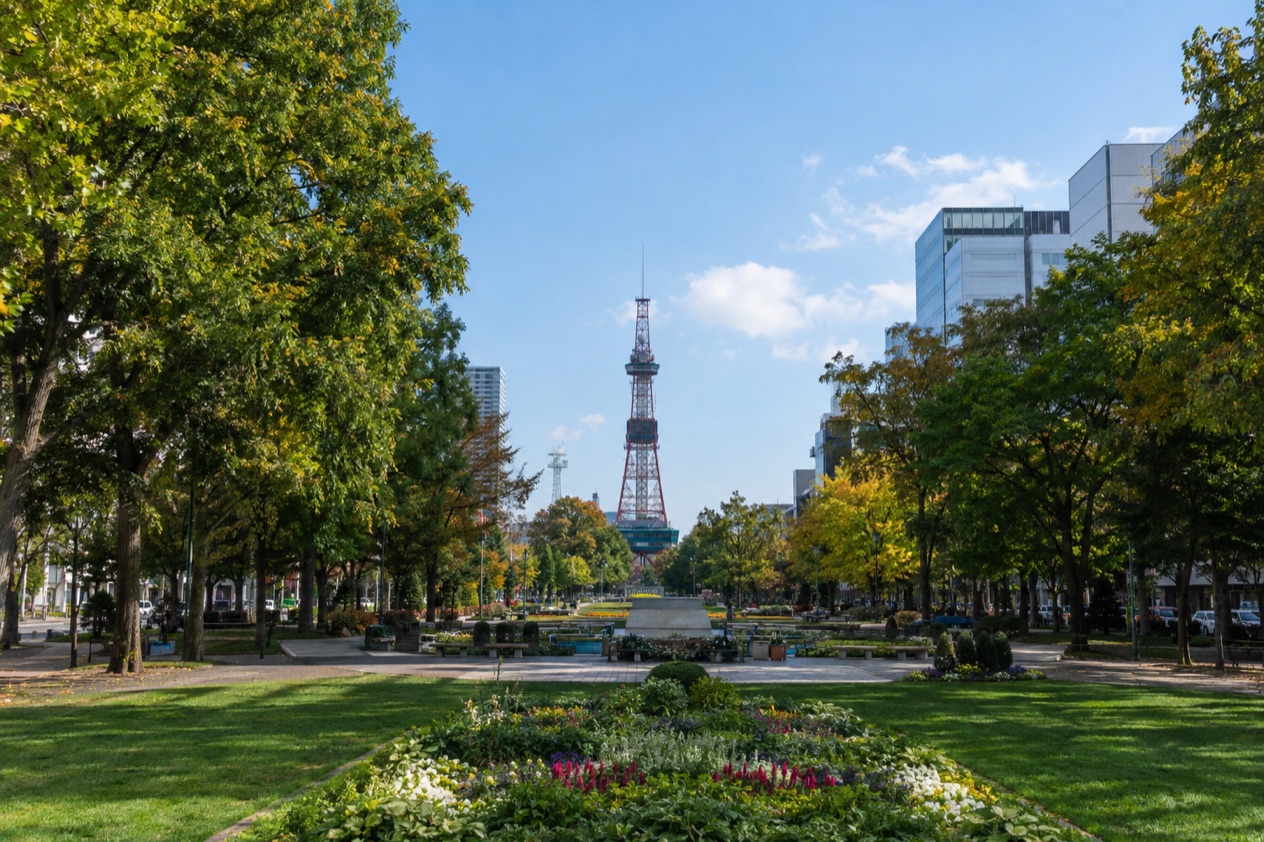
You step out into Sapporo with the air a little sharper than in the cities farther south, and the wide green belt of Odori Park runs through the middle of town. Somewhere nearby a bowl of ramen is steaming and a lamb barbecue is sizzling. Sapporo has its own rhythm, shaped by its northern island and its cold winters, and a few things are worth knowing before you arrive.
What should you know before visiting Sapporo?
The things that matter most are the season you choose, the way you pay, the habits of Japanese etiquette, and the fact that Sapporo sits on Hokkaido, the northernmost island and prefecture of Japan. The season shapes everything.
Winter brings the Sapporo Snow Festival in February, with three sites called Odori, Susukino and Tsudome, while summer, which lasts from June to August, fills Odori Park with outdoor events. Spring has the Lilac Festival in May, and fall is quieter, with crisp days and cool evenings.
What usually surprises first-time visitors is how different Sapporo feels from the Japan of postcards. The city hosted the first Winter Olympic Games in Asia in 1972, and it still has the feel of a place built around snow.
The local food is its own thing too: ramen, soup curry and jingisukan, a grilled lamb dish, rather than the sushi and kaiseki people expect elsewhere. And after dark, Susukino, the largest entertainment and nightlife district north of Tokyo, glows with signs well past the hours when the rest of the city has gone quiet.
Hokkaido as a whole draws travelers for skiing and trekking, hot springs, Ainu and Jomon culture, and a food scene of its own. Sapporo is the city where many of these threads meet, so it helps to arrive knowing which season you want to see.
Entry, customs and paperwork
According to the U.S. State Department, U.S. citizens coming to Japan for tourist or business stays under the visa-free arrangement need a valid passport and should have proof of a return or onward ticket. The visa-free stay runs up to 90 days, and the passport must stay valid for the entire time you are in Japan.
A visa-free stay does not allow you to work on the local economy. Once you are in the country, U.S. citizens are expected to carry their U.S. passport (or a Japanese Residence Card for residents) at all times, and a person who cannot show proof of identity and status may be questioned or detained.
One more point concerns the medicine cabinet. In Japan, CBD may be illegal depending on how much THC it contains, so it is not a product to slip into a suitcase out of habit.
Money, cards and tipping
International credit, debit and prepaid cards are generally accepted throughout Japan, which makes paying in Sapporo straightforward in most settings, from hotels to department stores. Some shops do not display the symbols of the cards they take, so it is simply a habit to ask the seller whether your card will work before the items reach the register.
Tipping is not part of daily life in Japan, and the bill you are handed is the bill you pay. A thank-you at the end of a meal comes as a smile and a word of appreciation, which restaurant staff are glad to receive.
A bowl of ramen in Susukino, a lamb barbecue at the Sapporo Beer Garden at the beer museum, a bowl of soup curry on a cold afternoon: these are the small spending moments of a Sapporo trip, and they are handled at the counter or table in the way you would expect in most Japanese restaurants.
Getting around and staying connected
Sapporo is laid out around Odori Park, which runs through the center of the city, and the Odori Site of the Snow Festival stretches along it for approximately 0.9 miles. That long green axis gives you an easy landmark to orient yourself, whichever neighborhood you are heading to.
Beyond the park, the city has its own cluster of places that visitors head to: the Sapporo Beer Museum with its pub and beer garden, Susukino for evenings, and Odori for the big seasonal events. Beyond the city, Hokkaido has Otaru with its canal and glowing gas lamps, and Furano with its craft village of about 15 shops tucked among the forests.
Specific train lines, subway fares, IC cards, SIM cards and pocket Wi-Fi are not covered here, since the details change by operator and provider. What stays constant is that the places above are the anchors of a visit, and planning your days around them gives a shape to the trip.
Health, water and the weather
Sapporo has real seasons, and the weather changes what you pack. January is a deep-winter month, with highs around freezing and lows well below it, and snow falling on most days of the month. Summer is gentler, with July highs in the upper 70s and humidity that makes the air feel soft.
| Month | Average high (°F) | Average low (°F) | Precipitation (inches) | Days with precipitation of at least 1 mm |
|---|---|---|---|---|
| January | 31.3 | 20.5 | 4.27 | 18.3 |
| April | 53.1 | 38.1 | 2.15 | 9.6 |
| July | 77.7 | 64.2 | 3.57 | 7.7 |
| October | 61.5 | 46.4 | 4.33 | 11.6 |
April is a month of transition, with highs in the low 50s and snow that has mostly given way to cool, brighter days. October brings highs in the low 60s, cool evenings and a wetter feel, with snow only a rare visitor at the very end of the month.
Sunshine follows the same arc: a dim January with few hours of sun, then brighter spring and summer days, then a softer fall. Layers are the sensible way to think about a Sapporo trip in any month outside midsummer.
Local customs and etiquette
Shoes come off at the entrance of many buildings in Japan. People step out of their shoes, slip into indoor slippers, and leave their shoes in a shoe box or neatly to the side. It is a small gesture, but it shapes how a home, a ryokan or a traditional restaurant feels the moment you walk in.
In a Japanese home or ryokan, the habit goes one step further: slippers come off again on tatami mats, which are walked on in socks or bare feet, and a separate pair of toilet slippers is often waiting at the bathroom door. Switching back and forth becomes second nature within a day or two.
Beyond the entrance, daily life in Sapporo runs on a quiet consideration for others. Voices tend to drop on public transport, people line up in an orderly way, and trash is carried until a proper bin turns up. A small bow or a nod is a natural way to say thanks, and a warm word goes a long way in return.
At festivals such as the Snow Festival or the Lilac Festival, the same spirit applies in a lighter register. Crowds move along the paths, people stop to look at sculptures or flowers, and the mood stays friendly.
Good to know before you go
The U.S. State Department rates Japan Level 1: Exercise Normal Precautions.
Keep your passport on you throughout your stay, and keep your proof of onward travel handy as part of your documents. The Sapporo sightseeing website lists events month by month from January through December, which is a useful way to see what is on during your dates.
One last habit: ask before assuming a shop takes your card, and carry yourself with the same quiet courtesy that locals do. It makes a trip to Sapporo smoother, and it opens the door to a warm welcome.
Sources
- Japan National Tourism Organization, Sapporo (https://www.japan.travel/en/destinations/hokkaido/hokkaido/sapporo-and-around/), checked October 11, 2026
- Hokkaido Love, the official Hokkaido tourism site (https://www.visit-hokkaido.jp/en/), checked October 11, 2026
- Hokkaido Love, what to see and do (https://www.visit-hokkaido.jp/en/spot/), checked October 11, 2026
- Sapporo Snow Festival official website (https://www.snowfes.com/english/), checked October 11, 2026
- Sapporo official sightseeing website (https://www.sapporo.travel/en/), checked October 11, 2026
- U.S. Department of State, Japan travel information, local laws and special circumstances (https://travel.state.gov/content/travel/en/international-travel/International-Travel-Country-Information-Pages/Japan.html), checked October 11, 2026
- Japan National Tourism Organization, manners, etiquette, shoes, bowing, chopsticks, public behavior (https://www.japan.travel/en/guide/understanding-and-mastering-japanese-manners-and-etiquette/), checked October 11, 2026
- Japan National Tourism Organization, credit cards and cash, where cards are accepted (https://www.japan.travel/en/plan/credit-cards/), checked October 11, 2026
- U.S. Department of State, Japan travel advisory (https://travel.state.gov/content/travel/en/international-travel/International-Travel-Country-Information-Pages/Japan.html), checked October 11, 2026
- U.S. Department of State, Japan travel information, entry and exit requirements (https://travel.state.gov/content/travel/en/international-travel/International-Travel-Country-Information-Pages/Japan.html), checked October 11, 2026
- Japan Meteorological Agency (JMA), Normal values 1991-2020, monthly (https://www.data.jma.go.jp/stats/etrn/view/nml_sfc_ym.php?prec_no=14&block_no=47412), station Sapporo, elevation 17 m, checked October 11, 2026
To plan your stay
- Best Time to Visit Sapporo: Snow Festival, Summer Weather and Seasonal Highlights
- Things to Do in Sapporo: Snow Festival, Odori Park, Ramen and Day Trips
- Where to Stay in Sapporo: Sapporo Station, Odori, Susukino and Ryokan Stays
- Sapporo from Tokyo: The Hayabusa Shinkansen, the Seikan Tunnel and What Awaits on Hokkaido