
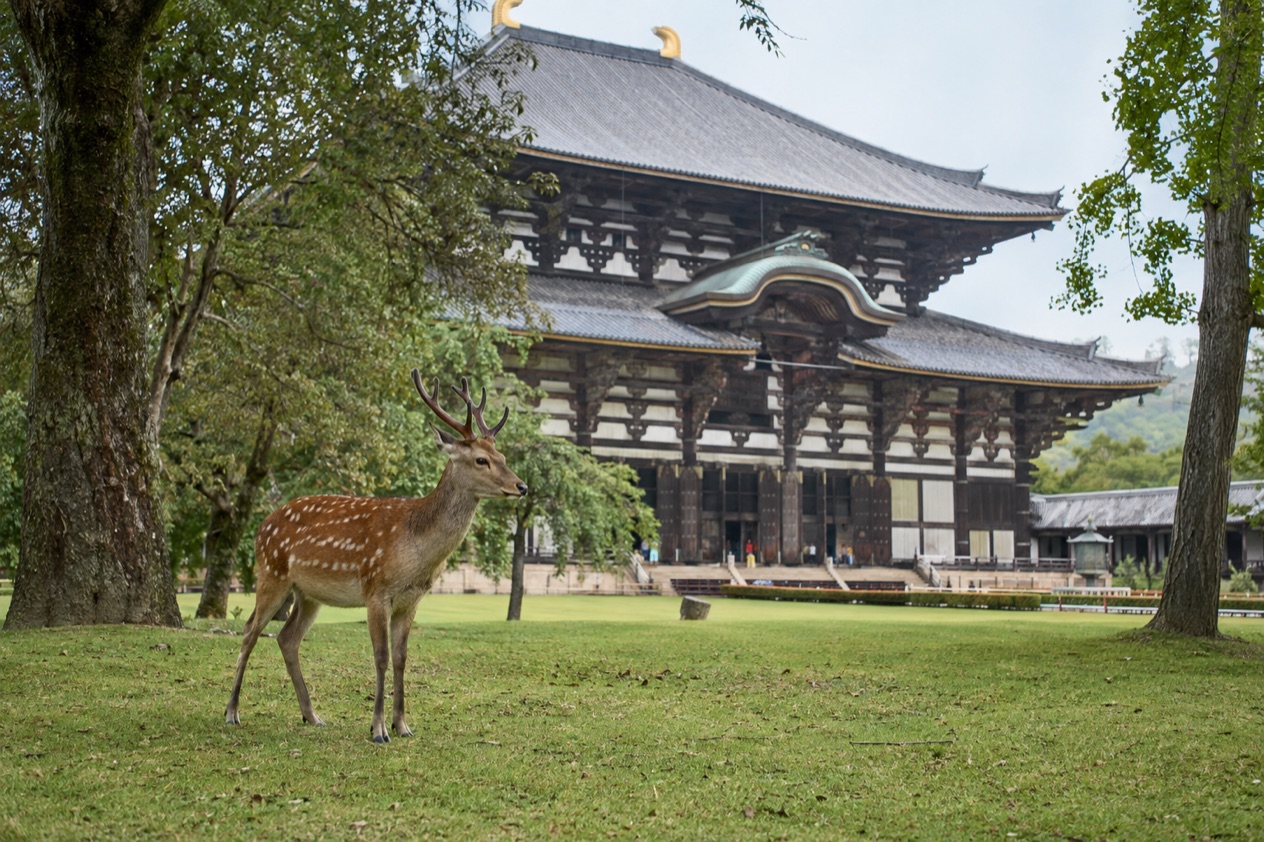
A deer bows its head, waits for a cracker from your hand, then nudges your pocket for more while a great temple roof rises behind the pines. The city holds old temples, a shrine hung with lanterns and lanes of merchant houses, and it suits travelers who like to spend their days among slow-moving history, whether on a stay of their own or on a trip from Kyoto or Osaka.
What are the best things to do in Nara?
The best things to do in Nara are meeting the deer in the park, standing in front of the Great Buddha at Todai-ji, walking the lantern-lined approach to Kasuga-taisha, and finishing the day with local dishes and sake. The rest of the list adds the old-capital sites, the merchant lanes and a few outings beyond the city.
- Feed the tame deer of Nara Park with the special crackers sold along the roadside, and watch them bow for their share.
- Stand before the Great Buddha inside Todai-ji, then look up at the guardian figures of the Great South Gate.
- Follow the stone and bronze lanterns to Kasuga-taisha, a Shinto shrine with a long history among the trees.
- Look at the pagoda and halls of Kofuku-ji, one of the sites of the Historic Monuments of Ancient Nara.
- Wander Naramachi, the old merchant quarter, for its lanes, small shops and townhouses.
- Take a bus to Horyu-ji, the temple Prince Shotoku founded, and to the open grounds of Heijo Palace.
- Eat kakinoha-zushi, narazuke and miwa somen, then raise a cup of regional sake in the evening.
- Stay for dusk, when the day visitors thin out and the lanterns and lanes take on another mood.
All of this sits in a city that was Japan’s first capital, Heijokyo, and the layout still shows it. Temples, shrine and park spread out together at the foot of Mount Wakakusa, so a day can run from a Buddha to a forest path to a bowl of noodles without ever feeling hurried. The sections below take each of these in turn and add the places that do not fit on a short list.
Nara sits east of Osaka and south of Kyoto, which makes it a stop on a Kansai itinerary and also a base of its own. Two stations serve the center, JR Nara Station and Kintetsu Nara Station, and both put you within reach of Nara Park and Naramachi. From either one, the day tends to begin with the deer, because they are simply there when you step into the park.
Sights and landmarks in Nara
The landmarks of Nara are temples and a shrine built when the city was the capital, and three World Heritage sites carry that history, taking in ancient monuments, sacred mountain trails and some of Japan’s oldest temples and shrines. Todai-ji, the Great Buddha and the deer of Nara Park are the best-established symbols of the city, and everything else is arranged around them.
Todai-ji and the Great Buddha
Todai-ji is a Buddhist temple complex in the middle of Nara, and it is listed by UNESCO among the Historic Monuments of Ancient Nara. You pass through the Great South Gate first, where two towering guardian figures stand on either side with fierce faces and raised muscles. Beyond the gate the path leads to the great hall, which shelters the Buddha statue that gives the temple its fame.
Inside, the statue fills the hall with a scale that is hard to judge from photographs. The seated bronze figure is surrounded by smaller guardians and offerings, and the wooden pillars that hold the roof are thick enough to make you slow down. Smoking and drone photography are prohibited in the precincts, and anyone arriving by bicycle or motorcycle parks in the lot southwest of the Great South Gate before going in.
The temple suits anyone with an interest in Buddhist art, and it also rewards those who simply like big, old wooden buildings. Deer wander into the approach from the park, so the visit often starts with a small detour around an animal standing in the path.
Kasuga-taisha
Kasuga-taisha is a Shinto shrine in Nara, established in 768 CE, and its approach is part of the experience. Stone lanterns line the paths through the trees, and inside the shrine hundreds of hanging bronze lanterns fill the corridors. Vermilion halls stand out against the dark green of the surrounding woods, and the effect is a place that feels settled into its forest.
The deer here were once believed to be messengers of the gods, which explains why they are tied so closely to the shrine and the park. Lantern festivals are held at the shrine twice a year, when the lanterns are lit, and the dates move from one year to the next. It is a good visit for anyone who likes shrines, forest paths and the quiet detail of old craftsmanship.
Kofuku-ji and the old capital
Kofuku-ji was founded in 669 and is part of the same World Heritage group as Todai-ji. Its pagoda is the shape people recognize from images of Nara, rising above the trees and the pond below. The temple was once among the most powerful in the city, and the halls and treasures that remain give a sense of that weight.
It sits close to the park and the shopping streets, so it fits easily between other stops. You can look at the pagoda from the pond, walk up to the halls, and then drift on toward Naramachi or the deer. Heijokyo, the first capital that began all of this, dates back 1300 years, and Kofuku-ji is one of the places where that age is most visible.
Naramachi and the merchant lanes
Naramachi is the old merchant quarter, reached from Nara Station and Kintetsu Nara Station. The lanes hold wooden townhouses with latticed fronts, small shops selling crafts and sweets, and cafés in converted storehouses. Some houses are open to visitors and show how a merchant family arranged its rooms around narrow courtyards.
The district works as a break from temples. Small shrines and temples sit tucked between the houses, so the sights continue even when you think you have left them behind.
Outdoor things to do in Nara
Outdoors in Nara means Nara Park, a public park at the foot of Mount Wakakusa that holds the deer, the great temples and the shrine inside one open stretch of grass and forest. The park was established in 1880, making it one of the oldest in Japan, and its size means a day outside can include meadows, ponds, tree-lined paths and gardens.
Nara Park and the deer
The park covers a vast area, and the free-roaming deer are the first thing you notice. They are tame, and visitors can approach and feed them with crackers sold at stalls all around the park. The deer have learned the routine well. They bow, step closer and sometimes follow you along the path, so keep the crackers in hand and not in a pocket.
Beyond the animals, the park is a place for slow circuits. Wide lawns spread between the temples, and the paths pass ponds, stone lanterns and old trees. People spread out on the grass, children chase after deer at a respectful distance, and the roofs of Todai-ji and Kofuku-ji appear and disappear between the trunks. Bring time, because the park rewards stopping more than rushing.
The park suits almost anyone, from families to travelers who simply want an open-air day. A bus route and a pass cover the area, which is useful if you want to sample the park, the shrine and the western temples without retracing steps.
The slope of Mount Wakakusa and the forest paths
Mount Wakakusa rises behind the park, and its smooth grassy slope is a landmark you see from many corners of Nara. The park lies at its foot, so the mountain forms a backdrop to the deer meadows and the temple roofs. Seen from the lower paths, it gives the park a clear edge, a green hill closing the view.
The forests around Kasuga-taisha belong to the sacred landscape that the World Heritage listing describes as sacred mountain trails. Under the trees, paths run between lanterns and small shrines, and the light is dim and green. It is a different mood from the open meadows below, and a good reason to leave the main paths when you have the time.
Gardens and ponds beside the park
Several gardens sit next to the park and give the outdoor day a slower rhythm. They are gardens designed to be looked at while walking, with every turn framing a roof, a tree or a lantern.
Ponds also dot the park itself, with pavilions at their edges and carp moving under the surface. Sarusawa Pond, near Kofuku-ji, reflects the pagoda in still water, and it is one of the places where people stop simply to sit. A bench and a view are often all you need here, and the deer tend to wander through the scene on their own schedule.
Day trips from Nara
The day trips from Nara go to Horyu-ji, the site of Heijo Palace, and the big cities of Kyoto and Osaka. Nara Prefecture is in the Kansai region, and the Kintetsu Railway and West Japan Railway (JR West) run service throughout it, while Nara Kotsu buses reach the places that trains do not.
Horyu-ji
Horyu-ji lies in Ikaruga, in Nara Prefecture, and a bus takes visitors there from Nara. Prince Shotoku founded the temple in 607, and in 1993 it was registered, together with Hokki-ji, as Japan’s first UNESCO World Heritage Site under the name Buddhist Monuments in the Horyu-ji Area. The age of the place shows in the wood, the proportions and the layout of the precinct.
The grounds hold a pagoda, a main hall, cloister corridors and halls with Buddhist sculpture. You walk from building to building with space between them, and the scale is more intimate than at Todai-ji. It suits travelers who like early Buddhist architecture and who want a contrast to the crowds and deer of the park.
Heijo Palace
A bus also runs to Heijo Palace, the site of the first capital, Heijokyo. The place is open ground, a wide field where the palace once stood, with reconstructed gates and halls marking the outline of the old court. After the dense temples of Nara Park, the sense of space is the main difference.
What you see is part archaeology and part imagination. Large vermilion gate structures stand against the sky, and information boards explain where the palace buildings were. It suits readers curious about how Japan’s first capital was laid out, and it pairs naturally with Horyu-ji on the same bus line, so the two can share a day.
Kyoto and Osaka
Kyoto and Osaka are the two big city trips. From Kyoto Station, Kintetsu Nara Station can be reached in just over 30 minutes, and the JR Miyakoji rapid service runs directly from Kyoto to JR Nara Station. From Osaka, the JR Yamatoji rapid train also serves JR Nara Station directly, which means a day in Nara can slot into either city’s schedule in either direction.
On the Kintetsu line from Osaka-Namba, the limited express reaches Kintetsu Nara Station in 35 minutes and costs 520 yen more than the regular express, which takes five minutes longer. Those two cities offer very different days, Kyoto with its temples and districts and Osaka with its food streets and nightlife, and Nara works as the calm counterpoint between them.
What to eat in Nara
Eating in Nara means local, old-fashioned dishes built around pickles, noodles, wrapped sushi and sweets made from kuzu and rice. The food here leans toward preserved and seasonal ingredients, because Nara is inland and its cooking grew from the mountains and fields around the old capital.
Kakinoha-zushi and narazuke
Kakinoha-zushi is the sushi most tied to the region. Slices of salted mackerel or salmon sit on small blocks of vinegared rice, and each piece is wrapped in a persimmon leaf. The leaf is not eaten, but it gives the sushi a faint, green scent and keeps the pieces neat. Many shops sell it in boxes, and it is easy to carry through the park.
Narazuke is the other signature. Vegetables, most often melon or cucumber, are pickled in sake lees until they turn dark, soft and savory with a lingering sweetness. A few slices go well with plain rice, and shops in the shopping streets and in Naramachi sell jars as souvenirs. The flavor is strong, and tasting before buying is part of the pleasure.
Miwa somen and chagayu
Miwa somen are thin wheat noodles from the area near Mount Miwa, served cold with dipping sauce or hot in a light broth. They slide down in a way that suits a long walking day, and a bowl with a few toppings makes a complete meal. The thin strands are a point of regional pride, and restaurants in Nara serve them in several styles.
Chagayu is rice porridge simmered in tea, a dish with roots in the temple kitchens of the region. It is mild and warm, with a faint smoky taste from the tea, and it is usually served with pickles and small side dishes. A bowl of chagayu is a good fit for a morning before a temple walk or a lunch that does not weigh you down.
Sweets, mochi and sake
Kuzu, a starch from a mountain root, turns up in Nara’s traditional sweets. Kuzukiri are translucent noodles served chilled with dark syrup, and kuzu mochi have a soft, wobbly texture. Tea houses and small shops serve them, often in rooms with views of a garden, and they pair well with green tea after a long stretch outdoors.
Mochi pounded by hand, often filled with sweet bean paste or rolled in soybean flour, is another thing to look for. Shops in the shopping arcades and near the park sell it fresh, and the pounding can sometimes be watched from the street. For something stronger, sake brewed in the region appears on many menus, and a small cup of it suits the end of a day of walking.
Things to do in Nara at night
Nara at night is a slower affair than the big cities, with dinner, a drink and a stroll through lanes and park paths as the main plans. Visitors come for the day and leave, so staying the evening gives a different feel to the same streets, with the temples behind you and the town turning toward food and lamps.
Izakaya, sake and dinner in Naramachi
The lanes of Naramachi and the streets around Kintetsu Nara Station hold izakaya, casual Japanese pubs where small dishes arrive one after another. Grilled skewers, pickles, tofu and seasonal vegetables share the table with cups of sake or beer.
Local sake is the natural order here, and the staff will often suggest something that suits the dishes. Restaurants in converted townhouses give a sense of the old merchant quarter, with wooden beams, low tables and lantern light. Pair kakinoha-zushi or a bowl of noodles with a small pour, and the evening takes care of itself.
Lantern festivals at Kasuga-taisha
Kasuga-taisha holds lantern festivals twice a year, when the hundreds of lanterns that hang in the corridors and line the approach are lit. The glow turns the shrine into something quite different from its daytime self, with the forest dark around and the vermilion halls picked out in warm light. The dates move from one year to the next, so it is worth checking when your trip falls.
Outside those festival nights, the approach to the shrine is still a place that people associate with lanterns and trees. Walking there after dark is different from daytime, and the sounds of the forest and the stone paths make the visit feel older than it is.
Evening walks and a night in town
A walk around Sarusawa Pond and the streets near Kofuku-ji is a gentle way to end the day, with the pagoda reflected in the water and the lanes lined with small shops. Shopping arcades near Kintetsu Nara Station stay lively in the early evening as people pick up souvenirs, snacks and last cups of tea.
Spending a night in Nara also opens the early part of the next day, when the park and the temples feel different before day visitors arrive from Kyoto and Osaka. Travelers choose a ryokan, a traditional inn, where dinner and a bath are part of the stay. Nightlife in the club sense is not what Nara is about, and the better plan is a long dinner and an early night.
Things to do in Nara with kids
Children in Nara mostly enjoy the deer, the open space of the park and the sheer size of the Great Buddha. The park is one of the rare places where a child can walk up to wild animals and feed them, and the crackers sold at stalls around the park make it a ritual rather than a risk.
Feeding the deer
The deer are tame, and the special crackers sold all around the park are what they respond to. Children hold out a cracker, the deer bows, and the exchange has a ceremony that kids tend to love. The animals are used to crowds, and they come right up to the hand, so small visitors get a close look at their faces, antlers and soft noses.
A few habits help. Deer will nibble paper, maps and bags if they think there is food inside, and they sometimes nudge when the crackers run out, so hold the last ones out of reach and show empty hands. Parents with small children often keep to the open lawns, where there is room to step back if a deer gets too eager.
Todai-ji for young visitors
The size of the Great Buddha impresses children without any explanation. The guardian figures at the Great South Gate, with their fierce faces, tend to hold attention as well. Inside the great hall there is a wooden pillar with a hole said to match the size of the Buddha’s nostril, a challenge that small visitors are often keen to try.
The temple precinct is large and spread out, so a visit involves steady walking on gravel and stone. Smoking is prohibited in the precincts, which suits families, and the surrounding park provides space to run once the indoor part of the visit is over.
Getting around with children
The park and the temples are spread across a large area, and distances add up for small legs. Gurutto buses in Nara City and the Nara 1-Day Pass, which has a child fare, cover the park and the Nishinokyo area, and they can save tired children from a long walk back. Plan a sit-down break at a tea house or a bench, and a sweet treat to match.
A trip to Heijo Palace gives children the open space to run, with wide fields and large gates to look at. Outdoor days in Nara call for sun protection, water and shoes that are comfortable on gravel, and the many ponds and lawns make it easy to stop whenever a child needs a rest.
Good to know before you go
Getting around Nara is mostly a matter of two stations and a bus network. JR Nara Station and Kintetsu Nara Station both lead toward Nara Park and Naramachi, and Nara Kotsu buses reach places the rail lines do not, including remote parts of the prefecture.
Osaka International Airport (Itami) and Kansai International Airport are both about one hour and fifteen minutes away by bus and train. Japan has a rainy season and a typhoon season, so rain gear belongs in the bag when you plan your dates.
| Fee | Amount | Who pays |
|---|---|---|
| Gurutto bus in Nara City, per trip | 100 yen | Each rider |
| Nara 1-Day Pass (Nara Park and Nishinokyo areas, valid for one day) | 600 yen | Adults |
| Nara 1-Day Pass (Nara Park and Nishinokyo areas, valid for one day) | 300 yen | Children |
Sources
- Japan National Tourism Organization, Nara (https://www.japan.travel/en/destinations/kansai/nara/), checked October 11, 2026
- Official Nara Travel Guide, getting around Nara (https://www.visitnara.jp/getting-around-nara/), checked October 11, 2026
- Official Nara Travel Guide, first-time visitors (https://www.visitnara.jp/for-first-time-visitor/), checked October 11, 2026
- Official Nara Travel Guide, Nara Park area (https://www.visitnara.jp/destinations/area/nara-park/), checked October 11, 2026
- Todai-ji Temple, official site (https://www.todaiji.or.jp/en/), checked October 11, 2026
- Wikipedia, Tōdai-ji (https://en.wikipedia.org/wiki/T%C5%8Ddai-ji), checked October 11, 2026
- Wikipedia, Nara Park (https://en.wikipedia.org/wiki/Nara_Park), checked October 11, 2026
- Wikipedia, Kasuga-taisha (https://en.wikipedia.org/wiki/Kasuga-taisha), checked October 11, 2026
- Wikipedia, Hōryū-ji (https://en.wikipedia.org/wiki/H%C5%8Dry%C5%AB-ji), checked October 11, 2026
- Wikipedia, Kōfuku-ji (https://en.wikipedia.org/wiki/K%C5%8Dfuku-ji), checked October 11, 2026