
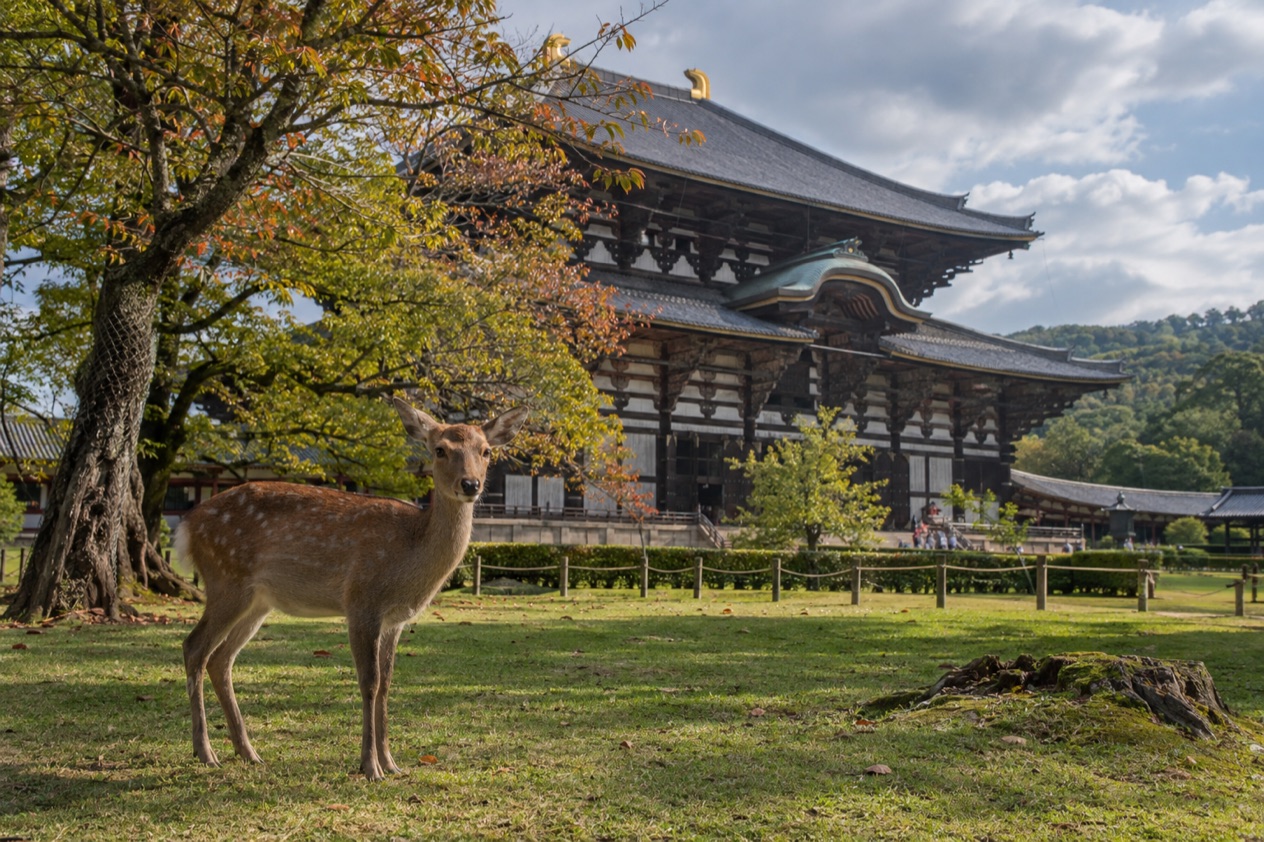
Deer drift across the lawns of Nara Park, nosing visitors for rice crackers, while the great wooden halls of the old capital stand in a light that is slowly turning softer. September here is the month when summer loosens its grip, and it suits anyone who wants to walk among temples, shrines and old streets without the full blast of August.
What is the weather like in Nara in September?
September in Nara is still warm and humid, but clearly a step down from August, with more gray skies and a few more days of rain.
| Month | Average high (°F) | Average low (°F) | Precipitation (in) | Days with 1 mm or more of precipitation | Hours of sunshine | Daylight on the 15th |
|---|---|---|---|---|---|---|
| August | 92.1 | 75.4 | 5.04 | 8.0 | 203 | 13 h 30 min |
| September | 83.8 | 68.2 | 6.26 | 10.0 | 152 | 12 h 27 min |
| October | 72.7 | 56.3 | 5.30 | 9.2 | 149 | 11 h 22 min |
Afternoons are warm enough for short sleeves, and the nights stay mild, so you will not need a coat at any point. The air still feels damp, with humidity around 71 percent, which is why a walk through the temple precincts can leave you sticky even when the thermometer is no longer at its summer peak.
Rain is the main thing to plan around. September is the wettest of the three months in the table, and the showers tend to come as a few gray, damp days rather than a single dramatic downpour. A compact umbrella or a light rain jacket does more for your sightseeing than any other item, and shoes that can handle wet gravel and stone paths make the temple grounds far more pleasant.
The light is changing too. Sunshine is noticeably thinner than in August, and the days have lost an hour of daylight since then, so evenings arrive earlier and the golden hour over the pagodas and the park lawns comes at a more reasonable time for dinner plans.
What to do in Nara in September
September is a month for slow walking: long loops through Nara Park, the temple halls, the shrine paths under the trees. There is no cherry blossom and no leaf color to chase now, since the maple color in the Kinki region comes from early to mid December. What you get instead is green, damp woodland, early-autumn food and the sense of a city settling back into its own rhythm after the summer.
The tradition that fits the month is tsukimi, moon viewing, when Japanese households set out dumplings and pampas grass to honor the autumn moon. Nara, an ancient capital where old poetry is still part of the city’s identity, is a fitting place to think about it, even if you simply sit outside with a cup of tea after dinner and watch the evening sky.
Nara Park and its deer
Nara Park sits at the foot of Mount Wakakusa and spreads across a vast area of lawns, ponds, paths and temple grounds. The deer are the stars. According to legend, the god of Kasuga Taisha rode a white deer, which is why the animals are treated as envoys of the god and are so at ease around people.
You can approach the tame deer and feed them with crackers sold along the roadside. They are quick to understand what a paper bag means, and a few will follow you with real determination. Bow to one and it will often bow back, which delights children and adults alike.
In September the park is green and the grass is thick, so the deer are not short of food, though they still crowd around anyone holding crackers. Wear shoes you do not mind getting damp, and keep your map and tickets in a pocket, since hungry deer will nibble paper.
Todai-ji and the Great Buddha
Todai-ji is the temple everyone associates with Nara, together with the Great Buddha and the deer. The main hall is described as the largest wooden building in the world, and it houses the world’s largest bronze Buddha statue. Walking through the great gate and into the hall, the scale of the seated figure takes a moment to absorb.
Smoking and drone photography are prohibited in the precincts. Take your time in the grounds, since the buildings, the stone lanterns and the wide gravel approach are as much a part of the visit as the hall itself. A rainy September afternoon actually suits the place, with the dark wood and the wet stone looking their richest.
Kasuga Taisha and the forest paths
Kasuga Taisha is a Shinto shrine in Nara, and its approach through the trees is lined with stone lanterns. The shrine and the surrounding Kasugayama Primeval Forest are part of the UNESCO site Historic Monuments of Ancient Nara. The forest gives a feeling of the old sacred landscape that the city was built beside.
In September the canopy is full and green, the moss is damp, and the path under the cedars feels cool after the open lawns. It is a good place to slow down and listen to the cicadas and the bell sounds from nearby temples.
Kofuku-ji, Naramachi and Nara’s table
Kofuku-ji is another of the monuments on the UNESCO list, with the five-story pagoda that appears on so many Nara postcards. Beyond it, the old merchant quarter known as Naramachi has narrow lanes with latticed wooden houses, small cafés and craft shops, a pleasant place to wander when the afternoon turns showery.
Food here has an early-autumn flavor: kakinoha-zushi, sushi wrapped in persimmon leaves, narazuke pickles, kuzu sweets made from arrowroot starch, and chagayu, rice porridge cooked in tea. Chestnuts, grapes and the first persimmons start to appear in sweets and shops as the season turns, and a bowl of hot noodles feels welcome on a damp evening.
Other sites of the Historic Monuments of Ancient Nara, such as Yakushi-ji, Toshodai-ji and the grounds of the old Heijo Palace, give you more of the ancient capital. Heijokyo was Japan’s first capital, dating back 1300 years to the Nara Period, and the open palace site reads very differently from the crowded temple core.
A two-day itinerary for Nara in September
Day 1 belongs to the park and the big names. Start at Todai-ji in the morning with the Great Buddha, then drift across Nara Park toward the deer lawns for a cracker-feeding break. After a lunch of kakinoha-zushi or a noodle set in one of the small restaurants near the park, walk into the forest paths up to Kasuga Taisha and its lantern-lined approach.
Daylight lasts a little over twelve hours, so there is still light for a slow walk back through the grounds in the late afternoon. For dinner, find a small place serving local dishes in the old town, and finish with a cup of tea or a kuzu sweet. If it rains, the temple halls are the obvious refuge, and you can linger inside the Great Buddha Hall until the shower passes.
Day 2 moves to the old town and the wider monuments. Begin at Kofuku-ji and its pagoda, then follow the lanes of Naramachi for small shops, a café stop and a lunch of local pickles and rice. Afterward, head to Yakushi-ji and Toshodai-ji, both on the UNESCO list, which give a slower, more spread-out feeling than the crowded park.
Finish at the Heijo Palace site, where the wide open grounds recall the first capital. The Gurutto buses in Nara City cost 100 yen per trip, and Nara Kotsu runs a wider bus network if you want to reach further sites. On a wet day, spend more time inside the temple halls and the cafés of Naramachi, and keep the palace site for the next dry spell.
Is Nara busy in September?
September is a month between seasons here, after the summer heat and before the autumn leaves, so the city sits between its major color seasons.
There is no cherry blossom now and no maple color yet, since the leaves in the Kinki region turn from early to mid December. That means the pull of the big seasonal displays is absent, and the visits you make are driven by the temples, the deer and the old streets themselves. Nara Park is a vast area, and the paths, lawns and temple grounds spread visitors across it.
The pace of the city is shaped by weather as much as by seasons. A rainy day sends people into the temple halls and the cafés, and a clear one sends them back out onto the lawns. Cooler evenings than in August make dinner outside more comfortable, and the shops and restaurants of Naramachi keep a steady, unhurried rhythm.
If you are staying in Nara itself rather than coming from Osaka, you get more of the city once the day-trippers leave. From Osaka-Namba Station the Kintetsu limited express reaches Kintetsu Nara Station in 35 minutes, so a day trip is easy to fit, but a night in the old capital gives a different feel to the evening streets.
What to pack for Nara in September
Pack for warm, damp days with the occasional shower, and for lots of walking on gravel, stone and wet grass.
- A compact umbrella or light rain jacket, since September brings more rainy days than August.
- Breathable short-sleeved shirts, because the air stays warm and humid.
- A thin extra layer for cooler evenings and air-conditioned temple cafés.
- Comfortable walking shoes that cope with wet gravel and park lawns.
- A small bag or pocket for deer crackers, with something that closes securely against hungry noses.
- A hat and a water bottle for sunny spells in the open park.
Good to know before you go
September in Nara is a wetter month than August, with showers that can turn a planned outdoor day into a temple-hall day, so keep your plans flexible. Japan’s weather agency runs an Emergency Warning System, issued for natural phenomena of extraordinary magnitude, and it is the kind of official alert you may see on news and phones during severe weather.
In the park, the deer are tame and can be fed with crackers sold along the roadside, but they remain animals and will nibble at paper and bags. Smoking and drone photography are prohibited in the Todai-ji precincts. For getting around town, Gurutto buses cost 100 yen per trip, while Kintetsu and JR West trains and Nara Kotsu buses cover the wider area.
Nara in September vs August and October
Moving the trip four weeks earlier puts you in August, with hotter, sunnier and slightly drier days and more daylight in the evening. It is a good choice if you love heat and long light, but the air is more oppressive for long temple walks, and the lawns of Nara Park can feel exposed under strong sun.
Moving four weeks later brings October, with noticeably cooler days and nights, fewer hours of sunshine and a slightly earlier dusk. The maple color in the Kinki region still lies ahead, from early to mid December, so October is not yet a leaf-viewing month here.
Choose August if you want summer light and do not mind the humidity. Choose October if you prefer cooler weather for walking. September sits between the two, warm enough to feel like summer’s end but with the first signs of a gentler season, which suits travelers who want temple days without the full intensity of either extreme.
Is September a good time to visit Nara?
Yes, September is a good time to visit Nara for travelers who like walking among temples and parks and can accept some humidity and the odd rainy day.
It suits people who are happy with a flexible plan, who enjoy feeding deer, wandering shrine forests and eating local pickles and persimmon-leaf sushi, and who would rather see the old capital in its green season than chase a single big spectacle. It is less ideal for anyone who wants blossoms or red maples, since those seasons fall in other months.
On arrival, head first to Nara Park and Todai-ji, since the Great Buddha and the deer are the images that define the city, then let the rest of your days unfold around the weather. Keep the old town and the further temples for the damp afternoons. What is special about September in Nara is the feeling of a thousand-year-old city exhaling after summer: green cedars still dripping from the last shower, deer grazing on thick grass, and the first hint of autumn in the food and the evening air.
Sources
- Japan Meteorological Agency (JMA), Normal values 1991-2020, monthly (https://www.data.jma.go.jp/stats/etrn/view/nml_sfc_ym.php?prec_no=64&block_no=47780), station Nara, elevation 102 m, checked October 11, 2026
- Computed from the date and the latitude of the place (sunrise equation, solar elevation -0.833 degrees), October 11, 2026
- Japan Meteorological Agency, Emergency Warnings (https://www.jma.go.jp/jma/en/Emergency_Warning/ew_index.html), checked October 11, 2026
- Japan National Tourism Organization, safety information (https://www.japan.travel/en/japan-safe-travel-information/), checked October 11, 2026
- Japan National Tourism Organization, weather and seasons in Japan (https://www.japan.travel/en/plan/weather/), checked October 11, 2026
- Japan National Tourism Organization, summer in Japan (https://www.japan.travel/en/guide/summer-guide/), checked October 11, 2026
- Wikipedia, Climate of Japan (https://en.wikipedia.org/wiki/Climate_of_Japan), checked October 11, 2026
- Japan Meteorological Agency, maple color-change dates 2025-2026 with difference from the 1991-2020 normal (https://www.data.jma.go.jp/sakura/data/phn_014.html), checked October 11, 2026
- Japan Meteorological Agency, kaede2020.pdf (https://www.data.jma.go.jp/sakura/data/kaede2020.pdf), checked October 11, 2026
- Japan National Tourism Organization, autumn in Japan (https://www.japan.travel/en/guide/autumn-guide/), checked October 11, 2026
- Japan National Tourism Organization, spring in Japan (https://www.japan.travel/en/guide/spring-guide/), checked October 11, 2026
- Wikipedia, Nara, Nara (https://en.wikipedia.org/wiki/Nara,_Nara), checked October 11, 2026
- Wikivoyage, Nara (https://en.wikivoyage.org/wiki/Nara), checked October 11, 2026
- Japan National Tourism Organization, Nara (https://www.japan.travel/en/destinations/kansai/nara/nara-park-and-around/), checked October 11, 2026
- Official Nara Travel Guide, getting around Nara (https://www.visitnara.jp/getting-around-nara/), checked October 11, 2026
- Official Nara Travel Guide, first-time visitors (https://www.visitnara.jp/for-first-time-visitor/), checked October 11, 2026
- Todai-ji Temple, official site (https://www.todaiji.or.jp/en/), checked October 11, 2026
- Wikipedia, Tōdai-ji (https://en.wikipedia.org/wiki/T%C5%8Ddai-ji), checked October 11, 2026
- Official Nara Travel Guide, Nara Park area (https://www.visitnara.jp/destinations/area/nara-park/), checked October 11, 2026
- Wikipedia, Nara Park (https://en.wikipedia.org/wiki/Nara_Park), checked October 11, 2026
- Wikipedia, Kasuga-taisha (https://en.wikipedia.org/wiki/Kasuga-taisha), checked October 11, 2026