
Under the old trees at the foot of Mount Wakakusa, deer wander across the paths as if the park were theirs, and in a way it is. They bow their heads for crackers, stroll past temple gates and graze on the lawns while visitors cross between shrines and pagodas. Nara Park is a large green space where wildlife, wooden halls and stone lanterns share the same ground, and it makes a visit for anyone who likes to spend a day outdoors.
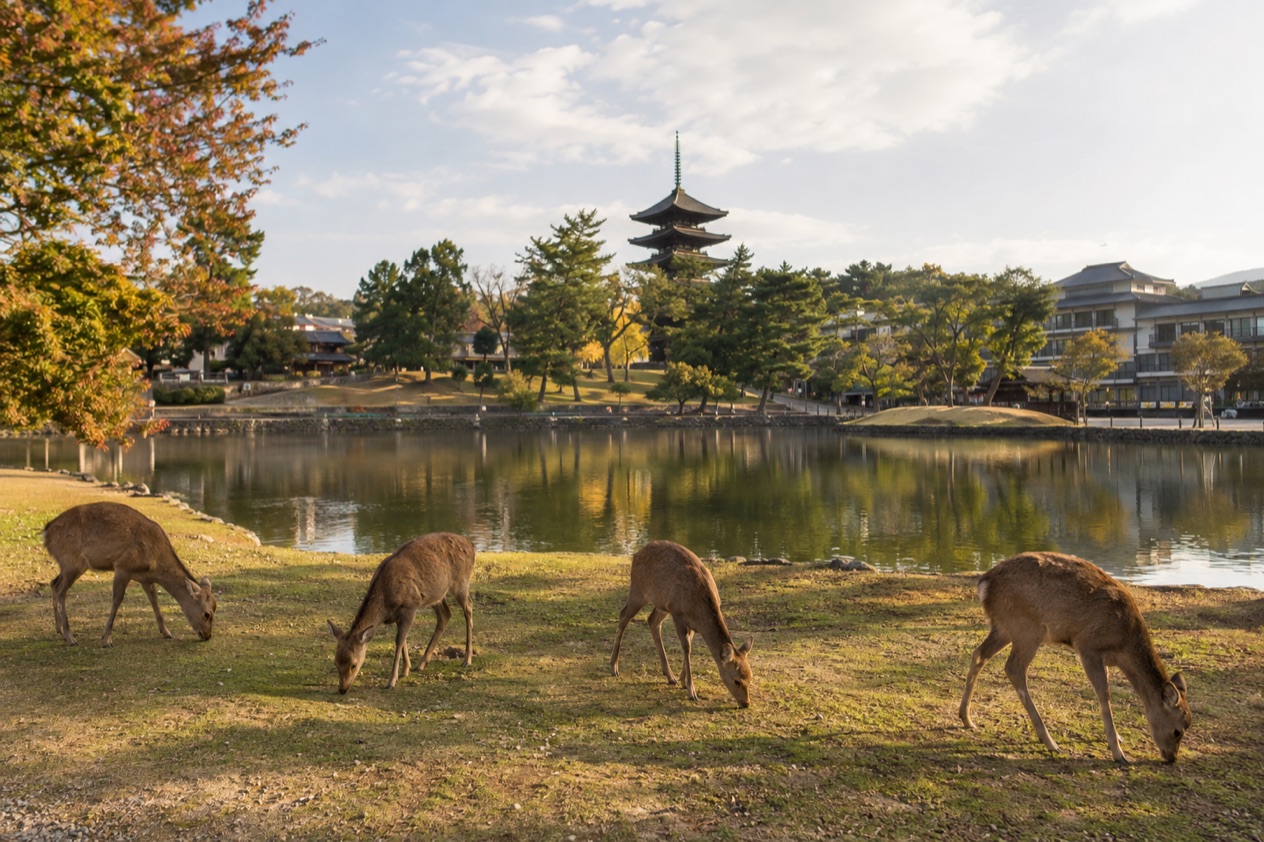
Is visiting Nara Park and its deer worth it?
Yes, especially for travelers who like to mix animals, history and long walks, and for families curious to meet wild creatures that come right up to them. The park holds almost 1200 deer, and they are the first thing people talk about afterward.
But the deer are only half of the story. The same grounds shelter Todai-ji, Kofuku-ji, Kasuga Grand Shrine and the Kasugayama Primeval Forest, all registered as World Heritage Sites under the title Historic Monuments of Ancient Nara.
What sets it apart from the other green spaces of the Kansai region is how open it feels. There is no gate to pass through to meet the animals, and the park flows into the temple precincts without a clear line between them.
You can wander for an hour among deer and lanterns, then step into a hall that holds a giant Buddha. The deer are wild animals, and signs in English, Chinese and Japanese remind visitors not to tease them during feeding. Treat them with respect and the encounters are delightful.
The setting also suits a slow day. Paths run under maples and cedars, tea houses serve meals in old villas, and rickshaw runners in traditional attire wait around the park to offer rides. It is a place to wander without a strict plan, and it rewards those who linger rather than those who tick off sights.
What to see at Nara Park and its deer
The deer and the deer crackers
The sika deer are the stars. More than 1,200 of them roam freely, and they are used to people.
Special deer crackers, called shika-senbei, are on sale all around the park, along the roadside, and they are sold exclusively by the WNOW company.
Deer have long been tied to the story of the city. Until 1637, killing a deer in Nara was punishable by death, a sign of how deeply the animals were woven into local belief. Today they are still treated with care, but they remain wild.
A record number of 121 people were injured by deer in 2016, which is why the park posted multilingual signs in April 2018 asking visitors not to tease the animals while feeding them. Hold the crackers openly, keep them away from pockets and bags, and give the animals room.
Todai-ji and its Great Buddha
Todai-ji is the temple visitors head for after the deer. Inside stands a Buddha statue 15 meters high, a presence that fills the great hall with silence even when people are talking in whispers. Before you reach it, you pass through Nandaimon Gate, where two guardian figures, each 8 meters tall, stand watch on either side of the entrance.
The temple is one of the World Heritage Sites of Historic Monuments of Ancient Nara. Look up at the guardians as you pass beneath the gate, then take in the scale of the hall before you step in. The approach is lined with trees, and deer often wander the grounds, so you may find yourself sharing the path with them.
Kasuga Grand Shrine and its lanterns
Kasuga Grand Shrine sits deeper in the trees, and the walk toward it along the stone-lantern-lined paths is part of the experience. The brass lanterns inside the shrine are lit twice a year, in winter and summer, when the interior takes on a warm glow. The shrine is also famous for its wisteria, which blooms in May and hangs in purple clusters.
The shrine is registered, along with the Kasugayama Primeval Forest behind it, among the Historic Monuments of Ancient Nara. If you come in May, the wisteria adds color to the visit. Outside the lantern nights and the bloom, the draw is the atmosphere of the approach, with moss, stone and the sound of wind in the cedars.
Kofuku-ji, Isuien Garden and the rest of the grounds
Kofuku-ji is the third temple registered as a World Heritage Site within the park, and it sits among the lawns where the deer graze. Its grounds make an easy pause between Todai-ji and the shopping streets near the stations. Nara National Museum is also part of the wider area, which together covers about 660 hectares, while the park proper is officially about 502 hectares.
Isuien Garden adds a quieter chapter. Its original villas and tea houses now offer meals, so you can sit down in a historic setting after a morning of walking. Rickshaw runners also wait around the park, offering a different way to see the paths.
How to get to Nara Park and its deer
Nara sits east of Osaka and south of Kyoto, and it can be reached by train from both cities. The city has two main stations, JR Nara Station and Kintetsu Nara Station, and each one works as a base for the park. Nara Park and Naramachi are both accessible from either station.
From Osaka
From Osaka-Namba Station, the Kintetsu Line runs to Kintetsu Nara Station. The limited express reaches it in 35 minutes and costs 520 yen more than the regular express, which takes 5 minutes longer. Kintetsu Nara Station is a short walk east of the park, so you step almost directly from the platform into the green.
The other route from Osaka is the JR Yamatoji rapid train, which serves JR Nara Station directly. From there the park is reached by walking roughly 20 minutes straight along Sanjo-dori Street.
From Kyoto and the airports
Nara is easily accessible by train from Kyoto, and the same two stations apply when you arrive. The closest airports are Osaka International Airport (Itami) and Kansai International Airport, both in Osaka Prefecture, about one hour and fifteen minutes away by bus and train.
Once you reach the city, the choice between the two stations depends on where you are coming from. Kintetsu Nara Station puts you closer to the park, while JR Nara Station gives you a walk along Sanjo-dori Street that passes through the city before the trees begin.
When to visit Nara Park and its deer
Nara Park can be visited in every month, and each season gives it a different mood. Spring brings mild days, with April highs averaging in the high 60s and about nine and a half rainy days. Sunshine is generous that month, and it is comfortable weather for long walks between the temples. May adds the wisteria at Kasuga Grand Shrine, which is famous for its blooms.
July is hot and humid, with highs near 89°F, lows in the low 70s and about eleven days with rain. A long walk across the park then means shade breaks, and it is the month when the summer lantern lighting at Kasuga Grand Shrine takes place, one of the two times a year the brass lanterns glow.
October is cooler, with highs in the low 70s and lows in the mid-50s. It is also the wettest of the months in the climate tables, with more than five inches of rain across about nine days, so showers are part of the picture.
January is cold, with highs in the high 40s and lows just above freezing. Snow or sleet falls on a good share of days, though totals stay very small. This is the season of the winter lantern lighting at Kasuga Grand Shrine, and the park feels hushed under gray skies.
| Month | Average high (°F) | Average low (°F) | Precipitation (inches) | Days with rain |
|---|---|---|---|---|
| January | 47.7 | 33.4 | 2.06 | 6.2 |
| April | 67.6 | 47.7 | 3.89 | 9.6 |
| July | 89.1 | 73.4 | 6.83 | 11.2 |
| October | 72.7 | 56.3 | 5.30 | 9.2 |
Tips for your visit
Plan for walking. The park and its temples spread across a large area, so comfortable shoes matter more than anything else in your bag.
Buy deer crackers from the sellers around the park, and keep them in hand only when you are ready to feed. Deer are wild and can get pushy, so avoid teasing them and keep paper, maps and snacks out of reach. Families with children can enjoy the encounters, but the signs in the park are clear that the animals are not pets.
Combine the park with Naramachi, which is accessible from the same stations, or with a meal at one of the tea houses in Isuien Garden. Rickshaw runners offer rides around the paths for those who want to rest their legs, and the wide grounds leave plenty of room to sit on the grass between visits.
If the day turns rainy, the temple halls give shelter, and the wet stone lanterns along the shrine paths look even more striking. Bring a light layer in spring and fall, sun protection in summer and warm clothes in winter.
Good to know before you go
The park itself is open ground, and the deer crackers are the main small purchase, sold along the roadside. Keep belongings closed around the animals and give them space. Summer brings heat and humidity, and autumn can bring wet weather, so a compact umbrella is a useful companion in the warmer months.
Sources
- Official Nara Travel Guide, Nara Park area (https://www.visitnara.jp/destinations/area/nara-park/), checked October 11, 2026
- Wikipedia, Nara Park (https://en.wikipedia.org/wiki/Nara_Park), checked October 11, 2026
- Japan National Tourism Organization, Nara (https://www.japan.travel/en/destinations/kansai/nara/), checked October 11, 2026
- Japan Meteorological Agency (JMA), Normal values 1991-2020, monthly (https://www.data.jma.go.jp/stats/etrn/view/nml_sfc_ym.php?prec_no=64&block_no=47780), station Nara, elevation 102 m, checked October 11, 2026