
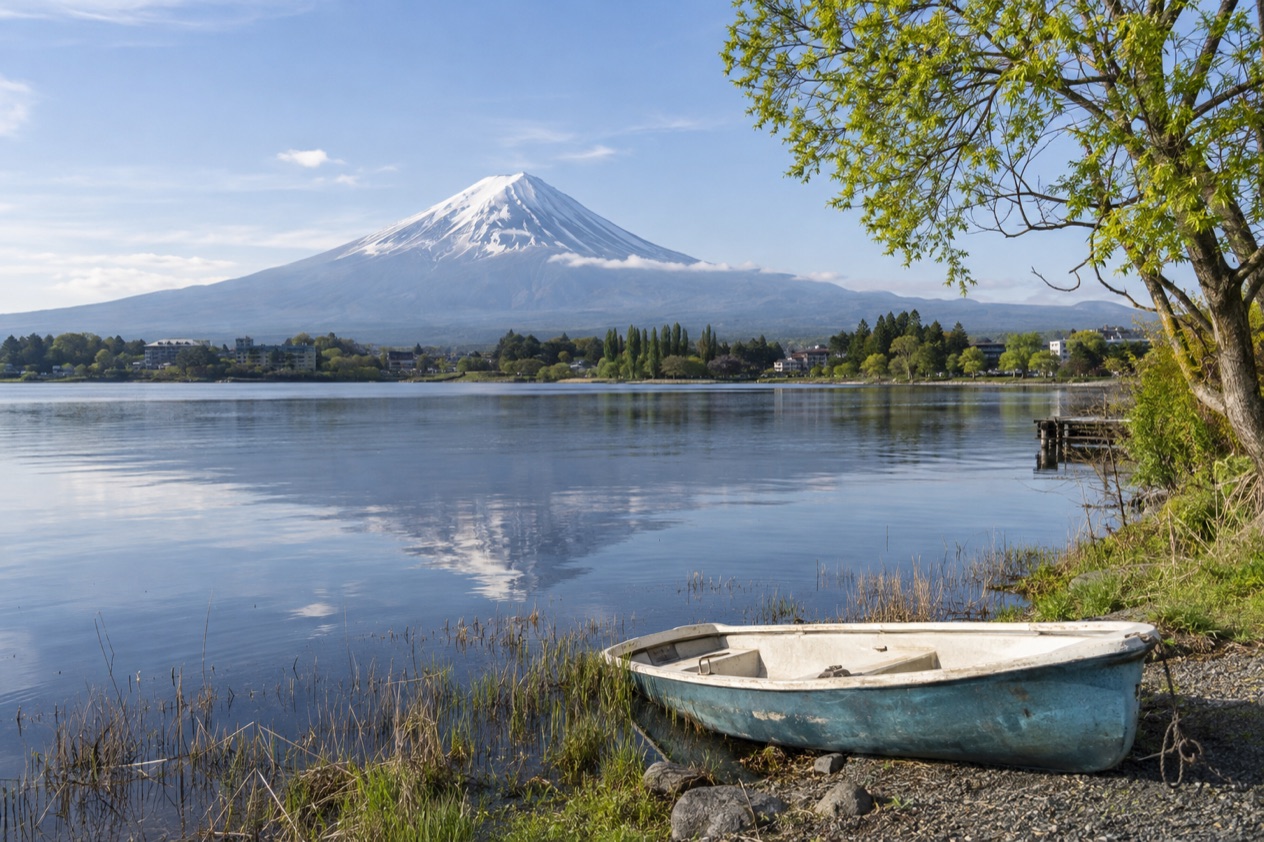
In May the lakeshore at Kawaguchiko turns green in a way it has not been since last year. Bare branches fill with new leaves, the air smells of wet earth, and the cone of Mount Fuji, still streaked with snow near the top, stands over the water whenever the clouds let it. Villages around the lake wake from the cold months, and this is a month for strolling the shore, eating hot noodles and watching the mountain change from hour to hour.
What is the weather like in Mount Fuji and Lake Kawaguchi in May?
May at Lake Kawaguchi is mild by day and cool by night, with the first properly warm afternoons of the year and a rain that comes in a handful of spells rather than all month.
| Month | Average high (°F) | Average low (°F) | Precipitation (in) | Days with 1 mm or more of precipitation | Hours of sunshine | Daylight on the 15th |
|---|---|---|---|---|---|---|
| April | 61.0 | 38.7 | 4.18 | 8.5 | 186 | 13 h 03 min |
| May | 69.1 | 48.0 | 4.85 | 9.4 | 181 | 14 h 01 min |
| June | 73.4 | 56.7 | 6.19 | 11.5 | 123 | 14 h 32 min |
At Kawaguchiko, which sits high above sea level, afternoons in May feel like a comfortable spring day in a T-shirt and a light layer. Once the sun drops behind the ridges, the lake air cools quickly and a sweater or jacket goes back on. Nights stay cool enough that a warm layer is welcome on an evening stroll or at an outdoor table.
Rain arrives on roughly one day in three. Many of those days bring showers between brighter spells, but others are gray and damp, and a cloud lid can hide the mountain for hours. A compact umbrella or a light rain jacket belongs in the bag, because the humidity makes a wet day feel heavier than the temperature suggests.
The days are long, with light stretching well into the evening, so there is room for a late walk along the water after dinner. Up on the summit, the story is different: the average high there hovers near freezing, which is a reminder that the top of Fuji stays in winter long after the lakeshore has turned green.
What to do in Mount Fuji and Lake Kawaguchi in May
The month opens with Golden Week, the string of public holidays that begins on April 29 and runs to May 5. Four of those days are official holidays: Showa Day, Constitution Memorial Day, Greenery Day and Children’s Day. Greenery Day suits this region, where the new leaves around the lakes are the main show.
May is not climbing season. The popular period to hike Mount Fuji is July and August, and the official climbing season closes on September 10. In winter the Yoshida, Subashiri and Gotemba trails are closed above the 5th station, and the Fujinomiya Trail above the 6th. Anyone with summit plans should read the latest notices on the Official Website for Mt. Fuji Climbing, and everyone else can enjoy the mountain from below, which is where May is at its pleasure.
Walking and looking at the mountain around Lake Kawaguchi
The lakeshore is the natural base for a day of looking at Fuji. You wander along the water, stop at small cafés and watch the reflection of the cone break and re-form as the breeze moves across the surface. The mountain may be perfectly sharp one minute and gone behind cloud the next, so patience pays off more than any plan.
Spring light is soft and the greens are fresh, which flatter photographs of the shore, the boats and the trees leaning over the water. This is a place for lingering, for couples, families and anyone who simply likes to watch a landscape change.
Arakurayama Sengen Park in Fujiyoshida
Arakurayama Sengen Park lies in Fujiyoshida, in Yamanashi Prefecture, and is known for a view that pairs a pagoda with Mount Fuji behind it. It is a favorite subject of photographers who come to frame the red tiers against the cone. In May, with new green around the pagoda and snow still on the upper slopes of the mountain, the picture has a contrast that belongs to this month.
Whether the mountain shows itself is down to the sky that day, so treat the view as a chance rather than a promise. The park suits anyone who likes a viewpoint that rewards a bit of effort, and it combines well with a lunch of local noodles in town afterward.
Eating around the lake
The dish of the region is hoto, wide flat noodles simmered with pumpkin and vegetables in a miso broth, served bubbling in an iron pot. On a cool evening in May it is exactly right. Fujiyoshida is also known for its Yoshida udon, firm, chewy noodles that come with simple toppings and a savory broth.
Spring suits lighter plates too, such as tempura of mountain vegetables and fresh seasonal sides. In rural areas shops often close earlier, sometimes as early as 6:00 p.m., while shops in urban areas of Japan are generally open from 10:00 a.m. to 8:00 p.m. every day, so plan dinner in the evening around that rural rhythm.
Flowers belong to spring around Fuji, though the cherry blossom has long passed at this altitude by May. Elsewhere in Japan the Somei-Yoshino cherry blossom reaches northern and eastern Hokkaido only in mid-May, a reminder of how far spring travels across the country. At the lake the show is green leaves, fresh grass and the first warm afternoons.
A two-day itinerary for Mount Fuji and Lake Kawaguchi in May
Day 1 belongs to the lakeshore. Start with a slow walk along the water at Lake Kawaguchi, with a jacket in the bag for the cool air, and let the mountain show itself if it wants to. Around midday, sit down for a pot of hoto in a local restaurant, which warms you without being heavy.
The afternoon is for the lake itself, with cafés, small shops and viewpoints along the shore, and a walk at whatever pace the weather allows. Days are long in May, so there is time to stay out past dinner and watch the light drain from the sky behind the ridges. If it rains, shelter in a café or a museum near the water and wait for a break.
Day 2 moves to Fujiyoshida. Spend the morning at Arakurayama Sengen Park for the view of the pagoda and the mountain, then come down into town for a bowl of Yoshida udon at lunchtime.
The afternoon can go to wandering the town streets, with its shops and shrines, before returning to the lake for a last evening by the water.
Is Mount Fuji and Lake Kawaguchi busy in May?
The start of May is Golden Week, a holiday period that runs from April 29 to May 5 and contains multiple public holidays, so the opening days of the month belong to the busiest stretch of the Japanese travel calendar. Beyond those days, May is a spring month, before the popular climbing period of July and August when huts and facilities are operating and the weather is warmest.
Holiday rules shape the dates. When a national holiday falls on a Sunday, the next working day becomes a public holiday, and any day between two other national holidays becomes one too. Those rules can stretch a long weekend, and in a year when Golden Week runs on, the days around it may feel different from a normal weekday.
For the lake, May means a pace that is lively around the holiday and settles afterward. The mountain itself is still a winter peak, so there is no trail traffic to speak of from the usual climbing season, and the energy of the month is about strolling, eating and looking. Rural shops often close earlier, sometimes as early as 6:00 p.m., which gives the evenings a gentler rhythm than a big city.
What to pack for Mount Fuji and Lake Kawaguchi in May
Spring in Japan suits a light jacket or a simple sweater, and at the lake the cool evenings and sudden showers make layers the sensible way to dress.
- A light jacket or sweater, for the cool air that settles after the sun goes down.
- A T-shirt or thin shirt, for the warm afternoons along the shore.
- A compact umbrella or rain jacket, for the showers that come on about a day in three.
- Comfortable walking shoes, for the lakeshore and the park paths.
- A camera or phone with space, for the views of the mountain when it appears.
- A warm layer for evenings, since the lake air cools fast.
Good to know before you go
The first days of May fall in Golden Week, from April 29 to May 5, with public holidays on four of those days. Rural shops often close earlier, sometimes as early as 6:00 p.m., so lunch is the safer meal for browsing and shopping.
Anyone thinking of going up the mountain should read the latest information on the Official Website for Mt. Fuji Climbing, because the trails above the 5th station and, on the Fujinomiya side, the 6th station are closed in winter and the season itself ends on September 10. May is not the popular climbing period, which runs from July to August.
Mount Fuji and Lake Kawaguchi in May vs April and June
Going four weeks earlier brings April, with cooler days, nights that fall close to freezing and a little snow that can still dust the lakeshore. The light is long enough for sightseeing, though layers matter much more. April has a touch more sunshine than May, but the warm afternoons that make an outdoor lunch pleasant are still ahead.
Going four weeks later brings June, warmer and greener, with more rain days and far fewer hours of sun. The humidity climbs, the skies are grayer and the mountain is more often hidden. Daylight is at its longest, which is the main gift of the month for anyone who wants the evening to last.
Travelers who want warm afternoons and a decent chance of sun should stay with May. Those who prefer a crisp, cool feel and winter’s last traces on the mountain should shift earlier, and anyone who likes full summer green and does not mind the rain can aim for June.
Is May a good time to visit Mount Fuji and Lake Kawaguchi?
Yes, May is a good time for anyone who wants to look at Fuji, walk by the lake and eat well in mild weather, but not for someone whose goal is to climb the mountain. Walkers, photographers, families and food lovers will find a month of soft light and fresh greens, with enough sun to enjoy being outside.
Those set on the summit should wait for the climbing season, and anyone who dislikes a cool evening or a gray, damp day may prefer another month. On arrival, begin with the lakeshore and a bowl of hoto, then let the sky decide how much of the mountain you see.
What is special about May here is the meeting of two seasons. The summit still holds winter near freezing, while at the lake the leaves are new and the days are warm enough for lunch outside.
Sources
- Japan Meteorological Agency (JMA), Normal values 1991-2020, monthly (https://www.data.jma.go.jp/stats/etrn/view/nml_sfc_ym.php?prec_no=49&block_no=47640), station Kawaguchiko, elevation 860 m, checked October 11, 2026
- Japan Meteorological Agency (JMA), Normal values 1991-2020, monthly (https://www.data.jma.go.jp/stats/etrn/view/nml_sfc_ym.php?prec_no=49&block_no=47639), station Fujisan, elevation 3,775 m, checked October 11, 2026
- Computed from the date and the latitude of the place (sunrise equation, solar elevation -0.833 degrees), October 11, 2026
- Japan National Tourism Organization, shop and attraction hours, national holidays (https://www.japan.travel/en/plan/business-hours-and-holidays/), checked October 11, 2026
- Wikipedia, Golden Week (Japan) (https://en.wikipedia.org/wiki/Golden_Week_(Japan)), checked October 11, 2026
- Wikipedia, Public holidays in Japan (https://en.wikipedia.org/wiki/Public_holidays_in_Japan), checked October 11, 2026
- Japan National Tourism Organization, flowers by season: cherry blossom, plum, wisteria, hydrangea, where and when (https://www.japan.travel/en/see-and-do/flowers/), checked October 11, 2026
- Wikipedia, Wisteria (https://en.wikipedia.org/wiki/Wisteria), checked October 11, 2026
- Japan Meteorological Agency, sakura2020.pdf (https://www.data.jma.go.jp/sakura/data/sakura2020.pdf), checked October 11, 2026
- Japan National Tourism Organization, spring in Japan (https://www.japan.travel/en/guide/spring-guide/), checked October 11, 2026
- Wikipedia, Kanda Matsuri (https://en.wikipedia.org/wiki/Kanda_Matsuri), checked October 11, 2026
- Wikipedia, Sanja Matsuri (https://en.wikipedia.org/wiki/Sanja_Matsuri), checked October 11, 2026
- Japan National Tourism Organization, festivals and events (https://www.japan.travel/en/see-and-do/festivals-and-events/), checked October 11, 2026
- Wikipedia, Gion Matsuri (https://en.wikipedia.org/wiki/Gion_Matsuri), checked October 11, 2026
- Official website for Mt. Fuji climbing (https://www.fujisan-climb.jp/en/), checked October 11, 2026
- Wikipedia, Mount Fuji (https://en.wikipedia.org/wiki/Mount_Fuji), checked October 11, 2026
- Wikivoyage, Mount Fuji (https://en.wikivoyage.org/wiki/Mount_Fuji), checked October 11, 2026
- Japan National Tourism Organization, Mount Fuji guide (https://www.japan.travel/en/fuji-guide/), checked October 11, 2026
- Wikipedia, Arakurayama Sengen Park (https://en.wikipedia.org/wiki/Arakurayama_Sengen_Park), checked October 11, 2026
To plan your stay
- Things to Do in Mount Fuji and Lake Kawaguchi: Lakeside Views, Fuji-Q Highland, Hiking Season and Local Food
- Where to Stay in Mount Fuji and Lake Kawaguchi: Lakeshore Hotels, Fujiyoshida, Mountain Lodges and Ryokan
- Mount Fuji and Lake Kawaguchi from Tokyo: Fuji Excursion, the Fujikyuko Line and Climbing Season
- Best Views of Mount Fuji: Five Lakes, Fifth Station Promenades and When to Go