
In early July the trails on Mount Fuji open for the summer, and the first hikers set out in rain jackets with the mountain still wrapped in cloud. Down at the lake the air is heavy and green, and bowls of cold noodles appear on café tables. July is the month when Fuji becomes a mountain you can walk up, and Lake Kawaguchi is where you rest, eat and look up at it between the clouds.
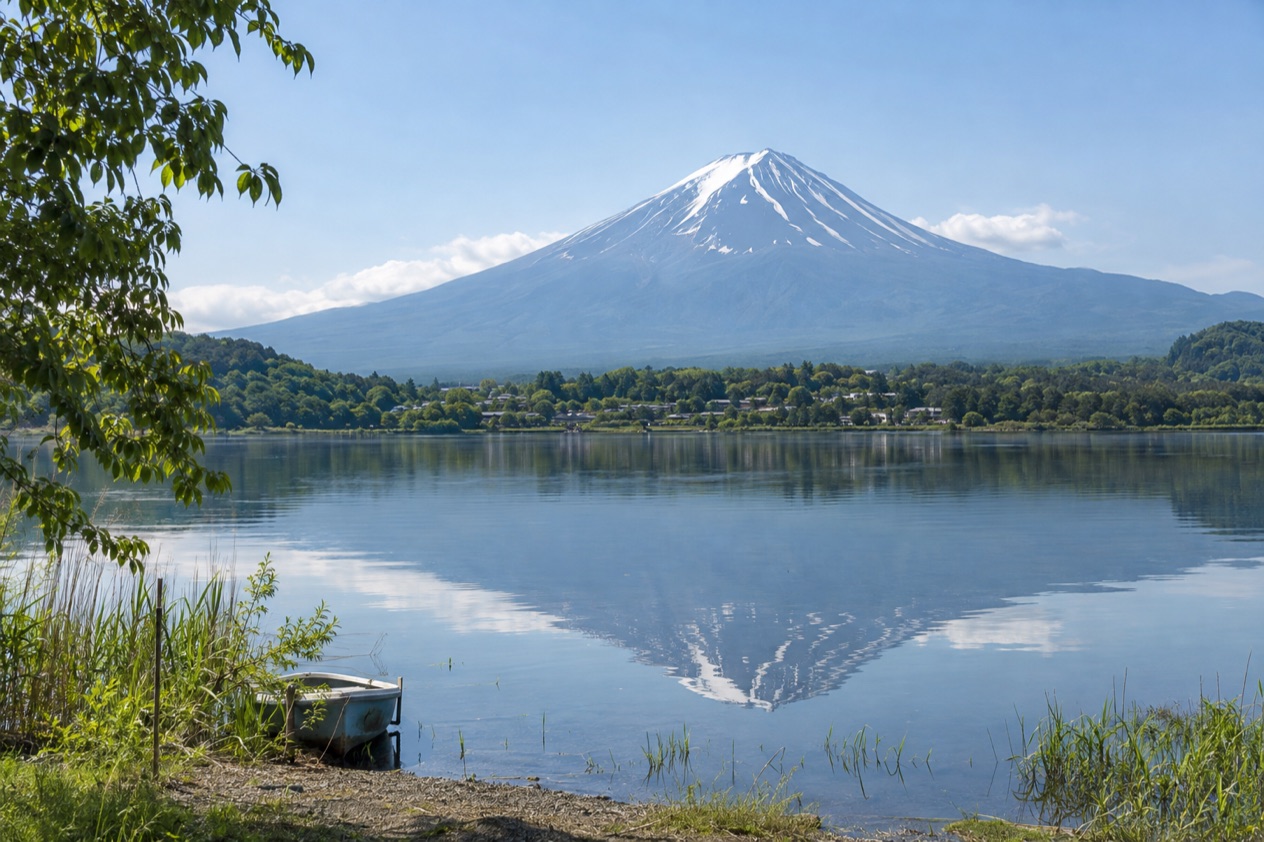
What is the weather like in Mount Fuji and Lake Kawaguchi in July?
July at Lake Kawaguchi is warm, humid and showery: comfortable in the daytime, cool enough in the evening for a light layer, and often gray.
| Month | Average high (°F) | Average low (°F) | Precipitation (in) | Days with 1 mm or more of precipitation | Hours of sunshine | Daylight on the 15th |
|---|---|---|---|---|---|---|
| June | 73.4 | 56.7 | 6.19 | 11.5 | 123 | 14 h 32 min |
| July | 81.0 | 64.4 | 7.02 | 11.7 | 148 | 14 h 21 min |
| August | 82.6 | 65.3 | 6.96 | 10.1 | 165 | 13 h 32 min |
These are the figures for Kawaguchiko, on the shore of Lake Kawaguchi. Summer here is sticky, because humidity stays high, and Honshu summers in general are hot and sultry. Cotton or quick-drying clothes feel better than denim, and a rain jacket belongs in the daypack every day, since July brings a share of wet days even as the sun comes out more than in June.
The mountain itself is a different climate. At the summit of Mount Fuji, July highs average in the mid-40s and lows in the upper 30s, so a hiker passes from a muggy lakeside to near-freezing air in a single day. Wind and wet make it feel colder than those figures suggest, which is why warm layers matter far more than the heat below.
The light is long in July, with days stretching well into the evening. The clouds that often hide Fuji can part and leave the cone sharp above the lake, but nobody can promise it. Plan the days so that a gray morning costs you nothing, with the lake, the museums and the noodle shops as backups.
What to do in Mount Fuji and Lake Kawaguchi in July
July is the opening of the climbing season. The season typically runs from the beginning of July to about the first week of September, and the official site gives its end as September 10.
The most popular period to hike Mount Fuji is July to August, when the huts and facilities are operating and the weather is warmest. Outside the season, climbing is extremely dangerous, with first-aid centers and huts closed, no cell phone service and severe weather.
Not everyone comes to climb, and the month still works for those who do not. Lake Kawaguchi gives you water, boats, lakeside paths and, when the clouds allow, Fuji standing over the far shore. Gray days suit slow lunches and hot springs, which is a good way to treat humid weather.
The food of the area suits summer well. Yamanashi is known for hoto, a thick noodle stew with pumpkin and vegetables in miso broth, which is hearty even in July for anyone back from the mountain.
Yoshida udon, firm and chewy noodles, can be eaten cold with a dipping sauce when the air is sticky. Roadside stands sell peaches and other local fruit in summer, and a cold glass of tea or a shaved-ice dessert fills the gap between meals.
Climbing Mount Fuji on the Yoshida Trail
The Yoshida Trail is the Fuji trail most often named around Lake Kawaguchi, and the official climbing site lists On-the-Day Nature Guided Tours on it. Like the Subashiri and Gotemba trails, it is closed from the fifth station to the summit in winter, so July is when it comes alive, with huts operating and hikers climbing through the clouds.
The mountain is treated as serious ground. Visitors planning to climb are strongly advised to check the latest information on the Official Website for Mt. Fuji Climbing, which provides information for all climbers to ensure a safe climb and return. A hiking fee applies on the trails, and refunds and reservations are handled through the official systems. In July the summit is cold, so the preparation matters as much as the walk itself.
Lake Kawaguchi days
Lake Kawaguchi works well as a base because it gives the mountain a foreground. You can follow the shore, stop at cafés and craft shops, and look back across the water for Fuji whenever the cloud lifts. A summer rain does not ruin the lake, which turns soft and silvery under low cloud, and the green hills around it look their fullest in July.
Many people also spend part of a gray day in an onsen, a hot spring bath, where the steam and the humid air feel a little odd together but warm the body after a damp walk. Onsen rules differ from one bath to the next, so follow the signs at the entrance of whichever you choose.
Arakurayama Sengen Park
Arakurayama Sengen Park stands in Fujiyoshida, in Yamanashi Prefecture, and is the spot many photographers have in mind when they picture a pagoda in the foreground with Fuji behind it. On clear days Mount Fuji can be seen from here, and in July that depends on the cloud, so treat the view as a chance rather than a promise.
The park suits a gray day better than you might think. Even when the summit is hidden, you still get the pagoda, the trees in full summer leaf and the town spread below. If Fuji appears, you will be glad you came. If it does not, you have still had a walk among shrines and greenery, and you can head back to the lake for lunch.
A two-day itinerary for Mount Fuji and Lake Kawaguchi in July
Day 1 belongs to the lake and the town. Start with the shore at Lake Kawaguchi and look for Fuji across the water, taking your time since the clouds change quickly in July. Late morning is for Arakurayama Sengen Park in Fujiyoshida, where you can climb up to the pagoda and look for the mountain behind it.
For lunch, choose a noodle shop in Fujiyoshida for a bowl of Yoshida udon, hot or cold, whichever the weather suggests. The afternoon is for the lakeside, with a café stop and a wander through the craft and souvenir shops. In the evening, settle into a hot spring bath, and dinner can be a pot of hoto. The days are long, so there is no rush to be indoors.
Day 2 turns to the mountain, which is open for climbing now that the season has begun. If you plan to climb, go through the official climbing website first and consider the Yoshida Trail, where guided tours are offered. If you would rather not climb, spend the day on a different part of the lake, with a long lunch and a boat or a lakeside walk.
If the weather turns, stay indoors in the morning with a museum or a craft workshop, then take a long onsen soak in the afternoon. A rainy day also suits a slow meal of hoto, which is the right thing to eat when the air is damp and the mountain is out of sight.
Is Mount Fuji and Lake Kawaguchi busy in July?
July is the start of the busy season on Mount Fuji, because the climbing season opens and the most popular period to hike runs from July to August.
That is the main thing to know about the pace of the month. With huts and facilities operating and the weather at its warmest, the mountain draws hikers, and the area around it feels the season. The trails are open for a limited stretch of the year, so the activity concentrates between early July and early September.
At the lake the mood is that of a summer vacation town. Walks along the shore, boats on the water and cafés with seats outside all belong to the season, and humid air sends people toward cold noodles and shaved ice. If you come only for the views and the food, you can fit the trip around the weather rather than the climbing calendar.
Climbers should keep the end of the season in mind. The official site gives September 10 as the end of the climbing season, and outside it the mountain is considered extremely dangerous. July therefore sits at the very start of a short window, with the whole of it still ahead of you.
What to pack for Mount Fuji and Lake Kawaguchi in July
The lake and the summit are two different climates, so pack for both, even if you never plan to leave the shore.
- A light rain jacket, because July brings frequent showers and the cloud can settle in at any time.
- Breathable, quick-drying clothes for the humid air around the lake.
- A warm fleece or insulated layer if you plan to climb, since the summit stays near freezing even in July.
- Sturdy shoes with good grip for trails that can be wet.
- A hat and sunscreen for the days when the sun does break through.
- A small towel for sweat, rain and the onsen afterward.
Good to know before you go
July is humid and showery around Lake Kawaguchi, and the official climbing season has only just begun. Anyone planning to climb should consult the Official Website for Mt. Fuji Climbing, which carries the latest information for all climbers.
The Yoshida, Subashiri and Gotemba trails are closed above the fifth station in winter, and in July they are open. The mountain’s own weather can differ greatly from the lake’s, so a clear morning below does not mean a clear summit.
Mount Fuji and Lake Kawaguchi in July vs June and August
Moving the trip four weeks earlier puts you in June, which is cooler and has less sunshine, with long days but a heavier gray feel. The climbing season has not yet begun, so the mountain is not the draw it is in July, and the lake is the main reason to come. If you want a quieter, cooler visit without the hike, June is an option.
Moving four weeks later puts you in August, which is the warmest of the three months and the sunniest, with fewer rainy days. The huts and facilities are still operating, and the days are slightly shorter than in July. August suits those who want the most sun and the warmest weather for climbing or lakeside time, while summit nights remain cold.
Choose July if you want to be there at the start of the climbing season and do not mind the showers. Choose June for a cooler visit focused on the lake, or August for more sunshine and the warmest conditions. Anyone who wants to climb should check the season dates, since the window is limited.
Is July a good time to visit Mount Fuji and Lake Kawaguchi?
Yes, July is a good time for anyone who wants to climb Mount Fuji or see it from the lake with the season in full swing, and who accepts humidity and the occasional gray day.
It will suit hikers, since the trails are open and the huts are operating, and it will suit travelers who like cold noodles, hot springs and green hills in summer. It is less suited to anyone who needs guaranteed clear views, because cloud often covers the mountain, and to anyone who dislikes sticky weather. Those people may prefer another month.
On arrival, look at the sky first and then decide the order of your days. If Fuji shows itself across the water, take the view while it lasts and leave the shops and museums for the gray hours. Then check the official climbing site if you plan to go up. What marks July here is the opening of the mountain: the trails come back to life after the winter closure, and the lake below fills with summer visitors looking up at a cone that may or may not appear from behind the clouds.
Sources
- Japan Meteorological Agency (JMA), Normal values 1991-2020, monthly (https://www.data.jma.go.jp/stats/etrn/view/nml_sfc_ym.php?prec_no=49&block_no=47640), station Kawaguchiko, elevation 860 m, checked October 11, 2026
- Japan Meteorological Agency (JMA), Normal values 1991-2020, monthly (https://www.data.jma.go.jp/stats/etrn/view/nml_sfc_ym.php?prec_no=49&block_no=47639), station Fujisan, elevation 3,775 m, checked October 11, 2026
- Computed from the date and the latitude of the place (sunrise equation, solar elevation -0.833 degrees), October 11, 2026
- Japan National Tourism Organization, weather and seasons in Japan (https://www.japan.travel/en/plan/weather/), checked October 11, 2026
- Wikipedia, Climate of Japan (https://en.wikipedia.org/wiki/Climate_of_Japan), checked October 11, 2026
- Japan National Tourism Organization, summer in Japan (https://www.japan.travel/en/guide/summer-guide/), checked October 11, 2026
- Japan National Tourism Organization, festivals and events (https://www.japan.travel/en/see-and-do/festivals-and-events/), checked October 11, 2026
- Wikipedia, Hanabi (https://en.wikipedia.org/wiki/Hanabi), checked October 11, 2026
- Wikipedia, Gion Matsuri (https://en.wikipedia.org/wiki/Gion_Matsuri), checked October 11, 2026
- Japan National Tourism Organization, Mount Fuji guide (https://www.japan.travel/en/fuji-guide/), checked October 11, 2026
- Official website for Mt. Fuji climbing, about the climb (https://www.fujisan-climb.jp/en/about/), checked October 11, 2026
- Wikipedia, Tanabata (https://en.wikipedia.org/wiki/Tanabata), checked October 11, 2026
- Official website for Mt. Fuji climbing, information (https://www.fujisan-climb.jp/en/info/), checked October 11, 2026
- Wikipedia, Mount Fuji (https://en.wikipedia.org/wiki/Mount_Fuji), checked October 11, 2026
- Wikipedia, Arakurayama Sengen Park (https://en.wikipedia.org/wiki/Arakurayama_Sengen_Park), checked October 11, 2026
To plan your stay
- Things to Do in Mount Fuji and Lake Kawaguchi: Lakeside Views, Fuji-Q Highland, Hiking Season and Local Food
- Where to Stay in Mount Fuji and Lake Kawaguchi: Lakeshore Hotels, Fujiyoshida, Mountain Lodges and Ryokan
- Mount Fuji and Lake Kawaguchi from Tokyo: Fuji Excursion, the Fujikyuko Line and Climbing Season
- Best Views of Mount Fuji: Five Lakes, Fifth Station Promenades and When to Go