
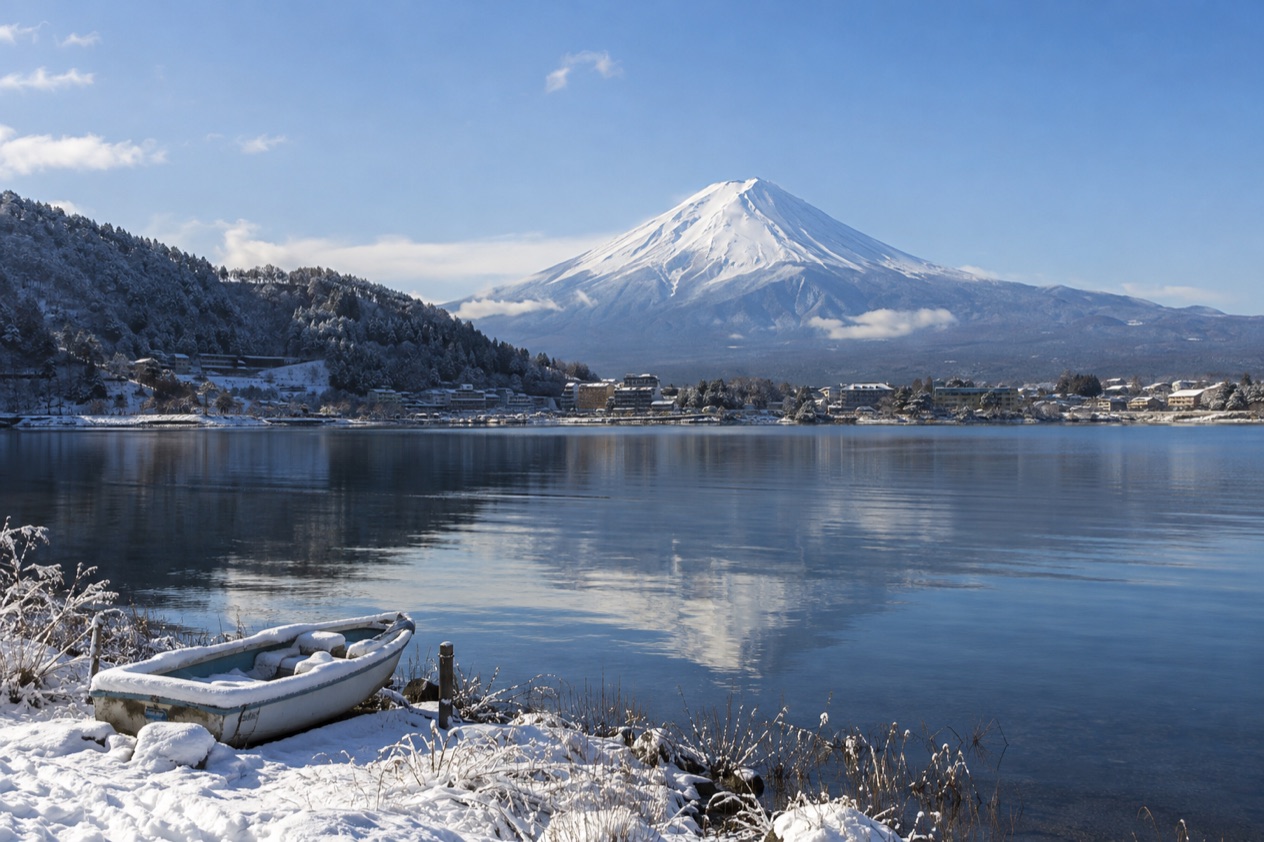
In December, the lakeshore at Kawaguchiko is bare and sharp-edged, the maples have dropped their last leaves, and Mount Fuji stands over the water with a cap of white when the clouds let it show. Breath turns to steam on the walk to a bowl of hot noodles, and the first snow of the winter sometimes dusts the roofs. It is a month for cold, clean air, long soaks in hot water and a mountain that looks its most wintry.
What is the weather like in Mount Fuji and Lake Kawaguchi in December?
December is properly cold at Lake Kawaguchi, with afternoons that stay cool and nights that drop below freezing, but it is also a drier and sunnier month than November, with only a little snow so far.
| Month | Average high (°F) | Average low (°F) | Precipitation (in) | Days with 1 mm or more of precipitation | Snowfall (in) | Hours of sunshine | Daylight on the 15th |
|---|---|---|---|---|---|---|---|
| November | 56.8 | 36.0 | 2.99 | 6.7 | 0.4 | 166 | 10 h 20 min |
| December | 47.3 | 26.8 | 1.96 | 4.6 | 2.8 | 200 | 9 h 47 min |
| January | 41.9 | 21.7 | 2.40 | 4.9 | 14.6 | 212 | 10 h 00 min |
These are the figures of Kawaguchiko, down at lake level. Up on the mountain it is a different world: at the summit the average high stays near 10°F, which is why the climbing trails are shut for the winter. Down by the water you are dressing for a cold town, not an alpine ridge.
What this means in practice is layers. A warm base layer, a sweater and a proper winter coat cover most days, and a hat and gloves earn their place. Rain gear matters less than in autumn, since wet days are fewer, but when precipitation does come it can arrive as snow or sleet on a handful of days, so shoes with a grip are a better bet than canvas sneakers.
The light is short in December, with a bit under ten hours of daylight in the middle of the month, and sunshine is more generous than in November. Plan the outdoor stops with the daylight in mind and keep the evening for the warmth indoors: an onsen, a table at a noodle shop, a futon in a ryokan.
What to do in Mount Fuji and Lake Kawaguchi in December
The main thing to do here in December is look at Mount Fuji and then warm up. The mountain sits on the border of Shizuoka and Yamanashi prefectures, and on clear days it can be seen from far away, but from the lakes around Kawaguchiko it fills the sky.
In winter the climbing season is long over, and the Yoshida, Subashiri and Gotemba trails are closed from the 5th station to the summit, while the Fujinomiya Trail is closed from the 6th station. So December is about viewing, walking at lake level and slow days.
The mountain is a World Heritage Site, listed in 2013 as a sacred place and a source of artistic inspiration. That second part is easy to feel on a winter day. Painters and print makers returned to this cone again and again, and a white-topped Fuji reflected in a cold lake looks very much like one of those prints come to life, when the weather allows it.
Walking the shore of Lake Kawaguchi
Lake Kawaguchi is one of the Fuji Five Lakes, and its shoreline is the natural place to spend a December day outside. Without the leaves, the lakeside paths open up views of the water and the mountain beyond that summer foliage would hide. Bare branches, reeds along the edge and a flat, cold light give the shore a stripped-down look that suits a camera well.
Bring a hat and gloves, because wind off the water cuts through a thin jacket. Pick a stretch of shore, walk it slowly, and stop where the mountain frames itself between the trees. Cafés and small shops near the lake give you somewhere to thaw out between walks, though in rural areas shops often close earlier, sometimes as early as 6:00 p.m., so a late afternoon stop is wise.
Fuji from a distance, and what the mountain looks like in winter
Seeing the mountain is never guaranteed, and December gives you a decent chance of it because the month brings more sunshine than November. When it does appear, the snow line has crept down the cone and the upper slopes look smooth and bright. When it hides, the lake and the town still have plenty to offer, so keep the plan loose and treat each clear stretch as a bonus.
Do not plan on climbing. The official climbing season ended in September, and the trails above the stations named earlier are closed through winter. Photographers, painters and anyone who simply likes to sit and look will be well served by lakeside spots, a window seat in a café or the glass wall of an onsen bath with a view.
Hot water and winter food
A cold month calls for onsen, the hot spring baths that Japan does so well, and the towns around the lake have places to soak after a day outdoors. Travelers pair a bath with a night in a ryokan, a traditional inn where shoes come off at the entrance, you sleep on futons laid over tatami, and dinner arrives as a series of small seasonal dishes.
For food, look for hoto, the thick, wide noodle stew of Yamanashi cooked with pumpkin and vegetables in a miso broth, served bubbling in an iron pot. It is built for a cold day. Beyond the pot, hot tea, grilled skewers and sweet red bean treats make good companions on a lakeside stroll.
Autumn color does not last into December at the lake itself, though at Kofu, the nearest reference point, maple leaves usually change color around the end of November. By December, expect bare trees and winter tones instead of red and gold.
December is also the start of the winter sports season across Japan, which generally opens this month and runs until April, with exact dates set by each resort. Peak snowfall comes later, in January and February. For a base at Lake Kawaguchi, the draw in this first winter month is the mountain view and the hot water rather than deep snow.
Christmas in Japan is not a national holiday, though gifts are sometimes exchanged, so expect festive lights and seasonal sweets without a day off for everyone. The big celebration comes a week later. The Japanese New Year falls on January 1, and the dishes eaten for it, called osechi, are a part of the season you may spot in shops toward the end of the month.
A two-day itinerary for Mount Fuji and Lake Kawaguchi in December
Day 1 belongs to the lake. Start with the shoreline walk while the light is still low and the air is at its coldest, with a hat and gloves on. Walk until the cold wins, then step into a café for something hot. The days are short, so use the middle of the day for the longest stretch outside and give up on any plan that needs the last hour of light.
For lunch, choose a place serving hoto, the Yamanashi noodle stew, and let it be the main event. After that, take a slower afternoon: browse the small shops near the lake, sit by a window facing the mountain, and let the clouds decide how much of Fuji you see. In the evening, check in to a ryokan or an inn with an onsen, soak, and have a dinner of small seasonal dishes.
Day 2 is for a different angle on the mountain. Pick another point around the Fuji Five Lakes region for your morning, since each shore gives Fuji a slightly different frame.
If the weather turns, make it an indoor day. Spend longer over a late breakfast, take another bath, wander through shops and sample the local sweets and grilled snacks. Rural shops often close earlier, so finish any shopping before late afternoon. For a last meal, a grilled-fish set or another bowl of noodles makes a warm ending.
Is Mount Fuji and Lake Kawaguchi busy in December?
December is the start of winter here, with the climbing season long finished and the trails closed above the stations. The season that fills the mountain in July and August, when huts and facilities are operating and the weather is warmest, is a distant memory by now.
What you see in town in this first winter month is the shift in rhythm. The climbing trails are closed, the leaves are gone, and the winter sports season is only beginning across the country. Visitors come for the view, the baths and the food, and the pace follows the short days and the cold.
The calendar brings its own changes toward the end of the month. Christmas is not a national holiday in Japan, so ordinary business continues, but the New Year holidays are different, and during them many restaurants and attractions are closed. That matters for anyone planning the last days of December or the first of January at the lake.
In urban areas shops are generally open from 10:00 a.m. to 8:00 p.m. every day, but near the lake, as in other rural places, closing times can come earlier. Plan your last meal and your last purchases with that in mind rather than counting on a late evening.
What to pack for Mount Fuji and Lake Kawaguchi in December
Pack for freezing nights and cool days, with the option of snow or sleet on a few days. Think layers you can take off in a warm café or a ryokan lobby.
- A warm winter coat, for walks by the lake in cold air.
- A hat and gloves, because the wind off the water bites.
- Thermal base layers, for nights that fall below freezing.
- Shoes with a good grip, in case of snow or sleet.
- Warm socks, which are handy for ryokan floors and for slipping shoes on and off.
- A camera with a spare battery, since cold drains batteries fast.
Good to know before you go
December is a cold, mostly dry month at the lake, with only a modest chance of snow or sleet. The New Year holidays bring closures of many restaurants and attractions, and rural shops often close earlier in the day than city ones.
Christmas Day is an ordinary working day in Japan, so do not count on a festive pause. When a national holiday falls on a Sunday, the next working day becomes a public holiday, which can shift opening days around the end of the year.
The climbing trails stay closed through winter, so the mountain is for looking at, not climbing. The official Mount Fuji climbing website is the place for information on the trails and the season, if you plan another visit in summer.
Mount Fuji and Lake Kawaguchi in December vs November and January
Moving the trip four weeks earlier brings you to November, when the air is milder and the maples still carry color in the region, as the usual date of the change at Kofu falls around the end of that month. November is also wetter, with more days of rain, and darker in the evening hours than the figures might suggest, since sunshine is lower. If color matters more than a crisp winter mood, November is the month to pick.
Moving four weeks later takes you to January, which is colder and far snowier at the lake, with a much deeper cover of snow than December. Sunshine is a little higher, the nights are the coldest of the three months, and the winter sports season reaches its peak in January and February. That suits travelers who want a real snow landscape and do not mind the cold.
December sits between the two. It is a good choice for people who want cold air, bare trees and a good chance of sun without committing to deep winter. Choose November for leaves, January for snow, and December if you want the quiet transition, with a bit of everything and the New Year closures to plan around.
Is December a good time to visit Mount Fuji and Lake Kawaguchi?
Yes, for travelers who want to look at Fuji, soak in hot water and eat warming food, and who are happy to dress for the cold. December suits photographers, onsen lovers and anyone who prefers a slow day by the water to a hike. It is less suited to people who want to climb, since the trails are closed, or who are chasing red maples, which have mostly gone.
On arrival, start at the lakeshore. A first walk shows you the mountain, the water and the weather in one go, and tells you how to shape the rest of the stay. Then head for a bowl of hoto and a bath. What stays with you from December here is the stripped-down look of it: bare branches, cold clear air, a white cap on the mountain and steam rising from a pot of noodles on the table.
Sources
- Japan Meteorological Agency (JMA), Normal values 1991-2020, monthly (https://www.data.jma.go.jp/stats/etrn/view/nml_sfc_ym.php?prec_no=49&block_no=47640), station Kawaguchiko, elevation 860 m, checked October 11, 2026
- Japan Meteorological Agency (JMA), Normal values 1991-2020, monthly (https://www.data.jma.go.jp/stats/etrn/view/nml_sfc_ym.php?prec_no=49&block_no=47639), station Fujisan, elevation 3,775 m, checked October 11, 2026
- Computed from the date and the latitude of the place (sunrise equation, solar elevation -0.833 degrees), October 11, 2026
- Japan National Tourism Organization, winter in Japan (https://www.japan.travel/en/guide/winter-guide/), checked October 11, 2026
- Wikipedia, Christmas in Japan (https://en.wikipedia.org/wiki/Christmas_in_Japan), checked October 11, 2026
- Japan National Tourism Organization, shop and attraction hours, national holidays (https://www.japan.travel/en/plan/business-hours-and-holidays/), checked October 11, 2026
- Wikipedia, Japanese New Year (https://en.wikipedia.org/wiki/Japanese_New_Year), checked October 11, 2026
- Wikipedia, Public holidays in Japan (https://en.wikipedia.org/wiki/Public_holidays_in_Japan), checked October 11, 2026
- Japan National Tourism Organization, skiing guide (https://www.japan.travel/en/guide/skiing/), checked October 11, 2026
- Japan National Tourism Organization, skiing and snowboarding in Japan: regions, resorts, seasons (https://www.japan.travel/en/sports/snow/), checked October 11, 2026
- Wikipedia, List of ski areas and resorts in Japan (https://en.wikipedia.org/wiki/List_of_ski_areas_and_resorts_in_Japan), checked October 11, 2026
- Wikipedia, Climate of Japan (https://en.wikipedia.org/wiki/Climate_of_Japan), checked October 11, 2026
- Japan Meteorological Agency, maple color-change dates 2025-2026 with difference from the 1991-2020 normal (https://www.data.jma.go.jp/sakura/data/phn_014.html), checked October 11, 2026
- Japan Meteorological Agency, biological season observations (https://www.data.jma.go.jp/sakura/data/index.html)
- Official website for Mt. Fuji climbing, about the climb (https://www.fujisan-climb.jp/en/about/), checked October 11, 2026
- Official website for Mt. Fuji climbing, information (https://www.fujisan-climb.jp/en/info/), checked October 11, 2026
- Wikipedia, Mount Fuji (https://en.wikipedia.org/wiki/Mount_Fuji), checked October 11, 2026
- Wikivoyage, Mount Fuji (https://en.wikivoyage.org/wiki/Mount_Fuji), checked October 11, 2026
To plan your stay
- Things to Do in Mount Fuji and Lake Kawaguchi: Lakeside Views, Fuji-Q Highland, Hiking Season and Local Food
- Where to Stay in Mount Fuji and Lake Kawaguchi: Lakeshore Hotels, Fujiyoshida, Mountain Lodges and Ryokan
- Mount Fuji and Lake Kawaguchi from Tokyo: Fuji Excursion, the Fujikyuko Line and Climbing Season
- Best Views of Mount Fuji: Five Lakes, Fifth Station Promenades and When to Go